The Impact of Artificial Intelligence on Custom EMR Software Development

Did you know that, as of May 2024, the FDA approved as many as 882 devices powered by artificial intelligence and machine learning for care delivery?
This alone can give you an idea of the impact artificial intelligence is having on healthcare. Furthermore, these devices are spread over five different categories, spanning from radiology to cardiovascular and neurology, etc.
Recognizing this, healthcare providers are actively looking for ways to integrate AI into their healthcare practice to prepare for a better future in healthcare. One of the major reasons for healthcare providers shifting towards AI-driven healthcare solutions is the limitations of traditional EMR systems.
From data silos to inefficient workflows and limited clinical decision support,AI in custom EMR development has set the motion to transform the healthcare industry from the way care is delivered to enhancing administrative aspects, while ensuring security and compliance.
To give you an idea about the adoption rate of artificial intelligence in EMR, 2 in 3 physicians use AI for various purposes, including documentation, charts, billing codes, and even discharge summaries, according to the American Medical Association.
But most of these are just administrative aspects of your healthcare practice. Beyond administrative automation, AI-powered EMR systems help clinicians personalize care, improve clinical decision-making, reduce operational costs, and enhance patient outcomes. And this is how AI is transforming EMR software.
Yet, despite the benefits of AI-assisted medical documentation, AI-driven healthcare software systems, and how they are transforming care practices is something that you must know.
On that note, in this blog, let’s explore the impact Artificial Intelligence, Machine Learning, and custom EMR software can have on healthcare practice and how it can change the face of the practice.
Assess Your EMR System for AI Readiness –
Get Free AssessmentWhat is AI in Custom EMR Development?
AI in custom EMR development is the integration of artificial intelligence into practice-specific electronic medical record systems to automate clinical documentation, support decision-making, improve workflows, and enhance patient care within a single healthcare organization.
Key Takeaways
- AI automates both clinical and administrative workflows within custom EMR systems.
- AI-powered EMRs improve clinical decision support, predictive analytics, and patient outcomes.
- Machine learning enables proactive care through risk prediction and personalized treatment recommendations.
- AI also strengthens interoperability by improving healthcare data standardization and exchange.
- Human oversight remains essential to ensure accuracy, transparency, and ethical AI adoption.
How is AI Transforming Custom EMR Development?
Let’s have a look at some of the core applications of AI in custom EMR and how AI is transforming the EMR system, making the lives of care providers easier and care delivery simpler:
- Clinical Decision Support Systems (CDSS)
When AI was brought forward for the world to use, it was observed that AI is excellent at analyzing data and giving suggestions on the basis of that. Bringing the same into the healthcare landscape, especially with AI in custom EMR software, can help healthcare providers make better and more informed decisions with clinical decision support systems.
Some of its applications include diagnosis assistance, personalized treatment recommendations, and medication dosage optimization to help clinicians make faster and more accurate decisions.
CDSS, by leveraging patient health data, can improve diagnostic accuracy, reduce the chances of medical errors, and enhance patient safety significantly. Furthermore, with generative AI implemented in EMR systems, clinicians can quickly scan through large documents and understand complex patient histories in ways that can help them deliver better care faster.
- Machine Learning in Healthcare for Predictive Modeling
While recovering from prolonged illness, there is often a chance that the patient might develop a certain disease. In such cases, machine learning in electronic medical records can be extremely helpful in identifying patients’ health patterns and predicting those who are at high risk.
Some of the possible examples of this can be seen in predicting hospital readmission, health complications, and disease outbreaks. Furthermore, using AI personalized patient care with risk stratification, you can easily prioritize interventions and improve resource allocation.
This alone can simplify most things for your healthcare practice and enhance care delivery. On top of that, by incorporating social determinants of health (SDOH) into your AI-powered EMR systems, you can give your providers the ability to create holistic patient risk profiles. It removes some of the accessibility barriers and makes care delivery more personalized to get the desired healthcare outcomes.
- Image and Data Analysis
Another benefit of AI in EMR systems is the ability to analyze medical images and other data. Since there is a huge amount of patient health data, analyzing all of it and drawing conclusions can be time-consuming. However, implementing AI algorithms for analyzing medical images like X-rays, MRIs, etc., can assist healthcare providers in diagnosis and treatment planning in real-time.
From image recognition for detecting abnormalities and identifying unique, unorthodox patterns in patient data, your customizable EMR system with AI can actually speed up the diagnosis process and enhance patient care with accuracy.
Another application of artificial intelligence in EMR can be seen in real-time wound care monitoring. For example, AI-powered wound analysis can evaluate wound images, provide dermatological insights, and help clinicians make more accurate diagnosis and treatment decisions while improving patient recovery planning. The use of computer vision has been deployed in most dermatological practices and has made a name for itself in the past few years.
Transforming Healthcare with AI-powered EMR
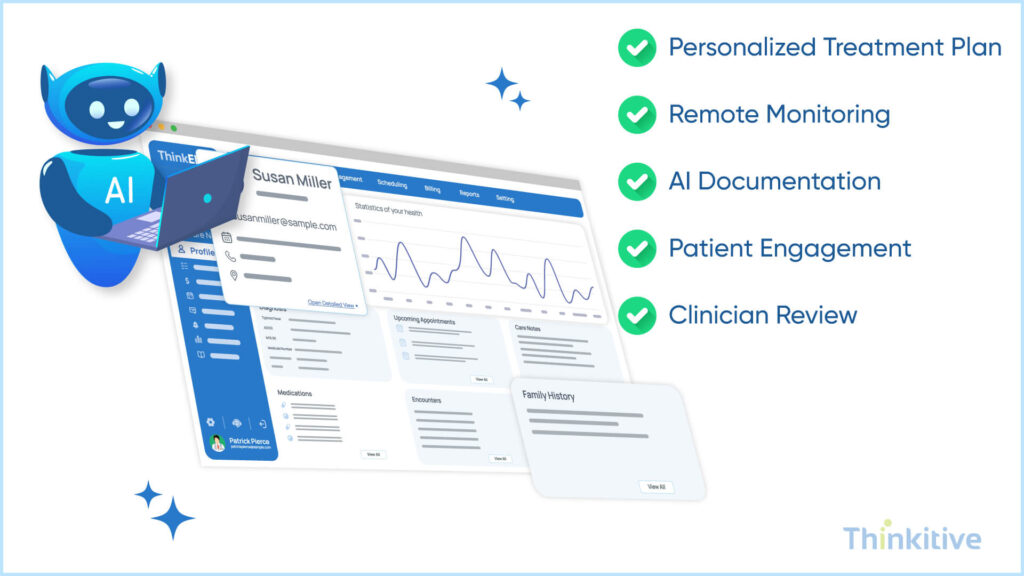
Artificial intelligence and healthcare go beyond clinical decision support. It can transform healthcare practice by actually helping them achieve their goals and pave the way for better and faster care delivery. On that note, let’s see some of the real-life applications in care delivery and how AI is transforming EMR software:
- Personalized Medicine Through Artificial Intelligence in EMR
Using AI for personalized patient care is one of the highly anticipated features. With this feature integrated into the EMR software, it can actually speed up the process and curate a treatment plan based on the individual patient’s needs, genetic information, and other health data.
For instance, the use of pharmacogenomics can predict which drugs suit the individual best and plan the entire care plan accordingly. Along with that, with precision medicine approaches, the accuracy of medication and treatment can significantly improve, leading to improved treatment outcomes and reduced side effects of the assigned treatment and medication plan.
Furthermore, you can even include the patient’s genomic data into your EMR workflows by linking genetic test results directly to the records. Here, AI-driven support tools can interpret data in real-time. It has been tried and tested in oncology, where clinicians can match tumor-specific genetic mutations with targeted therapies, clinical trials, and treatment guides. Some of its applications are also seen in pharmacogenomics, where genomic markers can help in better medications, as the system can predict how the patient will react or respond to certain medications.
- AI-Enhanced Documentation & Patient Engagement
While using AI for personalized patient care, you can also leverage its benefits in enhancing patient engagement and improving remote monitoring of patients. For example, with AI-powered EMR, patient portals can be made more personalized and interactive for patients, improving their engagement and enabling remote monitoring.
AI-powered chatbots for patient support, wearable device integration for real-time data collection, and telehealth consultations for improving interactions, AI can actually empower patients in their care journey, improve their adherence to treatment plans, and contribute to improving overall patient health outcomes.
However, during the entire process, you need to adopt a human-in-loop workflow, where clinicians can review, edit, and approve AI-generated notes. Since AI-driven healthcare software can make mistakes, having a human in the loop can make the difference.
In achieving this, the role of UI/UX is extremely important. For instance, with a smart system, these AI insights can appear contextually within the existing workflows without disrupting the care processes.
- AI-Driven Healthcare Software for Streamlining Administration
Indeed, the benefits of AI are lucrative in nature when it comes to clinical processes. However, we often forget that your customizable EMR also generates and deals with some data of its own. In such cases, AI-powered EMR can be a great tool to automate administrative tasks such as appointment scheduling, medical billing, and claims processing.
For instance, with natural language processing (NLP), you can automate the documentation process and even leverage robotic process automation (RPA) to streamline and automate the entire administrative workflow.
This way, you can not only improve the efficiency of your healthcare providers and staff members but also reduce the burden on the staff and lower the healthcare costs significantly. One of the best examples of this can be seen in smart billing. You see, AI can analyze the data, mapping the care journey of the patients, and according to that, it can predict the billing prospects of that care. For example, the system can predict insurance claims denials before submission. This results in streamlined practice finances and better financial management and health.
AI-Powered Features for Your EMR Software –
Get ConsultationHow Does AI Improve EMR Interoperability?
Artificial intelligence in EMR is no longer just a technology trend—it has become a strategic capability for improving interoperability, automation, and intelligent clinical workflows. Let’s see what the role of AI is in improving EMR interoperability is:
So, to improve interoperability of your EMR software, the integrated AI acts as a translation layer between healthcare data standards such as HL7 and FHIR. Let me explain, you see, healthcare interoperability standards such as HL7 and FHIR continue to evolve. AI helps normalize and translate data between these standards, reducing manual effort and improving data exchange.
Here, AI can intelligently map, normalize, and translate healthcare data between evolving interoperability standards, reducing manual effort and improving data exchange across systems. AI can also convert unstructured clinical data into structured, searchable formats across systems, improving data quality and interoperability. This way, you can not only cleanse your data, but also use it for migration.
Challenges of Implementing AI in Custom EMR Development
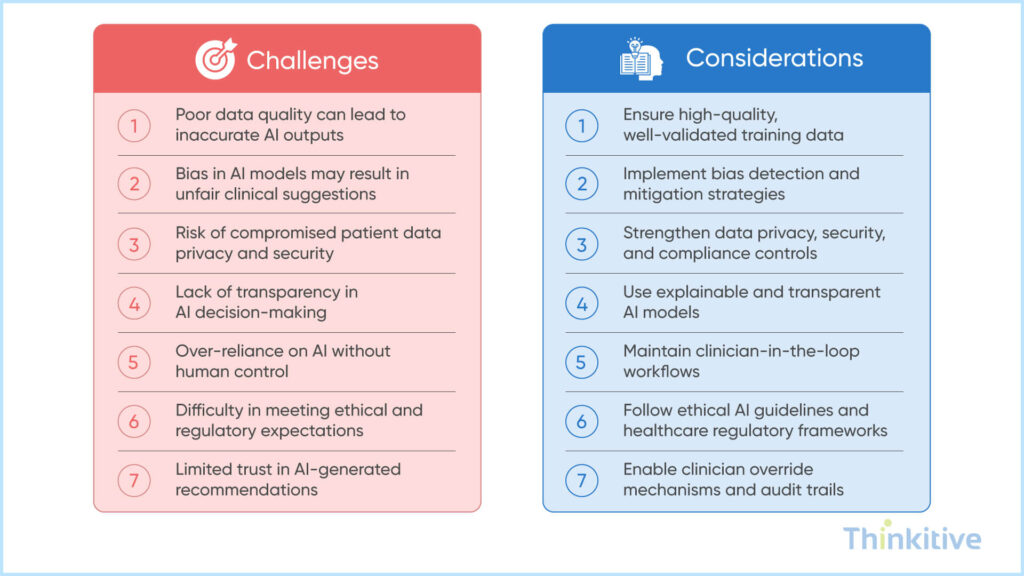
The impact of AI on healthcare workflow efficiency can only be experienced after it is implemented in your practice. Coupling this with the lucrative clinical benefits, AI in EMR software development seems to be the go-to option for healthcare providers. But implementing AI in your EMR software system is easier said than done.
Having said that, if you’re serious about harvesting the benefits of AI in EMR systems, here are some challenges and considerations that you must consider:
- Data Quality, Bias, and Fairness
The first challenge that comes with AI implementation is ensuring that the data on which the AI module is trained is of high quality. Furthermore, it should not contain any biases, so the suggestions given by the system are fair and not biased.
To overcome this, you need to implement robust data quality assurance and mitigation strategies. This is the only way you can ensure that your AI-powered EMR is fair and equal to all.
Apart from that, you need to give special attention to data privacy and security, as it is a still-evolving technology. There are some loopholes in the security that you need to address.
- Ethical Considerations of AI in Healthcare
AI can be used for many different purposes, and in healthcare, it can be used in ways that can determine the fate of the patient. That is why developing transparent and explainable AI models is necessary. It will not only be able to build trust but also ingrain an ethical decision-making process.
Ethical consideration of AI in healthcare is extremely necessary. Along with that, you need to have human oversight so that the system does not work on its own and does what is commanded.
Last but not least, during the EMR software development process, ensure that your EMR developers follow the ethical guidelines and regulatory frameworks that are consistent till the deployment.
A way to do this is to deploy clinician override mechanisms. This allows providers to review, modify, or ignore AI-generated suggestions, giving clinicians more control over decision-making. Furthermore, with auditability for every AI suggestion, override, and actions will be documented and traceable. This not only makes it critical for regulatory compliance but also brings in transparency in care decisions and builds long-term trust with AI-driven EMR systems.
Roadmap to AI-Powered EMR Development for Your Practice –
Get Free AssessmentConclusion
The news of AI making a difference in different industries is something that has become everyday news. However, when it comes to Artificial Intelligence and healthcare, there are a lot of things to consider, from security concerns to even development.
Having said that, the healthcare industry is also one of those industries that is investing heavily in developing AI-driven healthcare solutions and looking for ways in which they can help improve patient outcomes, enhance efficiency, and reduce costs. To an extent, AI has made a significant mark.
And if you ask me about the future of EMR development with AI, then I would suggest this is the right time to get on board and sail across the silent waters of the digital healthcare landscape. Read this exclusive article The Role of AI in Enhancing EHR functionality to get a better understanding.
Also, if you want to read about the future of EMR software, then read our blog, The Future of EMR Software.
Start AI-powered custom EMR development that supports smarter clinical workflows, improves efficiency, and prepares your practice for the future of healthcare.
Frequently Asked Questions
AI in custom EMR development is the integration of artificial intelligence into practice-specific electronic medical record systems to automate documentation, enhance clinical decision support, optimize workflows, and improve patient care within a healthcare practice.
AI in custom EMR development is embedded at both the application and workflow levels. Modern EMRs use artificial intelligence for data ingestion, clinical documentation automation, predictive analytics, decision support, and workflow optimization. Unlike off-the-shelf systems, custom EMRs allow AI models to be trained on organization-specific datasets, specialty workflows, and care protocols. This ensures that artificial intelligence in EMR systems enhances real clinical processes rather than forcing clinicians to adapt to generic automation.
Machine learning in healthcare enables EMRs to analyze historical patient data, population trends, and real-time clinical inputs to predict outcomes such as disease progression, readmission risk, or care gaps. Within EMRs, these models continuously learn from new data, improving accuracy over time. Predictive analytics powered by machine learning helps clinicians intervene earlier, prioritize high-risk patients, and shift care from reactive to proactive—one of the core ways how AI is transforming EMR software today.
AI powered EMR systems enhance clinical decision support by delivering context-aware recommendations at the point of care. Instead of static alerts, AI-driven CDSS evaluates patient history, lab results, medications, and clinical guidelines in real time. This reduces alert fatigue while improving diagnostic accuracy, medication safety, and treatment alignment. By embedding intelligence directly into workflows, AI-driven healthcare software supports clinicians without interrupting care delivery.
The benefits of AI assisted medical documentation include reduced administrative burden, improved note accuracy, and more time for patient care. AI tools such as ambient voice capture, natural language processing (NLP), and smart summarization automate clinical note creation directly within the EMR. This significantly cuts down manual data entry, minimizes documentation errors, and helps reduce clinician burnout—making artificial intelligence in EMR a major productivity enabler.
AI enables EMRs to move beyond standardized care plans toward personalized, data-driven treatment strategies. By analyzing patient-specific variables such as medical history, genomics, lifestyle data, and treatment responses, AI supports precision medicine initiatives. Custom EMRs can integrate these insights directly into care pathways, ensuring that AI in custom EMR development aligns treatment decisions with individual patient needs rather than population averages.
The role of AI in improving EMR interoperability lies in its ability to normalize, map, and interpret data from disparate healthcare systems. AI uses NLP and intelligent data matching to translate unstructured and semi-structured data into standardized formats, enabling smoother data exchange across platforms. This allows custom EMRs to integrate seamlessly with labs, imaging systems, pharmacies, and third-party health applications—reducing data silos and improving care coordination.
Trust in AI driven healthcare software is established through transparency, governance, and human oversight. Healthcare organizations implement clinician-in-the-loop workflows where AI recommendations support—not replace—clinical judgment. Audit logs, explainable AI models, and override mechanisms ensure accountability and regulatory compliance. By combining intelligent automation with clinician control, organizations ensure that how AI is transforming EMR software remains ethical, safe, and clinically reliable.


