The Benefits of Custom EMR Solutions for Healthcare Providers

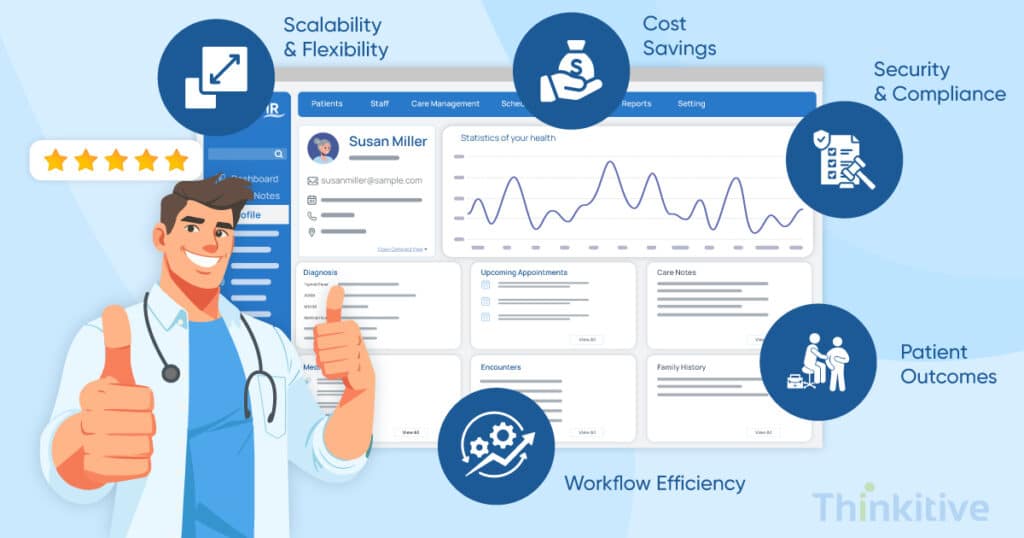
Look at the evolution of healthcare, and you will find technology at the center, fostering its growth. From the introduction of simple healthcare devices like a thermometer to complex MRI scanning machines, it can be argued that technology is paving the road to future growth in the healthcare industry.
Paving the way with digital advancements, the use of healthcare software systems has become a cornerstone of care delivery in the last decade or so. Moreover, the arrival of electronic medical records in care delivery brought efficiency and enabled healthcare providers to provide value-based care.
However, despite the lucrative benefits of technology, many healthcare organizations still struggle with the increasing administrative burden, and the rising demands of patients with respect to holistic care. Recognizing this as the pivot point for the growth of healthcare practices, many practices turned to tailored healthcare technology to meet their growing needs.
And since most of their practices have EMR software as the epicenter of their care delivery and administration, it made sense to develop with a custom EMR software, right?
On that note, let’s explore the benefits of personalized EMR applications and how they can help you transform your healthcare practice.
Key Benefits of Custom EMR Software
- Improves workflow efficiency by streamlining clinical and administrative processes.
- Enhances patient care with real-time access to accurate health information.
- Strengthens data security while supporting HIPAA and other regulatory compliance.
- Reduces long-term operational costs through automation and tailored workflows.
- Scales with your healthcare practice and adapts to evolving clinical needs.
- Integrates seamlessly with telehealth, RPM, wearables, billing, and other healthcare systems.
What Are the Benefits of Custom EMR Software?
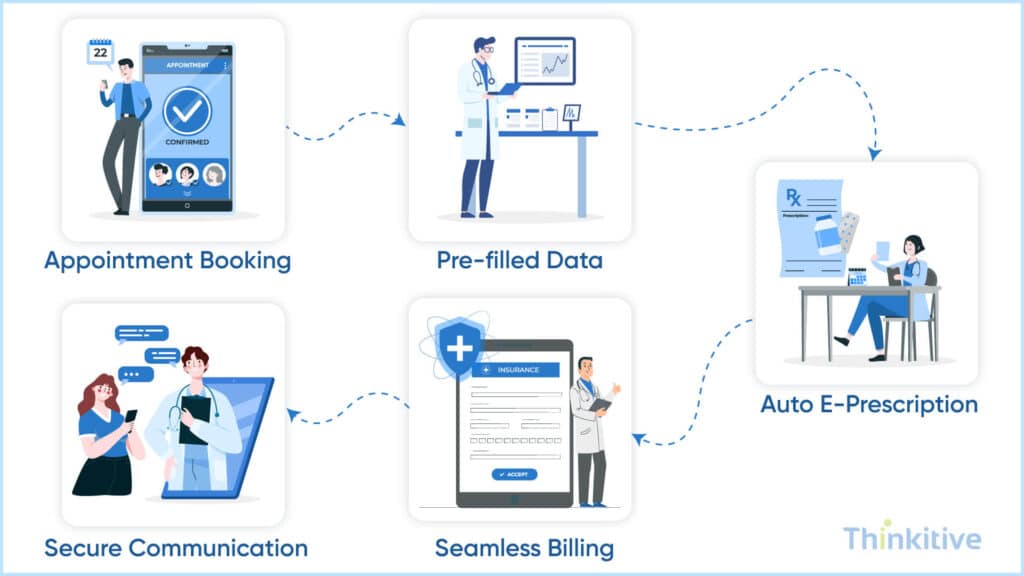
The benefits of custom EMR software include improved workflow efficiency, better patient care, stronger data security, long-term cost savings, greater scalability, and seamless integration with modern healthcare technologies. These advantages help healthcare providers deliver more efficient, secure, and patient-centered care.
One of the major advantages of custom EMR for your healthcare practice is that it enhances workflow, driving efficiency and productivity. But how is a customizable EMR able to do that? Well, let’s see how.
Starting with the very first step of care delivery, that is, appointment scheduling, it sets patients on their holistic care journey. Streamlining and simplifying the process of accessing care and the next steps that follow allow clinical teams to focus on care delivery and administration of administrative tasks. The benefit of a custom EMR solution here comes in a unique form, which allows your healthcare practice to mold the software’s clinical and administrative workflows as per your needs and requirements.
Create Unified Patient Records System with Custom EHR
Free ConsultationFurthermore, automating data entry removes the need for manual paperwork or data entries at every step. This way, you minimize, if not eliminate, the risk of errors that usually occur in manual data entry. Improving healthcare efficiency with custom EMR has become one of the major USPs of customizable EMR, which allows you to save time and spend more time on important tasks at hand. The same can be brought into other aspects of your care practice, such as appointment reminders, e-prescriptions, and even integrated billing systems.
And the stats prove it. For instance, in 2025, 22.5% clinical appointments and 7.2% of the total hospital appointments were done online. And if you look at the graph, it appears to be growing steadily.
Along with that, you can also include secure communication channels that can improve communication and collaboration between patients, providers and care team members. This allows you to make better and more informed decisions and a surge in productivity, and reduces the chances of staff burnout.
Some advanced features that you can incorporate into your EMR system with AI can further reduce documentation time. For instance, voice dictation, AI scribes, NLP, can be a great tool for your physicians to save time from documentation. This will lead to fewer errors with higher productivity.
Improved Patient Care Outcomes
Accurate and timely access to patient health information is something that many have observed to be the cornerstone for care delivery. While EMR software systems are able to do that, oftentimes, the factor of personalized or holistic care delivery is missing. However, custom EMR software benefits you from collecting, analyzing, and sharing patient data in real time with all the care team members to make informed care decisions.
Coupling that with communication channels through patient portals of secure messaging, you can improve the collaboration between patients and care team members, which can improve adherence and empower patients to proactively participate in their care journey.
Last but not least, by streamlining the clinical processes and bringing every member of the care team on the same page and working towards the same goal, they improve patient safety and reduce the margin of medical errors.
Here, you might be wondering how custom EMR software can help with that.
Well, with exclusive features like drug interaction checks, allergy alerts and clinical decision support tools, medical errors are minimized, allowing healthcare providers to take all the necessary measures to improve patient safety.
These clinical decision support tools and patient engagement features would give you a better idea about how EMR improves your patient care initiatives:
| Custom EMR Feature | How It Improves Care Delivery |
| Drug–drug interaction alerts | Helps providers avoid adverse medication events, improving patient safety and treatment accuracy. |
| Risk alerts | Automatically flags high-risk cases (allergies, abnormal vitals, post-op complications) to support timely clinical decisions. |
| Chronic disease flags | Identifies patients with ongoing conditions (diabetes, COPD, hypertension) for proactive monitoring and follow-up care. |
| Patient portals | Enables patients to access records, lab results, and visit summaries, improving transparency and engagement in care plans. |
| Secure messaging | Supports real-time provider–patient communication while maintaining HIPAA compliance, leading to faster resolutions and reduced no-shows. |
| Telehealth integration | Provides virtual consultations and remote monitoring, closing care gaps and enhancing access to treatment. |
Increased Data Security & Compliance
The digital infrastructure has indeed made the care delivery process much simpler and allowed the healthcare industry to be more streamlined and efficient. However, given the digital nature of the data stored in healthcare software systems, the risk of cyberattacks significantly increases.
This is one of the major benefits of custom EMR vs. off-the-shelf EMR since you can implement robust security measures in your system to protect sensitive patient data from cyber threats. If you’re looking for secure EMR software development, some of the essential features, like encryption and access control, along with regular security audits, must be implemented.
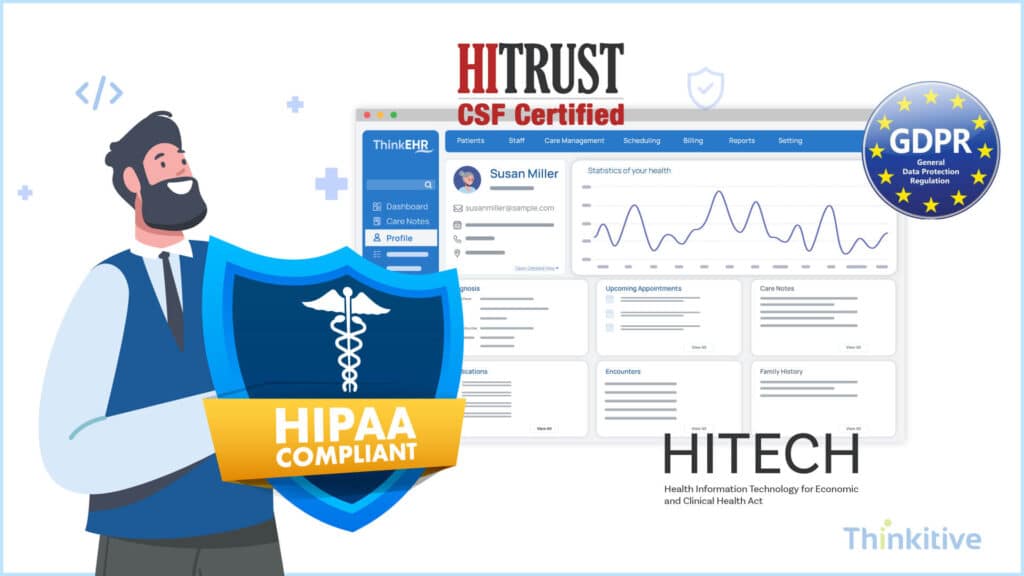
Moreover, with customizable EMRs, it is easier to comply with regulatory requirements and standards such as HIPAA, GDPR, HITECH Act, HITRUST, FDA, etc. In this way, you reduce the risk of data breaches and build a relationship with your patients on the basis of trust. And it is always good to have a strong and sensible reputation if you are working in the healthcare industry.
Cost-Effectiveness in the Long Run
The initial lower implementation cost of the off-the-shelf EMR software might appear cost-effective in nature. However, in the long run, the recurring subscriptions and reliance on other healthcare software systems might be costly. Decrease reliance on multiple software systems can be removed with EMR software development.
By streamlining the clinical and administrative workflow, you increase the efficiency of the system and reduce the burden on your staff members. Furthermore, the reduction in errors in administrative processes by tailoring to specific billing and coding requirements improves your revenue cycle management as the risk of errors is minimized and denials are reduced.
Moreover, in the long run, as the technology and healthcare landscape evolves, you can easily customize the software system. This drastically reduces your reliance on multiple systems, and by bringing it all to one single system, you make sure that your custom EMR solution is flexible, scalable, and sustainable for changes in the landscape and infrastructure. In this way, the cost-effectiveness of custom EMR solutions cannot be easily matched by the off-the-shelf software solutions in the long run.
Custom EMR ROI Calculate
Calculate ROIScalability & Flexibility
The healthcare landscape, as well as the technological landscape, is constantly evolving. This requires you to make frequent changes in your software system. While addressing this concern can be a little difficult and daunting in off-the-shelf EMR software, the best custom EMR solutions gives you enough flexibility and scalability options to adapt to these changes effectively and efficiently.
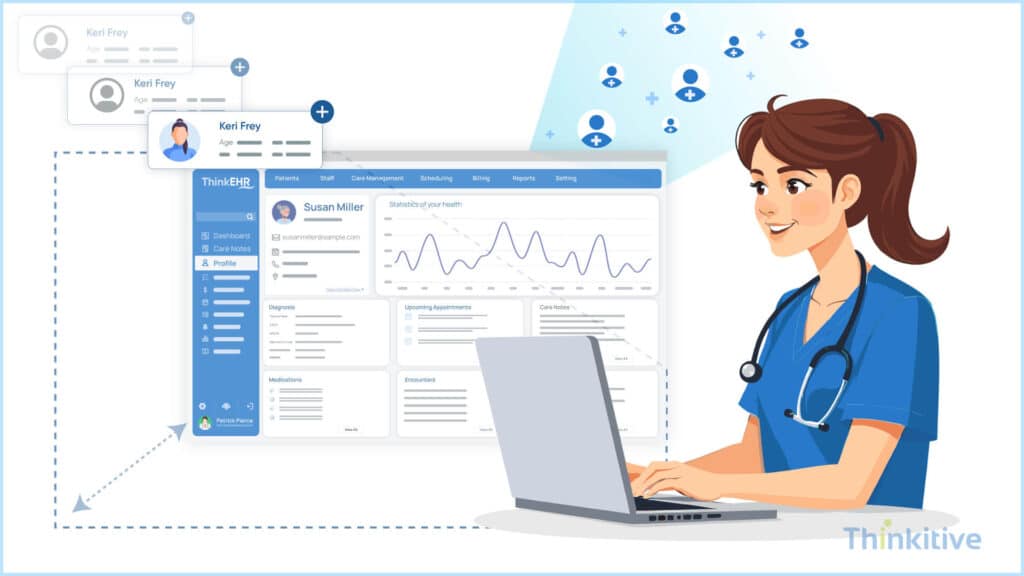
Let’s try to understand this with an example, as your practice grows, your patient population grows, increasing the load on your software systems. A customizable EMR software cloud-based infrastructure gives you the option of scalability, which makes it easier for your system to accommodate future growth by easily expanding its functionality.
Along with that, you want your EMR software to be robust. It needs to have the ability to easily integrate with new devices and technologies. This is one of the crucial steps to future-proof your EMR system; it adds compatibility and helps you achieve interoperability, which makes sharing data with disparate healthcare systems easier and more affordable.
Read More: But before you decide to move ahead with custom EMR software development, read this ultimate EHR software development guide, to know the intricacies and be better prepared before you actually talk with an EMR software development company.
Check My EHR Integration Capability
Get Free AssessmentIntegration with Emerging Technologies (Telehealth, IoT, Wearables)
Another trend that is slowly entering if not has already entered mainstream care delivery is remote care access. And as technology is closing the gaps in between care delivery, accessibility and data collection, the dream doesn’t seem to be too long.
That is why healthcare providers are demanding integration with RPM devices for remote patient monitoring. Along with that, integration with IoMTs such as glucometers, heart monitors and smartwatches, real-time data can be analyzed and care can be delivered as soon as possible.
This can be a great initiative to close gaps in care delivery and even better preventive care can be given. This can be an exceptional improvement for chronic disease management. On top of that, with embedded telehealth modules care access can be improved and no-shows can be reduced.
Conclusion
Custom EMR has become an increasingly important investment for healthcare organizations seeking greater efficiency, flexibility, security, and better patient outcomes. As healthcare continues to evolve, these benefits make custom EMR a practical long-term solution for practices looking to improve care delivery and operational performance.
Furthermore, the benefits of custom EMR vs. off-the-shelf EMR clearly outweigh the benefits, give you more flexibility, improve patient care activities, and help you bring all the aspects of traditional healthcare practice to a digital landscape.
That is why many prominent healthcare organizations and small-scale clinics are opting to choose custom EMR software development approaches to meet their unique needs and goals. So, what are you waiting for? If you’re considering a custom EMR for your organization, partnering with an experienced EMR software development company can help you build a solution tailored to your clinical and operational needs.
Frequently Asked Questions
Custom EMR software streamlines clinical workflows by aligning forms, templates, and decision pathways with the exact way your practice operates. Instead of forcing providers to adapt to rigid off-the-shelf workflows, a custom EMR automates repetitive tasks such as charting, coding, documentation, and patient data retrieval. Integrated billing, scheduling, and e-prescribing modules eliminate double data entry and reduce administrative overhead. Ultimately, these tailored workflows let clinicians focus more on patient care and less on system navigation, one of the core benefits of custom EMR for healthcare providers.
The primary benefits of custom EMR software include tailored workflows, specialty-specific modules, seamless interoperability, and full control over feature development. Healthcare providers can design interfaces that match real-world processes, improve usability, and reduce documentation fatigue. Custom EMRs also scale more effectively as the organization grows, support advanced analytics, and integrate new technologies without vendor restrictions. This flexibility makes custom EMR a strategic investment for providers wanting long-term efficiency and competitive advantage.
Yes. A major benefit of custom EMR systems is mature interoperability. Custom EMRs are built with open APIs, HL7/FHIR standards, and flexible interfaces that connect smoothly with lab equipment, imaging systems, billing platforms, telehealth tools, and population health systems. This unified ecosystem eliminates data silos, improves information accuracy, and accelerates clinical decision-making, demonstrating how custom EMR helps healthcare providers deliver coordinated, high-quality care.
AI-powered custom EMR solutions offer predictive analytics, automated charting, risk scoring, intelligent alerts, and personalized treatment recommendations. Machine learning can identify clinical patterns, flag anomalies, and support proactive care for chronic conditions. These capabilities improve diagnostic accuracy, reduce manual workload, and enhance patient outcomes. AI integration is among the emerging benefits of EMR in healthcare, enabling smarter, faster clinical decisions.
Custom EMRs incorporate advanced security frameworks including role-based access control, multi-factor authentication, audit logs, encryption at rest and in transit, and continuous threat monitoring. Custom development also ensures compliance with HIPAA, ONC, and state-level regulations by embedding safeguards directly into workflows. This level of control improves data governance and minimizes vulnerabilities, an essential benefit of EMR systems for modern healthcare providers.
Implementation timelines vary based on complexity, number of integrations, and required features. On average, a custom EMR takes 4–6 months for development, testing, pilot rollout, and full deployment. Larger, multi-specialty projects with advanced AI or IoT capabilities may take longer. The benefit of custom EMR software is that the development timeline is fully aligned with your practice’s needs, ensuring a high-performing, future-ready solution.
Yes, despite higher upfront investment, custom EMRs often reduce long-term costs by eliminating license fees, unnecessary features, workflow inefficiencies, and vendor lock-in. Practices can scale features gradually, integrate only what they need, and avoid costly workarounds associated with generic systems. For many small and mid-sized clinics, these long-term efficiencies highlight why healthcare providers need custom EMR solutions tailored to their operational and financial realities.
Custom patient portals allow providers to design intuitive, user-friendly experiences that match their care model. Features like appointment scheduling, secure messaging, medication reminders, care plans, and telehealth access empower patients to take an active role in their health. Personalized UI and workflow logic improve satisfaction, reduce no-shows, and strengthen continuity of care, which are some of the key benefits of custom EMR in healthcare focused on engagement.
Absolutely. A well-built custom EMR is designed for long-term scalability. Providers can add new specialties, locations, user roles, AI tools, IoT devices, and RPM workflows without major system disruptions. This adaptability ensures that your EMR evolves alongside your practice and one of the most strategic benefits of EMR systems for growing healthcare organizations.


