7 Key Features to Have in Custom EHR Software

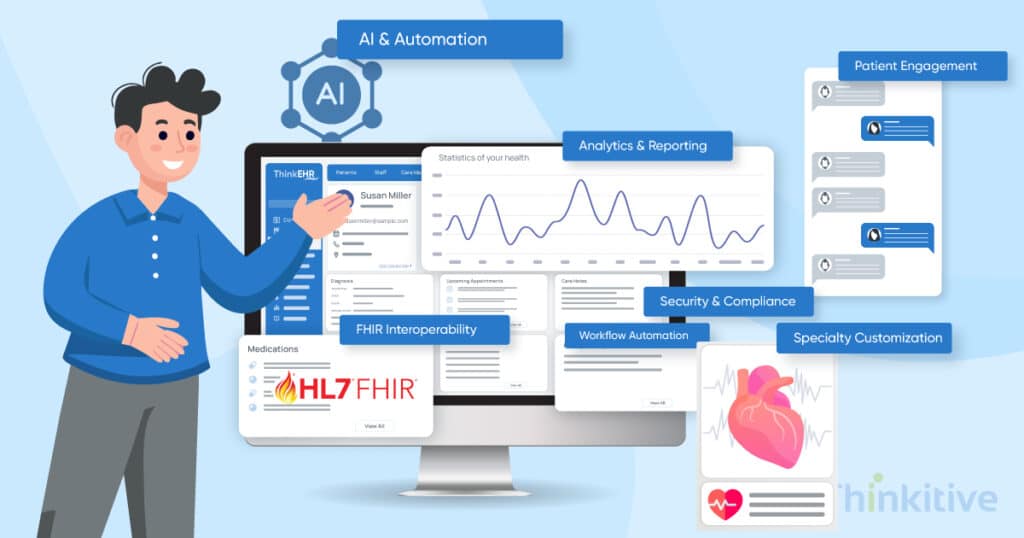
Do you know, apart from the specific needs of your clinic, some of the trends in the healthcare industry, especially with custom EHR software development, are determining the features of EHR software?
For instance, ever since the boom that was observed in the use of AI technologies, more than 71% of non-federal acute-care hospitals have been reported to use predictive AI models in their EHR systems. And just a year ago, in 2023, this figure was standing tall at 66% and that is a huge jump compared to year-on-year growth.
Having said that, as the demand for custom EHR rises amongst healthcare providers, the features they require for their EHR software are often not updated.
You see, every day technology is evolving and so is the healthcare industry and at the helm of these trends are technological advancements. And as specialty practices are also looking for custom EHR solutions, the features are becoming even more advanced.
Now, the problem that I’ve realized while conversing with some of the healthcare providers who are also our clients is that they know that they need a customizable EHR, but they don’t know what features they want to include.
Sounds familiar?
Well, this is what healthcare providers are struggling with. And they’re not to be blamed completely, with EHR software development vendors not giving them exactly what they need, the gap between their needs and software functionalities is widening.
And that is one of the major reasons why I decided to pen down the key EHR software featur this blog.
On that note, in this blog, let’s determine the 7 key features EHR software 2026.
So, without further ado, let’s start!
Key Feature Checklist for Custom EHR
Get Free ChecklistAI-Powered Clinical Documentation & Workflow Automation
AI being the trend of the world, the healthcare industry is actually one of those spaces that can extremely benefit from its inclusion. So, let’s see some of the AI-powered features that can enhance your documentation and workflow automation.
- AI Ambient Listening: One of the most anticipated features or functionalities of AI in custom EHR is AI Ambient listening. Proper implementation of this feature can easily convert real-time conversations between providers and patients into structured notes. It can immensely impact the documentation process and fasten certain processes.
- Natural Language Processing: Along with AI ambient listening, natural language processing is another feature that most healthcare providers are looking forward to. Some of the applications of NLP can be used for care episode summarization, template auto-filling and voice-to-text feature to capture notes in real-time.
- Automated Documentation Workflows: An AI feature that hasn’t caught the attention of many healthcare professionals is automated documentation workflows. Meaning the flow of data and tasks assignment to providers can be easily enhanced and streamlined. You see, when data flows from intake flows, to notes and orders, most of the administrative tasks can be easily completed.
Having these three functionalities with AI-powered EHR features can reduce your manual patient charting efforts. However, the most important factor in this is the factor of accuracy. It can remove most of the barriers in data sharing and minimizes burnout by reducing, if not eliminating, providers’ pyjama time.
Eliminate Pyjama Time for Your Providers
Learn HowIntelligent Interoperability with FHIR-Based Data Exchange
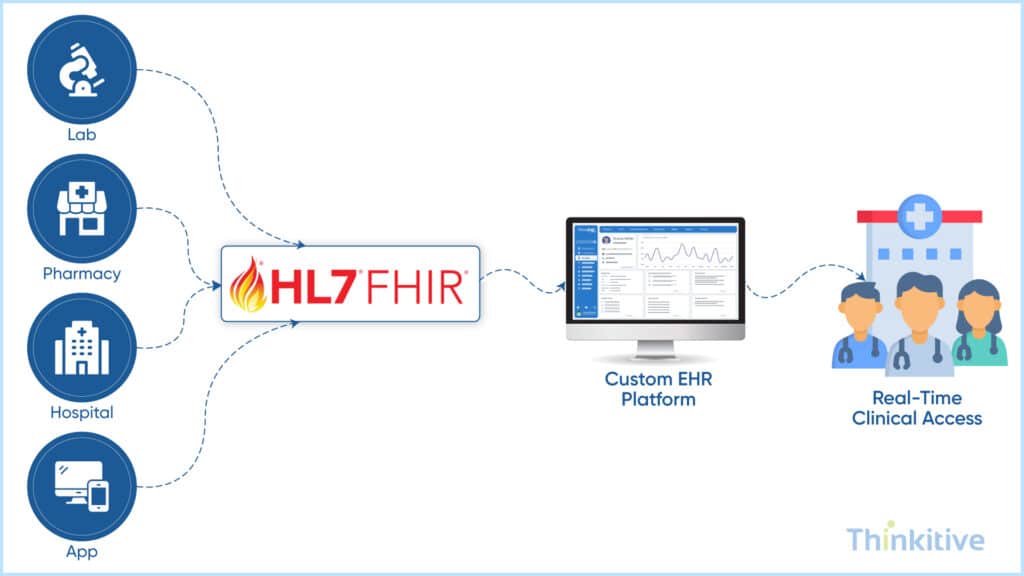
Sharing data with disparate healthcare systems is also one of the core functionalities of any EHR software. And to achieve that, you need to make your EHR software interoperable and on the HL7 FHIR data exchange standards. By doing this, here are some of the benefits that you get:
- FHIR-first Architecture: You get an FHIR-first architecture which allows your system to seamlessly exchange data across systems, both in and outside of your network. Having a FHIR-first software architecture can be one of the future-ready features of custom EHR software, as it helps in customization, flexibility and scalability.
- Integrated Lab and Radiology Orders: Establish seamless integration with disparate healthcare systems, such as labs and radiology. This will help you save time in reporting the results and delivering care on time. Furthermore, add the functionality of automated result reporting into the EHRs, so that the gap to care delivery is reduced significantly.
- Unified Longitudinal Patient Records: Another advantage of an interoperable and FHIR-first architecture is that you get a unified longitudinal patient record that helps in reducing repetitive tests, data entry, etc. This makes patient records more accurate and comprehensive to view.
Some of the other benefits of this include data validation, with all the external systems being connected to your system. On top of that, it can also be extremely helpful in managing the consent of your patients.
Know What Interoperability Approach Your Practice Require
Get Free ConsultationIntegrated Telehealth & Remote Patient Monitoring (RPM)
Along with AI-powered features and functionalities of EHR systems, the demand for healthcare practices to shift to a completely digital care delivery model is equally high. And surprisingly, this time the demand is from the patient’s side, and there are enough studies to prove that.
With telehealth platform integration, you can easily provide virtual consultations. However, some things where you will lack alignment of the digital care delivery processes with your clinical workflows. And that is where having a custom EHR with an integrated telehealth platform comes in handy.
Furthermore, for a completely digital ecosystem, what you need is integration with remote patient monitoring devices, just as IoT, wearables and whatnot. Now, having integrated both in your EHR can give you a competitive advantage, since they are some of the most important features of custom EHR software for completely virtual care delivery.
Some of the modern EHR software features for 2026 include secure digital consults, virtual intakes and remote prescribing. To offer your patients a more holistic experience, this will also include alerts for deterioration. This is crucial for chronically ill patients, as providing care to chronic patients becomes much easier.
Complete the Digital Transformation of Your Practice
Get Free ConsultationModern Patient Engagement & Digital Front Door
Keeping the patient engaged is another aspect of care delivery to keep in mind. On top of that, if you manage to allow them to actively participate in their care journey, then getting the desired results can be easy. For patient engagement and digital appointments via custom EHR software, here are some features that you need to know.
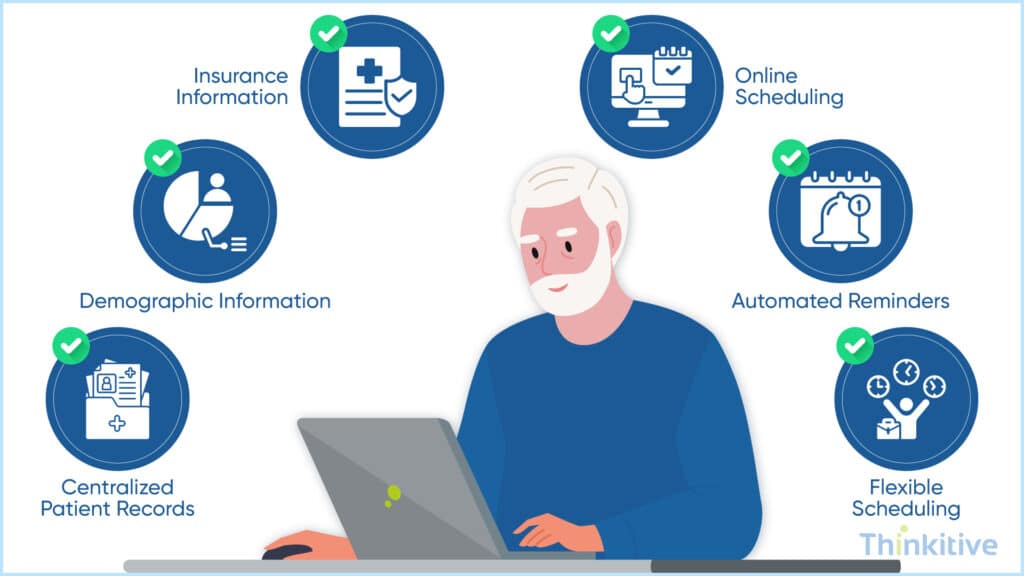
- Centralized Patient Records: With custom EHR software development, you can attempt to centralize patient records. In this, you would require comprehensive patient profiles, which would contain nearly all the necessary patient health information. This would not only improve accessibility to patient medical records, but it would also play a crucial role in care plan curation and the next processes that follow. Moreover, you should also provide secure storage of patient information to ensure your practice’s integrity and gain patients’ trust.
- Demographic Information: Apart from the clinical information that you are looking for, the demographic information of the patient should be accurate and up-to-date. It helps you in including the search and filter EHR capabilities of your custom software, which can save you time from searching the entire database for a particular patient.
- Insurance Information: While clinical and demographic information will streamline most of your patient management practices, including insurance information, can further make the process easier for you. It can improve your revenue management practices with functionalities like insurance verification and claims submission.
- Online Scheduling: With appointment scheduling, you set the patient’s care journey in motion. Give the patients control of their health by allowing them to schedule their appointments. Furthermore, with calendar integration, you can further simplify the process for them by allowing them to check real-time appointment availability and that of the physician.
- Automated Reminders: The problem that lies in the many practices that still use traditional healthcare practices is no-show and missed appointments. To avoid that, include the functionality of automated appointment reminders via SMS or email to remind patients of their scheduled appointments.
- Flexible Scheduling Options: A Flexible scheduling option is one of the necessary features for custom EHR software for small clinics. It gives the patients a way to efficiently schedule with multiple providers. To make it more personal, you can also choose to add the functionality of customizing the appointment by its type and duration.
Advanced Clinical Decision Support System (CDSS)
Clinical decision support tools have been in the software systems for a while now. At the same time, there are advancements in these systems that are making care delivery much more effective and better. While some of the features in this are already included in the previous sections, here are some of the features and functionalities that you need to know, as they are trending and know how they’ll benefit you and your patient population.
| CDSS Capability | How It Works | Benefit to Providers & Patients |
| AI-driven clinical guidance | Analyzes labs, vitals, medications, and patient history to offer context-aware suggestions. | Supports more accurate, personalized, and faster clinical decisions. |
| Real-time safety alerts | Detects drug interactions, allergies, contraindications, and abnormal results instantly. | Improves patient safety and reduces preventable medical errors. |
| Evidence-based recommendations | Surfaces guidelines, care pathways, and proactive insights from clinical best practices. | Ensures standardized, high-quality care aligned with the latest evidence. |
| Predictive risk analytics | Identifies early signs of deterioration, complications, or high-risk conditions using pattern recognition. | Enables early intervention, reducing hospitalizations and adverse outcomes. |
End-to-End Revenue Cycle Management (RCM) with Automation
Many healthcare practices often avoid the inclusion of billing and payment in their healthcare software development. This trend has especially been popular in custom EHR software development. So, if you are looking for a complete solution for your practice, here are the features and functionalities you must consider for the billing and payment part.
- Automated Claims Submission: Automate the claims submission process after the care is delivered. With this part integrated into your custom EHR software, it automatically becomes easy to share data and reduce the administrative burden on your staff. Furthermore, with automation, you improve accuracy, and the claims submission process is streamlined for both ICD-10 and other CPT codes.
- Real-time Insurance Verification: Add the functionality of real-time insurance verification so that you can add another layer of verification during patient intake. On top of that, it also allows for accurate billing and payment in the claims submission process. Furthermore, with verification, the chances of claim denials are minimized, if not eliminated.
- Denial Prevention through Predictive Analytics: As mentioned earlier, AI has been a great tool for analyzing data and making sense of it, right? Well, it can be turned into a profitable venture with predictive analytics for preventing denials. It can analyze the data and payment patterns of your patients, and even in data entries, to find the gaps and reduce the claims denial rate significantly.
- Patient Payment Options: Further simplify the process of payment for your patients by including an online payment portal in your custom EHR software. Also, if possible, study your patient population and on the basis of that, include flexible payment plans that can further make the payment process easier.
Know the ROI Boost Your Practice Can Get with Custom EHR
Get Free ConsultationSpecialty-Optimized Workflows & Customizable Templates
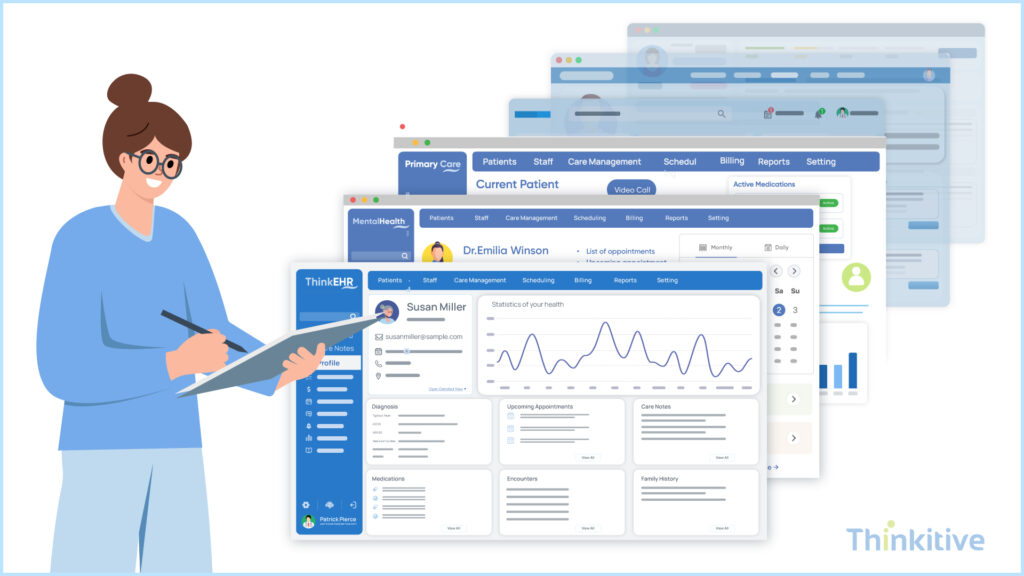
While most of the features and functionalities discussed above are majorly related to patients and everything that involves their care delivery, here are some of the features that can help you in effective medical practice management and truly make your custom EHR software a one-stop solution.
- Staff Scheduling: For efficient staff management and optimizing your workflow to its maximum potential, include the feature of staff scheduling. This will not only contribute to the practice’s efficiency but also streamline resource management for your practice.
- Performance Reporting: Evaluate your practice on the basis of performance. The best way to do that is by identifying the key performance indicators (KPIs), and since your custom EHR will generate certain data out of its usage, you can make data-driven decisions.
- Financial Management: In the end, it all comes down to money, for which you need to include the financial management features discussed above. This will help you control costs and improve revenue cycle management.
Conclusion
If you’ve made it till here, then you must be a little disappointed and a little relieved, right?
Well, a little disappointed because you must have been expecting 7 specific features, but you see, a software is made up of many functionalities that define its features. Having said that, we’ve managed to cover almost every feature that satisfies almost all the aspects of your practice.
On that note, let this blog be your guide to define the important features of your EHR software, and if you want to know about the advanced features, then read our in-depth blog – Must-Have Advanced Features of Custom EHR Software 2026.
And if you know the features and want to get started with the discovery, then get your first free consultation.
Frequently Asked Questions
The key features of custom EHR software 2026 include AI-driven clinical workflows, FHIR-based interoperability, advanced telehealth tools, remote patient monitoring integration, specialty-specific templates, intelligent documentation, and automated revenue cycle management. These future-ready features for custom EHR software ensure faster care delivery, higher accuracy, and seamless coordination across care environments. When evaluating what features a custom EHR should include in 2026, look for automation, predictive analytics, customizable modules, and scalable API-based connectivity.
AI-powered documentation streamlines charting by converting provider notes, voice inputs, and patient interactions into structured clinical data. This reduces time spent on manual entry, enhances accuracy, and minimizes burnout. Among the top custom EHR features for 2026, AI-driven documentation stands out because it automates repetitive tasks, supports real-time recommendations, and creates more meaningful patient-provider interaction time.
FHIR-based interoperability is a core requirement in the modern EHR software features for 2026 because it ensures smooth, secure exchange of patient data across hospitals, labs, pharmacies, imaging centers, and external systems. It enhances care coordination, reduces duplicate tests, and supports regulatory compliance. A customizable EHR system built on modern APIs and FHIR standards future-proofs your practice and enables seamless integration with AI tools, health information exchanges (HIEs), and third-party applications.
In 2026, telehealth and RPM are no longer standalone tools—they are embedded into the custom EHR software features list. Integrated workflows allow providers to schedule virtual visits, collect vitals from connected devices, receive real-time alerts, and document encounters directly in the EHR. These important features of custom EHR systems enable continuous care delivery, proactive interventions, and better outcomes for chronic care management.
Key patient engagement components in customizable EHR software include smart patient portals, mobile apps, two-way messaging, self-scheduling, digital consent forms, medication reminders, and educational content delivery. These tools make healthcare more accessible and interactive while supporting value-based care. Among the key EHR capabilities needed in 2026, patient empowerment features play a major role in improving adherence and satisfaction.
CDSS provides real-time alerts, AI-driven risk predictions, guideline-based recommendations, and automated checks for drug interactions or allergies. These must-have custom EHR features 2026 help clinicians make faster, safer, and more informed decisions. As part of the essential features in custom EHR software 2026, advanced CDSS reduces medical errors, supports precision medicine, and improves overall care quality.
A future-ready EHR must include automated eligibility checks, rule-based charge capture, coding assistance, claim scrubbing, denial prediction, payment posting, and financial analytics dashboards. These features of custom EHR software improve accuracy, reduce claim rejections, and optimize collections. Integrated RCM capabilities ensure that clinical and financial workflows operate seamlessly within a customizable EHR system.
Each specialty has unique documentation requirements, workflows, and compliance needs. A customizable EHR software solution allows practices to tailor templates, forms, dashboards, and order sets to match their specialty—whether it’s primary care, oncology, cardiology, behavioral health, or orthopedics. These important features of custom EHR systems significantly improve provider satisfaction, reduce charting time, and increase overall usability.
Yes. With modern cloud architecture and modular development, advanced automation and AI can be implemented cost-effectively. Practices can adopt essential modules first and scale over time. Many future-ready features for custom EHR software—like intelligent documentation, CDSS, and automated workflows—actually reduce operational costs by improving efficiency and lowering administrative workload.
The timeline depends on scope and complexity, but on average, building a customizable EHR system with the key features of custom EHR software 2026 takes 4–9 months. This includes design, development, integrations, testing, migration, and training. Implementations with highly specialized modules or extensive interoperability features may extend to 12 months. A phased rollout helps ensure faster adoption and smoother transitions.


