Selecting the Right EMR Development Company

The tide in the healthcare IT landscape is changing. You see, currently, most of the healthcare practices still rely on standard EMR systems, and given the fast-paced nature of healthcare, the inefficiencies in these systems are seen vividly everywhere.
To give you an idea, have a look at these stats:
- 60% of clinicians report EMR usability as a major contributor to provider burnout, according to the American Medical Association.
- 50% of the healthcare organizations lack interoperability, which limits their care coordination, according to HIMSS.
- Healthcare organizations using a custom EMR software report 30-40% more improvement in workflow efficiency and better reports, according to KLAS Research.
These are just some of the many statistics that I came across. However, something that you must have observed in these stats is that many healthcare practices have recognized the potential of custom EMR software development.
This is the reason EMR development is back in demand.
To address the growing demands of providers and healthcare organizations, many EMR development companies have emerged. However, EMR vendor selection is a crucial factor, as many facets of your practice and software depend on this. Furthermore, the right partner plays a crucial role in determining the success of your practice or your EMR development venture.
However, in the pool of vendors who claim to be the best EMR software development companies, finding the right partner becomes difficult. Furthermore, with someone who has very limited knowledge about technology and its ever-evolving landscape, without a proper partner, there is a high chance that you won’t get what you’re looking for.
So, you must ask here, ‘How to choose the right EMR development company?’
Well, to be honest, we can’t do that for you. However, here are the top 10 factors to consider when selecting an EMR development company.
On that note, let this blog be your guide to choosing the right healthcare software development company for your EMR development.
Assess Your EHR System for AI Readiness
Get Free AssessmentKey Takeaways
- Evaluate the vendor’s healthcare domain expertise and successful EMR implementation experience.
- Verify HIPAA compliance, interoperability standards (HL7/FHIR), and security certifications before making a decision.
- Assess the company’s technical capabilities, development process, and AI readiness for long-term scalability.
- Review case studies, client references, support services, and maintenance commitments to measure reliability.
- Compare long-term value—not just development cost—before selecting an EMR development company.
10 Factors to Consider When Selecting an EMR Development Company
Use the following evaluation checklist to compare EMR development companies before making your final decision.
1. Healthcare Domain Expertise & Track Record: Look for proven experience building EMR systems for hospitals, clinics, specialty practices, or healthtech organizations.
2. Technical Capabilities & Modern Technology Stack: Evaluate the company’s architecture, development expertise, AI readiness, and use of modern technologies.
3. Compliance, Security & Certification Standards: Verify HIPAA compliance, interoperability standards, security practices, and relevant certifications.
4. Development Methodology & Project Management: Assess their development process, project transparency, communication, and quality assurance practices.
5. Integration Capabilities & Interoperability Experience: Ensure they have experience integrating labs, pharmacies, billing systems, telehealth platforms, and FHIR/HL7 standards.
6. Team Composition & Expertise Levels: Review the experience, healthcare knowledge, and specialized skills of the development team.
7. Client References & Success Stories: Check healthcare case studies, client testimonials, and measurable project outcomes.
8. Support & Maintenance Capabilities: Understand their post-launch support, maintenance services, training, and SLA commitments.
9. Cost Structure & Value Proposition: Compare pricing transparency, engagement models, and the total cost of ownership rather than just the initial development cost.
10. Innovation & Future-Readiness: Choose a partner investing in AI, cloud technologies, interoperability, and long-term platform scalability.
What Healthcare Expertise Should an EMR Development Company Have?
Building an EMR is no small thing, especially in healthcare, where compliance and regulations are far stricter than in any other industry. That’s why, when evaluating an EMR development company, start with industry-specific experience and the years they have been developing EMRs. Do they have IT expertise and proven EMR implementation across diverse settings like hospitals, clinics, or specialty practices?
Next, take a look at their portfolio, ask to see any live EMR development, specialty-specific solutions. Finally, understand how well they understand the regulations. Can they show HIPAA compliance certification, Meaningful Use certification? Are they familiar with state-specific regulations?
With these questions, you can get a clear idea of the company’s experience in the industry and its development expertise. Also, if you want to know some of the common challenges and how to overcome them, then read our blog – Common Challenges in Custom EHR Development and How to Overcome Them.
What Technical Capabilities Should You Evaluate?
While these tables will give you an eccentric overview of the technical capabilities and modern technology stack, something that you must consider in your EMR software development company is their AI readiness.
You see, with AI being the need of the hour for every industry and especially the healthcare industry, it is important that your vendor can make your EMR software into an AI-powered custom EMR software. And the best way to check their AI readiness is through vendor maturity and how they are able to embed AI-enabled EMR capabilities into the clinical logics.
Another part that separates an expert custom EMR software development company from others is the tech stack and IT expertise. Here’s an evaluation chart that can help you understand this:
| Criteria | Evaluate |
| Development Expertise | Check the vendor’s skills in programming languages, certified cloud platforms, mobile apps, and AI/ML integration. |
| Architecture | Ensure experience with microservices, enterprise scalability, robust APIs, and proven performance tuning. |
| Standards | Look for compliance with FHIR, HL7, DICOM for imaging, and ICD-10/CPT coding standards. |
| Security | Verify security certifications, regular penetration tests, disaster recovery systems, and strong data encryption. |
Get our EMR Vendor Technical Assessment Checklist for Quick Vendor Evaluation
Download for FreeHow Can You Evaluate Compliance and Security?
Keeping PHI safe is essential in healthcare, and the EMR and EHR development company must understand this. A reliable EMR software development partner must meet strict compliance and security requirements.
- Compliance Certification: Ensure that the vendor provides HIPAA documentation, SOC 2 Type II, ISO 27001, and HITRUST CSF to show compliance readiness.
- Security Practices: Learn about their routine security audits, secure development cycle, incident response procedures, and staff security training.
- Data Protection Measures: Verify that the vendors provide end-to-end encryption, role-based access control, audit trail capabilities, and data breach history and response plan for accountability.
- Regulatory Compliance Support: Check if the vendor provides a compliance team, regular system updates, and follows complete documentation practices.
How Should You Evaluate Development Methodology and Project Management?
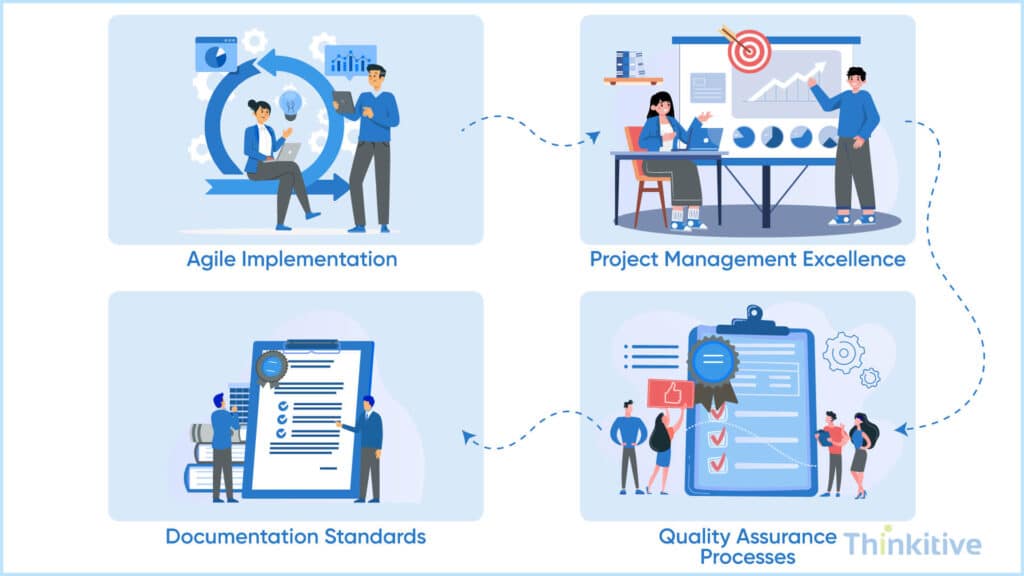
A right EHR and EMR development company will have a transparent development process with the following steps and components:
Step 1: Agile Implementation: They will use Scrum or Kanban methodology with regular sprint planning, reviews, and change management plans.
Step 2: Project Management Excellence: You will have a dedicated project manager overseeing proper communication protocols, mitigating risks, and ensuring that deadlines are met.
Step 3: Quality Assurance Processes: Through testing of features with complete frameworks, automation, and UAT support for developing a reliable system and resolving bugs.
Step 4: Documentation Standards: Comprehensive technical documentation, user manuals, and training resources support knowledge transfer and long-term system adoption.
How Do You Evaluate Integration Capabilities and Interoperability Experience?
Only developing an EHR or EMR is not enough; you need an EMR software development company that knows how to integrate and provide interoperability. So, here’s what you need to look for these capabilities:
| Criteria | What to Look For |
| System Integration | Proven EHR migrations, lab and pharmacy links, and billing synchronization experience. |
| Standards Implementation | Expertise in FHIR, HL7, CCD/CCDA, and modern API development practices. |
| Third-Party Connections | Ability to integrate devices, telehealth platforms, analytics tools, and mobile apps. |
| Data Migration | Large-scale transfers with cleansing, mapping, and zero-downtime migration history. |
If you follow this matrix, you can select the development partner that develops systems that understand interoperability.
What Should You Look for in an EMR Development Team?
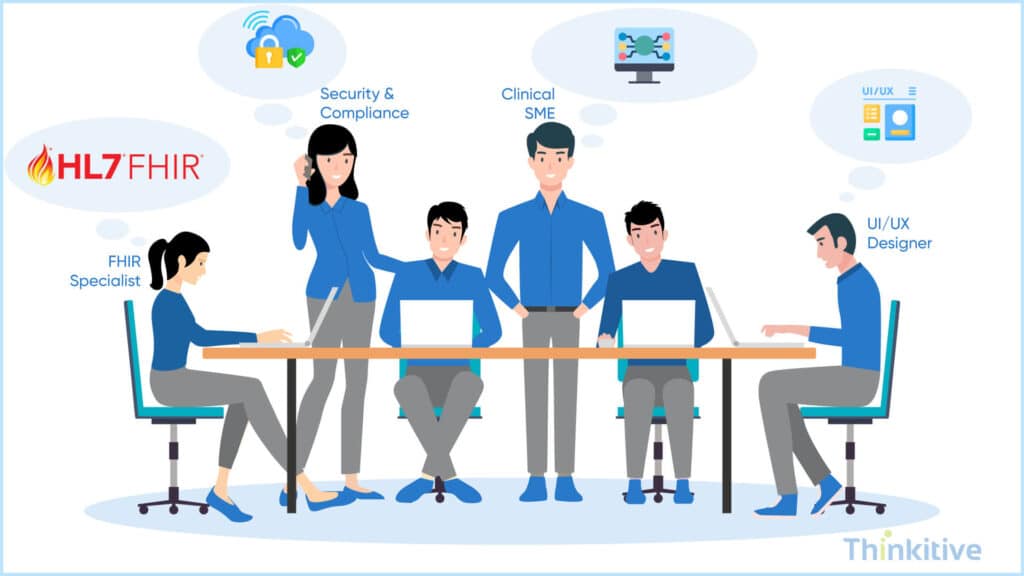
A skilled team of developers is needed for effective custom EMR software development. So, while choosing EMR developers, verify that the developer meets the requirements given below:
- Core Team Structure: The core team should contain at least 40% senior developers, along with healthcare consultants, dedicated PMs, and QA experts.
- Specialized Roles: As the EMR development requires FHIR/HL7 standards, there must be a specialist on them in the team. Also, they must have security engineers, UX designers with clinical experience, and informaticists.
- Team Scalability: The vendor must have the ability to quickly scale the team if needed, with staff trained to handle multiple roles, and have personnel who can quickly step in emergency situations, with knowledge retention protocols.
- Continuous Learning: Ongoing certifications, regular training, industry conference participation, and best practices adoption.
This mix ensures both technical excellence and healthcare domain expertise.
Get our EMR Development Team Evaluation Template
Download for FreeClient Reference & Success Stories
Before deciding to select the partner, ask for proof of their success with case studies. You can ask the following questions for the EMR development company;
- Can you share case studies from organizations similar in size and type to ours?
- What specific problems did those clients face before your solution?
- How did your team approach the project, and what technologies or methods did you use?
- What measurable outcomes were achieved? These metrics for this are delivery timelines, budget control, or satisfaction scores.
- Did the engagement lead to long-term collaboration, repeat business, or ongoing support contracts?
With these questions, you can understand whether or not the development company can successfully develop and implement the EMR software.
What Support and Maintenance Capabilities Should an EMR Development Company Provide?
When you have the right development partner, they ensure that the support extends beyond implementation. They provide 24/7 support, regular maintenance, training, and strong SLAs; they keep systems secure and ensure efficient software development.
| Category | What to Look For |
| Support Infrastructure | 24/7 help desk, tiered levels, response time guarantees, and clear escalation paths. |
| Maintenance Services | Regular updates, timely security patches, performance tuning, and feature enhancements. |
| Training Programs | User onboarding, train-the-trainer models, ongoing education, updated documentation. |
| SLA Commitments | 99.9%+ uptime, defined resolution times, penalty clauses, and measurable performance benchmarks. |
How Should You Evaluate Cost Structure and Value Proposition?
The final cost of custom EMR software development is not limited to just the license cost. You must evaluate the total cost of ownership (ToC), including hidden costs and ongoing maintenance costs. Keeping this in mind helps you ensure financial clarity and trust throughout implementation.
Here are the questions that you must ask the vendor before making the final decision:
- Can you provide a detailed and transparent cost breakdown?
- How are payment milestones aligned with project phases?
- What ROI or cost savings can be achieved?
- Which engagement models (fixed, T&M, hybrid) do you support?
- What is the projected total cost of ownership over five years?
- How do you manage change orders and budget adjustments?
If all these questions are answered positively, then you can go ahead with that EMR vendor selection for developing your custom EMR software.
How Can You Evaluate an EMR Development Company’s Innovation and Future-Readiness?
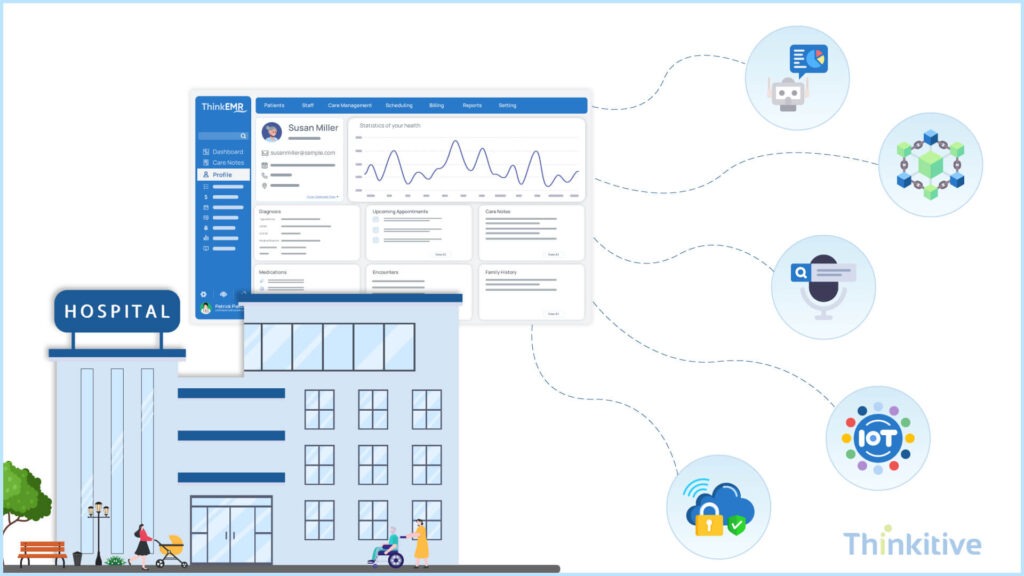
The final criterion for a good EMR development company is how far ahead they think. Whether they are preparing for the future or just going with the flow. That’s before selecting the development partner. Is the company investing in the future, and for that? Here are some proof points to help you evaluate:
Proof Points
R&D Investment
- Dedicated innovation labs
- Active patent portfolio
- Research partnerships with universities/industry
- Participation in pilot programs
Emerging Technology Adoption
- AI/ML-powered analytics and automation
- Blockchain exploration for secure data exchange
- IoT-enabled integrations with medical devices
- Voice-enabled interfaces for clinical workflows
Scalability Planning
- Cloud-native system architectures
- Microservices design for modular scaling
- Proven performance engineering practices
- Multi-tenant deployments for large enterprises
Industry Leadership
- Speaking at healthcare conferences
- Publishing whitepapers on innovation
- Serving on advisory boards
- Contributions to open-source health IT projects
AI Maturity
To make your custom EMR software futureproof and sustain a long-term partnership with your EMR software, you must consider its AI maturity. Here are some factors on which you should evaluate them:
- AI-ready architecture (clean data models, APIs, FHIR compatibility)
- Integration experience with clinical decision support, automation, or analytics
- A clear AI roadmap aligns with the growth aspects of your practice, which includes documentation automation, population health, and predictive insights
- Last but not least, governance policy for data privacy, explainability, and regulatory compliance
10-Point Evaluation Checklist
A checklist can make things much easier, right? Well, that’s exactly what you’ll find here. Here is a 10-point checklist that would help in choosing EMR developers and also in EMR vendor selection:
| Evaluation Criteria | What to Check | Why It Matters |
| Healthcare Domain Expertise | Experience building EMR/EHR systems for healthcare providers, clinics, or healthtech startups | Reduces learning curve and ensures industry-specific workflows are understood |
| HIPAA & Compliance Knowledge | Understanding of HIPAA, HL7, FHIR, ONC, CMS, and healthcare security standards | Ensures your EMR system remains compliant and audit-ready |
| Interoperability Capabilities | Ability to integrate with labs, pharmacies, billing systems, wearables, and third-party APIs | Seamless data exchange is critical for modern healthcare operations |
| Customization & Scalability | Flexibility to adapt workflows, specialties, and future expansion needs | Prevents limitations as your organization grows |
| UI/UX & Clinical Workflow Design | Experience designing intuitive provider and patient interfaces | Improves adoption rates and reduces clinician burnout |
| AI & Automation Readiness | Capability to implement AI-powered charting, CDS, analytics, or automation features | Future-proofs your EMR platform and improves operational efficiency |
| Security Infrastructure | Data encryption, access controls, audit logs, disaster recovery, and cloud security practices | Protects sensitive patient data and minimizes cybersecurity risks |
| Development Process & Transparency | Agile methodology, project milestones, communication process, and reporting structure | Keeps projects on schedule and avoids scope confusion |
| Support & Maintenance Services | Post-launch support, upgrades, bug fixes, monitoring, and SLA commitments | Ensures long-term stability and continuous improvement |
| Client Portfolio & Case Studies | Proven healthcare projects, testimonials, and measurable outcomes | Validates credibility and reduces vendor selection risk |
Conclusion
In a nutshell, without the right EMR system development company, your project can derail quickly. This not only impacts your investment but also patient care. That’s why you should choose a development partner that matches the given evaluation criteria to ensure your EMR software development is a success.
Additionally, evaluate what you need before hitting the market to search for the vendor. And you can save your efforts to search for a partner right here. We at Thinkitive have developed and implemented over a hundred EHRs and EMRs successfully and have been doing so for 10 years.
On that note, I hope I have answered some, if not all, of your questions, and nudged you in the right direction to help you ask the right questions. So, let this blog be your guide and rightfully build the software that you need.
Why Healthcare Practices Choose Thinkitive?
If you’ve run through the evaluation criteria above, you already know what a strong EMR development partner looks like. Here’s how Thinkitive measures up.
With over 11+ years of focused healthcare technology experience and 100+ successfully delivered EMR and EHR systems, Thinkitive brings proven domain depth across hospitals, specialty practices, and multi-site clinical environments. Our team of 400+ technology experts includes dedicated FHIR/HL7 specialists, clinical UX designers, security engineers, and healthcare informaticists, giving you the specialized bench strength that complex EMR projects demand.
On the compliance front, every system we develop is built with HIPAA-aligned architecture, SOC 2 practices, and end-to-end data encryption from day one. We follow Agile development methodology with dedicated project managers, sprint-based delivery, and complete documentation standards, so you have visibility and control at every stage.
When it comes to integration, our team has hands-on experience with HL7, FHIR APIs, CCD/CCDA, lab systems, pharmacy platforms, and third-party telehealth and billing integrations, ensuring your EMR connects seamlessly with the broader care ecosystem. And with AI-ready architecture embedded into our development process, your system is built to support clinical decision support, predictive analytics, and documentation automation as your practice grows.
Our track record speaks for itself: 150+ healthcare customers, a 98% client retention rate, and 50% average cost savings compared to traditional development approaches. These aren’t just numbers; in fact, they reflect long-term partnerships built on transparency, performance, and results.
Ready to see how Thinkitive fits your EMR vision? Book a free 30-minute consultation with one of the finest EMR software development companies and let’s evaluate your requirements together.
Frequently Asked Questions
Choosing the right EMR development company starts with aligning technical capability with clinical and business goals. Look for a partner that understands healthcare workflows, regulatory requirements, and long-term scalability—not just software development. The ideal EMR development company will demonstrate experience in custom EMR builds, interoperability standards, security-by-design architecture, and post-launch support. Most importantly, they should act as a strategic partner, not just a vendor delivering features.
Key factors include healthcare domain expertise, compliance readiness, interoperability experience, customization capabilities, scalability, data security practices, and long-term support. You should also evaluate their development methodology, UX design approach, and experience working with providers similar to your organization. A reliable EMR software development company will offer transparency in architecture decisions, timelines, and future upgrade paths.
Strong EMR system development expertise ensures the platform is built with modular architecture, optimized databases, and scalable infrastructure from day one. This directly affects system performance as patient volumes grow, new modules are added, or regulatory requirements change. Companies with deep EMR expertise design systems that avoid technical debt, ensuring faster enhancements, smoother integrations, and lower long-term maintenance costs.
An EMR development company should demonstrate compliance with HIPAA, HL7, FHIR, and applicable data privacy regulations such as GDPR (if relevant). Familiarity with ONC certification requirements, SOC 2 practices, and secure cloud standards (like ISO 27001) is also critical. These certifications indicate the company understands healthcare-grade security, audit readiness, and regulatory accountability.
Interoperability experience is essential. A strong EMR development partner should be proficient in HL7, FHIR APIs, CCD/C-CDA, and third-party integrations with labs, pharmacies, billing systems, HIEs, and payer platforms. Without interoperability expertise, EMR systems quickly become data silos—limiting care coordination, reporting, and value-based care initiatives.
Yes—and this is becoming a critical differentiator. The best EMR development companies design systems with AI readiness in mind, including clean data models, structured clinical data, and scalable analytics pipelines. This enables future use cases such as clinical decision support, predictive analytics, population health insights, automation, and AI-assisted documentation without requiring major system rework later.


