Unlocking Insights: Custom EHRs Enable Reporting

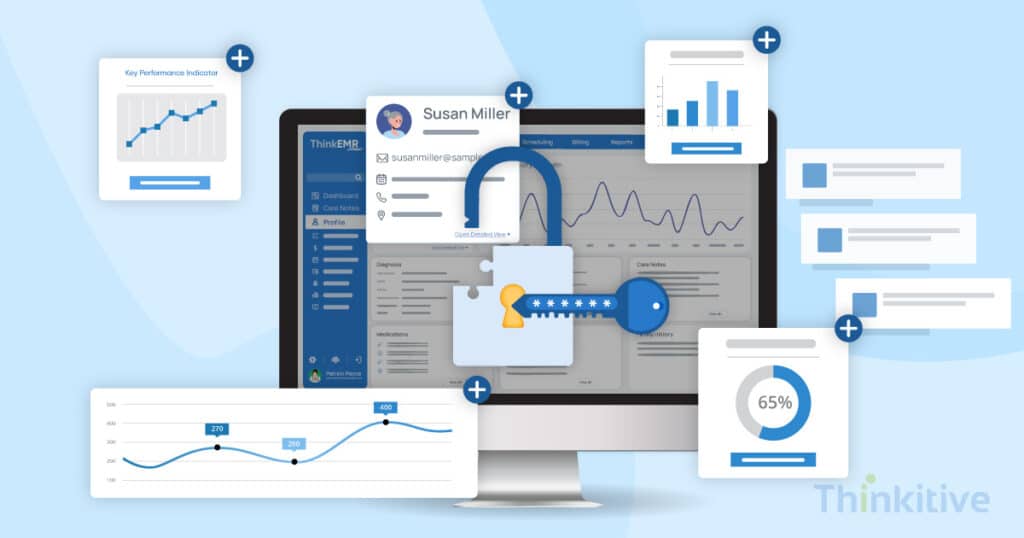
The widespread adoption of EHR systems has turned healthcare practices more data-driven. This has been one of the major improvements in the healthcare industry, as care became evidence-based, and the quality of care has improved.
Even though EHRs have made healthcare delivery much better, there are certain problems that they have brought with them. You see, in this highly digitalized world where data can tell you about the past, present, and future, in most of the practices, this data simply sits there in their EHR system.
Furthermore, when they want to use that data, the manual process adds to the documentation burden and takes up significant time for providers. The problem also lies in EHR systems, where, according to the ISPOR Good Practice Report, limitations of EHR data validity and relevance are aspects that affect the reporting quality of this data.
Data-driven insights in EHR can even help you in changing the nature of your care delivery from reactive to proactive. However, research showed that poor usability and workflow alignment in EHRs disrupt data retrieval and increase cognitive load on providers and administrators alike, hampering timely reporting.
In this situation, what if your EHR software provided you with data that can not only help you improve your care quality but also give you hidden insights for better operations?
Well, custom EHR reporting analytics features exactly what many healthcare providers are demanding during custom EHR. And for good reasons, as it unlocks visibility across clinical and operational data, giving you an edge over many aspects of your practice.
On that note, let’s see how EHR software development can help you in building a solid foundation for real-time custom EHR reporting insights and giving you actionable clinical insights for better care delivery.
So, without further ado, let’s get started!
Assess Your EHR System for AI Readiness
Get Free ConsultationWhat Are ‘Actionable Insights’ in a Custom EHR?
Everything that you store in your EHR system is data, and actionable insights are also data. Now, typically these datasets are presented on charts, giving you a comprehensive view of patient health.
Now, actionable insights in EHR data reporting are where the software extracts, organizes, and analyzes the data. On the basis of this data, the EHR system creates reports that contain summaries and other data pointers for clinical, operational, and financial purposes. These reports will give you a clear idea of what your next plan of action will be. And this can be called actionable insights.
How Does Custom EHR Reporting Analytics Work?
- Capture Healthcare Data: Collect clinical, operational, and financial data from your custom EHR system in real time.
- Organize & Analyze the Data: Structure, normalize, and analyze the collected data to identify meaningful patterns and trends.
- Generate Actionable Reports: Convert the analyzed data into reports and dashboards that highlight care gaps, operational bottlenecks, financial performance, and patient outcomes.
- Identify Clinical & Operational Opportunities: Use the reports to uncover actionable clinical insights, monitor value-based care reporting metrics, and identify opportunities for workflow improvements.
- Take Data-Driven Decisions: Act on these real-time healthcare reporting insights to improve patient care, streamline operations, and support better business decisions.
Also, analytics and predictive modeling are some of the core concepts on which you can easily generate insightful reports. Read this blog, Advanced Analytics, Reporting & Predictive Modeling for Custom EHR Systems, to understand these core concepts of reporting better.
Improving Patient Care Without Adding Paperwork
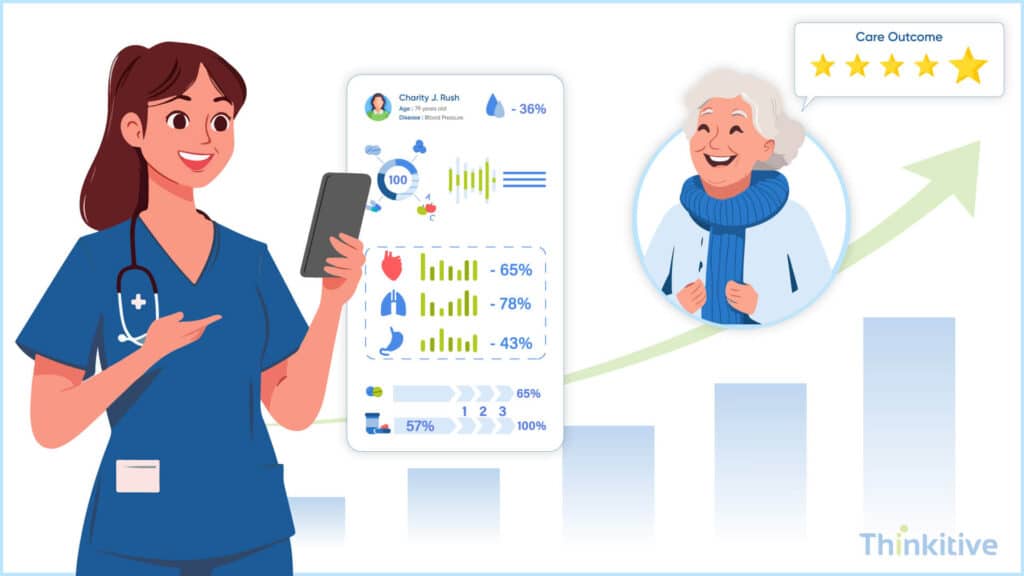
Data is the key to almost everything in this modern healthcare landscape. And as a healthcare provider, if there is something that you can do to improve the quality of care, it is to get custom EHR reporting analytics. With this, you can easily get actionable clinical insights about patients.
This will not only give you a comprehensive overview of the patient’s healthcare journey but also give you the insight that might nudge you in the right direction of patient care. Furthermore, if you’ve integrated other AI functionalities into your system, then the EHR system can also give you future treatment or diagnosis for that patient or a specific patient group.
On top of that, with custom EHR reporting insights functionality, you can feed some of the value-based care reporting metrics. Now, the system will run the data against the value-based metrics and simplify tracking for you. And on the basis of these actionable insights from custom EHR data, you can provide the best possible care to the patients that will add value, or in other words, help them make their health better.
And since every aspect of this is happening inside the system, you don’t have to manually connect data and analyze everything before making a decision. With this real-time healthcare reporting feature, you can not only support better outcomes and reimbursements, but you will also make better decisions faster.
Interested in implementing AI in your EHR system?
Get Free ConsultationMaking Daily Operations Easier for Staff
Do you know what the struggle is for most of the healthcare providers working in the operations department?
For those who are still using a generic EHR system, they are constantly on the hunt for data. You see, they have to analyze and go through almost every single aspect of patient care delivery before filing claims, etc.
With real-time healthcare reporting tools, your staff members or administrators, instead of going to every single file, can just find all the information they need on a single screen. Furthermore, if the system is powered by AI, then there is a high chance that you’ll get it sorted.
In this way, with custom EHR reporting analytics, you can make the daily lives of your staff members working in operations much easier. Here are some examples of actionable insights from custom EHR data that can be beneficial for your staff members:
- Staff Workload Visibility: As discussed earlier, with reporting and analytics features, you can significantly reduce the cognitive workload of your staff members and instill accuracy and transparency in the processes.
- Appointment Bottlenecks: Appointment bottlenecks are something that every practice has to face. These bottlenecks can be turned into smoother and streamlined workflows with custom EHR reporting insights analytics. For instance, with everything being present in your system and that being synchronized with the calendar, you can know the time slots better and bring in a smoother appointment booking and other processes. And to give better control of appointments to patients, you can include a patient portal showing available slots and allowing them to book online via the portal. This brings in transparency and convenience on their end.
- Low Patient Wait Times: With patient portals, another problem that you can solve is patient wait times. It was reported by patients on multiple occasions that they have to wait longer periods for the consultation or online consultation. This wastes their time and even adds to the growing burden on practice management staff. But with custom EHR reporting analytics, you can cut that short to a minimum as you bring transparency with patient portal and calendar synchronization.
EHR data reporting is that aspect of practice that improves both staff efficiency and patient engagement. Since most of the work is done with just a click or command, providers have more time on their hands. This time can be spent with patients, giving them a pleasant experience and improving both efficiency and engagement.
Why Standard EHR Reports Often Fail
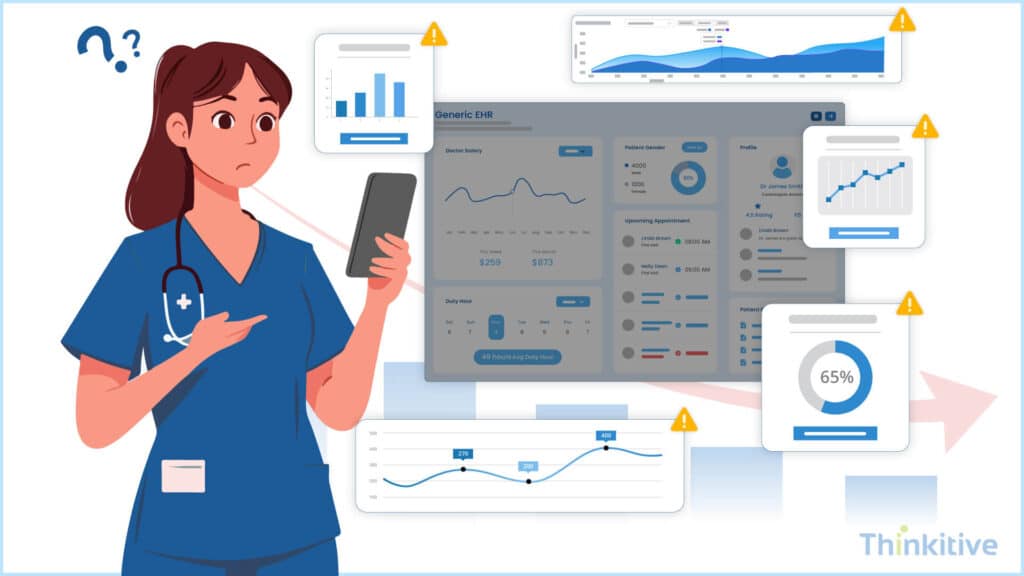
One of the core reasons why standard EHR often fails is because of the approach through which these software systems are built. Most of the time, these EHR software developers adopt a one-size-fits-all approach to build these systems.
Now, the problem with this approach is that these systems work in a generic setting; however, the moment a specialty requirement kicks in, they simply won’t be capable of measuring or capturing that particular data. For instance, suppose you are an orthopedic specialist, then during consultations, you often have to rely on data such as bone density, fracture length, etc. Here, with an off-the-shelf EHR system, you simply won’t be able to capture that particular data. And let’s not talk about the fact that there will be tons of data that will be needed for providing better care.
However, the situation completely changes with a custom EHR reporting analytics module. You see, not only will you be able to capture those data points, but also these EHR data reporting and analytics modules remove the clutter of data and allow you to focus on the relevant metrics only. This way, you are not only able to provide better care, but also accuracy would be improved.
Furthermore, these standard EHR systems come with limitations regarding space, storage, and, if any analytics modules are present, regarding their usage, etc. And it is common knowledge that with time, practice is bound to increase. In such cases, even with a custom EHR reporting analytics, you must plan for reporting flexibility. This will not only make your software future-ready, but many aspects of the development will also be covered.
Integrate Clinical Decision Support into Your EHR System
Get Free ConsultationIntegration with Power BI & Tableau for Advanced Reporting
Healthcare reporting tools are more than just static reports and spreadsheets. Now, when you integrate custom EHR reporting insights with platforms like Microsoft Power BI and Tableau, providers can easily convert complex clinical and operational data into real-time, actionable insights that would support faster and enable more informed decision-making.
Here is a sneak-peek into the EHR-to-BI workflow diagram:

Custom EHR reporting integrations help healthcare practices monitor performance across departments, improving their visibility into patient care, revenue cycles and operational efficiency. Refer to this table below to have a better understanding about this:
| Reporting Area | Dashboard Example | Business Impact |
| Revenue Cycle | Claims denial and reimbursement tracking | Improves financial performance |
| Population Health | Chronic disease trend analytics | Supports preventive care initiatives |
| Provider Performance | Appointment utilization dashboards | Optimizes scheduling efficiency |
| Quality Reporting | MIPS/HEDIS compliance reporting | Simplifies regulatory reporting |
| Operational Analytics | Patient wait-time and workflow monitoring | Enhances operational productivity |
Using healthcare reporting tools like Microsoft Power BI and Tableau, your EHR platform can support real-time KPI tracking, predictive analytics and executive-level dashboards that can be specifically tailored to your practice’s unique workflows and reporting requirements.
Moreover, unlike the typical restrictions that limit the reporting flexibility, custom EHR solutions provide a deeper control over EHR data reporting. This factor alone can help providers make data-driven decisions with greater confidence.
Key Takeaways
- Custom EHR reporting analytics transforms raw healthcare data into actionable clinical insights.
- Real-time healthcare reporting enables faster clinical and operational decision-making.
- Custom reporting supports value-based care by tracking specialty-specific performance metrics.
- Integrated analytics dashboards improve visibility across patient care, financial performance, and operations.
- Flexible reporting architecture ensures long-term scalability and better healthcare outcomes.
Conclusion: From Data to Decision
In modern-day healthcare, data is everything. It can define the scope of your treatment, bring in accuracy, and with value-based care reporting metrics, you can literally change your practice to value-based care delivery.
Having said that, with data being at the center, you need a strong reporting mechanism or system within your system. And it goes without saying, but the better the reports, the better your clinical efficiency and operational performance.
You see, the trick is not that you need more data; the trick is to get meaningful insights from the data that you already have.
On that note, let this blog be your guide and get your custom EHR software with reporting and analytics feature into your EHR system.

Frequently Asked Questions
Custom EHR reporting analytics captures clinical and operational data, organizes it into structured datasets, analyzes trends, and presents actionable insights through real-time dashboards and reports. This enables healthcare providers to make faster, evidence-based clinical and business decisions.
Actionable insights in custom EHR reporting analytics are meaningful patterns derived from clinical, operational, and financial data that directly inform decisions. Unlike raw data, these insights highlight care gaps, performance trends, risk indicators, and optimization opportunities—enabling clinicians and administrators to act immediately rather than interpret static reports.
Custom EHR reporting is tailored to a practice’s workflows, specialties, and goals, whereas standard EHR reports are rigid and generic. Custom reports allow flexible filters, real-time dashboards, and role-based views, enabling deeper analysis and more relevant insights compared to pre-built, one-size-fits-all EHR reporting templates.
Real-time healthcare reporting provides clinicians with up-to-date patient data, alerts, and trends during or immediately after encounters. This enables faster interventions, better risk stratification, and informed clinical decisions—reducing delays caused by retrospective reports and supporting timely, evidence-based care delivery.
Custom EHR data can generate insights such as high-risk patient identification, care gap detection, treatment adherence trends, readmission predictors, and population health patterns. These actionable clinical insights help providers proactively manage care, improve outcomes, and align interventions with patient-specific and population-level needs.
Custom EHR reporting enables precise tracking of value-based care reporting metrics such as quality measures, outcomes, utilization, and cost efficiency. By aligning reports with payer contracts and regulatory frameworks, practices can monitor performance continuously, identify improvement areas, and demonstrate measurable value across care episodes.
Generic EHR reports lack context, customization, and real-time capabilities. They often aggregate data broadly without reflecting specialty workflows, organizational KPIs, or evolving care models. As a result, they produce static outputs that require manual interpretation, limiting their ability to deliver true data-driven insights.
Real-time clinical insights from EHR reports help identify workflow bottlenecks, staffing inefficiencies, documentation delays, and resource utilization issues as they occur. This allows administrators to make timely operational adjustments, reduce manual reporting efforts, and improve throughput without relying on delayed or outdated data.
Reporting architecture determines how efficiently data is captured, processed, and analyzed within an EHR system. Designing reporting capabilities early in EHR software development ensures scalability, real-time analytics, interoperability, and accurate insights—preventing future limitations caused by rigid data models or fragmented reporting layers.


