Custom EHR Software Development Services: Outsourcing vs In-House Development

Do you know the total number of hospitals in the United States?
According to the American Hospital Association, the total number of hospitals in all of the United States is 6093, and this number may or may not surprise you.
Moreover, healthcare systems are becoming the new epicenter of care for every healthcare institution for data, and the number of hospitals that actually have an internal IT team is likely very low. To give you an estimated number, only 1100-1500 hospitals have in-house IT teams of some sort. And this number must be surprising for you, doesn’t it?
Having said that, as hospitals are turning their heads towards custom EHR software development, the choice of outsourcing vs in-house development for EHR is dilemmatic. And the choice you make here can determine the future of your healthcare practice to a large extent, especially in the long run.
Now, both outsourcing vs in-house custom EHR development have major implications on the development expenditure, quality, timeline of development, and long-term scalability options. With everything being so impactful on both clinical and administrative functioning of practices, the choice can be daunting.
Well, since you’ve come here by the mercy of the internet, I assume that you’ve made up your mind for custom EHR software development and are confused between outsourcing vs in-house custom EHR development, right?
On that note, let’s try to help you in making a clear choice between outsourcing and in-house EHR software development. Also, if you’re looking for a complete EHR software development guide, then click on the previous link.
So, without further ado, let’s get started!
What Should You Choose, When – Outsourcing or In-House
Download NowThe Case for In-House Custom EHR Development
To make the case for in-house custom EHR development, you need to weigh the pros and cons of in-house EHR development. But before that, let’s try to understand what exactly in-house EHR development is.
In-house EHR development is where you, as a healthcare practice, have an internal IT team that develops the software system for your practice, and everything from its maintenance and support is provided by the internal team.
Advantages of In-House EHR Development Approach:
- Complete Control & Alignment: With in-house EHR development, you get complete control of the software system and the data. Furthermore, the major advantage you get with an in-house development team is that you can easily align your software workflows with those of your practice and have the independence of designing the dashboards, screens, etc., as per your needs and requirements.
- Deep Institutional Knowledge: Another advantage that you have with in-house development is that your internal teams know the existing workflows and procedures of your practice inside out. This helps in better architecture and software development as you can easily cater to your specialty needs and overcome historical challenges easily.
- Long-Term Knowledge Retention: As time goes by, your software system evolves, and some of these include IPs, technical decisions, and architectural logic. This stays inside your organization and gives you a competitive edge for future growth and scalability.
- Data Security Oversight: The most significant advantage is control of data and ensuring its safety. In simple terms, you get full freedom in PHI handling, adhering to the local technical landscape, regulations, and network rules.
Disadvantages of the In-House Development Approach
- Resource Limitations & Skill Gaps: When hiring an internal IT team, your team might lack experience with the healthcare technological landscape. This might pose challenges in interoperability, complying with HIPAA regulations, training them can be time-consuming, and third-party integration ventures can be difficult.
- Hire Upfront Costs: Hiring an internal IT team can, at times, be more costly than outsourcing the development team. To give you an idea about the cost, you would have to incur costs for hiring development teams, training them, buying development tools, building technical infrastructure, and ongoing staffing expenses that come with all this.
- Slower Time-to-Market: With a dedicated team working on your EHR software development project, the development time for your EHR system can be longer. Hospitals have faced challenges like internal bandwidth constraints and delays in delivery that can vary from months to years.
| Aspect | Advantages (Pros) | Disadvantages (Cons) |
| Control & Ownership | Total control over product roadmap, features, design, and long-term IP ownership. | Requires ongoing internal resources, leadership, and technical decision-making. |
| Workflow Alignment | Direct access to clinicians enables precise alignment with real-world workflows and specialty needs. | Slower to iterate if internal teams lack healthcare UX/UI and clinical workflow expertise. |
| Security & Compliance | Full oversight of HIPAA controls, data storage rules, audit trails, and internal governance. | Risk of compliance gaps without dedicated legal, security, and HIT staff. |
| Integration Strategy | Tailored interoperability planning for labs, EHRs, billing, telehealth, and imaging systems. | Complex, time-consuming integrations without prior experience with HL7/FHIR standards. |
| Long-Term Cost Efficiency | Can be more cost-effective over many years, avoiding recurring vendor licensing fees. | High upfront investments in hiring, training, infrastructure, and quality assurance. |
The Case for Outsourcing Custom EHR Development
Moving on to the next option of outsourcing custom EHR development, here are some pros and cons of outsourcing custom EHR development.
Advantages of Outsourcing EHR Software Development
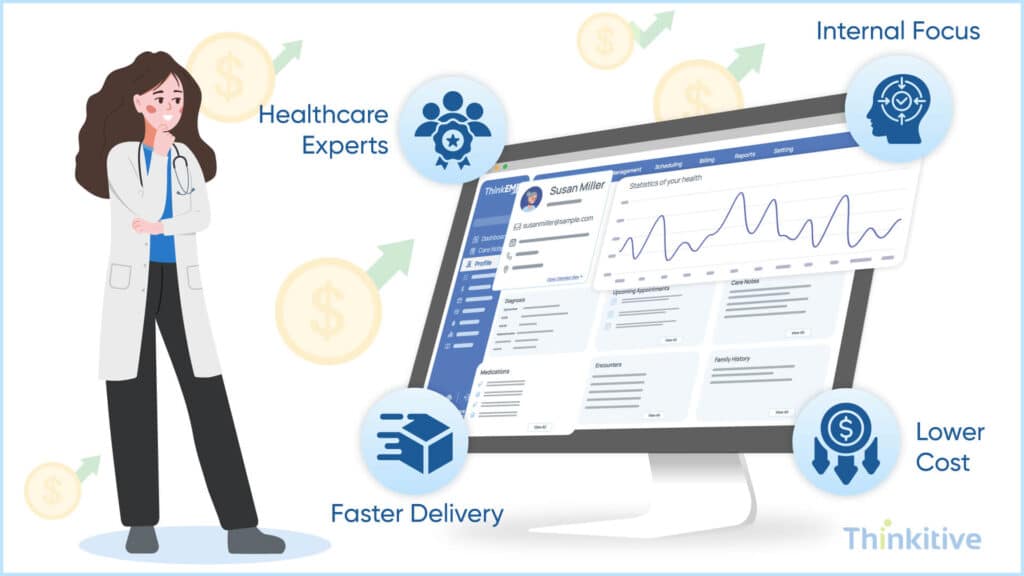
- Healthcare-Specific Expertise: When you outsource your custom EHR software development, you get immediate access to talented resources that are skilled in the healthcare technology space. Meaning, your development team will be skilled in HL7 FHIR standards, HIPAA compliance rules, and integrations with telehealth platforms, IoMT, custom workflows, etc.
- Cost Efficiency & Predictable Budgeting: Compared to an in-house EHR development team, outsourcing gives you a cost advantage with lower upfront investment. Furthermore, with project-based or milestone-based billing, the nature of expenditure is predictable, which makes it easier for you to budget.
- Faster Time-to-Market: Most of the vendors you decide to work with for your development have optimized delivery methodologies that make development faster. Some of the vendors even use their pre-built accelerators that enhance the development speed significantly. This allows you to release the software sooner.
- Allows Internal Teams to Focus on Core Tasks: With an outsourced development team, your internal teams can focus on their day-to-day tasks easily, which can ensure your work is uninterrupted.
Disadvantages of Outsourcing EHR Software Development
- Reduced Direct Control: Since the development is outsourced, you do not have direct control over their development activities. While this doesn’t usually hamper your development, for smoother development processes, strong communication and governance are required.
- Potential Communication Gaps: The Quality that is delivered by outsourced EHR software development teams can vary significantly due to communication gaps. This is a recurring phenomenon with international vendors, but the process can be smoothed with communication enhancement.
- Security & Compliance Vetting Required: Understand that the security aspects of the software is crucially necessary. Ensure that your vendor meets all the necessary requirements put forth by HIPAA, SOC 2, and ONC.
| Aspect | Advantages (Pros) | Disadvantages (Cons) |
| Expertise & Experience | Access to teams with proven healthcare domain knowledge, HIT standards (HL7, FHIR), and regulatory compliance (HIPAA, ONC, CMS). | Quality varies across vendors; due diligence is required to avoid inexperienced partners. |
| Development Speed | Faster time to market due to established processes, reusable code libraries, and dedicated cross-functional teams. | Communication delays or project misalignment if requirements are not documented clearly. |
| Cost Efficiency | Lower upfront investment and predictable costing models (fixed, milestone-based, or subscription). | Long-term dependency on external vendors for updates, fixes, and enhancements. |
| Access to Latest Technology | Vendors bring modern tech stacks, cloud hosting setups, QA frameworks, and security modules out of the box. | Limited control over technology choices and architectural decisions. |
| Scalability & Support | Ability to scale resources quickly, add new features, or integrate third-party systems without hiring internally. | Potential vendor lock-in and contractual constraints regarding source code, IP, and future ownership. |
Outsourcing vs In-House: How to Choose? A Strategic Decision Checklist
If you’re still reading this, then you’ve come to the most important part of this article. While the choices between outsourcing and hiring an in-house team are daunting and overwhelming, this section will help you make a strategic decision that will benefit your practice.
Here are of the key decision-making factors that you must undertake:
- Urgency of Delivery: How soon you want your EHR software to be delivered is something that should be at the top of your checklist. Choosing outsourcing for quick delivery is suggested, and in-house development if you have a flexible EHR development timeline.
- Budget Structure: The budget is the next criterion that should be on the list. While outsourcing EHR development can be economical, refer to the advantage section above for better clarity.
- Internal Technical Expertise: Consider the technical expertise you get with both approaches, such as FHIR HL7 standard awareness, HIPAA compliance, engineering, cybersecurity, DevOps engineering, and analytics. These will not only help you in building a strong core but also ensure that your EHR development is moving ahead in a compliant manner.
- Software Complexity & Integration Requirements: The complexity of your system and integration requirements should be the next thing on your checklist. This is important because integrations with telehealth platforms, billing systems, labs, pharmacies, and IoMT devices can be quite complex. Check the expertise of your vendor or team and then make a wise choice.
- Long-Term Maintenance Strategy: Considering the long-term maintenance, internal ownership will give you full control over the maintenance activities. However, with outsourcing, you get a vendor-managed lifecycle, which can pose problems if a proper agreement is not reached.
- Compliance Readiness: Compare whether your internal team or outsourcing can meet the regulatory obligations and requirements better. This is important because it is not only legally necessary but also allows you to navigate the legal landscape smoothly.
Interested in implementing AI in your EHR system?
Get Free ConsultationHybrid Approach – Leveraging the Best of Both Worlds
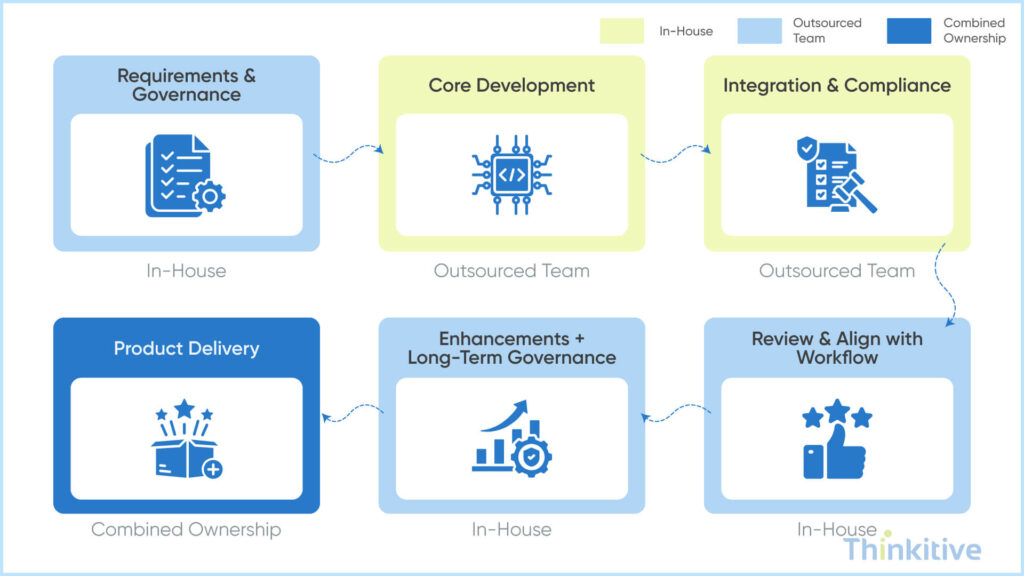
The choices between outsourcing and hiring can be daunting and at times put you in a dilemma of what to choose. You see, having an internal IT team has a significant advantage and gives you a competitive edge as well; however, you cannot bring the flexibility and expertise of an outsourcing partner, right?
So, why not take the good parts of both and curate a development plan that gives you an advantage? For instance, you can outsource the development part and have an in-house team to monitor the development and make necessary enhancements with long-term governance.
It works great for mid-size to enterprise health systems that want speed and control over their systems. Though the example given above is just a reference, you can curate a way that suits your development needs better.
Know the Difference for Making Decision
| Factor | In-House Development | Outsourced Development |
| Control | Very high control over roadmap, features, and priorities. | Moderate control, influenced by vendor workflows and project scope. |
| Speed | Slower due to hiring, onboarding, and internal resource limits. | Faster development with experienced teams ready to start immediately. |
| Cost | Higher upfront investment in talent, infrastructure, and maintenance. | Lower and more predictable costs through contracts and milestone-based billing. |
| Expertise Required | Must hire, train, and retain technical and healthcare compliance talent. | Expertise available instantly from specialized EHR development companies. |
| Scalability | Limited by internal team size and budget. | Easily scalable by adding vendor resources as needs grow. |
| Compliance Readiness | Full internal responsibility for HIPAA, ONC, CMS, and security controls. | Vendor-supported compliance frameworks, audits, and best practices. |
| Maintenance | Entirely handled by internal IT and development teams. | Shared or fully managed by the outsourcing partner. |
End Thoughts: The Best Custom EHR Development Paths Depend on Your Strategy
There is no concrete criterion that can tell you that you should choose custom EHR software development outsourcing or in-house development. While one gives you complete control over your development and other things, the other gives you an advantage in development expertise and cost. Read our ultimate guide for custom EHR software development 2026, to know more.
Now, one of the best strategies that has been used by many healthcare providers who developed a custom EHR software has been a mix of both. And which part of the development to be given to whom can be decided as per your needs. However, one of the most important things that you need to keep in mind here is the technical strength and capability of your development team.
On that note, let this blog be your guide or a checklist, in fact, to make a better decision between outsourcing vs in-house development of EHR. And if you’re confused about where to get started, then click here to book your first free consultation.
Frequently Asked Questions
In most cases, yes—outsourcing EHR software development is significantly more cost-effective than hiring and maintaining a full internal engineering team.
Building in-house requires major upfront investment in salaries, benefits, DevOps, security infrastructure, and continuous compliance training.
With custom EHR software development outsourcing, you pay only for the required expertise and development time, often reducing costs by 40–60%.
However, the in-house model may be justified if you have large-scale operations, in-house engineering maturity, or highly proprietary workflows that require constant internal iteration.
Outsourcing vs in-house development for EHR has the biggest impact on delivery speed.
An outsourced team already has healthcare engineers, UI/UX designers, QA specialists, security experts, and compliance knowledge ready to go—meaning faster kickoff and a shorter development lifecycle.
In contrast, in-house custom EHR development often slows down due to hiring cycles, skill gaps, and the need to build domain knowledge from scratch.
Outsourcing typically accelerates delivery by 30–50% for most healthcare organizations.
Both approaches carry risks, but the nature of those risks differs:
- With EHR outsourcing, the primary risks include vendor reliability, third-party access to PHI, and ensuring strict adherence to HIPAA, FHIR, HL7, SOC 2, and regional regulations.
- With in-house EHR development, the risks stem from limited compliance expertise, improper infrastructure configuration, and lack of continuous security monitoring.
A reputable outsourced EHR company mitigates risks with secure development frameworks, audit trails, BAAs, encryption standards, and healthcare-focused DevSecOps.
Ultimately, the risk level depends more on vendor maturity than the outsourcing model itself.
Yes, but it is resource-intensive and difficult, especially for small or mid-sized practices.
Meeting regulatory requirements demands:
- Specialized EHR architects
- Compliance officers
- Data security engineers
- HL7/FHIR integration specialists
- Continuous monitoring and audits
This is why many organizations choose outsourcing vs in-house custom EHR development, as external healthcare engineering firms already have frameworks and pre-built compliance modules to accelerate certification and reduce errors.
You don’t lose control over product direction or ownership, but you do relinquish control over:
- Day-to-day technical decision-making
- Development pace and staffing
- Internal visibility into engineering operations
A well-structured outsourcing partnership still ensures complete IP ownership, source code access, and transparent sprint reporting.
In contrast, in-house development vs outsourcing gives you granular operational control but requires significantly more management bandwidth.
Common challenges with outsourced EHR development include:
- Time-zone differences
- Slower feedback loops
- Misalignment on requirements
- Knowledge transfer gaps
These challenges are mitigated by requesting:
- A dedicated project manager
- Agile sprint planning
- Weekly demos
- Shared documentation
- Clear SLAs for communication
With proper governance, communication friction becomes minimal.
Outsourcing shines for continuous upgrades, security patches, interoperability updates, and evolving regulatory requirements.
A specialized vendor maintains:
- FHIR version upgrades
- API updates
- OS/browser compatibility
- New compliance mandates
With in-house EHR development, long-term support depends entirely on retaining skilled talent—which is challenging in the healthcare IT market.
Thus, for most organizations, outsourced long-term maintenance is more predictable and scalable.
Yes. Skilled outsourced EHR teams are experienced in integrating:
- LIS, RIS, PMS systems
- Billing & RCM platforms
- Telehealth tools
- Medical devices
- Patient engagement systems
- Pharmacy and e-prescription modules
- HL7 and FHIR APIs
Because they work across multiple healthcare environments, they often achieve integration faster and more reliably than newly formed in-house teams.
A hybrid model is ideal when:
- You want internal control over core IP but need external specialists for complex modules.
- You have an internal product owner but lack full engineering capacity.
- You need to scale development quickly without long-term hiring commitments.
- You want outsourced expertise for integrations or compliance-heavy components.
This blended model gives you the best of outsourcing vs in-house development—flexibility, cost savings, and strategic control.
Leaders should assess:
- Budget and long-term operational costs
- Internal technical capability and hiring feasibility
- Urgency of product delivery
- Compliance readiness
- Integration complexity
- Scalability requirements
- Ownership and control expectations
- Risk tolerance and vendor reliability
Comparing the pros and cons of in-house EHR development vs pros and cons of outsourcing custom EHR development helps clarify which model aligns with your strategic goals.


