Custom EMR Solutions for Specialized Practices

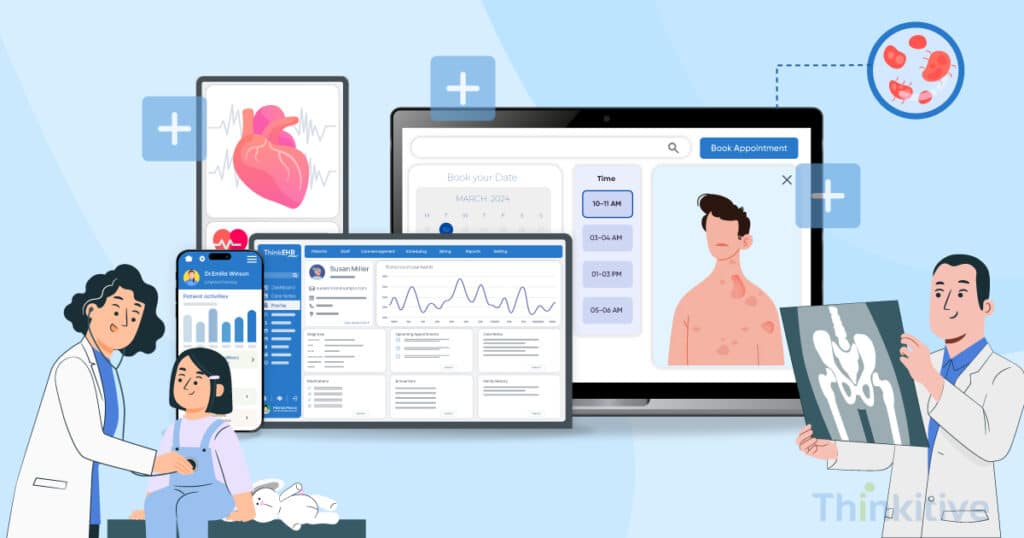
One of the most pressing concerns in healthcare, especially with specialty care practices, has been the increasing time physicians spend on EMR. A study across 100 million ambulatory visits suggests that, on average, 16 minutes and 14 seconds are spent on EMRs per encounter.
To further break down this time, physicians spend 33% of their time on chart review, 24% on documentation, and almost 17% on ordering. That’s almost the entire encounter time or face-to-face consultation time, right?
Well, understanding the intricacies of healthcare and specialty systems, the daily active usage of these EMR systems also varies. For instance, a study by the JAMA Network found that 46 minutes per day are spent in surgical specialties, 86 minutes for medical specialties, and 115 minutes for primary care.
This is because specialized medical practices have unique workflows, complex data types, and unique specialty-driven requirements. And this is one of the major reasons why many specialized practices are moving away from off-the-shelf EMRs in favor of Customizable EMR solutions designed around their clinical needs.
But why choose a custom EMR solution for a specialty practice?
Well, when healthcare practices choose a custom EMR solution for their specialized practices, they can tailor their EMR functionalities, get better efficiency in documentation, and improve the quality of care they provide. This is because specialty-driven EMR enhances accuracy, reduces administrative burden, and directly improves patient outcomes.
But here you might ask, how can a custom EMR solution for specialized practices help in all this?
Well, let’s explore that in the blog below. So without further ado, let’s get started!
Specialized Features You Need in Custom EMR for Better Care
Download Free ChecklistWhat Custom EMR Solutions Do Specialized Practices Need?
Every specialty has a unique way of care delivery, documentation requirements, treatment protocols, and regulatory obligations, and these processes result in unnecessary clicks, inefficient documentation, and other bottlenecks. That is why EMR customization for medical practices is beneficial, allowing them to tailor their systems to their clinical, administrative, and compliance needs.
Some of the practical examples of specialty-specific EMR are:
- Cardiology practices benefit from EMRs with ECG integrations, structured cardiac templates, and long-term heart monitoring capabilities.
- Oncology practices require chemotherapy management, cancer staging, and treatment timeline tracking to support complex care journeys.
- Dermatology clinics need lesion mapping, image annotation, and visual comparison tools to improve diagnostic accuracy.
- Behavioral health providers benefit from narrative documentation, privacy controls, and behavioral assessment templates.
- Orthopedic practices require imaging integrations, rehabilitation tracking, and procedure-specific documentation.
Every specialty follows a different clinical workflow, documentation process, and patient care model. Rather than forcing providers to adapt to a generic EMR, specialty-specific EMR solutions can be configured to support these unique clinical requirements. From specialty templates and coding support to AI-powered documentation and diagnostic integrations, these solutions help practices work more efficiently without changing how they deliver care.
If you’re looking for a detailed guide on designing specialty-specific workflows, explore our guide on specialty EMR workflows, where we cover workflow mapping, automation strategies, and implementation best practices in depth.
You can tailor your EMR solution to match the unique requirements of your specialty, but it would be pointless if the users were not able to navigate the software easily. That is why the user-friendliness of your EMR software interface must be considered, and your users must be provided with effective and hands-on training.
Note: Depending on the workflows and practices, some of the features that you require often change. Addressing that factor is important, and you need to cater to that as well. That is why we suggest you read this EMR feature guide to help you choose the right capabilities for your specialty practice.
On top of that, with an EMR solution for specialized medical practices, you can embed specialty coding into your practice system, such as ICD-10 for diagnosis, CPT for billing, LOINC for clinical observations and lab tests, and SNOMED codes to support better documentation.
For example, a specialty-specific primary care EMR supports preventive care, chronic disease management, and long-term patient tracking through configurable templates, care plans, and reporting tools.
Because every specialty has different clinical and operational requirements, specialty-specific EMR solutions provide the flexibility to support the right features, documentation, integrations, and compliance standards for each practice. On that note, let this EMR specialized software matrix be your guide, and make a few things clear:
| Specialty | Clinical Workflow | Custom EMR Features | Compliance Needs | Outcome |
| Primary Care | Preventive care, chronic disease management, high patient volume | Smart templates (SOAP, annual visits), care plan tracking, ePrescribing, population health dashboards | Quality reporting (MIPS), preventive care guidelines | Faster documentation, improved patient continuity, better quality scores |
| Cardiology | Diagnostic imaging, ECG interpretation, long-term cardiac monitoring | ECG/device integration, structured cardiology templates, imaging data capture, risk scoring tools | Cardiac reporting standards, interoperability for devices | Faster diagnosis, improved longitudinal tracking, reduced manual entry |
| Dermatology | Visual diagnosis, lesion tracking, procedural documentation | Image capture & annotation, dermatology-specific templates, before/after comparison tools | Clinical documentation accuracy for procedures | Better visual tracking, faster charting, improved diagnostic accuracy |
| Psychiatry / Mental Health | Session-based care, narrative-heavy documentation, longitudinal tracking | Customizable narrative templates, voice-to-text notes, privacy controls, behavioral assessment tools | HIPAA-sensitive workflows, psychotherapy documentation requirements | Improved documentation quality, reduced clinician burnout, enhanced patient privacy |
| Orthopedics | Injury assessment, imaging review, surgical workflows, rehab tracking | Imaging integration (X-ray/MRI), motion tracking, procedure templates, rehab progress tracking | Surgical documentation, post-op care protocols | Faster treatment planning, better surgical prep, improved recovery tracking |
While every specialty requires different clinical tools and documentation, the goal remains the same: to provide each practice with an EMR solution that supports its unique care delivery model without unnecessary complexity. The following sections explore how these specialty-focused solutions improve efficiency, data management, patient care, and long-term scalability.
Know the Features You Need in Custom EMR for Specialized Practice
Download Feature ListHow Tailored EMR Solutions Improve Specialty Practice Efficiency
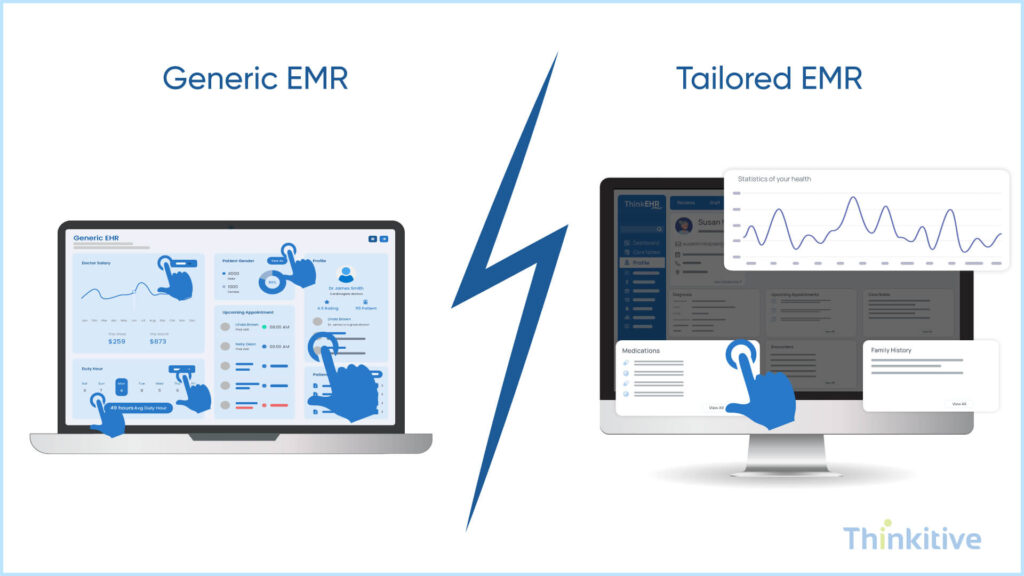
Healthcare practices deal with different types of patient data, and depending on the specialty, the data changes. This is where managing complex data, including images, lab results, and genetic information in large volumes, can be complex. The best way to manage such complex data is by tailoring EMR solutions for medical specialties in such a way that they are able to meet the specific requirements of the practice.
Other than just patient data management, the system should also be capable of generating reports for research, care quality improvement, and keeping an eye on regulatory compliance. Moreover, the data generated by systems is often complicated and difficult for the normal eye to understand. This can pose numerous problems in care delivery and administrative management. However, the best way to deal with this is by the use of reporting tools for analyzing patient outcomes and identifying unique trends in data.
Furthermore, if you’re opting for a virtual care delivery option, then integration with specialized medical devices and equipment to collect and share the data is necessary. Some of the most common integrations that you’ll need are ECG machines, MRI scanners, and other tools and devices. All this can be achieved with a custom EMR solution designed for medical specialists, with custom forms and templates that reduce documentation time and increase provider satisfaction.
On top of that, with AI dominating technological advancements, you can also have specialty-specific automation, such as auto-dosing calculators during medication, auto-generated procedure reports with a quick overview, and structured documentation shortcuts to simplify and speed up the documentation process.
These EMR customizations for specialty practices are on the clinical side; here are some administrative customizations that can be implemented in your software. For instance, with intelligent task routing, the administrative burden can be reduced to a minimum, and it can also be routed in the billing workflows, so that it also gets streamlined. And to simplify automated authorization, you can have automated triggers that can trigger the PA process so that care delivery is not interrupted.
A perfect example of this can be seen with a custom mental health EMR, as it allows you to focus on narrative documentation and sensitive data, needing highly customizable and privacy-focused systems.
Features that Enhance Efficiency for Your Specialized Practice
Get Feature-ListHow Specialty-Specific EMRs Simplify Data Management and Reporting
Specialty practices have to manage large and complex datasets, which include radiology images, pathology slides, genomics reports, and lab sequences. Managing these datasets with a generic EMR can be a mess, and the chances of mismatches are huge. That is why with an EMR for niche medical practices, custom reporting can be made possible for almost all aspects, including outcomes, research, compliance, and specialty metrics.
However, to achieve this, you need to integrate your system with specialty devices like ECG machines, imaging systems, and diagnostic tools, which can be easily done with specialty-specific EMR software.
You can even leverage the power of AI in your system. Let me explain how, for instance, with AI-powered insights for specialty datasets, here are a few specialty-specific examples:
- Oncology: With an AI-powered system, tumor progression trends can be easily mapped. You can have a look at the features in detail about Oncology EHR here.
- Cardiology: Waveform interpretation can be done easily. Furthermore, diagnostic data, device integration, and continuous heart monitoring can be obtained with a custom cardiology EHR.
- Dermatology: AI-powered systems can help you in real-time image comparison, pinpointing specific differences. Have a look at this here at custom dermatology EHR.
Moreover, with advanced visual dashboards, tracking clinical trends in your clinic can also be easily done.
How Specialty EMRs Improve Patient Care and Outcomes

Personalized healthcare technology is where the healthcare industry’s offerings are heading. Coupling this with customized EMR solutions, you actually put the same data you collect from patients to its proper use. For instance, with EMR, you can include data-driven healthcare practices and implement evidence-based treatment protocols for specific conditions. This way, you can deliver personalized care and improve patient adherence to their care plans and journey.
Urgent care with custom urgent care EMR clinics indeed thrives on speed and complaint-driven templates with real-time queue management and one-screen charting, keeping high-volume walk-in workflows moving efficiently.
Moreover, with almost instant access to data, both patients and providers facilitate communication with each other. This not only proves to be crucial for collaboration but also serves as a medium to make informed decisions. Some of the most essential features in this include secure messaging, video conferencing, and shared patient records.
A custom EMR solution gives specialty practices the flexibility to add features that match their clinical requirements. The best example of this can be seen in automated reminder features or drug interaction checks to ensure the right medication, etc.
Keep Specialty Practices Secure and Compliant with Custom EMRs
Industry regulations and standards with respect to virtual healthcare delivery are often evolving. Furthermore, for specialty practices, it changes more often. In such cases, adhering to industry regulations and standards becomes difficult for many. With EMR customization for specialties, better compliance with industry standards and regulations can be maintained to ensure patient data safety and privacy. Furthermore, it also becomes easier for your practice to navigate through the legal landscape of virtual healthcare.
Patient data security and privacy should be key considerations when selecting or implementing a custom EMR solution. Ensure your implementation partner follows industry best practices for healthcare security and compliance. Complying with some of the regulatory bodies, such as HIPAA, GDPR, etc, is necessary.
As a healthcare practice, you need to ensure the confidentiality, integrity, and availability of sensitive patient data. For all of this, you need to leverage the power of data encryption to ensure the data is not leaked, access control to stop unauthorized access, and conduct regular security audits to identify and address the growing security concerns.
Internal Medicine EMR manages complex conditions with detailed documentation and coordinated care workflows; one of the finest examples can be seen here.
Security Features Checklist You Need in Custom EMR
Download ChecklistHow Specialty EMRs Reduce Costs and Improve Practice Efficiency
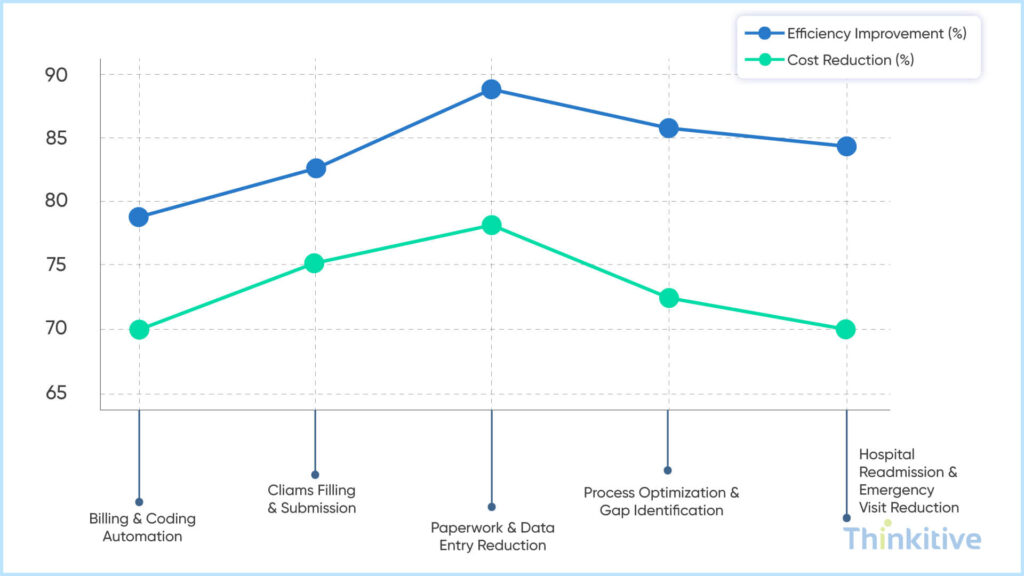
Specialty-specific EMR solutions have become increasingly popular because they improve operational efficiency and reduce administrative burden. You see, streamlining administrative tasks such as billing and coding clearly takes a lot of the burden off the administrative staff. Here is the finest example of such customizations as done here in wound care EMR.
With automation, manual interventions are limited, and the entire process, from claims filing to submission, can be automated with the bare minimum intervention. Along with this, by digitizing the entire process, the need for manual data entry at every process is eliminated, and you don’t have to rely on paperwork since everything is done digitally.
Now, evaluate the areas where your specialty EMR solution supports daily clinical and administrative operations. It will show you all the intricacies of your practice and the loopholes that were financially impacting your practice. However, with EMR customization for specialties, you streamline the entire process and fill in the gaps that are crucial for revenue cycle management, as you can see in a physical therapy EMR.
Along with that, a reduction in hospital readmissions and emergency visits allows you to use your resources effectively and reduce the margin of financial losses significantly.
Scalability & Multi-Location Specialty Expansion
As your specialty practice grows, a scalable custom EMR solution makes it easier to add providers, locations, and specialty modules. Furthermore, with a cloud-based architecture, expansion can be easily done.
On top of that, specialty modules can also be added as your practice will diversify its services, and by adopting a unified data model, you can ensure data formats are consistent across all locations, allowing you to oversee your practice functioning effectively on a daily basis.
For example, Neurology EMR involves detailed documentation and long-term tracking of neurological conditions, which can be easily achieved with a customized EMR.
Conclusion
A custom EMR solution helps specialty practices deliver care more efficiently by supporting specialty-specific documentation, integrations, compliance, and patient management. On top of that, you can also ensure seamless care delivery by meeting all your specific needs and requirements effectively..
So, what are you waiting for? Let’s get started with your discovery of how a specialty-specific custom EMR development can support your practice’s growth and care delivery.
Frequently Asked Questions
Custom EMR solutions for specialized practices are designed around the specific clinical, operational, and documentation needs of a particular specialty. Unlike generic EMR systems that follow one-size-fits-all workflows, EMR solutions for specialized medical practices align with specialty-specific charting, protocols, compliance needs, and billing rules—resulting in better usability, accuracy, and efficiency.
A custom EMR for unique clinical workflows mirrors how specialists actually deliver care. It supports customized intake forms, specialty templates, decision pathways, and automation tailored to each practice. This ensures the system adapts to the practice—not the other way around—clearly demonstrating how custom EMR supports specialized medical practices.
Essential specialty-specific EMR software features typically include:
- Custom clinical templates and assessment tools
- Specialty-focused clinical decision support
- Device and diagnostic integrations
- Procedure-specific documentation workflows
- Specialty billing and coding logic
- These custom EMR features for specialty-specific workflows ensure accuracy and speed in daily operations.
Yes. A well-designed custom EMR for specialty practices seamlessly integrates with imaging systems, lab platforms, medical devices, and diagnostic tools using HL7, FHIR, APIs, and DICOM standards—creating a unified clinical data ecosystem for EMR for niche medical practices.
Tailored EMR solutions for medical specialties eliminate unnecessary steps, reduce clicks, and automate repetitive tasks. Providers spend less time navigating the system and more time delivering care—leading to faster encounters, improved productivity, and reduced cognitive load.
The key benefits of custom EMR for specialized practices include:
- More accurate and consistent documentation
- Better clinical decision-making
- Faster diagnosis and treatment planning
- Improved continuity of care
- Together, these advantages enhance patient safety, experience, and outcomes.
EMR customization for specialty practices enables pre-built templates, auto-filled fields, voice dictation, and smart defaults aligned with specialty workflows. This reduces manual data entry, shortens documentation time, and minimizes clinician burnout.
Yes. Modern custom EMR software for medical specialists is built with scalability in mind. It supports multi-location access, role-based workflows, specialty-specific modules, and centralized reporting—making it ideal for growing or multi-specialty healthcare organizations.
Specialty-specific EMR software should include:
- HIPAA-compliant data handling
- Role-based access control (RBAC)
- Multi-factor authentication
- Audit logs and data encryption
- Secure integrations and backups
- These features ensure patient data protection while meeting regulatory requirements.
Custom EMR features for specialty-specific workflows align clinical documentation with correct coding, reduce claim errors, and automate billing rules. This leads to fewer denials, faster reimbursements, and stronger financial performance—making custom EMR solutions for specialized practices a strategic investment.


