The Ultimate Guide to Custom EHR Software Development

One of the most important things that technology has brought into healthcare is ‘Data’. If you observe the trajectory of the use of technology in healthcare, then innovation has always been about finding the relevant data to measure the complexity of diseases. This is why the introduction of Electronic Health Records has become the epicenter of healthcare practices.
This can be distinctly seen in the adoption rate of EHR systems. Nearing its projected growth in 2026, it currently stands at $33.43 billion. And North America, especially the United States of America, shares the largest market with 44.01% according to the Grand View Research.
However, there are certain trends in the EHR software development market that are slowly developing and slowly dominating a certain market percentile. You see, most of the practices use standard or branded EHRs, but the mindsets of practices have slowly started to turn their heads to custom EHR software development.
We’ll explore the ‘ifs’, ‘buts’, and ‘whys’ later in the blog, but you’ve come here in the hope of knowing everything about developing a custom EHR software that would benefit your practice.
On that note, let’s discuss some of the intricacies of EHR software and let this EHR software development guide be your blueprint in developing an ideal EHR software. In this blog, we will cover the benefits of custom EHR, the basics, and everything you need to know in between development and practice.
So, without further ado, let’s get started with this custom EHR software development guide for 2026.
Free Guide to Building Practice-Specific EHR Software
Free DownloadUnderstanding EHR: What is a Custom EHR Software?
Electronic Health Record (EHR) is a digital system that stores, manages, and securely shares a patient’s complete health information across healthcare providers. Unlike traditional paper records or standalone systems, modern EHR software supports clinical documentation, care coordination, billing, patient engagement, and interoperability from a single platform.
Let’s start with the basics and understand what exactly the EHR software is all about. On the base level, EHR acts as a digital version of your paper-based records that your practice used to store in registers and forms. In short, EHR software allows you to store, manage, and share the healthcare information that is being stored in your software.
This is what you will find as the definition of EHR software on the internet. But, in parallel, the EHR software itself has undergone a lot of transformation. And one of the major ones has been its transformation from a data management software to a practice management system.
And this is the reason why you see many practices wanting to develop their own EHR software, which is specially designed for the practice and its unique clinical as well as administrative workflows.
This trend has been carried forward in patient behaviors as well. For instance, almost 99% of hospitals offered their patients the ability to view their records, 96% also offered the functionality of downloading it, and 84% even allowed sharing it with third parties, according to a survey by HealthIT. And the fun fact is that this change came in response to patients demanding these changes.
Here, you might get an idea of how EHR software has changed from data management software to practice management software, keeping its core quality at the center.
If you want to know more about what an EHR software looks like for a modern-day practice, then read our blog – what does an EHR software stand for?
Who Needs Custom EHR?
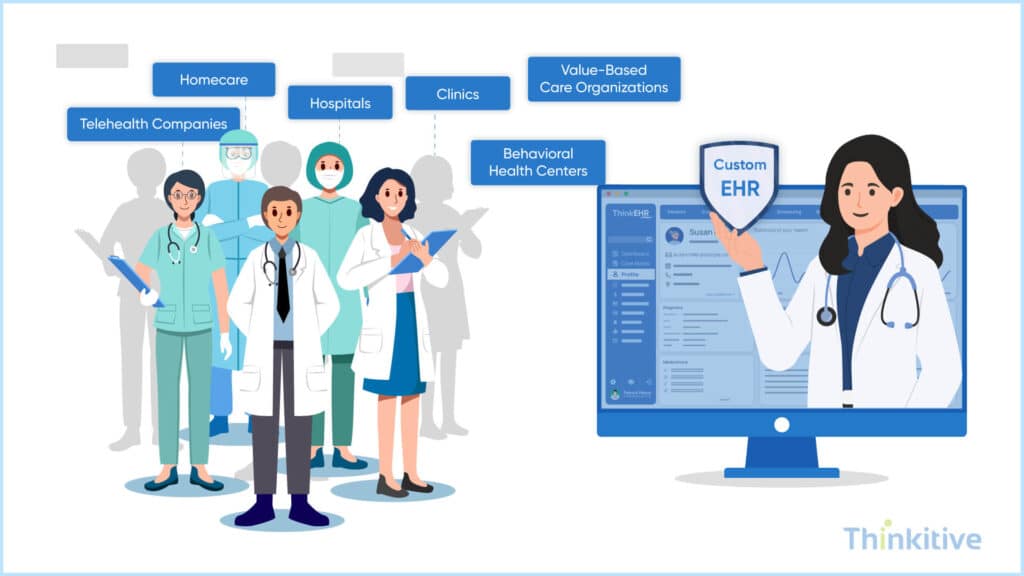
Healthcare organizations with complex workflows, specialty-specific requirements, or long-term scalability needs benefit the most from custom EHR software. But if you ask me, then every healthcare practice should go ahead with specialized EHR software. However, with so many affordable and convenient options available in the market, trying to convince you to choose a relatively costly option will be unfair and would not even satisfy the whole purpose of this development guide for custom EHR.
On that note, let’s briefly understand which healthcare practices or entities can benefit from a custom EHR solution:
- Hospitals: Hospitals have huge data-based and complex necessities that a simple off-the-shelf EHR software simply could not satisfy. In such cases, using a branded EHR not only becomes inefficient but also costly. On top of that, the unique work structure of your hospital, with connected networks and workflows, can be easily addressed with a customizable EHR.
- Clinics & Multispecialty Groups: Mid-scale clinics and multispecialty groups have unique needs that are specific to their practice. Here, a custom EHR helps in smoothing the workflows and data flows that directly or indirectly affect the functioning of your practice both clinically and administratively.
- Behavioral Health Centers: Remember the data factor we talked about earlier; well, the importance of data can be easily observed with an EHR system made specifically for your behavioral health centers. Let me explain how, you see, for behavioral health, you constantly collect, analyze, and share different types of patient health information.
- Telehealth Companies: During the COVID-19 pandemic, telehealth consultations were on the rise and started a new trend in healthcare with remote consultations. And telehealth being the catalyst in them, developing a custom EHR with your telehealth platform can be a great step in taking your platform and the concept of virtual care delivery to a holistic level.
- Homecare & Long-Term Care Groups: During all our software development ventures, home care and long-term care groups have had the highest demand for building their own EHR system. For such care groups, developing a custom EHR software that is specific to their practice and home care population needs can be easily achieved.
- Value-Based Care Organizations: A trend that the entire healthcare industry is going through is shifting from service-based care delivery to value-based care delivery. These organizations can benefit extremely from curating an EHR system for their practice, as it puts data at the center of their practice, and delivering care on the basis of data makes it easier to make that transition.
Coming back to what I said earlier, any practice can benefit from a custom EHR, depending on your budget and needs; at times, having a generic EHR software at the start can do the work. However, if you want to know in detail about which healthcare entities can benefit from custom EHR software and why, then click here to read a separate development guide for custom EHR for different healthcare entities.
Get Free EHR System Assessment
Assess My EHRBenefits of Custom EHR for Healthcare Providers
Some of the biggest benefits of custom EHR software include improved productivity, streamlined workflows, reduced long-term costs, stronger data security, and the flexibility to support your practice’s unique needs.
If you have made it this far, then you might get a custom EHR that is better than off-the-shelf software. Some can even argue that the cost factor in off-the-shelf software is clearly better, right?
Well, let’s have a look at some of the benefits of custom EHR software and why it is one of the reasons why healthcare providers are making the shift. So, if you are questioning why a customizable EHR, then here are some of the benefits of making a shift to building your own EHR software for your practice:
- Productivity Improvement: One of the proven benefits of custom EHR software has been its impact on improving productivity. For instance, with advanced features of custom EHR software, the time spent on documentation can be minimized, if not eliminated. Automation and synchronization are some of the major functionalities of an EHR that can contribute immensely to increasing productivity.
- Faster Documentation: As said earlier, an EHR system dedicated to your practice can increase your documentation speed, and one of the major contributing factors in this has been automated data entry and synchronization in your connected healthcare systems.
- Better Patient Experience: Another benefit that people rarely talk about is a better patient experience. You see, with customized EHR software, the transparency in your data and care planning can be done better. Also, with patient engagement features, you close the conventional communication gaps between patients and care teams, improving the care experience for the patients.
- Cost Savings: Yes, it is true that off-the-shelf EHR software is affordable, but in the long term, it indeed becomes costly. Your monthly expenditure that involves majorly subscriptions, integration, customization, and other aspects of making your generic EHR customized can be saved with a custom EHR.
- Compliance & Security: Poor security infrastructure and a lack of compliance with regulators lead to data theft and other healthcare data security issues. That is why almost half of the practices experienced at least one cybersecurity incident in the last year. Given there are a number of compliances that you need to adhere to depending on the region your practice is in and other regulatory requirements, developing your own EHR software is a tried and tested method to easily navigate through the compliance and security landscape.
While these are some of the major and common benefits of custom EHR software for healthcare providers, there are also several underlying experiences that help you make your practice even better. If you want to know these specific benefits, then read the blog – The Benefits of Custom EHR Software for Healthcare Providers.
Custom EHR vs Off-the-Shelf Solutions
Custom EHR software offers greater flexibility, customization, and long-term scalability, whereas off-the-shelf EHR software provides faster implementation and lower upfront costs.
And if you are looking for an EHR software system, there are just two choices: either go ahead with custom EHR software or with off-the-shelf EHR software. To help you understand both the choices better, here are a few things about custom EHR vs off-the-shelf EHR software that you need to know:
- Limited Features of Generic EHRs
First things first, it is the features that define the functionality of your software. And with a generic EHR, you get limited features which may or may not be aligned with your clinical or administrative needs, right? And this is one of the major reasons why many healthcare practices are shifting to a customizable EHR.
- When Does an Off-the-Shelf EHR Work?
An off-the-shelf EHR software works if you are a small practice and working with limited care teams and manage a certain number of patients on a daily basis. If you are a generic practice serving a limited patient population, then off-the-shelf EHR software is a perfect choice for you.
- When is a Custom EHR Necessary?
As your practice grows, your needs change, and with respect to that, your software also needs to be changed or updated. This is where you realize the need for custom EHR software, since you can easily address the specific clinical and administrative needs of your practice.
To help you make the decision-making simple between custom EHR software and off-the-shelf EHR software, refer to the table below:
| Category | Custom EHR | Off-the-Shelf EHR |
| How it’s built | Tailor-made for your clinic | Pre-built, same for everyone |
| Workflow Fit | Fits the way you work | You adjust to the software |
| Features | Only what you need — can add more later | Lots of features, many you may not use |
| Time to Start Using | Slower — needs development time | Fast — can start within days/weeks |
| Cost | Higher upfront, no ongoing license | Lower upfront, ongoing monthly fees |
| Changes & Updates | You decide what changes and when | Vendor decides features & release cycles |
| Integrations | Can integrate with any tools you use | Limited to what the vendor supports |
| Data Ownership | You own everything | Vendor controls storage & access terms |
| Scalability | Grows with your practice long-term | Scaling may require upgrades or new plans |
| Who Should Choose | Clinics with unique workflows or growth plans | Clinics with standard workflows & quick needs |
Also, for a detailed comparison between off-the-shelf EHR vs custom EHR software solution, read our detailed blog here.
Furthermore, this EHR development guide would be incomplete without telling you some aspects about the cost you would have to pay for custom EHR development services or simply go ahead with off-the-shelf software.
So, to give you a brief idea, here is the table for a quick cost breakdown:
| Factor | Custom EHR Development | Off-the-Shelf EHR | Open-Source EHR |
| Initial Cost | $50,000 – $300,000+ | $0 – $50,000 (setup/licensing) | $10,000 – $80,000 (implementation & customization) |
| Ongoing Costs | Maintenance: $10K–$50K per year | Subscription: $200–$700 per provider/month | Maintenance & support: $5K–$30K per year |
| Customization | Fully customizable to workflows | Limited customization | Moderate (requires developer support) |
| Time to Deploy | 4 – 12 months | 2 – 8 weeks | 2 – 6 months |
| Integration Capability | Fully flexible (FHIR, HL7, APIs) | Limited to vendor capabilities | Flexible but requires technical expertise |
| Hidden Costs | Low to moderate (well-defined upfront; changes may increase scope) | High (add-ons, upgrades, training, vendor lock-in fees) | Moderate (developer support, customization, security & compliance efforts) |
| Long-Term ROI | High (no recurring licensing, optimized workflows) | Moderate (subscription accumulates) | High (if managed well) |
Which EHR Software Should I Choose?
Book Free ConsultationWhy Custom EHR Matters Today?
Custom EHR software has become increasingly important as healthcare organizations adopt value-based care, interoperability, AI-powered workflows, and specialty-specific care delivery models that generic EHRs often struggle to support.
The healthcare industry is in a transitional stage where the focus is shifting from service-based delivery to value-based delivery. And the demand is on the rise from both healthcare providers and patients alike. Taking this factor along with several other factors, here are some reasons that I have found why you or your practice needs a custom EHR in 2026.
- Workflow Customization Needs: With value-based care delivery in the picture, the need for customized workflows of their software with their practice has become their need of the hour. And this can only be achieved with an EHR system that is built for your practice.
- Interoperability & Integrations: You also need to be a part of your connected digital healthcare landscape to send, receive, and share data with other healthcare practices or professionals. For that, making your software interoperable and integrated with other systems is necessary. Again, an off-the-shelf EHR software offers you a very limited scope, which can be flexible with a customizable EHR.
- Data Ownership & Security Control: Now, most of the off-the-shelf software vendors sign data ownership agreements, which put the vendor in ownership of the data that you use. And once the subscription is finished, there is a high chance that you can lose that data. Moreover, with data security being one of the top priorities of the healthcare IT landscape, building an EHR system for your practice will not only keep you in control of security, but you will also be responsible for the data that is stored in your EHR software.
- Specialty-Specific Features: There are a number of EHR software systems available in the market. However, there are very few software systems that align with your specialty needs, right? This clearly indicates the need for specialty practices to develop their own EHR software that aligns with their specialty.
The role of custom EHR software has become increasingly evident, reflecting the changing landscape of the healthcare IT industry. Read our blog, The Importance of Custom EHR Solutions for Healthcare Organizations, here to know why custom EHRs have become so important for healthcare providers.
Critical Features & Functionality
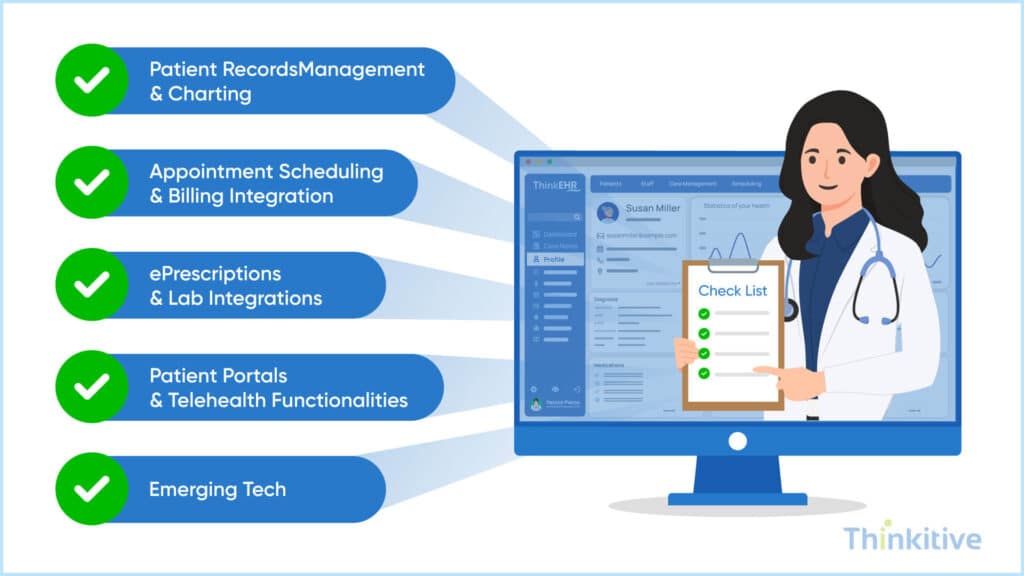
Ideally, a modern EHR system should include patient records management, clinical documentation, scheduling, billing, ePrescribing, interoperability, patient engagement tools, and AI-powered capabilities to support efficient care delivery.
If you have searched the internet for an EHR development guide, then every guide will tell you about certain features and functionalities. If you have, and you have somehow come here by the mercy of the internet, then you need to know that features define the functionalities of your software system.
And EHRs being at the transition stage themselves, they need to have both the common functionalities of an EHR software and also those of a practice management software to an extent. So, here are some of the critical features and functionalities of a modern-day EHR software that you need to know:
- Patient Records Management & Charting: Managing patient records and charting are some of the core functions of any EHR software. These features you will find in almost every good EHR. And even if you are developing an EHR system from an EHR development vendor, then their preference for these two features can be the litmus test for you to at least consider them as your partner or not.
- Appointment Scheduling & Billing Integration: One of the major reasons for custom EHR software development for practices has been to remove their dependency on multiple systems and use one system for the entire practice. For this appointment, scheduling and billing integration are two major features. While one gives your patients more control of their care journey, the other eases the workload of administrative staff and ensures everything is in sync.
- ePrescriptions & Lab Integrations: Two major disparate healthcare service providers that your practice will depend on are pharmacies and test laboratories. Now, integration with these systems can ensure the data flows in a better way from your system to their system instantly. Furthermore, it also reduces the need for repetitive entry and, at times, completely eliminates the margin of human error in the process.
- Patient Portals & Telehealth Functionalities: In your EHR software, you need some features and functionalities to give your patients more control over their care journeys. This can be easily done by patient portals and telehealth features, where one allows them to take control of their care journey, and the other bridges the communication gaps between patients and providers in a virtual ecosystem.
- Emerging Tech: Some of the recent demands of healthcare providers that they have been making in their development requests are the integration of AI for clinical support and voice recognition for data entry.
What Essential Features are Missing from My EHR?
Get Free AssessmentIf we are talking about essential features and not mentioning AI-powered features simply tells you that they are not talking about the necessary features. You see, healthcare providers today use AI in almost every aspect of their practice and day-to-day administrative and clinical operations.
On that note, here are some of the AI-powered features that you need to consider when it comes to EHR development.
- AI-Assisted Clinical Documentation: With this feature, physicians don’t have to take notes manually. The AI embedded into your EHR system will listen to your conversations and prepare structured clinical notes in real-time, saving time and reducing documentation burden significantly.
- Predictive Analytics & Risk Scoring: This feature can be extremely useful for analyzing patient history, vital records, and behavioral data to flag high-risk patients before any mishaps. This not only enables proactive care management but also reduces hospital readmissions. And the best part, it’s all data-backed to ensure accuracy.
- NLP for Medical Coding & Billing: Natural Language Processing has been around for a while, and some practices have been using it for reading clinical notes and automatically assigning correct ICD-10 and CPT codes. Some of the aftermath of these use cases is reducing manual coding errors and claim denials.
- Smart Appointment Scheduling: AI is one of the best things out there that can make accurate predictions on the basis of data. Bringing that concept into the healthcare IT ecosystem, it can predict no-show patterns, optimize provider availability, and auto-fill cancellation slots. Imagine the scheduling burden it can reduce for providers.
- AI-Powered Diagnostic Support: Clinical diagnostic and decision support is one of the most anticipated use cases of AI. You see, by cross-referencing patient symptoms, lab results, and medical history against large data sets, it can suggest the best possible potential care plan and even flag anomalies that a human can easily miss.
Custom EHR Software Shaping Modern Healthcare
Modern healthcare is increasingly being shaped by custom EHR software that adapts to evolving technologies, changing care models, and the unique needs of healthcare organizations.
While off-the-shelf EHR software systems give you a final product, a customized development approach gives you enough flexibility to experiment with your EHR software. And this is how they have been dictating or shaping the trends of modern healthcare in the EHR software system. Moving ahead with the development guide for EHR system, here are some of the trends that you need to know:
- AI-Driven Clinical Support: The arrival of AI has become the talk of the town even in the healthcare industry. It was even surprising to see the rise in the demand for AI-driven clinical support that many healthcare providers have been asking for. In simple terms, they basically want an enhanced system for diagnostic accuracy, image analysis, and predictive modeling to personalize treatment plans and improve documentation and care delivery.
- Ambient Intelligence & Voice Tech: Some of the healthcare practices have also asked for advanced systems that can adapt to their unique needs, without explicit human interactions. Finding a combination of both in ambient intelligence and voice commands, many healthcare providers are actually looking forward to this feature in their custom EHR software.
- Wearable & IoT Connectivity: With virtual care delivery being in talks recently, wearable and IoT connectivity for real-time seamless data transfer to your system has been another trend in EHR software development.
- Predictive Healthcare Analytics: Dealing with huge amounts of data coming into your EHR system is simply too overwhelming for both clinicians and administrators. That is why healthcare professionals have been asking for predictive healthcare analytics in their customizable EHR to help them with predictive patterns to not only improve their care delivery but also billing and patient management aspects.
If you want to know more about such trends that can improve your custom EHR software, then read our blog — Custom EHR Software Dictating the Trends in Modern-Day Healthcare — and know which latest trend in EHR development can benefit your practice.
Strategic Planning & Development for Custom EHR Software
Developing an EHR system involves a structured process that includes workflow analysis, solution planning, UI/UX design, development, system integrations, testing, deployment, and ongoing support.
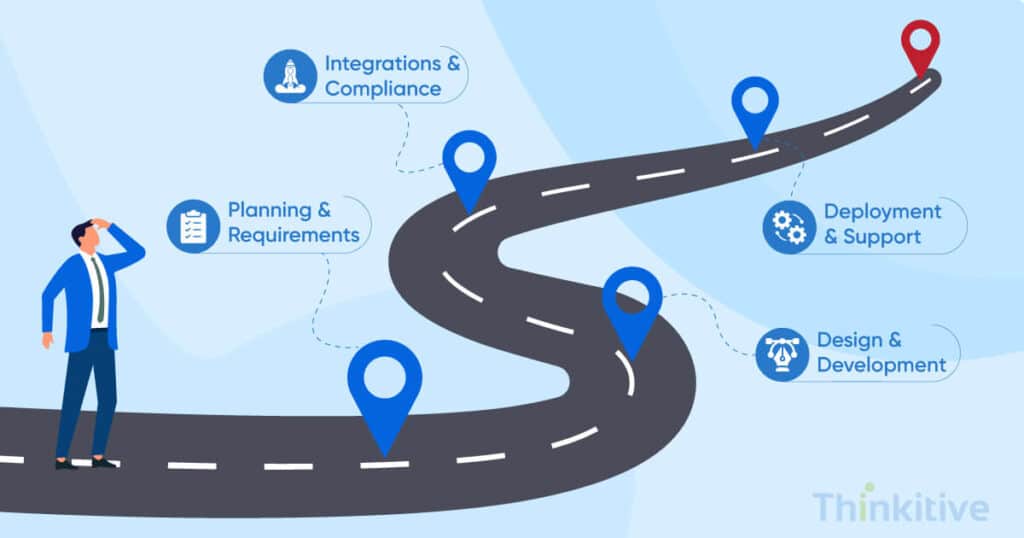
And if you have made the decision that you want customized EHR software, then you have actually entered the EHR software development lifecycle. This is where your actual planning of developing EHR software starts. In this section of the EHR software development guide, let’s try to uncover the key steps to developing EHR software and the things that you need to keep in mind.
Refer to this table to know the different steps of EHR software development and what you need to keep in mind when planning for EHR development.
| Development Step | What It Means | Key Outputs |
| Discovery & Requirements | Understand clinical workflows, challenges, and goals | User stories, feature list, workflow maps |
| Technical Architecture | Choose technology stack, hosting, and data strategy | System architecture diagram, integration plan |
| UI/UX Design | Create screens, dashboards, and user flow prototypes | Wireframes, design mockups, clinician feedback |
| Core Development | Build EHR modules and backend functionality | Working features (charting, scheduling, billing, etc.) |
| Integration Setup | Connect with labs, pharmacies, billing, and third-party systems | FHIR/HL7 interfaces, eRx, LIS & PACS connectivity |
| Testing & Quality Assurance | Ensure reliability, speed, compliance, and security | QA checklist, bug reports, performance metrics |
| User Training | Train physicians, nurses, admin staff, and billers | Training sessions, onboarding manuals, video guides |
| Deployment & Go-Live | Launch system in real world with monitoring | Live environment, support team on standby |
| Maintenance & Support | Fix issues, add new features, ensure uptime | Updates, dashboards, SLA support |
Things to remember:
The purpose of developing EHR software for your practice is to align with respect to your different needs, requirements, and especially the clinical and administrative workflows. This includes how the data flows from your system to other systems and vice versa. Also, depending on the data required for clinical needs, it needs to be there at the right time. For instance, during the consultations, the physicians must have access to the patient’s previous information, which can be crucial for care planning. Other than that, all the important notes and time stamps must be available to the biller so that they can submit claims and other stuff as appropriate to avoid denials and other things.
This is the reason why identifying the workflow gaps in your practice is necessary, and if not one of the most important things in your EHR software development venture.
Note: You can either outsource EHR software development or build it in-house. Though they both come with their own distinct advantages and disadvantages, it’s always good to know about your choices, right? Here is the link to our blog to help you choose better – Custom EHR Software Development Services: Outsourcing vs In-House
Calculate the Cost of Custom EHR Software
Get Free QuoteCost of Custom EHR Development in 2026
The cost of custom EHR software development can range from $50,000–$300,000 for an MVP to $200,000–$1.5 million+ for a fully featured EHR, depending on your practice’s requirements, integrations, and overall complexity.
Before we start talking about the EHR development, there is one crucial difference that you need to know. Read our blog—EMR Software Vs. EHR Software—first to get a better understanding. Understanding this is important because a lot of aspects of the cost depend on this.
Having said that, the cost of EHR development highly depends on different aspects, and mainly on your unique needs and requirements. If you are on a limited budget, then let this EHR development guide be your blueprint for developing EHR software that actually benefits you, your staff, and ultimately your practice.
- Minimum Viable Product: Also known as MVP, is a product that addresses your initial core needs, both clinical and administrative. You can also call it a first working version, and some of the typical MVP features for your EHR system include patient data entry, patient charting, appointment scheduling, billing module, ePrescriptions, dashboard, user roles, and basic reporting. And the cost of developing this depends on the size of your practice. To give you a rough idea, an MVP EHR can be developed for as low as $50,000 – $60,000 to as high as $200,000 – $300,000.
- Full-Featured Custom EHR: A full-featured EHR software includes complete clinical features with billing functionalities and has an ecosystem for your patients to engage. It includes all the features that are present in an MVP EHR but also has practice management functionalities, RCM functionalities, labs and radiology integration, telehealth platform, patient portal, role-based controls, HIPAA-compliant and secure system. Developing this system requires a higher investment, which starts from $200,000 to as high as $1.5 million.
One of the major reasons for the failure is the cost of EHR software development. You see, you will need to hire EHR software developers to develop your EHR system. And here, the cost factor seems real, depending on the region you practice in, the hourly rates of developers change. For instance, in the US, developers charge around $120 – $250 per hour, depending on the seniority; however, the prices can significantly change.
After that comes your EHR module complexity, where feature type can become a costly affair. For instance, to include telehealth functionalities, you need to spend somewhere around $20k – $90k. And for different modules, the price increases depending on the complexity.
Factoring Influencing EHR Development Cost
For this section, we will not consider the MVP cost, since you would anyway have to develop that for running your practice. Now, the factor that influences the cost is the number of modules you want to include. A practice with billing, telehealth, and AI modules will naturally double the cost of your EHR development, including the MVP features.
Next, your system integration needs and complexities, such as FHIR, HL7, and clearinghouse contracts, again influence the cost. Coupling that with compliance requirements such as HIPAA controls, logging, threat models, and penetration tests, etc, can again add up to your EHR development cost.
Furthermore, if you want to add user roles and workflows, the complexity of the workflows increases, indirectly increasing the cost. Reading all this might make you question your choices, right?
Well, worry not, refer to the ROI estimation table below, and you get an idea about your returns:
| ROI Category | How ROI Happens | Typical Annual Impact (Estimate) |
| Time Savings for Clinicians | Reduced clicks, faster charting, automated templates | +150–300 hrs saved/provider/year |
| Operational Efficiency | Fewer manual tasks, auto-sync billing, single data entry | Save 1–2 FTE salaries/year |
| Claim Acceptance & Revenue Capture | Better coding, cleaner claims, real-time eligibility | +8–25% increase in accepted claims |
| Subscription Cost Elimination | No per-user or recurring SaaS EHR licensing fees | $12,000–$80,000/year per clinic |
| Patient Retention & Satisfaction | Patient portal, reminders, telehealth access | +5–18% increase in patient retention |
| Staff Productivity | Less time on data entry, scheduling, faxing | 20–40% reduction in admin workload |
| Reduced Compliance Risk | Audit logs, RBAC, PHI controls | Avoid $25K–$1.5M in penalties |
| Telehealth Revenue Expansion | Faster virtual visits, better follow-up scheduling | +15–40% increase in reimbursable visits |
| Data-Driven Decision Making | Analytics dashboards and performance metrics | Improved financial forecasting + lower leakage |
Having said that, if you want to know about the complete breakdown of the EHR development cost, then read this blog – Custom EMR Development: Complete Cost Breakdown.
Compliance & Regulatory Requirements
Compliance is a critical part of EHR software development. From HIPAA and ONC requirements to the HITECH Act and state-specific regulations, meeting these standards helps protect patient data, support interoperability, and ensure your EHR operates within legal requirements.
Compliance and regulatory requirements are some of the important considerations in your development. Being compliant not only makes your data safe but also allows you to seamlessly navigate through the legal landscape. Refer to this table to know which compliance and regulations you need to abide by and why they are important.
| Requirement | What It Is | Why It Matters |
| HIPAA | Protects patient health information (PHI) | Avoid data breaches, legal penalties, and patient trust loss |
| ONC Certification | Federal certification for EHR functionality & interoperability | Enables Medicare/Medi-Cal incentives and data exchange |
| HITECH Act | Strengthens HIPAA with stricter enforcement and reporting | Ensures secure electronic record handling |
| FDA (for CDS) | Regulates clinical decision support software that influences treatment | Improves patient safety and reduces clinical risk |
| State-Specific Rules | Local privacy, telehealth, and medical record laws | Keeps EHR legally compliant across all practice locations |
| Security Controls (RBAC, MFA, Audit Logs) | Access control, authentication, and activity tracking | Prevents unauthorized access and supports investigations |
Key 2026 Compliance for EHR Software
The healthcare compliance and regulatory landscape is constantly evolving, as you know. However, many practices struggle with keeping up with the latest changes and updates in the landscape.
The same has happened in the year 2026, and these will dictate the trends going forward in 2026. On that note, here are some updates that you must know and prepare for in 2026.
- HTI-1 Rule: Given the necessity of the HTI-1 Rule, this rule is now fully enforced and requires your EHR system to support standardized FHIR-based APIs, to enhance data sharing and updates to USCDI v3, data classes. Meaning interoperability and data standardization are something you can’t ignore.
- TEFCA Goes Operational: The TEFCA is now fully operational. Because of this, systems are now able to exchange healthcare data across the nation through Qualified Health Information Networks.
- Information Blocking Penalties Escalate: Under the 21st Century Cures Act, the rules on information blocking have become more intensified. Furthermore, penalties under this can reach up to 1 million. It is brought to make your EHR seamless and compliant with data sharing practices.
- AI & Clinical Decision Support (CDS) Transparency: The updated guidelines of the FDA state that AI-driven CDS tools are now required to be more transparent in how they came to that conclusion and how the algorithms should function, along with the data it should rely on. It is crucial for your AI-powered EHR software to be more explainable, auditable, and compliant.
Best Practices for a Successful EHR Project
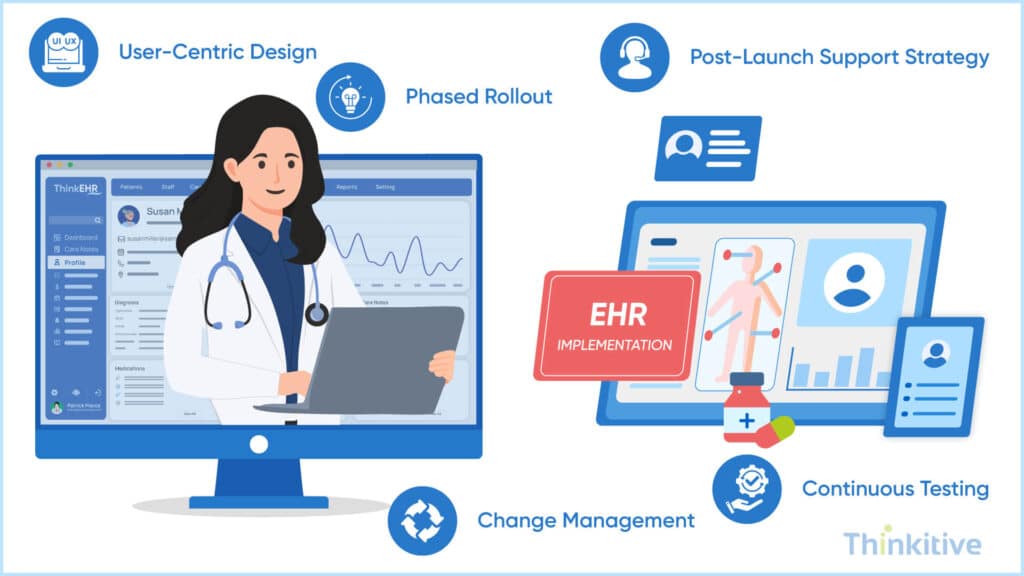
Now, building an EHR system from scratch is a little bit costlier than just buying and implementing a generic EHR, right? Well, when you are developing EHR software, there are some best practices that you need to adopt so that your EHR development is an actual success.
Here are some of the tried and tested methodologies that you can use:
- User-Centric Design: Think for the user and how the software will make their lives easier. This increases the usability and gives the user a delightful experience.
- Phased Rollout: Choose a phased rollout approach so any complications in the system can be addressed earlier without disrupting other functionalities.
- Continuous Testing: Test your EHR system continuously throughout and after development to cover no stone unturned and secure your system from all other obstructions.
- Change Management: If you are already using any EHR system, then have a change management plan so that you can smoothly transition from the existing system to a new system.
- Post-Launch Support Strategy: After the launch of the software, support and maintenance become extremely crucial. Having a discussion with your vendor and curating a post-launch support strategy can go a long way.
Conclusion
If you’ve made it this far, then there is something that you need to know. The purpose of this custom EHR software development guide is to help you know all the important things that you need to consider when developing the software.
I know this guide may seem overwhelming, but keeping this as your roadmap to development can help you make smart choices. If you really want to develop, then one of the smartest decisions that you can make is to develop a Minimum Viable Product and later scale according to your needs. This is one of the most cost-effective ways of developing an EHR system, and it can also help you cut unnecessary costs that may occur.
It is true that a customized and personalized EHR offers more value than any generic system, but it all depends on how you develop it. On that, let this blog serve you as a guide to EHR software development, and if you want to get started, then get your free consultation from one of the top EHR software development companies.
Frequently Asked Questions
EHR (Electronic Health Record) software stores a patient’s complete health information and allows data to be shared across multiple providers, facilities, and systems. EMR (Electronic Medical Record) software focuses mainly on clinical documentation within a single practice.
In short, EHR = interoperable and shareable; EMR = practice-specific and limited.
These EHR software systems is built around your workflows instead of forcing your staff to adapt to generic screens and features. It improves efficiency, reduces clicks, supports specialty-specific needs, streamlines billing, and eliminates ongoing licensing fees. Long-term, a custom EHR gives you control, flexibility, and complete data ownership.
A basic MVP takes 3–6 months to build, while a full enterprise-ready EHR with integrations, billing, and compliance can take 9–18 months, depending on features, complexity, and the number of stakeholders involved. Planning, testing, and training are as important as development time.
On average, EHR development costs range from $60,000 to $250,000 for an MVP and $250,000 to $1.5M+ for a full system with telehealth, billing, and interoperability features. Costs depend on module count, integrations, UI complexity, compliance requirements, and development region.
Specialties with unique clinical workflows see the greatest value, including cardiology, oncology, orthopedics, dermatology, pediatrics, behavioral health, urgent care, physical therapy, telehealth, and remote patient monitoring (RPM). Multi-clinic groups and value-based care organizations also benefit significantly.
A 2026-ready EHR should include:
- Patient charting and documentation
- Appointment scheduling and billing integration
- E-prescribing and lab/radiology interfaces
- Patient portal and telehealth tools
- Audit logs, access controls, and security
- AI/automation for clinical support and documentation
- Interoperability using HL7 and FHIR standards
Compliance is achieved by implementing:
- PHI encryption in transit and at rest
- Role-based access control (RBAC)
- Multi-factor authentication (MFA)
- Audit logging and activity tracking
- Secure data storage and backup
- ONC-certified interoperability modules
- Regular security audits, documentation, and third-party certification are recommended before go-live.
Yes. Customizable EHRs can connect with billing software, labs, radiology systems (PACS/RIS), pharmacy networks, clearinghouses, and legacy EHRs using FHIR APIs, HL7 messaging, webhook systems, and integration engines. Integration is often the biggest factor affecting project scope and cost.
Major challenges include:
- Complex workflow mapping and provider adoption
- Managing multiple integrations with legacy systems
- Ensuring regulatory compliance and data security
- Avoiding “feature overload”
- Handling performance at scale (especially cloud systems)
- Training and change management for clinical staff
Key emerging trends include:
- AI-powered clinical decision support
- Ambient voice documentation (no typing chart notes)
- Telehealth and remote patient monitoring (RPM)
- FHIR-first interoperability
- Predictive analytics for risk scoring and care management
- Patient-generated data from wearables and IoT devices
- Low-code EHR component libraries for faster development


