Scalability Considerations for Custom EHR Solutions

Amidst the rapid adoption rate of electronic health records software, custom-built EHR software has also marked its market presence. In the United States alone, almost 4 out of 5 office-based physicians have adopted electronic health records software systems.
EHRs are at the helm of the digital drive in the healthcare sector, and they are slowly entering the mainstream healthcare workflow worldwide. While most of the healthcare institutions and practices have made it evident that EHRs are beneficial for their practice, the fact is that, along with technology, healthcare practices are also evolving.
This is where the question, ‘Is my custom EHR software scalable?’ becomes crucial for healthcare practice. It is natural that Electronic Health Records are making up a larger portion of the digital healthcare infrastructure. Your healthcare practices depend heavily on it, connecting every other aspect of healthcare delivery with your practice.
And this is where most healthcare professionals who are trying to shift to digital care delivery miss the mark. The foundation of scalable EHR development is set during the development phase of the Custom EHR.
EHR scalability is crucial because, over the course of time, your practice will scale, and the software should be able to handle a significant amount of load while allowing multiple users to work on it efficiently.
In this blog, let’s see how to develop a future-proof EHR by enabling EHR scalability and what factors you should keep in mind during the custom EHR software development.
Guide to Building a Scalable EHR Software
Download Free GuideUnderstanding Scalability in Custom EHR Software Solution
Before diving deep into the core aspects of developing a scalable custom EHR software, let’s first understand what scalability refers to in EHR software systems.
In a nutshell, the scalability of the EHR software is the software’s ability to handle the increasing workload without compromising the performance of the software system.
Here, the increasing workload refers to the growing patient population, which is fairly natural as your patient population is bound to increase as your healthcare practice is sustained. With an increase in the patient population comes more users and the need to add new features and applications.
Custom EHR development performance can be truly scalable when its software is able to withstand the increasing workload and keep the system intact and running by avoiding system crashes and enabling smooth data flow.
But as discussed earlier, the foundation of scalable custom EHR software is laid during the development phase. What really are the considerations that we should take to achieve EHR scalability?
Well, find out more details below.
Key Scalability Considerations in Custom EHR Solutions
1. User Growth & System Expansion
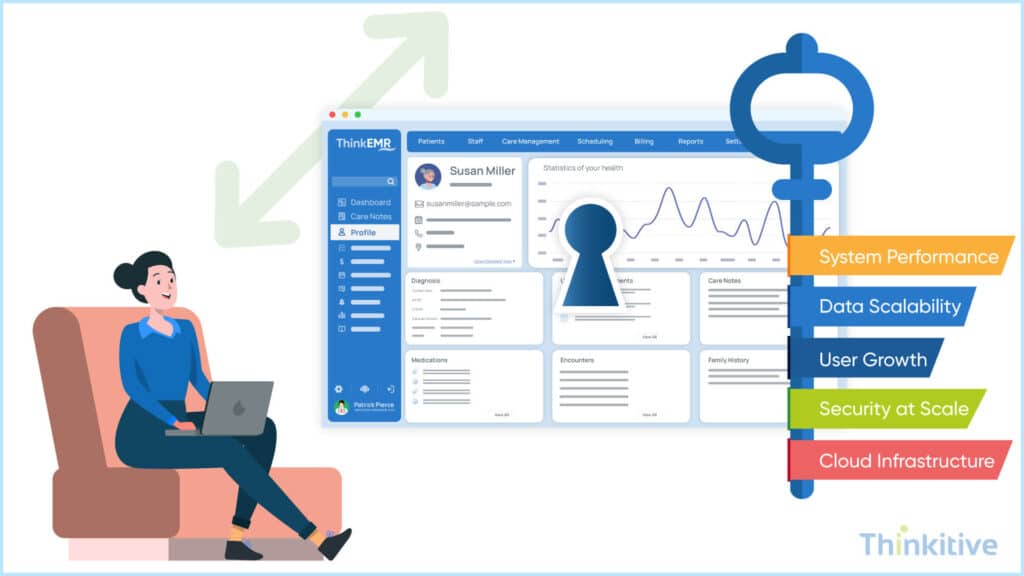
To understand this aspect of healthcare practice better, let’s assume that you’ve started a specialty clinic and have developed a custom EHR software for the same. Now, since there will be less inflow of patients, the software will be easily compatible with the data flow. However, as your practice grows, the number of patients and providers using the same EHR software will increase, which will require you to have a growth-ready EHR.
To ensure that your software is able to accommodate the growth in users, building a multi-tenant architecture can come in handy. This way, you can enable multiple users to access one instance of the application at the same time. Along with that, enabling role-based access control will help you in safeguarding the information and efficiently managing patient data for holistic healthcare delivery.
Furthermore, if you need the system to accommodate new specialities and departments, then the software needs to be flexible enough to give you enough room to add additional features and handle traffic as well.
For instance, your system should give you the ability to add new specialties, departments, and even locations in case you open a practice at a different location. This feature is exceptionally important for your practice and reveals almost everything about the scalability of custom EHR. And this is one of the major scalability challenges in custom EHR solutions.
When your practice grows, and you have to add new users to your system, your scalable custom EHR system should ensure smooth concurrent usage. This is one of the most crucial things for multi-location practice; many users will access and use the system simultaneously. In such cases, there are high chances that the system might crash, and there might be some complications in data management.
This issue must be addressed, and concurrent usage of your system must be ensured.
2. Data Storage & Management
The inclusion of technology has provided us with crucial data on almost everything that we do on the internet. The same is the case in the healthcare industry; it is predicted that by the end of 2025, healthcare data will increase by 36%.
Some of the major contributors to this healthcare data will be from genomics, wearables, and the usage of IoT devices. This will provide you with new challenges with data volume and storage capacity.
One of the best practices for scalable EHR in terms of data storage and management is to leverage cloud-based storage like AWS or Azure. These cloud-based storage solutions offer you unlimited capacity and can be scaled to meet your needs and requirements. Along with that, implement data compression practices so that data integrity is maintained and you have enough room to store data for a prolonged period.
Another best practice for scalable EHR in terms of data storage is to archive the older data, as it offers an economic solution with regard to the cost of scalable EHR development. Also, the factor of scalability in a custom EHR majorly depends on the database performance as well. With respect to that, you should have a dedicated team to maintain the databases.
Since you will practice adding and generating more data, the volume of data will scale over time, and your system and database should be able to handle the amount of data. Top-notch database performance is the sign of a future-proof EHR system.
Top 10 Scalability Must-Haves Features for Your Custom EHR
Download Feature ListLeveraging Cloud-Based Infrastructure for Scalable Custom EHR Systems
If you ask any developer about their infrastructure choice for a scalable software, then most likely they’ll suggest a cloud-based infrastructure. And for good reasons, you see all the software systems that have a large user base rely on cloud infrastructure, as it has a direct impact on their long-term scalability and stability.
An on-premise system fails in handling growth spikes because these databases have limited scope for scalability, and they are capacity-bound. On top of that, on-premise systems require a higher upfront investment and every minor expansion will also require more cost; in short, it is a costly venture.
Furthermore, other limitations come in the form of operational and maintenance overhead, limited resilience to traffic spikes, physical expansion constraints, and, most concerning, long provisioning timelines. You see, due to its less elastic nature, adding new servers, storage, or even computing power to your systems can take weeks or even months.
Considering all these, cloud infrastructure is what many healthcare IT professionals choose for scalable custom EHR systems. Cloud systems give you elastic support that enables your system to function smoothly even during high traffic spikes or for multi-location access.
Having a cloud infrastructure for scalability is like having an elastic and endless database that expands as per the needs of your system. Here’s a brief overview of the major cloud-based service providers that you can use for your custom EHR.
| Cloud Service | Use Case | Scalability Features | Healthcare Fit |
| AWS RDS | Managed SQL databases (MySQL, PostgreSQL, etc.) | Read replicas, Multi-AZ, automatic backups | Structured EHR data like appointments, billing, and clinical records |
| Azure Cosmos DB | NoSQL database for unstructured/JSON data | Auto-scaling throughput, global distribution, and multi-region replication | Real-time data, clinical dashboards, wearable data |
| Google Healthcare API + BigQuery | FHIR/HL7/DICOM data storage & analytics | Petabyte-scale analytics, real-time querying via BigQuery | Advanced analytics combining structured records with imaging/telemetry |
| Amazon HealthLake | FHIR-based healthcare data platform | Petabyte-scale ingestion, indexing, and natural language processing | AI/ML for population health, clinical insights, predictive care |
| Azure SQL Managed Instance | Fully managed SQL Server in Azure | Elastic pools, auto-scale, geo-replication | Core EHR systems, migrations from on-prem SQL databases |
Benefits of Scalable Custom EHR Solutions
Choosing a scalable custom EHR software is beneficial for your growing practice, but what exactly are the benefits of choosing a scalable custom EHR or migrating data to a scalable EHR?
Well, here are a few of the many benefits of scalable EHR software apart from the ability to handle increased users and higher workloads:
- Improved System Performance: Since you’re choosing custom EHR software, it will be dedicated to your specialty, which will enhance the efficiency of your growing practice. Along with that, the flexibility of the system will improve the overall performance of the software system, making it ideal for your practice.
- Cost-effectiveness in the Long Run: For a growing practice, as time goes by, the practice grows. By choosing a custom scalable EHR software, you don’t have to migrate data from one system to another, and you can be comfortable using the existing system.
- Flexible for the Future: Growing practices are flexible, and they need a system that is flexible enough to accommodate and adapt to their needs and requirements. A scalable custom EHR solution is a perfect solution for them.
- Enhanced User Satisfaction: Since scalable custom EHR software is flexible in nature, it enhances user experience with improved speed and workflow. Apart from that, access to features and other functionalities of the software also contributes to user satisfaction.
Talking about the benefits of a scalable EHR system, you need to know some of the intricacies about system architecture and compliance adherence. For better understanding read our blog – A Deep Dive into Custom EHR Software Architecture, Compliance & Scalability.
Challenges in Scaling Custom EHR Software
Scaling EHR solutions might come with challenges such as interoperability, data security concerns, and varying standards across healthcare systems, along with integration complexities and the system’s resistance to change.
Overcoming these challenges requires implementing standardized data formats, achieving interoperability through industry collaboration, and prioritizing robust cybersecurity measures. Flexible and modular EHR designs, coupled with user-friendly interfaces, facilitate smoother adoption. Additionally, promoting a culture of adaptability and providing comprehensive training are essential strategies to address resistance and ensure the successful scalability of EHR solutions.
Also, as your system grows, the usage becomes more distributed. Due to a large database and a distributed network used, the issue that seems to be persistent is latency. This is one of the major challenges that many providers are struggling with, and to overcome this, you have to discuss with your development partner to keep latency to a minimum.
Best Practices for Supporting EHR Scalability
- Collaboration between developers and healthcare professionals: Effective collaboration between developers and healthcare professionals ensures optimal EHR solutions by combining technical expertise with real-world medical insights. Continuous communication helps address evolving clinical needs, ensuring user-friendly interfaces, data security, and scalability. This partnership ensures that custom EHR solutions align with industry standards and best practices, ultimately improving patient care and healthcare workflows.
- Regular updates and maintenance for ongoing scalability: Regular updates and maintenance in developing scalable custom EHR solutions involve continuous monitoring, performance optimization, and addressing emerging needs. Adhering to best practices ensures system resilience, security, and adaptability to evolving healthcare standards. This iterative approach enhances scalability, enabling the EHR system to seamlessly accommodate growing data volumes and user demands while maintaining efficiency and compliance.
- Future Trends in EHR Scalability: Emerging technologies such as blockchain and AI are shaping the future of EHR scalability, enabling efficient data management and interoperability.
- Scalability is an Ongoing Process: Many practices, or rather many custom EHR software development projects, fail because they do not treat scalability as an ongoing process. Investing in a scalable infrastructure is necessary, but it has limitations for the time being. However, as your practice grows, the database also grows and adds more to your scalability factor.
The Role of Performance Testing & Scalability Monitoring
Scalability and performance of your software go hand in hand. This is because the scalability can directly impact the performance of your custom EHR software. That’s why the role of performance testing complements the scalability monitoring process. Let’s first look at the different aspects of performance testing and later at the aspects you need to consider in scalability monitoring.
- Importance of Performance Monitoring: When you conduct performance testing to check the scalability side of your custom EHR software, ensure that your system can handle growth without degrading user experience or risking patient safety. For instance, it validates your system’s behaviour under load and helps you identify bottlenecks, such as slow database queries, memory leaks, etc. Along with that, this test also ensures the responsiveness of your software, checks where the scalability supports regulatory compliance, and reduces the risk of downtime.
- Scalability Monitoring: The key areas you need to focus on when monitoring the scalability in custom EHR are performance metrics (CPU usage, memory usage, response time, data query, etc), load testing, database scalability (where the database is accommodating increasing load), autoscaling, and infrastructure monitoring with tools and user experience feedback.
Hidden Facts & Considerations for Scalable EHR Development
Download Free GuideConclusion: Building a Future-Ready Scalable Custom EHR
As healthcare data continues to burgeon, the ability of EHR systems to seamlessly adapt, expand, and integrate is paramount. From user growth considerations to data storage, performance optimization, and security, the blog underscores the critical role scalability plays in the future of healthcare organizations. Choosing scalable custom EHR solutions not only ensures improved system performance, cost-effectiveness, and flexibility for future growth but also enhances user satisfaction. The challenges in scaling EHR solutions are acknowledged, and best practices emphasize collaboration, regular updates, and maintenance.
Furthermore, in recent years, scalability has become a foundational requirement as practices prefer modern healthcare systems. And one of the best practices that you can implement in this is to start early and monitor its progress continuously.
On that note, to give you a nudge in the right direction, read this exclusive guide on interoperability, security, and compliance in custom EHR to have a better understanding of the factors that play a crucial role in the scalability of your custom EHR software.
Comprehensive Guide to Scale Your EHR Software Solutions
Download nowFrequently Asked Questions
Scalability in custom EHR solutions refers to the system’s ability to handle growth—more users, higher patient volumes, additional data, new locations, and expanded features—without performance degradation or architectural rework. A scalable custom EHR is designed to grow alongside clinical operations while maintaining speed, reliability, and compliance.
Scalability ensures your EHR remains usable and cost-effective as your organization evolves. Clinics often expand services, add providers, adopt new integrations, or comply with new regulations. Without scalability, even well-built systems become bottlenecks, forcing expensive reengineering. Scalable custom EHR systems protect long-term ROI and support future-proof EHR systems.
As user growth increases, EHR systems must handle more concurrent logins, transactions, and real-time data access. Without proper scalability planning, this can lead to slow load times, system timeouts, and clinician frustration. Scaling custom EHR software requires optimized databases, efficient APIs, and an architecture designed for concurrent clinical workflows.
Common scalability challenges in custom EHR solutions include:
- Monolithic architectures that are difficult to expand
- Database performance degradation as data volume grows
- Inefficient integrations with labs, billing, or imaging systems
- Infrastructure limits during patient or user spikes
- Rising maintenance costs due to poor modular design
Addressing these early is critical to long-term system stability.
While not mandatory, cloud infrastructure significantly simplifies EHR scalability. Cloud-based environments enable elastic resource allocation, high availability, disaster recovery, and geographic expansion. For most modern practices, cloud infrastructure provides the flexibility required to scale a custom EHR system efficiently while maintaining security and compliance.
Yes—if scalability is built into the architecture from the start. Modular design, service-oriented components, API-first integrations, and scalable databases allow EHR systems to grow incrementally. This approach enables organizations to add users, features, and integrations without rebuilding the entire platform, reducing risk and long-term costs.


