What is the Importance of Custom EHR in Healthcare

As someone who has spent around a decade in the healthcare industry, I want to ask every provider a question: ‘What do you think is the major problem healthcare providers face, care delivery or administrative documentation?’
If your answer is care delivery, then you are partially right. The major problems that healthcare providers face are not delivering quality care, but documenting that goes around delivering that care.
One of the major reasons for this has been the introduction of Electronic Health Records. To give you an idea about its impact, healthcare practices have witnessed a 22% reduction in documentation time, giving them more time for patient care.
On top of that, according to a survey by Sagepub Journals, 90% of providers stated that the EHR system helped them streamline scheduling, results management, and intra-team communication. And that has been the impact of EHR software systems.
However, the rise in adoption of EHR software systems has given rise to new sets of problems that many healthcare organizations have started to make note of. And this is why many healthcare providers have started to look for custom EHR and EMR software development for their practices.
But you might ask here, why are healthcare providers making a shift to custom EHR, and what is the importance of custom EHR in healthcare, and how can you impact your practice?
On that note, let’s try to find out the importance of custom EHR solutions for healthcare practices and why practices need custom EHR in modern healthcare.
So, without further ado, let’s get started!
Free System Assessment for Custom EHR
Get Free AssessmentImportance of Custom EHR in Healthcare
One of the major custom EHR advantages is that they can be specially curated to perform specific tasks with separate functionalities as per the needs and requirements of the clinic. Here is how a custom EHR software can be tailored to the specific needs of a clinic:
- Customization to Workflow: You see, each and every healthcare practice has a specific workflow that works perfectly for their staff to deliver care. In such cases, with the introduction of a custom EHR solution, the processes can be streamlined, and the providers and staff members do not have to struggle with manual administrative burdens.
- Specific Features and Functionality: If you are a specialty practice, then you need some specific features to perform certain care activities. For example, an orthopedic would require a medical image-centric dashboard or a cardiology specialty with heart vitals-centric. To meet these unique needs and requirements, the custom EHR solution can be curated accordingly with the inclusion of specific features and functionalities. This would not only enhance patient care activities but also help providers in getting the desired outcomes from the patients.
- Scalability and Flexibility: Your practice is bound to grow with time, and with that, your software should be capable of matching the growing data and features. While off-the-shelf EHR software might not be able to meet their needs, its scalability features combined with its flexibility in customization can help them adapt to changes quickly and comfortably, without much hassle.
Improved Patient Care
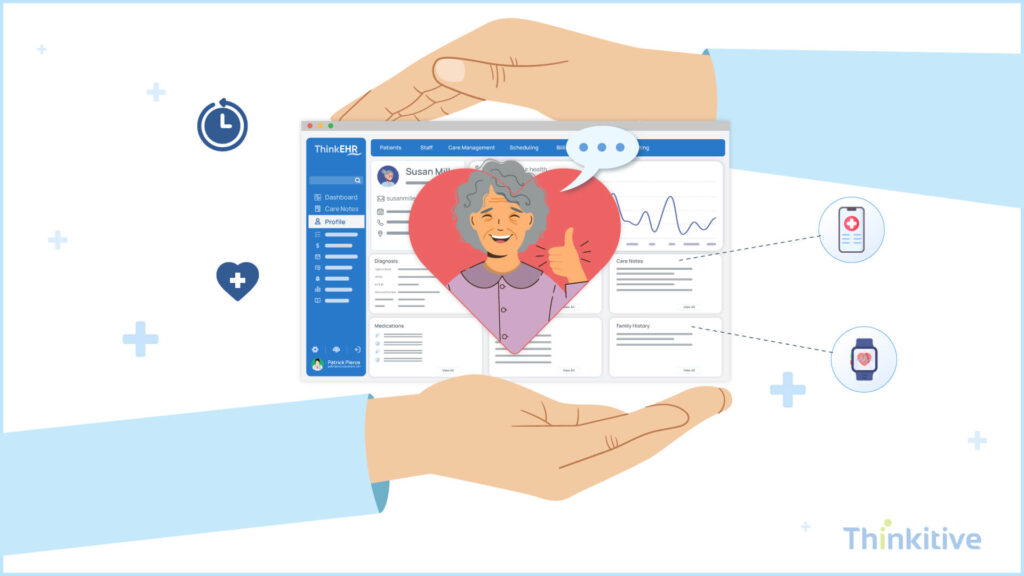
A custom EHR software development approach is often associated with quality of care, and implementing a custom EHR successfully can improve patient care by a mile. Let’s see how:
- Better Patient Outcomes: With data becoming the epicenter for care delivery, clinical decisions can be made effectively without much time spent on diagnosis, etc. Furthermore, allowing patients to take control of their health leads to proactive decision-making with improved patient engagement and satisfaction rates.
- Efficient Patient Management: A customizable EHR streamlines workflows by aligning itself with clinical and administrative activities. Furthermore, automation will reduce administrative tasks, leading to improved care coordination and communication between patients and providers for better patient care practices.
Is Your EHR System Really Secure?
Get Free AssessmentEnhanced Data Security & Privacy
Healthcare institutions are widely adopting healthcare IT solutions, and this has invited new challenges in terms of data security and privacy. But a custom EHR solution can be a solution to that as well; let’s see how:
- Robust Security Measures: Custom EHR software development can include robust security measures with advanced encryption and access control features. Where encryption makes the data hard to decipher, and access control eliminates the chances of unauthorized access. This way, your custom EHR solution ensures the protection of sensitive patient information.
- HIPAA Compliance: Your electronic health records will deal mainly with sensitive information about patients, which can compromise their fundamental rights. HIPAA compliance is required to ensure they are rightly used and safe. And with custom EHR software development, the solution can be set in compliance with the specific sets of rules and requirements. Furthermore, it would reduce the risk of data breaches and fines if there is a mishap.
- Data Integrity and Accuracy: Custom EHR solutions, with their unique approach, can significantly improve data quality, and even consistency can be maintained. This can enhance the decision-making process, turning your care delivery into a value-added, data-backed care delivery.
Increased Operational Efficiency
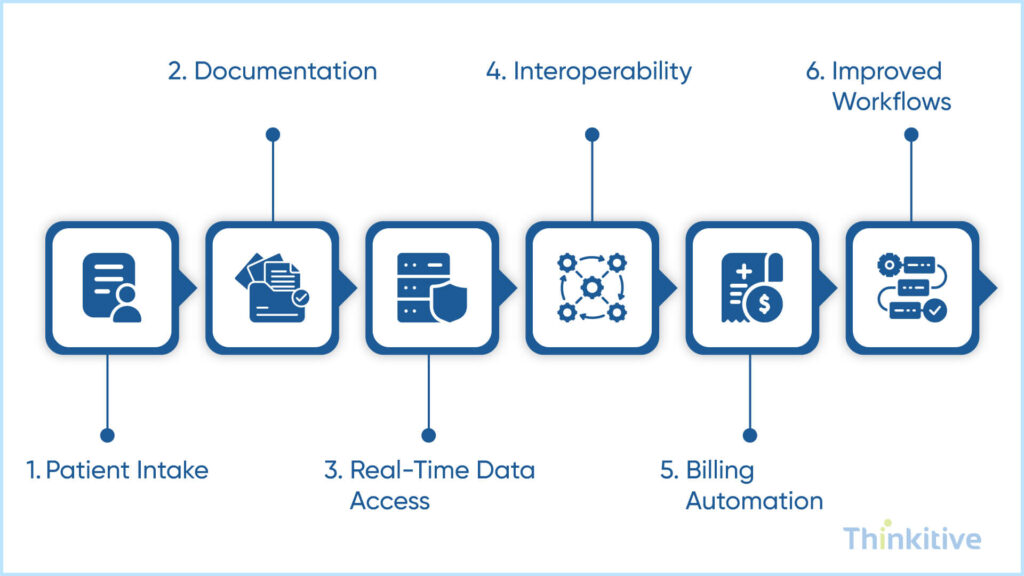
While the clinical aspects are the core of any healthcare, operations play a crucial role in keeping the practice running and profitable. And as discussed earlier, let’s now see how an EHR value proposition can contribute to enhancing the operational efficiency of your clinic:
- Automated Workflows: Automated features in your custom EHR solution help reduce the need for manual task entry to achieve operational efficiency. On top of that, integration and other features reduce, if not eliminate, the margin of human errors, leading to efficiency and increased productivity for administrative staff.
- Real-time Data Access: Timely decision-making can reduce the time to care and improve response time for care delivery. This is made possible with real-time data access that promotes collaboration between healthcare providers to provide better and enhanced care.
- Interoperability: Furthermore, the need for custom EHR in healthcare has been interoperability. You need your EHR system to be interoperable as you constantly have to share data with various healthcare systems such as labs, imaging centers, telehealth platforms, pharmacies and Healthcare Information Exchanges.
Calculate My EHR System ROI
Calculate ROILong-term Cost Effectiveness
The cost of custom EHR solutions is slightly higher than that of off-the-shelf EHR solutions. However, if you are looking for healthcare IT solutions like electronic health records, then a custom EHR solution can bring long-term cost-effectiveness to your practice.
- Reduced Operational Costs: Lower administrative costs and overhead expenses can be significantly reduced by successfully implementing a custom EHR. Features like automation and streamlined workflows are some of the aspects that help improve revenue and enhance the financial performance of your practice.
- Increased Revenue: Again, automation in data sharing can simplify billing procedures for your custom EHR solution. This, when coupled with coding accuracy, can not only enhance your financial performance but also bring transparency to your code of conduct of business, improving patient satisfaction and retention rate.
But before you move ahead or make any decision, read this ultimate EHR software development guide, to know the intricacies and development process in a much better way with all the considerations properly explained.
Real World Use Cases of Custom EHR Software
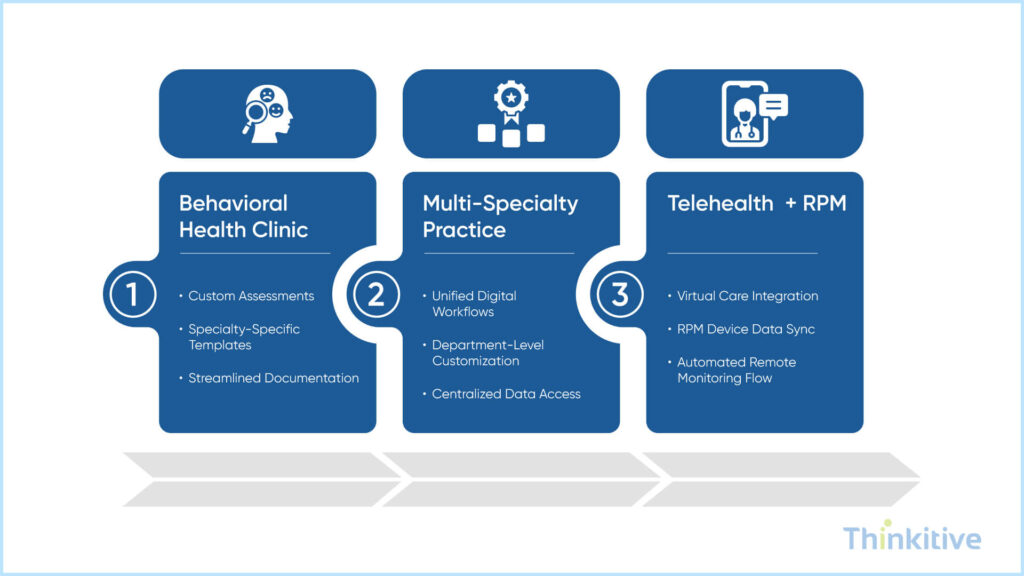
In the last few years, there has been a significant change in the demands of healthcare providers for their custom EHR software development. Here are some of the sneak peeks into the projects we’ve delivered to our clients:
- Behavioral Health Clinic with Customized Assessments: One of our clients was looking for custom EHR software, specific to their behavioral health clinic. They realized that the assessment criteria in their existing EHR were inefficient and irrelevant at times. By addressing their specific needs and aligning the software with their clinical workflows, we delivered customized EHR solutions with a customized assessment dashboard for easy data capture and care delivery.
- Multi-Specialty Practice Using Unified Digital Workflows: Another multi-specialty practice wanted to start its digital transformation. The very first problem they realized was that their EHR software did not align with their digital workflows. By developing a custom EHR specific to their digital healthcare needs, they literally transformed their practice, shifting most of their operations to digital platforms.
- Telehealth Provider Integrating Remote Monitoring & Virtual Care Tools: Noticing the trends in the use of telehealth technologies, a practice wanted to start its own telehealth platform and integrate it with RPM devices and other virtual care tools. Finding a mid-way-out of their solution, we developed a custom EHR platform and integrated a telehealth platform into their software with a specific pathway for the data to flow from RPM devices to their system, etc.
When is Custom EHR the Right Choice?
The importance of customized EHR for specialties is evident, but given the shift in healthcare delivery from traditional to value-based care delivery, every healthcare practice will have to shift to a custom EHR software to address its growing needs and requirements. And that is the importance of custom EHR in healthcare.
Now, you must be questioning if your practice needs a custom EHR or not, right? Well, let this table below be your checklist to see if your practice actually needs a custom EHR or not.
| Checklist Item | What It Means / Why It Indicates Custom EHR |
| Unique clinical workflows | Standard EHRs can’t match specialty-specific processes; custom EHRs fit your exact care pathway and documentation style. |
| Multi-location healthcare network | Custom EHRs scale easily across departments, satellite clinics, and provider groups with centralized data and role-based access. |
| Heavy integration requirements | If you rely on multiple third-party systems (labs, billing, imaging, telehealth), custom EHR supports deeper API-level interoperability. |
| Specialized compliance or reporting needs | Custom solutions adapt to niche regulatory requirements, research reporting, state mandates, and specialty scorecards. |
| Need for higher usability and staff adoption | Custom EHRs minimize clicks, improve charting speed, and boost productivity by aligning with real-world user behavior. |
Conclusion
Electronic health records have become the epicenter not only for care delivery purposes but also to carry out day-to-day administrative activities for healthcare institutions. In a nutshell, over the years, custom EHR solutions have sort of provided healthcare organizations with a one-stop solution for their every need.
And that along with the pointers that we’ve discussed above, can give you an idea about the importance of EHR solutions. Moreover, the future of EHRs in healthcare is slowly laying the solid foundation of digital healthcare practice.
So, what are you waiting for? Let’s start your transformation journey today, click here to get your first free consultation .

Frequently Asked Questions
Custom EHR solutions can significantly enhance patient outcomes by:
- Tailoring care: They can be designed to fit the specific needs and preferences of individual patients and healthcare providers.
- Enhancing communication: They can improve communication and coordination among providers, leading to better care delivery.
- Improving data accuracy: They can help ensure that patient data is accurate, accessible, and up-to-date.
- Facilitating proactive care: They can support proactive and preventive care by providing tools for risk identification and management.
When choosing a custom EHR solution, healthcare organizations should consider factors such as budget, interoperability, data security, workflow integration, and scalability.
Custom EHR solutions can cost hundreds of thousands to millions of dollars, depending on features, complexity, and vendor.
Implementing a custom EHR solution successfully typically takes several months to multiple years. The exact timeframe depends on factors such as the complexity of the project, the size of the healthcare organization, and the level of customization required. Smaller practices may be implemented in 6-12 months, while larger hospitals require 18-24+ months.
Choosing the right EHR vendor requires careful consideration. Key factors include:
- Your organization’s specific needs: Consider your workflow, patient volume, budget, and desired level of integration with other systems.
- Vendor reputation: Research vendor reliability, customer support, and track record of successful implementations.
- EHR features: Evaluate the software’s functionality, user interface, and compliance with relevant regulations.
- Cost: Obtain detailed pricing information, including licensing fees, implementation costs, and ongoing maintenance expenses.
Implementing a custom EHR solution presents several challenges, including high development and maintenance costs, ensuring data security and privacy, integrating with existing healthcare systems and maintaining compliance with regulations like HIPAA.
Custom EHR solutions may be right for your organization if you have unique needs, a sufficient budget, and strong IT support. Consider these factors carefully before making a decision.


