Common Challenges in Custom EHR Development and How to Overcome Them

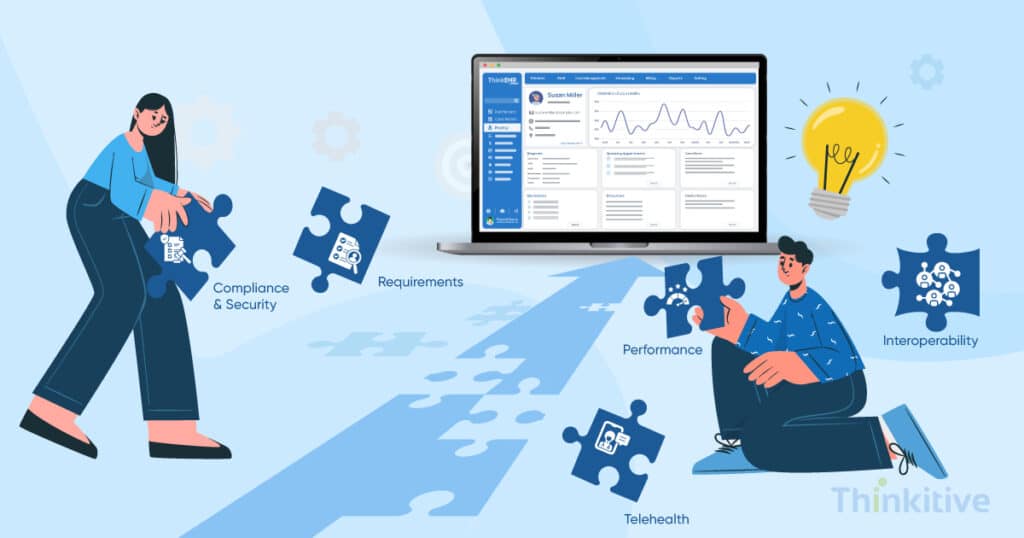
The adoption rate of EHR systems in healthcare practices is nearing a perfect 100%, with the last survey showing an almost 96% adoption rate in certified EHR systems.
Ever since then, the healthcare industry has undergone significant changes that are shaping the way healthcare works and functions. For instance, after the COVID-19 pandemic limited our movements, the demand for telehealth EHR integration increased, and what started as an alternative became a mainstream trend in 2026.
You see, in 2022 alone, according to a SOTI report, almost 70% of healthcare organizations have used certain devices for remote health monitoring of their patients. This report describes several other factors that contribute to the impact technology has on healthcare practices. For instance, it shows 98% of clinics providing frontline services have already adopted IoT into their system.
One of the major trends that we’re living in right now is that 46% of healthcare organizations offer RPM through non-wearable technologies like apps. And somewhere, this is a major upgrade for healthcare practices.
In this quest to make healthcare services more accessible to patients, many healthcare providers are actively pursuing EHR custom software development initiatives. However, a stat that can show you the staggering reality of custom EHR development challenges is that even after developing a custom EHR software, 60% of healthcare IT professionals reported system downtime with the use of these advanced technologies.
And for your Electronic Health Record software to be developed as per your needs, it is important for you to know: what are the common challenges in EHR development, and how to overcome these challenges in EHR.
And trust me, there are a lot!
On that note, in this blog, let’s have a look at the most common and essential custom EHR development challenges and how to overcome challenges in EHR. So, without further ado, let’s get started!
Understanding Custom EHR Development in Modern Healthcare
To understand custom EHR development in modern healthcare, you first need to understand the basic difference between custom EHR software and off-the-shelf EHR software. Here is a quick comparison that will help you understand this difference better:
| Aspect | Custom EHR Software | Off-the-Shelf EHR Software |
| Workflow fit | Built around your exact clinical and administrative workflows. | Forces practices to adapt to predefined workflows. |
| Customization | Fully customizable features, modules, and interfaces. | Limited customization within vendor constraints. |
| Scalability | Scales easily across locations, specialties, and users. | Scalability is often limited or costly. |
| Integrations | Supports deep, API-level integrations (FHIR, HL7, labs, billing). | Integrations are vendor-dependent and often restricted. |
| Control & ownership | Full control over data, roadmap, and future enhancements. | Vendor controls updates, features, and data access. |
For your better understanding, an off-the-shelf EHR software is basically a software that is ready-made and comes with pre-defined features and functionalities. On the other hand, custom EHR software development is the process of developing an EHR software specifically for your practice.
During the development process, you must involve key stakeholders in the discussions. This is important because it is not you who regularly uses the software system; instead, it’s your providers and other staff members.
Now, these users become the key stakeholders, and when you involve them, you can know the real challenges that they face. This way, you can design and develop the software in a better way and provide these users with a delightful experience.
The strategic value of EHR custom software development is reflected in this stage.
Defining Accurate Clinical & Technical Requirements

The very first step in custom EHR software development is the discovery phase. It is at this phase that you identify, define, and curate the clinical and technical requirements of your custom EHR.
While this stage is the most important stage of your custom EHR software development venture, some of the crucially important things related to your practice’s workflows are ignored here.
Now, the problem with this is that when your EHR software requirements are not completely met or aligned with the needs of your practice, the users get frustrated. This increases the chances of rework as most of the data is stored in isolation or fragments, and this results in delays and other inefficiencies in your custom EHR.
On top of that, unclear clinical and technical EHR software requirements can lead to misalignment of your entire practice. In simple words, inefficiencies can be experienced in clinical workflows, and administrative aspects of your practice will be nothing short of a haywired process. Here are some ways in which you can overcome these challenges:
- Workflow-based requirement discovery process
- Stakeholder validation and sign-off
- Structured requirement documentation
So, overcome the first and most important challenge that you might face during custom EHR development by paying attention to your development phase. With specific requirements and planning, the development of that aspect can lead to the success of custom EHR software.
Interoperability & Data Exchange Across Healthcare Systems
Have a look at this: according to this survey, almost 62% of the healthcare professionals cited poor data integration as the direct cause of delays in diagnosis and care delivery.
This might give you a brief idea about the interoperability and data exchange challenges that you need to overcome during your custom EHR software development. But before diving deep into the challenges, let’s first understand why it is important.
You see, your EHR acts as an epicenter for almost all the healthcare activities that take place in your practice. For your providers to get a holistic and comprehensive overview of a patient’s healthcare journey, your electronic health records software must be integrated with external healthcare software systems like labs, pharmacies, HIEs, and other third-party systems.
Only when your custom EHR software is integrated with other healthcare systems can you seamlessly exchange data between your EHR system and other systems.
However, for your system to communicate and connect with other disparate healthcare systems, achieving interoperability is extremely important. For this, you need to adhere to healthcare interoperability standards such as FHIR, HL7, etc.
Adhering to these healthcare interoperability standards sets the base for the information to be stored in your software. With these healthcare interoperability standards, your system can communicate with other disparate systems and enable data sharing whenever necessary.
By overcoming the interoperability and integration challenges, you basically improve the care coordination aspects in your practice. Furthermore, by removing manual data entry procedures, you also ensure data accuracy of the exchanged information in your software systems.
Regulatory Compliance & EHR Data Security

Remember the high adoption rate we discussed earlier in this blog?
Well, out of those 96% US hospitals that have adopted EHR systems, almost 78-88% of those practices imply low non-compliance with HIPAA safeguards.
Now, imagine the challenges that you might encounter with respect to regulatory compliance or data security during your custom EHR software development.
But you’re not to be blamed completely. Due to the evolving nature of healthcare practices and technologies, the regulations are getting more strict, and so are the risks of cybersecurity. The number of data breaches is shocking, and a major breach can lead to hefty fines, legal procedures, financial penalties, and reputation damage.
However, there is a simple yet complex solution to this. You see, while you design your EHR software, keep security and compliance as your blueprint for development. For instance, identify all the core security aspects that are common in all the compliances. This will help you design your electronic health records software with security-by-design principles and align it with EHR data security compliance.
Some core aspects of these security-by-design principles are:
- Data Encryption: The core aspect that ensures your data is always secure and protected, even during transmission or when it is at rest. If you’re implementing a key mechanism, then this would ensure that only systems with the key can access and make sense of that information. Due to this, even if your system is breached, the integrity of the data would be safe as it would be unreadable.
- Role-Based Access Controls: With role-based access controls, you define the roles in your practice, and they only have access to certain sections of data, which is important to them. Not everybody in your practice needs access to all the data your practice has to offer.
- Audit Logging: This feature is extremely important as you deal with the most sensitive data of your patients. With these features, you can keep track of every activity that is happening in your system. This gives you a chance to identify any loopholes in your security and address them before any major mishap.
With these EHR data security compliance features, you can lay the foundation of secure electronic health record software.
However, the worst part about compliance is that they constantly change. Due to this, you have to make changes to your system every once in a while. And this is one of the most integral things that you need to do. Continuously monitor the compliance and your system for any loopholes and threats.
Integrating Telemedicine Into Custom EHR Systems
Ever since COVID-19, almost everyone shifted from traditional healthcare practices to digital healthcare practices. However, given the convenience and other factors that came with it, the patients demand it from practices.
And this has today become a norm in younger generations. However, with telemedicine EHR integration, you make the arc complete for the digital transformation of your healthcare practice and enable virtual care.
However, the challenges you would most likely face in this are maintaining workflow continuity between in-person and virtual care.
Enabling Seamless Telehealth Experiences Within EHRs

Talking about telehealth, it is important for you to understand that telehealth has become one of the major parts of healthcare delivery. You see, with telehealth EHR integration, you add the factor of convenience to access care.
However, providing a seamless experience for both providers and patients over telehealth platforms is the challenge that you’ll most likely face. Some of the core challenges that you’re likely to face are:
- Fragmented remote-care workflows: Remote-care workflows, if not connected, can be isolated. This might create data gaps during consultations and other aspects.
- Poor provider and patient usability: Since consultations depend on many factors like the internet, device, etc., it can offer very poor experiences for both providers and patients.
However, the best way to overcome this problem is by EHR-native telehealth design. In short, by building a telehealth platform into your custom EHR software, your software can itself be used as a telehealth platform.
Furthermore, check for your software’s remote access performance with optimized UX for delightful user experiences. Also, with EHR performance optimization best practices for remote delivery, you can ensure the performance of your software under different circumstances.
Performance & Scalability in High-Volume EHR Environments
Talking about EHR performance optimization, this is also one of the core reasons why many healthcare practices are making a shift from off-the-shelf EHR software to custom EHR software development.
You see, as time passes by, your practice is bound to increase, and with that, there will be a surge in data as well. Your system will already have data that you migrated from development, then it generated some of its own, and then some that you add. Now, any software system can handle data to some extent.
And as data increases, the load on your system increases. This impacts the performance of your system; at times, it can become slow, and sometimes even cause the entire system to slow down. To avoid such, you need to adopt EHR performance best practices.
During the development stage, one of the best things that you can do is adopt a scalable EHR architecture with cloud infrastructure. And when developing fully, you need to rigorously test it for load and stress. With successful testing, your system is able to manage high data volumes much more effectively.
Choosing the Right EMR/EHR Development Partner

If you’ve made it this far, then I can be assured that you’re actually thinking about custom EHR software development. And you’re at the right place and at the right time.
Since you’re here, it feels like a compulsion to tell you that your custom EHR software will only be successful when you are developing it with the right vendor or development partner. The right EMR development company will understand your EHR software requirements accurately, provide you seamless telehealth EHR integration, and adhere to healthcare interoperability standards.
However, if you’re choosing a development partner that does not hold expertise in the healthcare domain, then they might develop the software, but the custom EHR development challenges will delay the process. Moreover, the post-implementation challenges might give you a feeling of a rigid system, just like off-the-shelf software.
That is why, when you’re dealing with an EMR development company, evaluate them on the basis of their technical knowledge and stronghold. Other than that, check for their expertise and the best practices they adopt. In this EHR data security compliance is something that you need to check.
And last but not least, check if the vendor is able to develop scalable EHR systems and how.
Note: if you’re developing a custom EHR software from a development partner, then aim for a long-term partnership. This comes in handy for a lot of things, including security, features, scalability, compliance, etc.
Key Benefits of Electronic Medical Records for Modern Healthcare
You probably already know the benefits of electronic medical records. However, it is my duty to inform the new providers, who are looking for EHR custom software development, of the benefits of a custom EHR system in modern healthcare.
- Operational Efficiency & Reduced Administrative Burden: One of the major advantages of custom EHR systems is that they improve the operational efficiency of your practice by improving access to data. On top of that, with features like automation and synchronization, most of the administrative overhead can also be reduced.
- Improved Clinical Decision-Making & Care Coordination: Access to data in real-time, which is holistic in nature, your providers can always turn to data for making any clinical decision. This will embed evidence-based practices into your system. Furthermore, with seamless integration, you can coordinate care better and ensure that everyone in a particular care team is on the same page and working towards the same goal.
Conclusion: Building Future-Ready Custom EHR Systems
On that note, if you’re still here, then salute to you!
You’ve genuinely come a long way, and congratulations, you’ve covered almost all the custom EHR development challenges that you’re most likely to encounter. Then let that be related to EHR data security compliance, or EHR performance optimization; it can be overcome during the EHR software requirement gathering, or the discovery stage.
And all these efforts will go to waste if your development partner is not capable.
On that note, ride the digital wave of healthcare with EHR custom software development and let this blog be your guide to seamlessly overcome it. If you don’t know where to get started, then click here to get your first free consultation.
Frequently Asked Questions
In 2026, the biggest challenges include regulatory complexity, interoperability across fragmented systems, clinician burnout due to poor UX, scaling performance for high patient volumes, and integrating AI responsibly. These challenges are best addressed through compliance-first architecture, modular system design, clinician-led UX research, and cloud-native infrastructure.
Custom EHRs are designed around real clinical workflows—not generic templates. They eliminate unnecessary clicks, reduce redundant data entry, and align documentation with specialty-specific care pathways. Unlike off-the-shelf systems, custom EHRs adapt to clinicians instead of forcing clinicians to adapt to software.
Key cost drivers include system scope, specialty complexity, regulatory requirements, interoperability needs, data migration, AI features, and long-term scalability. While upfront costs may be higher than subscription-based EHRs, custom systems often deliver lower total cost of ownership (TCO) over time.
Compliance is ensured through encrypted data storage, role-based access control, audit logs, consent management, secure APIs, and regular security testing. A compliance-by-design approach—rather than retrofitting security—helps organizations meet HIPAA, GDPR, and evolving global privacy regulations.
A comprehensive checklist includes clinical documentation, scheduling, billing integration, interoperability (FHIR/HL7), audit logs, role-based access, analytics, reporting, telemedicine integration, scalability, and system performance benchmarks—along with regulatory and security requirements.
Most custom EHR systems take 6–12 months depending on complexity, specialty scope, and integrations. Phased development with an MVP approach allows faster deployment while continuing to enhance features without disrupting clinical operations.
AI helps automate clinical documentation, surface relevant patient insights, reduce data overload, and improve decision support. When implemented responsibly, AI enhances efficiency without replacing clinical judgment—making EHRs more intelligent, not more intrusive.
Seamless telemedicine EHR integration requires native video workflows, real-time data syncing, secure patient portals, and unified clinical records. Custom EHRs allow telehealth features to be embedded directly into care workflows rather than treated as disconnected add-ons.
Best practices include API-first development, strict adherence to FHIR profiles, version control, standardized data mapping, and continuous validation testing. Custom EHRs provide greater flexibility to evolve with interoperability standards without vendor lock-in.
Performance issues are addressed through scalable architecture, database optimization, load balancing, caching strategies, and real-time monitoring. Cloud-native and microservices-based EHR architectures prevent system slowdowns as patient volume grows.
Cloud-based EHRs offer scalability, remote access, and lower infrastructure overhead, while on-premise systems provide greater control over data residency. Many modern custom EHRs use a hybrid approach to balance compliance, performance, and flexibility.
Data migration is handled through structured data mapping, validation layers, phased migration, and parallel system testing. Custom EHR development minimizes data loss while ensuring historical patient records remain accurate and accessible.
Organizations should look for healthcare domain expertise, regulatory knowledge, interoperability experience, strong UX capabilities, and a proven track record in scalable healthcare software development—not just technical skills.
Scalable architecture uses elastic cloud resources, modular services, and fault-tolerant design. This ensures consistent performance, high availability, and minimal downtime even during peak clinical demand.
Poor UX leads to clinician frustration, longer documentation times, and lower adoption. Custom EHRs overcome this by involving clinicians early, simplifying interfaces, and designing workflows that support care delivery—not slow it down.


