Ultimate EHR Software Development Requirement Checklist

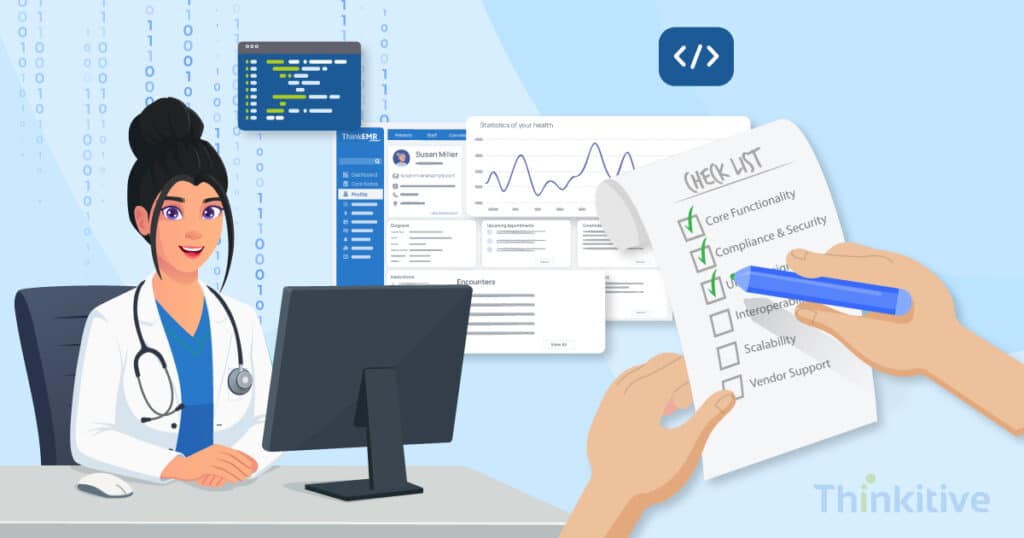
Did you know, according to the American Medical Association, that 70% of physicians report EHRs as their major reason for burnout?
Some of the major reasons for the increased burnout rate among providers are due to EHR software’s rigid usability, workflow inefficiencies, and clerical work that never seems to be completed.
Despite this, the healthcare industry today is mostly dependent on EHR software systems. You see, ever since its adoption, it has slowly made its way to become the epicenter of care delivery. And for valid reasons, as almost all the types of data flow through it.
Furthermore, the widespread adoption of off-the-shelf EHR software systems provided a different set of problems. One of those is interoperability, where only 30% of the organizations reported seamless data exchange between their healthcare software systems and disparate systems.
The impact of this can be seen in the time spent on the EHR system. To give you an example, a study suggested that for every one hour a provider spends on patient care, he/she has to spend almost 2 hours on EHR work.
And for a practice that is already burdened with huge amounts of data and patient flow, bringing the focus of providers from documentation to patient care becomes extremely important.
This is where custom EHR software development comes into the picture. It is an approach that allows healthcare organizations to design, develop, and customize an EHR based on their own workflows and requirements.
However, though the demand for custom EHR software projects has increased, many of those projects fail due to various reasons. When I tried to find a reason for this, it turned out that the EHR development checklist is often missing.
But what exactly is an EHR software requirement?
Well, the EHR software development requirement checklist is nothing but a checklist of all the features and functionalities that your custom EHR software must have. This includes both the clinical and administrative sides of the software.
But this can be quite a challenge for someone who has very limited expertise in the IT domain. And as the healthcare industry is experiencing a shift from static EHRs to intelligent and integrated EHR systems, having this EHR development checklist becomes even more important.
On that note, to help you develop your EHR software that meets your needs, let this blog act as a guide as well as an EHR software development requirement checklist. So, without further ado, let’s get started!
Assess Your EHR System for AI Readiness
Get Free AssessmentEHR Software Development Requirements Checklist
| Checklist Area | What to Define |
| Core Functionality | Patient management, scheduling, ePrescribing, clinical workflows |
| Compliance & Security | HIPAA, GDPR, TEFCA, encryption, RBAC, MFA |
| UI/UX Design | User-friendly interface, mobile access, customizable dashboards |
| Interoperability | HL7 FHIR, HIE, lab, pharmacy, third-party integrations |
| Scalability | Cloud architecture, growing data volumes, AI readiness |
| Data Strategy | Structured data, analytics, AI, data standardization |
| Customization & Support | Workflow customization, vendor support, maintenance |
What Core Features Should Your EHR Software Requirements Checklist Include?
The first thing you need to do while creating your EHR software requirements checklist is to define its core functionality. And as you know, the features define the functionality of any software. For your EHR software, you need to first define the EHR software features.
Here are some of the major EHR system functionalities that you must have in your EHR software requirements checklist:
- Patient Management: Storing and managing patient data is basically the purpose of an electronic health record system. That is why, while mapping the EHR software development requirement, the EHR software features of patient management are something that it must have. Some of the major functionalities in this are storing patient demographics, medical history, and the current health status of any ongoing medication, treatment, etc.
- Appointment Scheduling: Moving a little away from patient data management and including the EHR software features that set the first step for a patient’s clinical journey and practice administration is the feature of appointment scheduling. In this, you need to integrate your software with calendars with clear availability management and custom appointment reminder functionalities. On top of that, to add convenience, you must also add the factor of appointment rescheduling and cancellation.
- Prescription Management: What is done after consultation? Yes, you are right, prescriptions are handed out. And it is one of the major things in the patient’s care journey, which you are trying to digitize, and simply, you must include the functionality of electronic prescriptions, drug interactions, and establish a connection with the pharmacy system.
These functionalities can differ a little when you cater to the different and specific needs of the healthcare organization. For instance, if you are providing specialty services, then both the clinical and administrative workflows change. In such cases, it becomes important for the EHR software to align itself with the workflows. This way, the software workflows and practice’s documentation workflow functions in sync, removing additional hindrances from the process.
Note: During the creation of the EHR system requirements, ensure you add the requirements as per the needs of your EHR system that supports care delivery and reporting. These two are the major features that allow your practice to shift towards holistic care delivery.
Regulatory Compliance & Security Standards
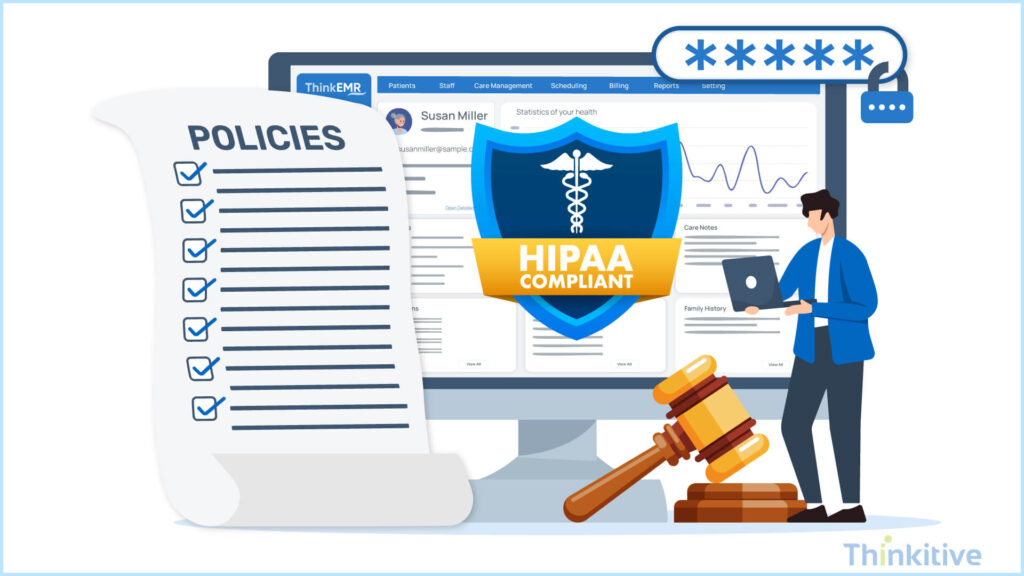
The health data of individuals is very personal, and since your EHR Software will be majorly dealing with personal health information of your patients, it automatically becomes your responsibility to ensure its safety and privacy. That is why there are some regulatory compliances and security standards that you need to adhere to, to ensure your software has taken all the data security and privacy measures.
- HIPAA Compliance: HIPAA stands for Health Insurance Portability and Accountability Act, which is a federal law of the United States. It sets the rules and guidelines to ensure data safety.
- GDPR: GDPR stands for the General Data Protection Regulation, which is a European Union law that protects the data of the citizens of the European Union. It is similar to that of HIPAA in the United States and sets guidelines for the collection and processing of individuals’ personal information and its ethical use.
- Data Encryption and Secure Data Storage: You see, your complete system understands a different language, which is the binary language. In such cases, while transmitting data from one system to another, there is a high chance of a data breach, which can compromise the fundamental rights of the individual. However, with data encryption, you add another layer of protection to your data, further ensuring its privacy.
Failing to comply with these regulations can lead to serious consequences such as hefty fines, legal troubles, and even reputation damage. That is why you need to take robust security measures like two-factor authentication and implement role-based access control, encryption, etc.
Having this in your EHR development requirement checklist is necessary because as your system integrates with third-party apps, devices, and BI tools, security requirements also increase, and it must address API security, identity management, and continuous monitoring. By having this as your functional requirements of the EHR system, it covers compliance risks, avoids costly rework,s and gains provider and patient trust.
Talking about data exchanges, TEFCA (Trusted Exchange Framework and Common Agreement) cannot be ignored. Today, it is shaping how healthcare organizations exchange information nationwide. Having an adherence to TEFCA in your EHR software requirements checklist will ensure that your EHR is future-ready, avoids interoperability roadmaps, and supports broader care coordination as the healthcare industry evolves.
Download Compliance & Regulatory Requirements Checklist
Download ChecklistUser Interface and User Experience (UI/UX) Design
Moving ahead with core EHR system functionalities and EHR software development requirements checklist, the first thing you will encounter is the User Interface and User Experience (UI/UX). Here are some of the things that you need to have on your checklist to build an ideal EHR software for your practice:
- User-friendly Interface: As a provider, the priority is your patient’s health; in such cases, having a complex UI can lead to spending more time on the system. This can disrupt the flow and other factors in the care delivery. That is why minimizing the learning curve for healthcare providers keeps the interface as easy and comprehensive as possible.
- Mobile Access: Since most of the patients will be using mobile devices for appointments and daily communication, designing a responsive design for mobile apps as well is also necessary.
- Customizable Dashboard: Have a customizable dashboard that will allow healthcare providers to prioritize and streamline the information they want to see. This will not only enhance the care delivery process but also make the job very simple and easy for healthcare providers who deliver care.
One of the best practices to reduce clinical workload and burnout percentage of your providers is to design the User Interface with respect to the workflows of your practice. For instance, when you align the design of your software and compare it with the UX of the software, you can understand that most of the additional features can be removed.
Furthermore, by making your system smart with EHR integration, automation, and synchronization, most of the manual repetitive tasks, such as data entry, can be bypassed. Saving valuable hours of providers.
Last but not least, if you wish to include AI into your EHR system, then add Ambient Clinical Intelligence readiness to your EHR software requirements checklist. This feature supports voice-to-text documentation, so the system can take notes in real-time.
Data Interoperability & Integration Capabilities
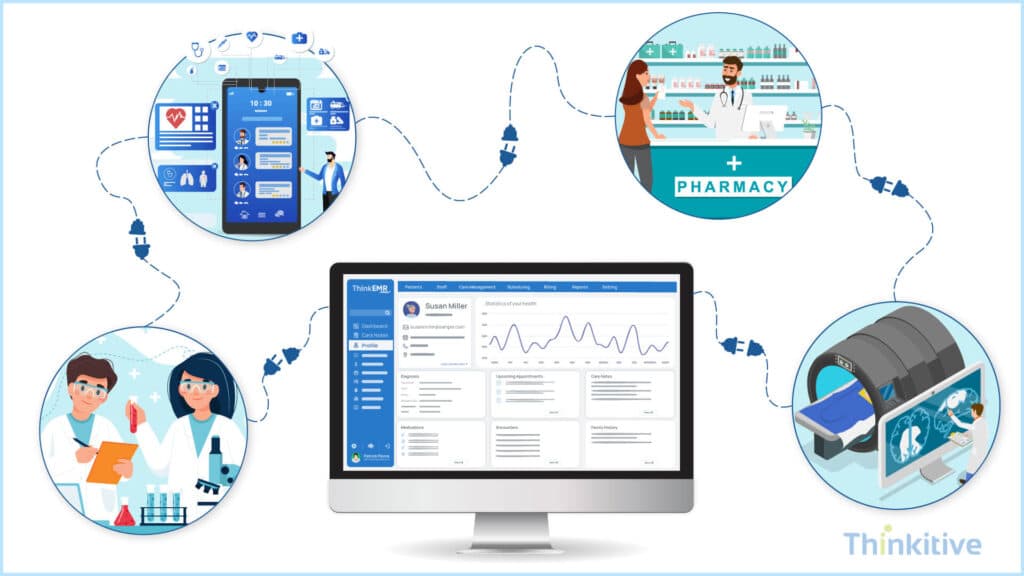
When choosing an EHR software vendor, their specialty in data interoperability and integration must be on your EHR development requirement checklist. Here are some things that must be considered for this:
- Integration with Lab Systems: Given the high dependency of the healthcare organization on laboratories for results, an integration with their system will allow seamless transfer of results directly into the patient’s EHR.
- Electronic Health Information Exchange (HIE): With integration with HIE, you can ensure that your EHR system can easily communicate with other healthcare systems. This will not only enhance patient care coordination but also have a significant impact on improving the quality of care.
- Third-party Integration: Other than other healthcare systems, you also need to integrate your software with third-party software such as billing software, insurance providers, and even telemedicine software.
Talking about integration and interoperability in EHR systems, adherence to HL7 FHIR R4/R5-based data exchange must be your major EHR system requirement. Without FHIR, your EHRs are likely at risk of limited interoperability, and restrict your practice in national health information exchange initiatives.
NOTE: With the digital healthcare services taking over traditional care delivery processes, telehealth-ready architecture functional requirements of the EHR system must be included in your checklist. This way, even if you’re providing digital care ,it will not lead to fragmented workflows, duplicate systems, and poor clinical and patient experiences.
Free Guide on Future-Proofing Your Custom EHR System
Download Free GuideScalability & Future-Proofing
Since you will be using your customizable EHR software for a long time, you will have considered the ever-evolving nature of the technical as well as digital healthcare landscape. Depending on that, here are some considerations that you can include in the software infrastructure that you must have on your checklist:
- Cloud-Based EHR Solution: When it comes to scalability, a cloud-based solution is something that is unmatched. Moreover, it will not only offer the flexibility that it offers in customization but also give you the option of unlimited data storage.
- Handling Increased Data Volume: Remember that with time, as your practice increases, the data load on the software will also increase, which will also increase the load on the software. That is why your custom EHR should have the ability to handle the growing patient records that your healthcare practice has also increased.
- Future Technology Trends: With AI, machine learning, and predictive analytics making headlines in the healthcare industry every now and then, it would be wise for you to include such technologies in your software. It will set the bedrock for future innovations and can make it easy for your digital healthcare practice to adapt to the changing nature easily and rapidly.
Having a scalable architecture in your functional requirements of EHR systems can go a long way. For instance, with scalable architecture, your software can easily adapt to the growing needs of your practice, such as data, providers, users, specialty workflows, etc.
Due to this, even when your practice is under immense pressure, your software can easily accommodate your needs without compromising performance.
TIP: If you’re making your EHR system intelligent, then add AI infrastructure readiness in your EHR software requirements. This is one of the core aspects for your EHR software to support analytics and predictive modeling.
Having said that, there are going to be numerous challenges when curating your practice’s customizable EHR system. While there are various ways to deal with that, just knowing about them can make things much easier. On that note, know the most common challenges you’re going to face while custom development. Read our blog – Common Challenges in Custom EHR Development and How to Overcome Them, to be a step ahead in the process.
Step-by-Step Custom EHR Implementation Roadmap
Get Free ConsultationData Strategy & Intelligence Readiness
While creating your EHR software development requirement checklist, data standardization and structured clinical data models must be present. You see, you’re building a custom EHR software, which you will probably use for a long period of time.
Now, by having clean and structured data, your system understands the data in a better way. This promotes integrations, interoperability and creates a base for making your EHR software intelligent. By implementing a quality data strategy, such as data validation, normalization, etc., you can embed intelligent features into your EHR software, such as analytics, AI, and interoperability outcomes.
However, keep this EHR software requirement as one of the core requirements that must be implemented at the early stages of EHR software development.
Customization & Vendor Support
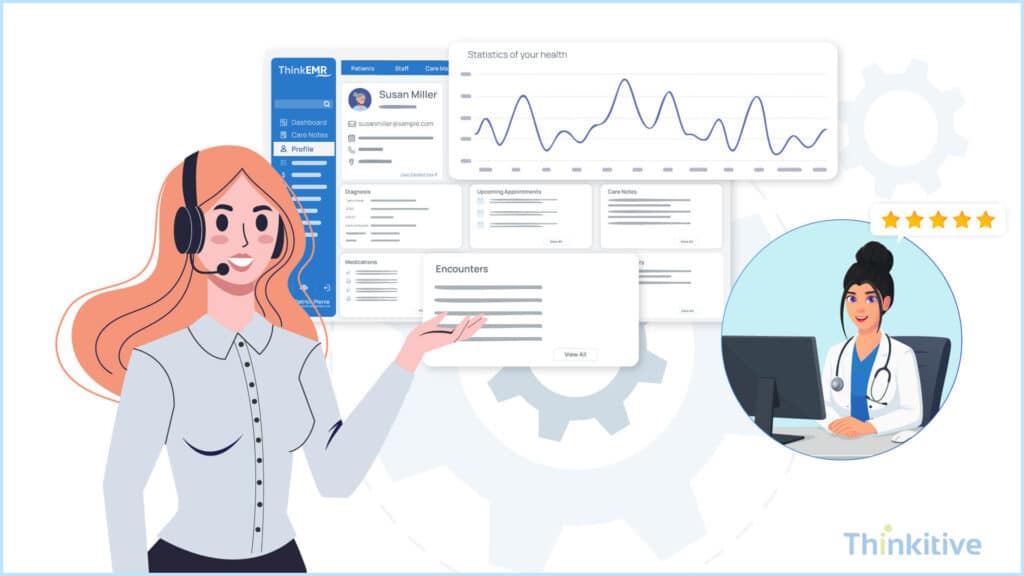
The last and most important checklist item, which in many cases should be the first, is customization offerings and vendor support. Vendor support plays an equally important role because it helps keep your EHR secure, updated, and running smoothly throughout its lifecycle. In this checklist, here is something that must be there:
- Customizable Features: You see, the technological and healthcare landscapes are always changing. That is why you need to ensure that no matter what, your system should be able to adapt to these unique workflows and user needs. And the only way to ensure that is by having customizable features that make life easier not only for your EHR developers but also for your practice.
- Vendor Relationship: The best way to get your work done is by having good relations with your EHR software developers. As a development partner, learn what you need from them and have constant support from them. This will keep you in the loop and will update you constantly on how much and how the software is being built.
- System Updates and Maintenance: Given the ever-changing nature of the healthcare technological landscape, you need to stay updated with the ever-changing legal landscape as well. This will not only keep you in the loop for feature improvements but will also keep you in the loop for security, compliance, and the legal landscape.
However, building a custom EHR comes with its own set of challenges, and if the common pitfalls are ignored, it cannot give you an ideal EHR software. Keeping that in mind, click here to know the most common challenges you’re likely to encounter and how you can overcome them.
Having said that, when defining your EHR implementation roadmap, cover crucial aspects like post-launch optimization and enhancements in your system. As the healthcare technological landscape is constantly changing, you always need to make certain changes and updates to your system.
While you’re at it, when building the core AI components of your EHR software, ensure you meet the quality assurance requirements in your EHR development requirement checklist. In this, you need to aim for accuracy and remove biased suggestions.
Know the Functions in Your Custom EHR that can be Powered by AI
Get Free ConsultationConclusion
To summarize, I wanted to keep this article short, but couldn’t as there is so much to cover for your very short attention span. So, even reading the headlines would keep you in the loop for what you will find in this blog, and it will be a complete checklist for building an ideal EHR software that is also your practice management and virtual consultation software.
I hope I have answered the broad question – ‘What are the requirements for EHR development?’ and provided you with the EHR software development requirement checklist that will help you in the entire development process.
On that note, let this guide be your ultimate checklist, which can be your guide to every software development. And you are looking for someone to verify and turn your business ideas into practical solutions, then book your free demo and learn more about EHR software development services .
Frequently Asked Questions
In 2026, the functional requirements of an EHR system extend far beyond basic charting. A modern EHR software development requirement checklist should include:
- Patient registration and longitudinal medical records
- Clinical documentation with specialty-specific templates
- ePrescribing and medication management
- AI-assisted clinical decision support
- Integrated telehealth and remote patient monitoring (RPM)
- Interoperability using HL7 FHIR R4/R5 standards
- Revenue cycle, billing, and claims management
- Reporting, analytics, and quality measure tracking
Custom EHR development ensures these functions align directly with real clinical workflows rather than forcing providers to adapt to rigid, off-the-shelf systems.
The EHR software development process timeline depends on scope, compliance needs, and integrations. On average:
- Discovery & requirements checklist finalization: 4–6 weeks
- Design & architecture planning: 4–8 weeks
- Core EHR development: 4–6 months
- Integrations, testing, and compliance validation: 2–3 months
A fully custom EHR typically takes 6–9 months from checklist to production launch, with phased rollouts often used to accelerate early adoption.
The cost of EHR software development varies based on complexity, but typical ranges include:
- Basic custom EHR: $80,000–$150,000
- EHR with AI automation and analytics: $150,000–$250,000
- Enterprise-grade EHR with telehealth, RPM, and interoperability: $250,000–$500,000+
While upfront costs may be higher than subscription-based systems, owning a custom EHR significantly reduces long-term licensing fees, integration costs, and workflow inefficiencies.
To ensure compliance, your EHR software requirements checklist must explicitly address:
Key areas to focus on:
- Role-based access control and audit logs
- End-to-end data encryption (at rest and in transit)
- Secure identity and consent management
- Interoperability governance aligned with HIPAA security rules
- Nationwide data exchange readiness under TEFCA
Working with healthcare-focused EHR developers ensures compliance is embedded into system architecture—not retrofitted later.
Understanding this distinction is critical when creating an EHR development requirement checklist:
- Functional requirements define what the EHR does — clinical workflows, documentation, scheduling, billing, and patient engagement features.
- Technical requirements define how the EHR is built — system architecture, APIs, cloud infrastructure, security controls, scalability, and performance benchmarks.
A strong EHR software requirements checklist balances both, ensuring the system is clinically effective and technically future-proof.


