We took the full cycle: eligibility before the session, session-based charge capture, and the 90837 and unit-count edits behavioral health payers reject most often, scrubbed pre-submission. Charges now reconcile against sessions daily, and denials are worked to appeal inside the platform their clinicians already document in.

Trusted by 125+ Clinics
Outsource Medical Billing at 2.5% Flat
Reduce claim rework and payment delays with a 97% first-pass acceptance rate, Get end-to-end medical billing services to maximize reimbursements and streamline your revenue cycle.
Free billing audit in 48 hours. No setup fees. Works with your EHR and clearinghouses.
Book a Free Billing Audit
No calls required. No patient data needed.
Audit request received.
A senior billing specialist will reach out within one business day to set up your walkthrough. Want to lock in a time right now?
Maximize Your Net Collections with Medical Billing and Coding Outsourcing
Outsource your medical billing to improve your net collection rate and accelerate reimbursements with AI-powered claim verification, certified medical coders, proactive A/R follow-ups, and smarter denial management.
Net Collection Rate
Maximize earned revenue with accurate billing, timely claim submissions, and consistent follow-ups that help your practice collect more.
Claim Verification
Submit cleaner claims with accurate coding and thorough checks that reduce avoidable rejections and keep reimbursements moving.
Clean Claim Rate
Identify missing information, coding inconsistencies, and potential claim errors before submission to reduce rework and payment delays.
Average A/R
Keep claims moving with timely payer follow-ups, diligent A/R tracking, and consistent action on outstanding balances.
Denial Recovery Rate
Recover more revenue through timely denial analysis, targeted appeals, and persistent follow-ups on underpaid or denied claims.
Certified Coders
Rely on certified coding expertise to support accurate documentation, appropriate code selection, and cleaner claims across specialties.
3 Reasons to Choose Thinkitive for Medical Billing Services
See how Thinkitive's medical billing services can improve collections and reduce billing costs. Calculate your potential savings with a flat 2.5% fee.
Calculate My Savings →-
Maximize Reimbursement 95% net collection
Keep more of what you earn. Certified coders and pre-submission claim checks help reduce errors and underpayments, improving the share of revenue your practice collects.
-
Simplify Your Revenue Cycle Management one accountable team
One dedicated team manages your billing workflow from eligibility checks to A/R follow-ups, reducing administrative work and giving your practice a single point of accountability.
-
Reduce Claim Denials 32% fewer denials
Pre-submission checks for eligibility, coding, documentation, and payer requirements help prevent avoidable denials, reduce rework, and keep reimbursements moving.
End-to-End Medical Billing Services for Healthcare Providers: From Claim to Cash
Focus more on patient care while a dedicated team manages your revenue cycle. From eligibility verification and medical coding to claims, denial management, and A/R follow-ups, get comprehensive medical billing and consulting services tailored to your workflows.
Insurance Verified Before the Patient Arrives
Catch coverage issues early with medical billing services that help reduce preventable denials and front-desk follow-ups.
Automated Eligibility Verification
Early Coverage Issue Detection
Daily Verification Coverage
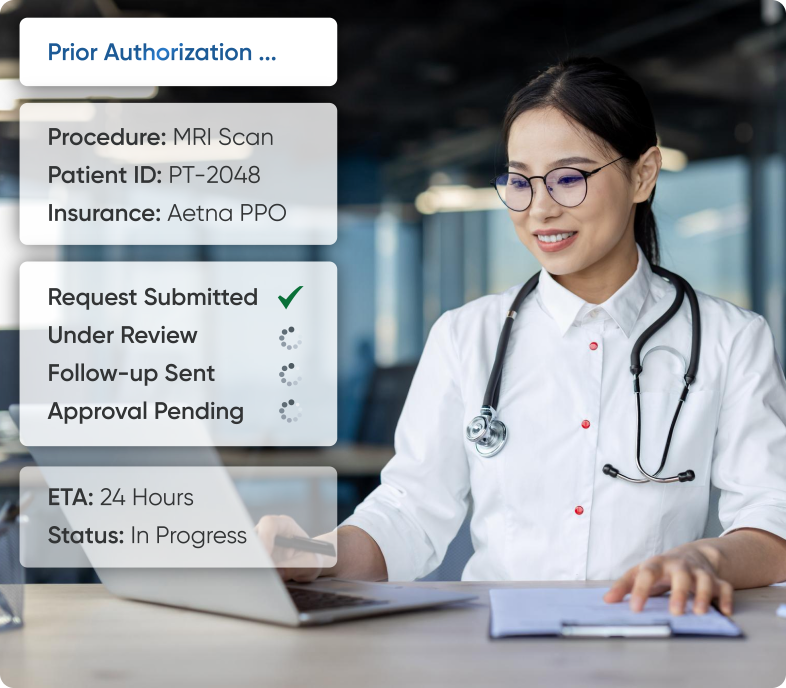
Prior Authorizations Handled From Submission to Approval
55% faster turnaround, without your staff spending hours chasing payer approvals.
Authorization Submission & Follow-Up
Payer-Specific Requirement Checks
Dedicated Authorization Support
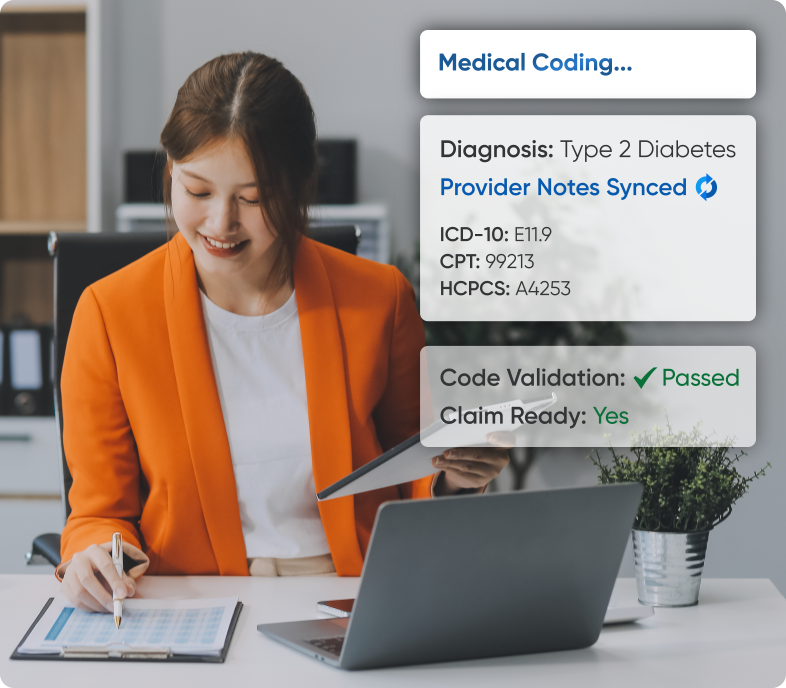
Certified Medical Coders Without Adding to Your Payroll
Access expert medical billing and coding services without the overhead of building an in-house team. Support accurate coding, cleaner claims, and consistent billing workflows across specialties.
Certified, Specialty-Matched Coders
ICD-10-CM, CPT & HCPCS Coding
Continuous Coding Coverage
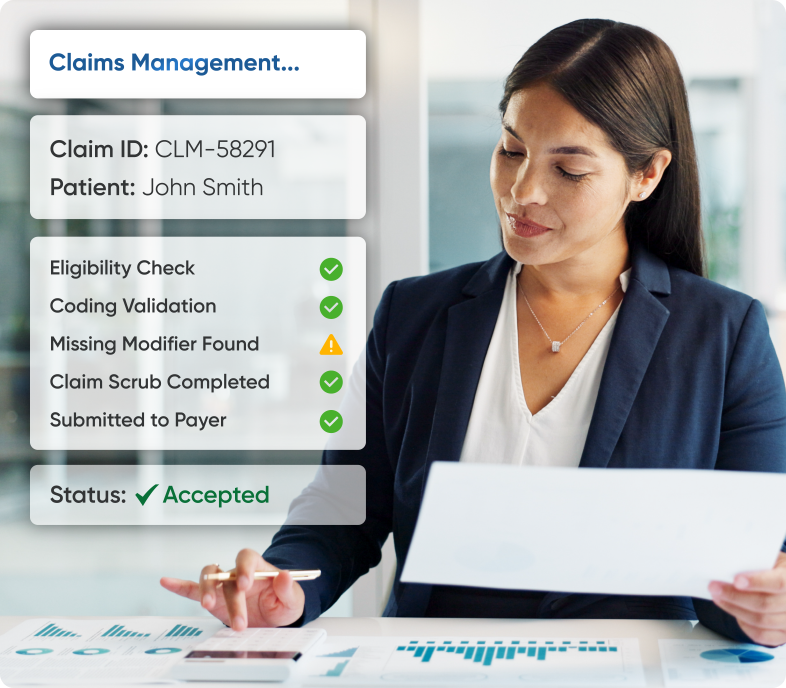
Claims Submitted Every Business Day, Without the Backlog
Keep reimbursements moving with medical billing outsourcing services that streamline claim submission, catch errors early, and ensure payments are accurately recorded.
Daily Charge Entry & Claim Scrubbing
Same-Day Rejection Correction
Payment Posting & Reconciliation
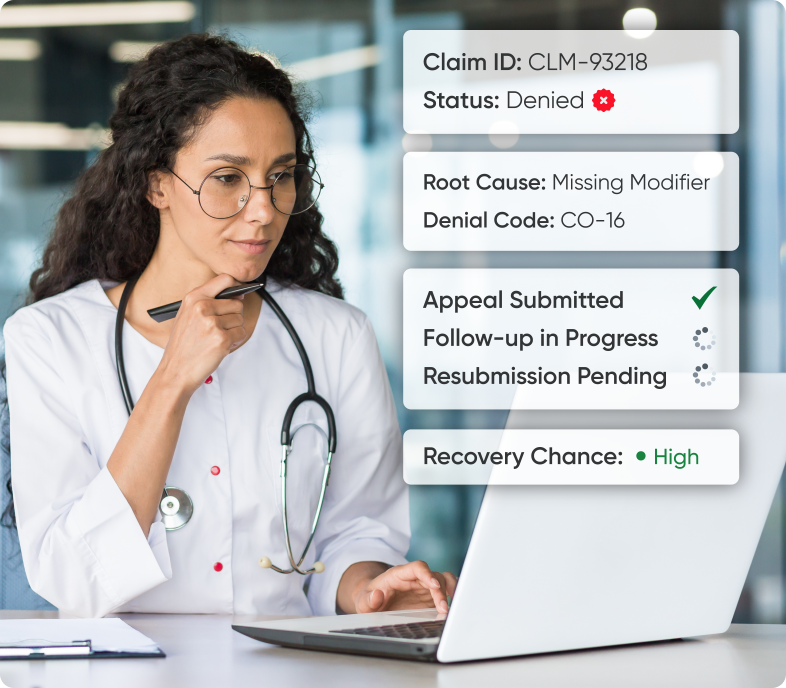
Every Denial Worked Daily Until It’s Resolved
Recover lost revenue with medical billing services that identify denial causes, correct claim issues, and support timely appeals and follow-ups.
Denial Categorization & Root-Cause Analysis
Root-Cause Correction
Daily Appeals & Follow-Up
Your A/R Gets Worked Daily, So You Don’t Have To
Improve cash flow with medical billing services for healthcare providers that track outstanding claims, prioritize payer follow-ups, and help reduce days in A/R.
A/R Aging & Prioritization
Payer Follow-Up & Call Tracking
Underpayment Detection & Recovery
Your Front Desk Stops Handling Patient Billing Calls
Simplify patient payments with medical billing services that manage statements, answer billing questions, and help patients understand their outstanding balances.
Clear, Easy-to-Understand Statements
Patient Billing Support
Balance Collection & Payment Plans
See Exactly Where Your Billing Stands, Every Month
Make informed revenue decisions with medical billing and consulting services that provide clear performance reports, billing insights, and ongoing account support.
Monthly Billing Performance Reports
Dedicated Account Management
Accessible Billing Data
See How Our Medical Billing Services Fit Your Existing Workflow.
Why Practices Choose Thinkitive as Their Outsource Medical Billing Company
See how our medical billing outsourcing services help healthcare providers streamline billing, resolve denials, and improve collections while working within their existing systems.
Hear It Directly From Our Clients
4 Simple Steps to Outsource Medical Billing Services
Start with free medical billing audit services to identify revenue gaps, assess your current billing performance, and plan a smooth transition to outsourced medical billing within 7–14 days.
1. Free Practice Audit & Scoping
Start with medical billing audit services that assess your A/R, denials, claims, and billing workflows to identify revenue gaps and prioritize improvements.
- Review 30-, 60-, 90-, and 120+ day balances to identify overdue claims and prioritize recovery.
- Analyze recent 837 claims and 835 remittances to assess first-pass acceptance and recurring payment issues.
- Review your EHR, practice management system, and clearinghouse workflows to understand how claims move through your practice.
- Define billing support based on your specialty, claim volume, provider count, and revenue cycle needs.
Key Deliverables
- A written overview of aging trends, denial patterns, and priority areas.
- Initial A/R and first-pass acceptance metrics to measure progress after onboarding.
- A service plan and pricing tailored to your practice’s billing requirements.
- A named billing team and account manager for communication, performance reviews, and ongoing support.
2. BAA, Access & Payer Setup
Set up secure system access, payer connections, and billing workflows to prepare your medical billing services for a smooth transition.
- Complete the Business Associate Agreement (BAA) and establish authorized access before sharing patient or billing data.
- Set role-based permissions across your EHR, practice management system, and clearinghouse, with appropriate access controls and audit trails.
- Configure payer IDs, fee schedules, and contracted rates to support accurate claim submissions and payment posting.
- Initiate required electronic data interchange (EDI) and electronic remittance advice (ERA) enrollments while maintaining existing submission workflows where possible.
Key Deliverables
- Documentation of authorized users, permissions, and applicable privacy and security controls.
- A record of payer IDs, EDI connections, ERA status, and outstanding enrollment requirements.
- Agreed processes for charge entry, coding, claim submission, payment posting, and practice-specific requirements.
- A transition schedule identifying when the team will begin managing your billing operations.
3. Parallel Run
Compare billing performance before the full transition. Your new billing team processes claims alongside your current biller, reconciles submissions, and works outstanding A/R to help keep revenue moving.
- Submit daily claim batches and reconcile them against 999 and 277CA responses to track acknowledgments and identify submission issues.
- Review ICD-10-CM and CPT coding, applicable NCCI edits, and supporting documentation before claims are submitted.
- Work aged receivables and denials in parallel while tracking payer deadlines and outstanding recovery opportunities.
- Keep your current billing team active throughout the parallel run to help prevent missed claims or gaps during the transition.
Key Deliverables
- Compare first-pass acceptance results between the new team’s claim batches and your existing billing operation.
- Track encounters, submissions, acknowledgments, and outstanding items to identify potential gaps.
- Organize denials by CARC code, assigned owner, current status, and next action.
- Document whether the billing operation is ready for full handover or requires further validation.
4. Full Handover & Reviews
Transition to fully managed medical billing services with a dedicated team, clear performance reporting, and continued access to your billing data and systems.
- Manage charge entry, coding, claim submission, payment posting, and patient billing through your dedicated billing team.
- Preserve claim histories, notes, appeal details, statuses, and follow-up dates throughout the handover.
- Track collections, denial trends, A/R aging, first-pass acceptance, and payer performance to identify improvement opportunities.
- Review reimbursement rates, underpayments, and payer payment patterns to flag discrepancies and potential revenue gaps.
Key Deliverables
- Review collections, denials by CARC code, A/R aging, and first-pass acceptance.
- Maintain visibility into outstanding claims, current status, and next follow-up dates.
- Continue under a month-to-month agreement without a long-term commitment, subject to the agreed contract terms.
- Know your point of contact and escalation process, including support availability during US business hours.
See How Much You Can Save With Thinkitive's Medical Billing Services
Answer four quick questions to compare your current billing costs with Thinkitive’s flat 2.5% fee and estimate your potential savings with medical billing outsourcing services.
Step 1 of 4
What's your specialty?
What's your average monthly collections?
What are you paying now?
Enter your current billing fee as a percentage of collections.
Enter your current fee as a percentage, e.g. 6.
Get your exact quote
Quote request received.
A senior billing specialist will send your exact quote within one business day. Want to lock in a time right now?
Answer the three questions and your estimate appears here, based on switching to 2.5% flat.
- Specialty
- —
- Monthly collections
- —
- Current fee
- —
Runs in your browser. Nothing is sent until you ask for a quote.
Specialty-Specific Medical Billing and Coding Outsourcing
Every specialty has unique coding requirements, payer rules, and reimbursement challenges. Outsource medical billing and coding services tailored to your specialty to reduce avoidable denials, streamline claims, and protect your revenue.
Mental & Behavioral Health 
Specialized Billing for Time-Based Therapy
- Psychotherapy Coding & Billing
- Telehealth Billing & POS
- Session Limit Tracking
- Insurance Verification & Eligibility
- Denial Management & A/R Follow-Up
Didn’t See Your Specialty?
From Family Medicine and OB/GYN to other specialized practices, get medical billing support tailored to your specialty. Let’s discuss your billing needs and find the right fit for your practice.
HIPAA-Compliant & Secure Medical Billing Services
Protect your patients’ PHI with secure, access-controlled medical billing outsourcing services backed by signed BAAs and documented security practices. SOC 2 Type II and HIPAA compliance documentation is available upon request.
HIPAA & HITECH: Billing Access Comes With Responsibility
Protect patient information with secure medical billing outsourcing services, signed BAAs, role-based access controls, and safeguards designed to protect PHI.
What's At Risk
- Unauthorized PHI access can lead to breach investigations and notification costs.
- A billing vendor without the right safeguards can create compliance exposure for your practice.
- Broad system access gives more people access to patient information than their role requires.
- Poor access controls make it harder to see who accessed patient records and when.
- Weak offboarding can leave former billing staff with access after their work has ended.
Why It Matters
- Your practice needs billing partners that properly safeguard protected health information.
- Payer and health system contracts may require documented privacy and security controls from vendors.
- A breach can create costs beyond penalties, including investigation, notification, legal support, and patient communication.
- Patients expect their health information to stay protected, whether billing is handled internally or by a vendor.
- Every person accessing your EHR needs clear permissions, accountability, and oversight.
How We Handle It
- A signed BAA before anyone gets access to PHI.
- Named users, role-based permissions, access limited to the work.
- PHI stays within your approved EHR and practice management systems.
- MFA, encryption, and audit controls used wherever supported by the systems we access.
- User access is reviewed during staffing changes and revoked promptly when someone leaves.
SOC 2 Type II: Security Should Be Built Into the Billing Process
Keep sensitive patient and billing data protected through documented security controls, controlled system access, and secure medical billing services.
What's At Risk
- Weak security controls can expose billing data to unauthorized access or misuse.
- Inconsistent access practices make it harder to control who can view sensitive billing information.
- Poorly documented security processes can leave gaps that stay hidden until an incident occurs.
- Unmonitored system activity can make suspicious access harder to identify and investigate.
- Security gaps at a billing partner can create operational and reputational risk for your practice.
Why It Matters
- SOC 2 Type II shows that defined security controls are operating consistently over time.
- Your practice needs billing operations to follow documented security processes, not informal employee practices.
- Controlled access limits unnecessary exposure of patient and financial information.
- Documented processes make security responsibilities clear across people, systems, and billing workflows.
- Consistent controls give your practice greater visibility when evaluating an external billing partner.
How We Handle It
- Billing access follows defined security controls, not unrestricted access to your practice systems.
- Named users receive only the permissions required for their billing responsibilities.
- System activity is controlled and monitored to support accountability across the billing workflow.
- Security procedures are documented and followed consistently across billing operations.
- Access and security controls remain part of the ongoing engagement, not just the onboarding process.
Coding Standards: Accurate Coding Starts With Knowing the Rules
Our certified medical billing and coding professionals follow current coding guidelines, payer requirements, and specialty-specific rules to support accurate claims and fewer avoidable denials.
What's At Risk
- Incorrect ICD-10-CM, CPT, or HCPCS codes can trigger denials, underpayments, or payer scrutiny.
- Unsupported modifiers can cause separately billable services to bundle or deny.
- Coding beyond the documentation can create compliance concerns during payer reviews or audits.
- Missed payer-specific coding rules can cause otherwise clean claims to fail during adjudication.
- Inconsistent coding across providers can create billing variations and unreliable reimbursement patterns.
Why It Matters
- Accurate coding keeps submitted claims aligned with the services documented and provided.
- Current coding standards help reduce preventable denials and improve first-pass claim acceptance.
- Specialty-specific coding knowledge matters because billing rules vary across clinical services.
- Consistent coding gives your practice a reliable foundation for tracking reimbursement and billing performance.
- Proper documentation and coding alignment helps support claims when payers request additional information or review.
How We Handle It
- AAPC- and AHIMA-certified coders review claims against applicable ICD-10-CM, CPT, and HCPCS requirements.
- Coders validate documentation before assigning codes, keeping billed services supported by the clinical record.
- NCCI edits and applicable modifier rules are reviewed before claims are released.
- Payer-specific coding requirements are built into workflows to reduce recurring errors and denials.
- Coding patterns are monitored to identify inconsistencies, recurring errors, and opportunities for corrective action.
Payer & Government: Payer Rules Change. Your Billing Team Has to Keep Up.
Our medical billing services for healthcare providers account for payer-specific policies, Medicare and Medicaid requirements, authorization rules, and documentation standards.
What's At Risk
- Payer-specific rules can cause accurate claims to be denied when required codes, modifiers, or documentation are missing.
- Medicare and Medicaid requirements vary by service, provider, and program, adding more billing complexity.
- Outdated payer policies can leave billing workflows producing recurring denials and reimbursement delays.
- Missed authorization or coverage requirements can leave completed services without a payable claim.
- Inconsistent payer follow-up can allow unresolved claims and government program issues to age without resolution.
Why It Matters
- Each payer has its own billing, documentation, authorization, and reimbursement requirements.
- Medicare and Medicaid require close attention to program-specific billing and coverage rules.
- Staying current with payer requirements helps reduce preventable denials and reimbursement delays.
- Accurate payer handling helps prevent eligible services from going unpaid because of process errors.
- Consistent payer oversight matters even more when your practice works across multiple plans and government programs.
How We Handle It
- Payer-specific requirements are built into claim, coding, authorization, and documentation workflows.
- Medicare and Medicaid rules are applied according to the applicable service, provider, and program.
- Payer policy changes are reviewed and incorporated into billing workflows when they affect your claims.
- Authorization and coverage requirements are verified before claims are submitted for services that require approval.
- Payer responses and trends are tracked to identify recurring issues and adjust workflows early.
Certified Team: Qualified People Behind Every Billing Decision
Outsource medical billing and coding services to qualified professionals with relevant coding credentials, specialty knowledge, and the oversight needed to support consistent billing operations.
What's At Risk
- Inexperienced billing staff can lead to coding errors, missed follow-ups, and avoidable denials.
- Unqualified personnel handling PHI can increase privacy, security, and compliance risks.
- Generic billing experience may not cover the specialty-specific coding and payer rules your practice depends on.
- High turnover can disrupt billing continuity, leaving claims, denials, and A/R follow-ups without consistent ownership.
- Poor oversight can leave billing issues unresolved until they start affecting collections and cash flow.
Why It Matters
- Certified professionals bring established coding knowledge and billing practices to complex revenue cycle workflows.
- Specialty experience helps your billing team understand the clinical and payer requirements behind each claim.
- Clear team oversight creates accountability for claims, denials, A/R, and other billing responsibilities.
- Backup staffing helps maintain billing continuity when individual team members are unavailable or change.
- Experienced billing professionals can identify issues earlier and address them before they become recurring revenue problems.
How We Handle It
- Certified billing and coding professionals are assigned based on your specialty and billing requirements.
- Specialists are matched to your practice based on specialty, claim volume, payer mix, and workflow complexity.
- A named account manager provides clear communication and ongoing performance oversight.
- Trained backup resources help keep billing work moving during planned or unexpected staffing changes.
- Team performance is reviewed regularly using billing KPIs, denial trends, A/R aging, and other agreed measures.
Outsource Medical Billing Services That Work With Your Existing Systems
Our medical billing team works within the 30+ EHRs, 10+ clearinghouses, and billing systems you already use, keeping your existing workflows intact without disrupting day-to-day operations.
*No migration. Works with 30+ EHRs & 10+ Clearinghouses. We work inside what you already run, using your existing access and submitter IDs under a signed BAA. No platform switch, no rerouting your billing, and no migration back if you ever leave.
Outsource Medical Billing Services Across All 50 States
Get medical billing services tailored to your state's Medicaid programs, Medicare Administrative Contractor (MAC) jurisdiction, and payer-specific requirements. Select your state to explore relevant payer rules and billing considerations for your practice.
Find your state
50 states supported — tell us yours on the audit call and we'll confirm your exact payer setup.
California
- Medicaid program
- Medi-Cal
- Your Medicare MAC
- Noridian (Jurisdiction E)
Medi-Cal managed care plans add their own balance-billing limits, and major commercial payers each apply their own edits that are not interchangeable.
We enroll under your existing submitter IDs, so we bill whichever payers you already contract with — in California or any other state. Check my payers →
Texas
- Medicaid program
- Texas Medicaid (TMHP)
- Your Medicare MAC
- Novitas (Jurisdiction H)
Managed-care MCOs administer most Medicaid claims separately from TMHP fee-for-service, so eligibility and timely-filing rules vary by plan.
We enroll under your existing submitter IDs, so we bill whichever payers you already contract with — in Texas or any other state. Check my payers →
New York
- Medicaid program
- NY Medicaid (eMedNY)
- Your Medicare MAC
- NGS (Jurisdiction K)
Medicaid managed care plans layer their own prior-auth and timely-filing rules on top of eMedNY base requirements.
We enroll under your existing submitter IDs, so we bill whichever payers you already contract with — in New York or any other state. Check my payers →
Florida
- Medicaid program
- Florida Medicaid
- Your Medicare MAC
- First Coast Service Options (Jurisdiction N)
Statewide Medicaid Managed Care (SMMC) routes most claims through MCOs, each with its own authorization and appeal windows.
We enroll under your existing submitter IDs, so we bill whichever payers you already contract with — in Florida or any other state. Check my payers →
New Jersey
- Medicaid program
- NJ FamilyCare
- Your Medicare MAC
- Novitas (Jurisdiction L)
Managed care organizations administer the bulk of NJ FamilyCare claims, with plan-specific credentialing and filing deadlines.
We enroll under your existing submitter IDs, so we bill whichever payers you already contract with — in New Jersey or any other state. Check my payers →
Illinois
- Medicaid program
- Illinois Medicaid (HFS)
- Your Medicare MAC
- NGS (Jurisdiction 6)
HealthChoice Illinois managed-care plans apply their own prior-auth rules layered on top of HFS fee-for-service policy.
We enroll under your existing submitter IDs, so we bill whichever payers you already contract with — in Illinois or any other state. Check my payers →
Medical Billing Services for Small Practices
Get reliable medical billing support tailored to your practice’s size, specialty, and budget. Reduce administrative workload, improve collections, and spend more time focusing on patient care.
Fair Questions, Straight Answers
What does an outsourced medical billing service actually do?
An outsourced medical billing service manages the administrative work that turns patient encounters into payments. This typically includes insurance eligibility verification, medical coding, claim submission, payment posting, denial management, A/R follow-ups, and patient billing. A medical billing services company can also provide performance reports to help you track collections, denials, and outstanding claims while your team focuses on patient care.
How much does it cost to outsource medical billing?
The cost depends on your practice's claim volume, specialty, payer mix, and the scope of services required. Common pricing models include a percentage of collections, a per-claim fee, or a fixed monthly fee. Thinkitive offers medical billing services pricing at a flat 2.5% fee, helping practices understand their billing costs upfront. A billing assessment can help clarify the scope, expected costs, and potential savings before you commit.
Is outsourcing medical billing a good idea for my practice?
Outsourcing can be a good fit if your practice struggles with claim denials, delayed reimbursements, growing A/R, staffing gaps, or the cost of maintaining an in-house billing team. Medical billing outsourcing services give you access to dedicated billing expertise without having to manage every part of the revenue cycle internally. The right choice depends on your current performance, costs, and how much control you want to retain over billing operations.
How long does the transition take?
The timeline depends on your practice's size, payer setup, software access, and the complexity of outstanding claims. A structured transition may include an initial billing audit, system and payer setup, and a parallel run to validate claim processing. Thinkitive's onboarding process is designed around an initial 7–14-day setup and validation period, with full handover following readiness checks. Your transition plan should specify milestones and responsibilities before work begins.
How do you take over without disrupting cash flow?
A controlled transition starts by documenting open claims, outstanding A/R, payer connections, submission workflows, and upcoming filing deadlines. The incoming team can validate access and claim processing before assuming full responsibility, while the existing billing operation remains active during the agreed parallel run. This approach helps reduce the risk of duplicate submissions, missed claims, and payment delays. Clear ownership of every claim is essential throughout the handover.
Do I have to switch my EHR or billing software?
Usually, no. A medical billing outsourcing company can often work within your existing EHR, practice management system, and clearinghouse, provided the required access and workflows are supported. Thinkitive supports a range of existing healthcare systems, allowing practices to retain familiar workflows rather than migrate to a new platform solely for billing. Compatibility and any payer-specific requirements should be confirmed during onboarding.
What reporting will I get, and how often?
Reporting should give you a clear view of collections, days in A/R, denial rates, first-pass acceptance, outstanding claims, and underpayments. Your reports should also identify recurring problems and the actions being taken to resolve them. With medical billing and consulting services, regular performance reviews can help you understand not just what changed, but where your revenue cycle needs attention. Thinkitive's proposed reporting cadence includes monthly performance reviews, with additional updates based on agreed requirements.
What happens to my aged A/R when you take over?
Aged accounts receivable should be reviewed and prioritized rather than treated as a fresh start. The incoming team can segment outstanding balances by age, payer, denial reason, claim status, and recovery potential, then create a follow-up plan based on filing deadlines and expected reimbursement. Medical billing audit services can help identify stalled claims, underpayments, and missed appeal opportunities. Agree on how legacy A/R will be tracked and reported before the transition begins.
What if my current billing company stops submitting claims?
Start by identifying the last claims submitted, outstanding encounters, payer acknowledgments, rejected claims, and upcoming filing deadlines. Your new billing partner should reconcile these records before resuming submissions to reduce the risk of duplicate claims or gaps in billing. An organized handover should also preserve denial histories, appeal documentation, payment records, and follow-up notes. If the previous company has already stopped working, the priority is to assess outstanding claims quickly and establish clear ownership of each next action.
Can I outsource only part of my billing?
Yes. Depending on your needs and the provider's service scope, you may outsource specific functions such as medical coding, claim submission, denial management, aged A/R recovery, or payment posting while keeping other tasks in-house. Partial medical billing outsourcing can be useful when your team handles routine billing but needs extra capacity for backlogs or complex claims. Define responsibilities, handoff points, and reporting expectations clearly so that claims do not fall between teams.
Do you handle medical coding as well as billing?
Yes. Medical billing and coding outsourcing can combine coding and billing workflows, from reviewing clinical documentation and assigning appropriate codes to validating and submitting claims. Qualified coding professionals should follow applicable ICD-10-CM, CPT, HCPCS, modifier, and payer-specific requirements. When you outsource medical billing and coding services, confirm the team's credentials, specialty experience, documentation review process, and approach to correcting coding-related denials.
Do you handle Medicare and Medicaid billing?
Medical billing services for healthcare providers can include Medicare and Medicaid claims, subject to the applicable programs, provider enrollment, service requirements, and payer arrangements. These claims may involve specific coverage policies, coding rules, documentation requirements, authorization conditions, and filing deadlines. Your billing partner should confirm the relevant Medicare Administrative Contractor (MAC), state Medicaid program, and payer-specific requirements during onboarding rather than applying a single process to every state or program.
Who will work on my account, and where are they based?
Before selecting a medical billing services company, ask who will handle your account, what experience the team has with your specialty, who supervises performance, and how support is provided. You should know your primary contacts, escalation process, and expected response times. If the team is based outside the United States, clarify working-hour coverage, communication arrangements, authorized system access, and the safeguards used to protect patient information.
Is my patient data safe with an outsourced team?
Patient data protection depends on appropriate contractual, administrative, and technical safeguards. Before sharing protected health information (PHI), your practice should establish the appropriate Business Associate Agreement (BAA), verify authorized access, and review applicable privacy and security controls. A medical billing outsourcing company should explain how it manages user permissions, authentication, monitoring, staff access changes, and incident response. Verify the provider's actual HIPAA-related practices and any claimed SOC 2 Type II or other certifications rather than relying on badges alone.
Will I lose visibility or control over my revenue cycle?
No. Outsourcing billing should change who performs the work, not remove your visibility into its results. Your agreement should define access to billing reports, claim statuses, payment records, denial worklists, and A/R data, along with the frequency of performance reviews. A reliable medical billing outsourcing company should establish clear accountability and escalation paths while keeping your practice involved in important financial and operational decisions.
Everything You Need to Know About Medical Billing
Medical Billing Outsourcing: The Complete Guide (2026)
In-House vs Outsourced Medical Billing: Which Is Right for Your Practice
Is Outsourcing Medical Billing Worth It? A Cost-Benefit Breakdown