Cost Comparison: In-House vs Outsourced EHR Integration

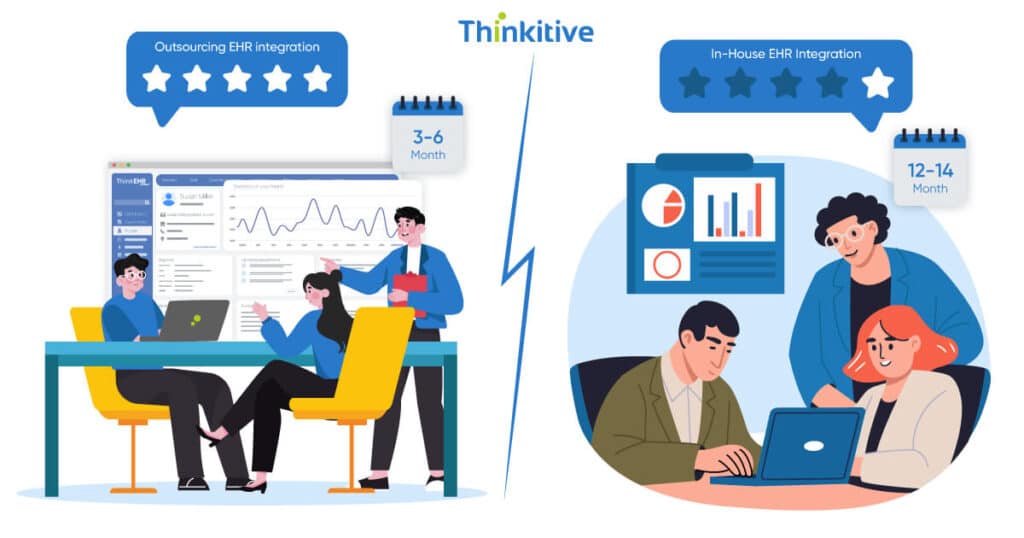
The digitization of the healthcare industry has progressed smoothly and rapidly; it has come a long way. From the first ever Electronic Health Record (EHR) used just to store patient data to today’s EHR integration, which is a necessity for seamless and connected care.
This is also why integrating systems with EHR has become the first priority of every healthcare organization. However, when it comes to starting integration projects, organizations come to a crossroads.
Should we build an in-house EHR integration team or partner with a specialized vendor providing EHR integration services?
The reason for this dilemma is the money that these organizations put into the integration. One wrong decision here means sinking money, delayed go-lives, or worse, integration failing to deliver the efficiency it promised.
Because oftentimes, deciding what to do becomes a thin line between success and failure of EHR interoperability and integration. On one hand, keeping integration in-house means full control, flexibility, and your IT team that already understands workflows and what you need.
But the catch is, integration is not only APIs; it also requires understanding HL7, FHIR, and security frameworks. Moreover, the always-evolving regulatory landscape makes it a much more difficult task, becoming a hurdle that is hard to cross.
On the other hand, outsourcing gives you people who are already experienced and have been integrated multiple times. They understand regulations and security needs, and most importantly, keep your staff free to focus on core operations. The downside of outsourcing is that it can be expensive, and you may lose the flexibility and control that comes with in-house building.
This is what troubles the leaders the most, as choosing one is not as simple as picking a phone based on the features. In this blog, we will explore this dilemma and give you a walk-through of the pros and cons of both in-house and outsourced electronic health record integration, enabling you to make informed decisions about the integration.
So, let’s get started!
Breaking Down the True Cost of In-House EHR Integration
Understanding the benefits and drawbacks of both in-house and outsourced integration is necessary before deciding. So, let’s take a look at the costs of the in-house integration from the infrastructure to the final time-to-market.
1. Setting Up the Infrastructure: When a healthcare organization decides to build an in-house team for the EHR integration projects, it’s not about hiring some developers. Organizations need a robust infrastructure to have a smooth and seamless development. This means you need servers powerful enough to handle healthcare data, security systems to protect it, and backup solutions to ensure a failsafe in case something goes wrong.
2. Talent Acquisition & Retention Cost: Only having the IT team is not enough; organizations need people who clearly understand HL7, FHIR, and interoperability standards. But these developers are not cheap; their salaries can go up to $120K-$180k annually per developer. Add the cost of recruitment and later on retaining them in the highly competitive landscape. Also, certifications and training for each changed regulation take the final costs way up and, quickly.
3. Ongoing Operational Expenses: EHR integration is not a one-and-done thing. It needs routine maintenance and updates as the regulations change and new technologies are introduced. Moreover, running regular compliance audits and security monitoring alone can eat up a big part of your budget. Hidden costs are always there; if the system fails, the downtime could stall patient care and disrupt routine operations.
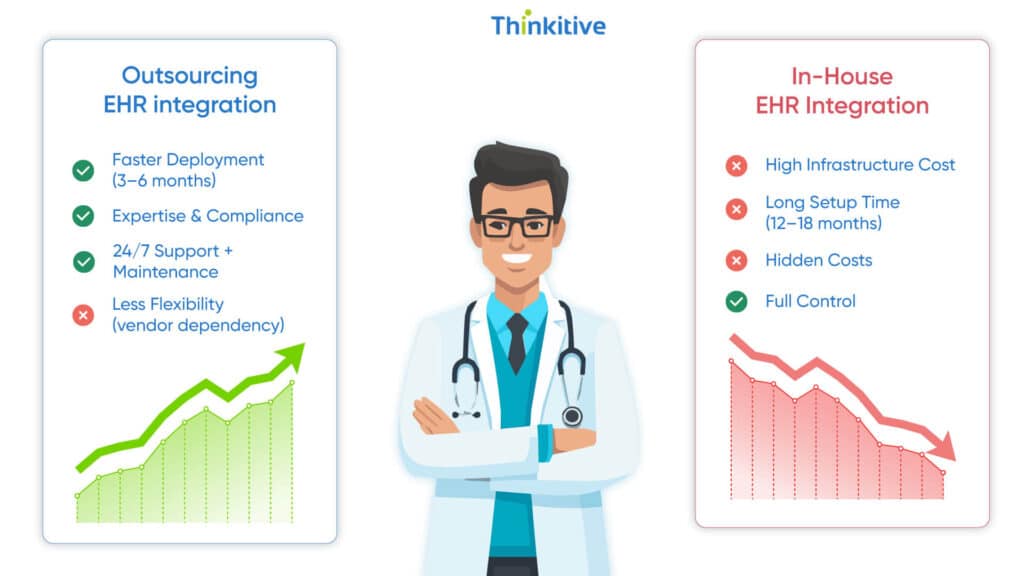
4. Time-to-Market Considerations: Building an in-house team is not a quick process. It takes up to 12-18 months to develop the right expertise and infrastructure that can handle integration. During this period, patient care improvement stops, and even the revenue cycle is affected. This means waiting for in-house teams may cost organizations opportunities to improve care.
Quickly Estimate Your In-House Development Cost with Our EHR Integration Cost Calculator
Download nowUnderstanding the Investment in Outsourced EHR Integration Services
Now that we have looked at the cost of the in-house integration, it’s time to look at its counterpart, outsourcing. Outsourcing has an advantage over an in-house team, which is the expertise that comes with the hired teams. We will look into it one by one and see what’s different, then build an in-house team.
1. Pricing Models & Structures: Pricing changes as the vendor changes. Some vendors offer a fixed-cost model, meaning that organizations know what the final cost will be. Another option is the time-and-materials approach, where vendors charge organizations based on the hours and resources they spend. Finally, there is a subscription option, which can be paid monthly or annually based on the services and features organizations are going to use.
2. What’s Included in Service Packages: Oftentimes, vendors have tools and assets that save organizations money and time. One such tool is pre-built connectors for major EHRs like Epic and Cerner, plus services for FHIR API integration and HL7 integration, which gives it an additional benefit. Ongoing support and maintenance become the cherry on top, as organizations don’t need to worry about maintenance.
3. Value-Added Services: This is where outsourcing has an advantage over in-house teams. Vendors usually have expertise in healthcare data migration and know how to handle compliance and HIPAA safeguards as part of the workflow. Moreover, they provide 24/7 monitoring and support, something that is tough for in-house teams.
4. ROI Timeline: One of the biggest benefits of outsourcing is the time-to-market. These projects are much faster to deploy, generally three to six months instead of over a year. Another thing is that organizations gain instant access to expertise and proven best practices. Also, the reduced risk of project delays or outright failures means ROI is much sooner.
Hidden Costs Nobody Talks About: In-House vs. Outsourced
There is more to the costs when an integration project fails; however, nobody focuses on those. When comparing which option to pick, organizations pay most of the attention to the upfront cost and final returns, and not to the hidden costs of each approach. This can lead to slow drain on the money and frustrate the staff, so here are the hidden costs of each approach:
| Hidden Costs | In-House Integration | Outsourced Integration |
| Staffing & Knowledge | High turnover (20%+ annually) leads to lost expertise | Risk of vendor lock-in and costly migration if you switch providers |
| Technology Challenges | Technical debt from custom solutions; hard to scale for new EMR requirements | Limited customization options depending on vendor tools |
| Compliance & Security | Risk of HIPAA violations, fines, and reputational damage | Data security concerns when third parties manage PHI |
| Operational Burden | Time lost to maintaining/upgrading integrations | Communication overhead and project management effort |
| Financial Impact | Delays = opportunity cost; penalties from compliance lapses | Hidden fees in service contracts, if not negotiated clearly |
These are some common pitfalls that cause trouble for the integration projects. To avoid these, properly evaluate the EHR vendors and verify whether they are good for long-term stability. Also, negotiate contracts carefully to avoid hidden fees, and consider hybrid models, where organizational teams retain control over core functionalities.
ROI Analysis: Which Model Delivers Better Value?
Return on Investment (ROI) is a point that concerns everyone, and the choice of approach also differs based on the ROI expectations. This is why we will see both quantifiable and qualitative returns on each approach.
| Metric | In-House Integration | Outsourced Integration |
| Cost per Integration | $150K–$300K | $50K–$100K |
| Time-to-Value | 12–18 months | 3–6 months |
| Success Rate | ~45% | ~85% |
| System Uptime & Reliability | Dependent on internal IT resources | Backed by SLAs & vendor monitoring |
| Scalability | Limited, requires new hires & upgrades | Built-in into vendor frameworks |
| 5-Year TCO | Higher due to staffing, training, and maintenance | Lower due to shared infrastructure & expertise |
In short, with outsourcing, organizations can get the EHR integration to the market much faster than in-house integration. Moreover, the risks are much higher when organizations use the in-house team if they are not trained and experienced.
So, outsourcing can deliver a faster return than in-house integration, which comes with more risks and a much longer ROI timeline.
Use Our ROI Calculator Template to Know the Cost of EHR Integration Projects
DownloadDecision Framework: Choosing the Right Approach for Your Organization
When it comes to whether to go with in-house or outsource, it can’t be decided that easily. It depends on multiple factors, from the organization’s size, how good the IT department is, the budget, and finally, how quickly the organization needs the EHR system integration up and running.
Based on these assessment criteria, organizations can decide what to choose and what their optimal choice is. For instance, large healthcare organizations have multiple systems and need to adjust the integration to suit complex workflows.
This is where opting for the in-house approach is the right call because they can afford the costs of setting up infrastructure, training, and hiring technically sound staff, and waiting for a period of 12-18 months.
Outsourcing is the best choice for small- and medium-sized healthcare organizations. They don’t have to build infrastructure, train staff, and hire additional staff, as vendors take care of all the requirements. Also, the deployment is faster as they can make use of features in three to six months max.
So, choosing in-house or outsourcing completely depends on the needs of each healthcare organization. However, there is one more option, and that is to go with a hybrid approach. This gives control over the core functionality of the EHR and brings in the vendor expertise.
In short, if organizations can wait for more than a year and have technical and financial capabilities, in-house can be a better option. Whereas, for small and mid-sized organizations, outsourcing is the best bet. A hybrid approach is best if you want to have control yet don’t want to hire and train additional staff.
Conclusion
In a nutshell, when it comes to EHR system integration, healthcare organizations can’t decide whether to go with an in-house team or outsource the EHR integration services. However, if they assess their needs, capabilities, and how fast they need the integration to go live.
However, in-house integration brings risks, and the success rate is quite low. This is why the best option is to either outsource from a good and experienced vendor or use a hybrid approach to have the best of both worlds.
Thinkitive can help you either by outsourcing or providing technical support. Click here to book a call and complete your EHR integration successfully.
Frequently Asked Questions
In-house EHR integration requires hiring 2–5 full-time IT staff, ongoing certifications, and infrastructure, often costing $500K+ annually. Depending on the scope, outsourced services typically range from $100K–$300K. The cost difference is significant; outsourcing usually saves 40–60%, especially for small to mid-sized practices without deep technical resources.
Most organizations begin seeing ROI within six to twelve months of outsourcing EHR integration. Savings come from faster reimbursements, reduced manual errors, and efficiency gains in clinical workflows. The timeline depends on project complexity, but outsourced teams often accelerate results compared to in-house builds, thanks to their experience and tools.
Yes, HIPAA compliance is absolutely possible when outsourcing EHR integration. Reputable vendors use secure data transfer protocols, encryption, audit logs, and Business Associate Agreements (BAAs). The key is choosing partners with proven healthcare experience and compliance certifications, so patient data remains protected at every integration touchpoint.
Hidden costs often come from underestimated data migration, interface customization, extended project timelines, and post-go-live support. Training staff and maintaining interoperability with legacy systems also add expenses. Outsourced vendors usually flag these upfront, but in-house teams may overlook them, leading to budget creep. Transparency is critical.
Look beyond marketing. Ask for case studies, references, and experience with your specific EHR vendor (Epic, Cerner, athenahealth, etc.). Verify certifications in HL7, FHIR, and HIPAA. A good partner will demonstrate hands-on integration success stories, not just theory, while offering clear frameworks for testing and validation.
Yes, but it requires careful transition planning. Outsourced vendors can take over mid-project, but they’ll need documentation, code repositories, and access to existing work. This may slow things briefly, but can ultimately accelerate completion, especially if in-house teams hit technical or resource roadblocks.
Your data always belongs to you, not the vendor. When switching vendors, contracts should guarantee full access to structured data, interface mappings, and documentation. Good vendors support smooth handoff, but some may add exit fees or delays. Always clarify data rights upfront before signing.
Outsourced vendors typically specialize in building custom healthcare interfaces, whether for labs, pharmacies, or telehealth platforms. They use standards like HL7 and FHIR, but can also design proprietary APIs for unique workflows. The advantage is scalability; vendors often reuse proven templates to speed up delivery without reinventing the wheel.
You maintain strategic control, workflow requirements, data governance, and approval checkpoints stay with you. Vendors handle execution, coding, and testing. The best partnerships work collaboratively, with clear SLAs and reporting dashboards. So, while day-to-day coding shifts out, oversight and compliance decisions remain firmly in your hands.
Yes, experienced vendors can integrate legacy systems as effectively as in-house teams. They often bring middleware, data transformation tools, and prior experience working with outdated platforms. The challenge isn’t whether it’s possible, but how efficiently. Outsourced teams usually move faster because they’ve solved similar legacy puzzles before.


