How to Develop an AI-powered EHR System? Features and Cost Analysis

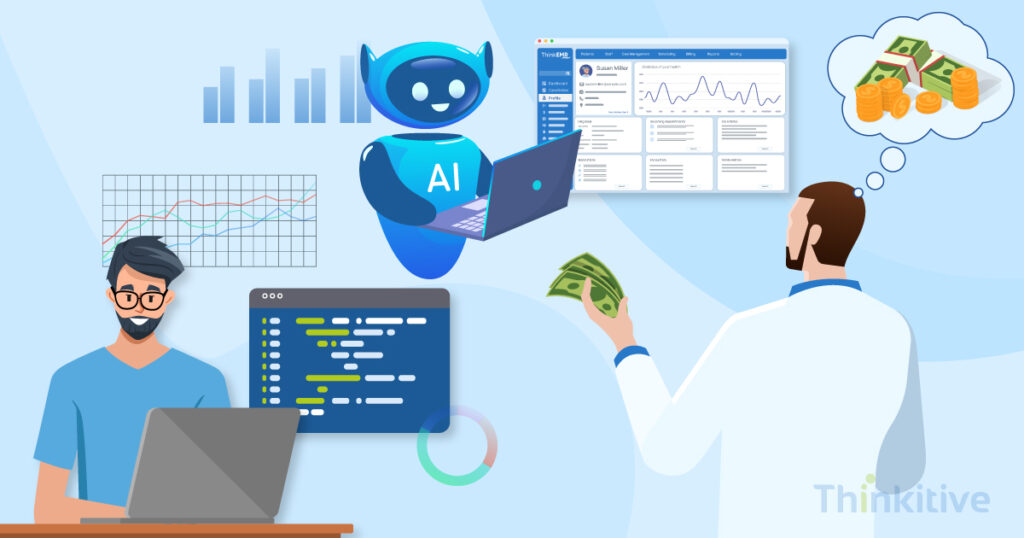
In the last few years, a huge transition in the healthcare industry has been observed. Just in 2024, almost 75% of the US hospitals integrated AI and machine learning functions into their EHR systems.
Furthermore, ever since the introduction of generative AI platforms, the use of generative AI in EHR systems has reached almost 31.5% across all hospitals that have adopted AI and machine learning functionalities.
This shift can even be seen in the healthcare practices looking to develop their own customizable EHR. You see, in the last couple of years, healthcare providers have not been looking to develop their EHR systems on the basis of features; instead, they are trying to make their systems more intelligent by integrating AI into the system’s architecture.
AI-powered EHR development is something that dictates the terms of EHR software development in 2026. Practices have realized the shift that these intelligent systems can bring to improve care quality and streamline administrative workflows.
That is the reason practices are demanding AI models in EHR systems that can better their approach to care with features like automation, analytics, and decision support tools.
However, the main question that many practices are asking is ‘How to develop an AI-powered EHR system?’
While the answer to this question can be simple, the details are where things get complicated. But worry not, in this blog, let’s discuss the intricacies of custom AI EHR software development, such as development strategy, data architecture, compliance planning, costs, etc.
So, without further ado, let’s get started!
Core Architecture of AI-Powered EHR Development
The foundation on which your entire software’s features, functionalities, and different aspects is architecture. And in your quest to make your customizable EHR intelligent, you need to ingrain AI into your EHR software system’s architecture. Here are some of the core architecture needs of an AI-powered EHR that you need to consider:
- FHIR-Based AI Data Architecture
First things first, since your software will be dealing with data, you need to prioritize and implement a FHIR-based AI data architecture. This will standardize how your clinical data is stored, accessed, and exchanged, in short, making it machine-readable. By organizing data into structured FHIR resources, your AI-powered EHR software can reliably perform on consistent datasets and give you the power of prediction, pattern recognition, and clinical automation.
- Structurizing Normalized & Interoperable Clinical Data
Once the data is normalized with FHIR standards, some of the core aspects in your data are eliminated, such as duplication and inconsistency. After this, you need to structure and normalize data across modules such as labs, vitals, medications, etc., to improve your data quality. This will ensure that your AI can analyze trends accurately.
- HL7 & Semantic Interoperability
You also need to achieve semantic interoperability so that the data in your EHR system retains the same meaning across systems and not just by format. For this, you need to follow the standards from HL7 International, which enable semantic interoperability. This is crucially important because it allows your AI-powered EHR system to interpret clinical data correctly, even though it has come from a disparate source outside your network.
- Cloud-Native Infrastructure to Support Scalable AI Workloads
The reliability of your AI-powered EHR system majorly depends on the infrastructure, and you must have a cloud-native infrastructure to support the scalability aspects of your AI. You see, a cloud-native infrastructure allows your system to scale, compute, and store resources dynamically based on the workload. This becomes a necessity to enable functions like clinical decision support, natural language processing, predictive analytics, etc.
How to Develop an AI-Powered EHR System
Coming to the question, you must have asked yourself, ‘How to develop an AI-powered EHR system?’ Here is a simple breakdown of all processes and a few things that you need to consider for custom AI EHR software development.
- Defining Clinical Workflows & AI Use Cases: Your AI modules must be directly mapped to real clinical workflows and then added as a standalone feature. That is why we emphasised the FHIR-based AI data architecture so much. Having said that, for the implementation of AI, you need to identify high-friction areas such as documentation, chart review, decision support, etc. Once that is done, define how AI can reduce effort, improve accuracy, and accelerate decision-making without interrupting clinician flow.
- Compliance Planning: After defining the AI use cases and clinical workflow of the EHR system, you need to plan the adherence of your software to regulatory compliance. By adhering to the regulatory requirements from the start of the development, you can ensure secure data handling, auditability, transparency, and long-term eligibility for interoperability programs and certification. Some of the major compliances that you have to adhere to are HIPAA and ONC.
- Selecting AI Models: After defining workflows, use cases, and planning for compliance, here are some of the most dilemmatic questions you have to face: Which AI model should you choose? Some of the choices that you’ll get are NLP, ML, and LLMs. Here, you need to understand that different models serve different clinical needs. For instance, NLP supports ambient documentation, ML enables predictive analytics, and LLMs enhance summarization, chart navigation, and clinician assistance. Recognize the features and functionalities you need and select the model on the basis of your needs.
- Data Normalization & Governance: The accuracy of your AI system directly depends on the data quality and consistency. That is why normalizing clinical data across sources and implementing strong data governance ensures reliable model training, reduces bias, and maintains traceability.
- Clinician-First UI/UX Design to Reduce Burnout: When designing your custom AI EHR software, you need to understand the core user groups of the software, and that is clinicians. This is important because with an AI-powered EHR, you are trying to reduce the load on your clinicians and staff members. Some of the important things that you can focus on while designing your software are minimal clicks, contextual AI assistance, and intelligent automation.
- API-Based Integration: API-driven integration allows your system to seamlessly exchange data with external systems such as labs, pharmacies, imaging platforms, and legacy systems. This ensures that your AI system operates on complete, real-time patient data while supporting scalability, vendor flexibility, and future interoperability requirements.
Key Features of an AI-powered EHR System
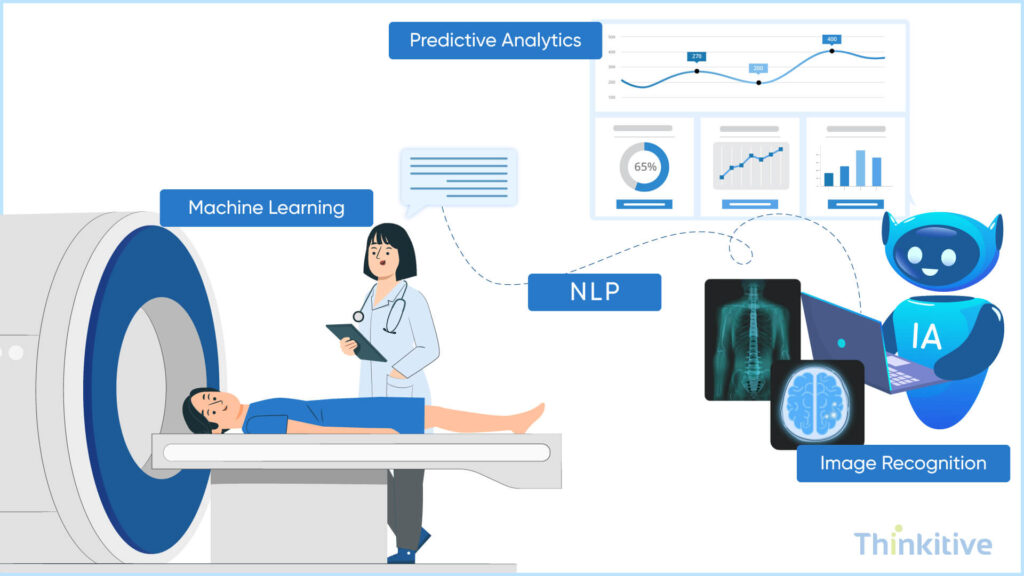
The latest trend in healthcare is AI-powered EHR systems, and they come with some incredible features that are revolutionizing healthcare. Let’s discuss this in detail.
Before that, understanding the core concepts about some of the AI-powered is something that you should understand. Read our blog – Advanced Analytics, Reporting & Predictive Modeling for Custom EHR Systems, before moving ahead.
- Integration of Natural Language Processing (NLP)
Natural Language Processing (NLP), in simpler terms, means something related to language understanding by machines.
In the context of EHR systems, integration of NLP plays a crucial role in enhancing text recognition and interpretation. Imagine doctors not spending hours typing patient notes; instead, they can speak naturally, and the system converts their voice into accurate, detailed documentation. So, it’s like a voice-to-text capability for clinical documentation.
NLP enables the system to understand spoken language, convert it into text, and integrate it seamlessly into the patient’s electronic health record. This saves time and reduces the risk of errors associated with manual data entry.
- Predictive Analytics for Proactive Healthcare
AI algorithms analyze historical patient data to predict potential health issues and forecast outcomes. By identifying patterns and trends, healthcare providers can take preventive measures before issues escalate. It’s like stopping a health problem before it even starts.
AI in the EHR system helps identify high-risk patients. The system uses complex algorithms to pinpoint individuals at risk for specific health issues. Once high-risk patients are identified, healthcare providers can implement targeted interventions to prevent complications and improve outcomes.
- Machine Learning Algorithms for Clinical Decision Support
Machine learning algorithms analyze vast amounts of patient data to provide valuable insights. It assists in treatment planning by identifying patterns and correlations in the data, helping doctors make more informed decisions.
These algorithms act as a support system, offering recommendations based on historical patient data, ongoing health conditions and even predicting potential risks. They significantly enhance the efficiency of healthcare delivery, not only saving time but also improving the accuracy of diagnosis and treatment. Imagine having a tool that can analyze data from thousands of patients to help tailor treatment plans for individual cases.
AI-powered EHR systems use advanced algorithms to personalize recommendations. They take into account a patient’s medical history, genetic factors, lifestyle, and even real-time data from wearables to create customized treatment plans. The ability to customize recommendations ensures that healthcare professionals can provide personalized and targeted care, ultimately leading to better patient outcomes.
- Image and Pattern Recognition
One of the key features of AI-powered EHR systems is image and pattern recognition, especially in radiology. AI can analyze radiology images with incredible precision.
But how does it work?
Well, AI algorithms are trained to recognize patterns in medical images. For instance, radiology can identify abnormalities, tumors, or any anomalies in X-rays, MRIs, or CT scans. This could significantly speed up the diagnostic process.
AI in EHR provides diagnostic assistance with up to 98.7% accuracy.
AI uses complex algorithms to analyze pixel patterns, shapes, and textures in medical images. It’s like teaching the system to identify the subtle differences between a healthy and an abnormal image.
It’s not about replacing human expertise but enhancing it. AI can process large volumes of medical images almost instantly, allowing healthcare professionals to focus on interpretation and decision-making.
- Personalized Medicine and Treatment Plans
AI in EHRs can analyze vast patient data to tailor treatment strategies based on individual needs. Healthcare providers can leverage patient data, including medical history, lifestyle factors, and even genetic information, to create personalized treatment plans.
AI-powered EHR software can analyze a patient’s genetic makeup to identify specific markers and potential risks. By understanding the genetic factors influencing an individual’s health, healthcare providers can tailor treatments with accurate precision. On top of that, with deeper and complete analysis of patient data, high-level reference to genetics can be accessed for risk awareness. This can personalize the care delivery and other processes.
To help you understand the full potential of AI-powered features in your custom EHR system, refer to this below:
| AI Capability | Technical Requirements | Potential Benefits |
| Clinical Decision Support (CDS) | ML models trained on patient data, EHR integration, and rule engines | Reduces errors, flags drug interactions, and improves treatment accuracy |
| Predictive Analytics | Data lakes, historical data, custom algorithms, real-time ETL | Early risk identification (e.g., readmissions, sepsis, deterioration) |
| Medical Coding Automation | NLP models, access to clinical notes, and billing data | Streamlines documentation, improves billing accuracy, and reduces manual work |
| Speech-to-Text Dictation | Voice capture tools, NLP transcription, clinician training | Saves provider time, enhances documentation speed |
| Chatbots for Patient Interaction | NLP engine, patient portal integration, scripted decision trees | 24/7 patient engagement reduces front-desk burden |
| Image Analysis (Radiology/Pathology) | Deep learning, labeled imaging datasets, DICOM integration | Speeds up diagnostics, flags abnormalities, and supports specialists |
| Personalized Treatment Plans | AI-driven data synthesis from EHR + genomics + outcomes databases | Enhances precision care, improves patient outcomes |
| Voice Assistants (e.g., bedside AI) | On-device ML, secure voice recognition, EHR command integration | Hands-free interaction is ideal for inpatient and emergency care |
| Anomaly Detection (Security/Fraud) | Behavioral pattern monitoring, real-time AI, and access logs |
Interested in implementing AI in your EHR system?
Get Free ConsultationHow Much Does a Custom AI-Based EHR Cost?
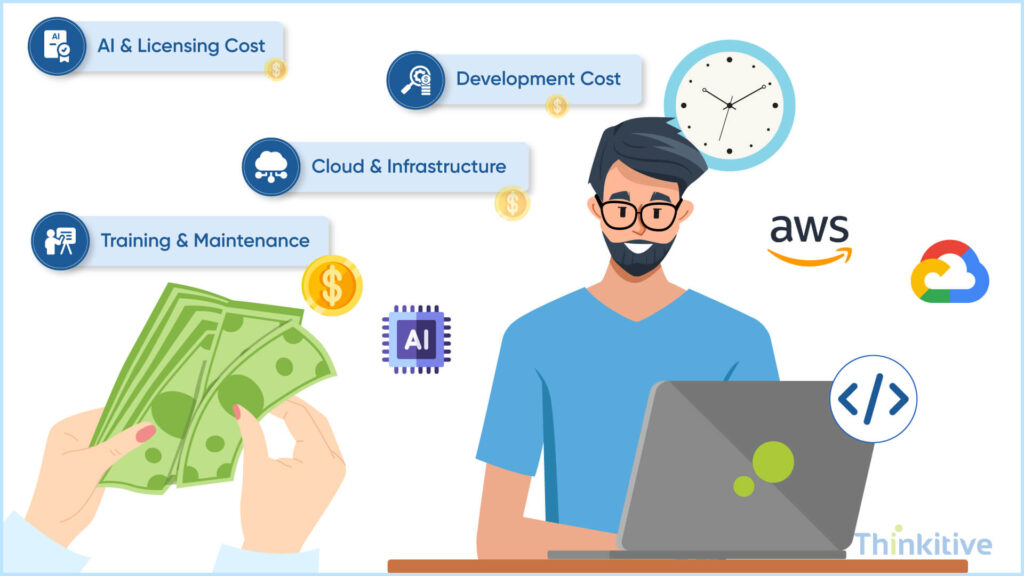
The cost of developing a custom AI-based EHR system can vary widely depending on several factors, including the complexity of the project, the features and functionalities required, the technology stack used, and the scale of implementation. Here’s a breakdown of the different cost components:-
- Development Costs
Development costs include hiring healthcare software developers and other technical staff. Hourly rates for custom AI EHR software development work range from $22 to $40 per hour and vary based on location and expertise. The complexity of the AI algorithms and features will impact development costs.
If you are using third-party AI technologies or tools, licensing fees may apply. The cost will depend on the specific AI tools and technologies integrated into the EHR.
- Infrastructure Costs
Infrastructure costs account for the costs related to purchasing or renting servers for hosting the EHR system. Moreover, maintenance expenses for server hardware, including upgrades, are also liable.
If the EHR is hosted on a cloud platform (e.g., AWS, Azure, Google Cloud), costs will include usage charges, storage fees, and data transfer costs. Cloud services offer scalability, but costs can increase as usage grows.
- Training and Implementation Costs
Training costs can vary based on the complexity of the system and the level of customization required.
Training healthcare professionals on AI-powered Electronic Health Records (EHR) incurs costs for educational materials, instructor fees, and potential productivity loss during training hours. Additional expenses may arise from software licenses and updates. Efficient training minimizes disruption, ensuring seamless integration of AI-enhanced EHR into healthcare workflows.
Moreover, costs associated with system integration relate to deploying the EHR system, integrating it with existing healthcare systems, and ensuring data compatibility. Furthermore, implementation costs may include project management, data migration, and system testing expenses.
Free eBook on ‘Building AI-powered EHR Systems’ for expert insights and strategies.
Download Free eBookPotential Challenges and Solutions
- Ethical considerations in AI-driven healthcare
Ethical challenges in AI-driven healthcare include patient privacy, biased algorithms, and accountability. Solutions involve developing AI EHR transparently, rigorous testing for bias, and clear guidelines for data privacy. Additionally, establishing ethical frameworks and involving multidisciplinary teams in AI implementation can ensure responsible and equitable use of technology in healthcare.
- Data quality and bias issues in machine learning models
Data quality challenges in machine learning models can arise from incomplete or biased datasets. To address this, rigorous data cleaning processes and diverse, representative datasets must be used. Regular audits and bias detection tools help mitigate biases. Continuous monitoring and transparent reporting are essential for maintaining model fairness and accuracy.
- Addressing resistance to technological changes among healthcare professionals
Healthcare professionals may resist technological changes due to unfamiliarity or perceived disruptions. Solutions include comprehensive training programs, emphasizing user-friendly interfaces, and involving staff in the decision-making process. Continuous support, feedback mechanisms, and showcasing positive outcomes can further alleviate resistance, fostering a smoother transition to technology-driven healthcare practices.
Furthermore, if you want to read more about the impact AI can have on your practice with its inclusion in custom EHR software, then read this exclusive guide on the role of AI in enhancing EHR software functionality.
Conclusion
In conclusion, the integration of Artificial Intelligence (AI) with Electronic Health Records (EHR) marks a significant milestone in healthcare evolution. While traditional EHR systems have streamlined processes, AI-powered EHRs promise unprecedented advancements. With features like Natural Language Processing, Predictive Analytics, and Personalized Medicine, these systems enhance efficiency and patient care. Despite challenges like data privacy and resistance to change, AI-driven EHRs offer immense potential to revolutionize healthcare delivery, paving the way for a smarter and more personalized future.
On that note, click here to get started with building an advanced AI-powered EHR software system today.
Frequently Asked Questions
AI decisions must be built with auditability by design. Each output should be linked to its source data, model version, and clinical context using explainable AI layers, versioned datasets, and immutable audit logs. This allows clinicians and compliance teams to understand why a recommendation was made and verify its clinical validity. Traceability also supports medico-legal reviews and future AI governance requirements.
HIPAA compliance must span the entire AI lifecycle, not just production use. Training should rely on de-identified or tokenized datasets with strict access controls, while real-time inference requires encrypted data exchange, secure APIs, role-based access, and BAAs with AI vendors. Continuous security monitoring ensures compliance is maintained as models and workflows evolve.
Future-ready EHRs use modular, AI-ready architectures that separate models from core clinical workflows. Continuous performance monitoring, scheduled retraining, and configurable compliance rules help detect model drift early. This approach allows healthcare organizations to adapt to new regulations and clinical standards without rebuilding the system.
Beyond model development, significant costs come from data normalization, clinical annotation, validation cycles, compliance documentation, and ongoing monitoring. These hidden efforts often exceed initial development costs but are essential for patient safety and regulatory readiness. A realistic budget should account for long-term operational and governance expenses.
AI-powered EHRs rely on confidence thresholds, longitudinal patient records, and human-in-the-loop workflows to manage uncertainty. When encountering rare conditions or incomplete data, the system escalates decisions to clinicians instead of forcing automation. This ensures AI supports clinical judgment rather than replacing it.
Bias prevention starts with diverse, representative training data and regular fairness testing across demographic groups. Ongoing monitoring helps detect disparities that emerge in real-world use. Strong clinical governance ensures AI recommendations remain equitable as patient populations and care patterns change.
The fastest ROI typically comes from high-volume, documentation-heavy workflows such as clinical note generation, chart summarization, coding assistance, and population risk stratification. These automations reduce administrative load and improve clinician productivity. Many organizations see measurable efficiency gains within months of deployment.
Clinical success is measured through workflow efficiency, clinician adoption, guideline adherence, and patient outcomes, not accuracy alone. Reduced burnout, faster decision-making, and improved care consistency are key indicators of value. Qualitative clinician feedback is critical to understanding real-world impact.


