The Role of Artificial Intelligence in Enhancing Custom EHR Functionality

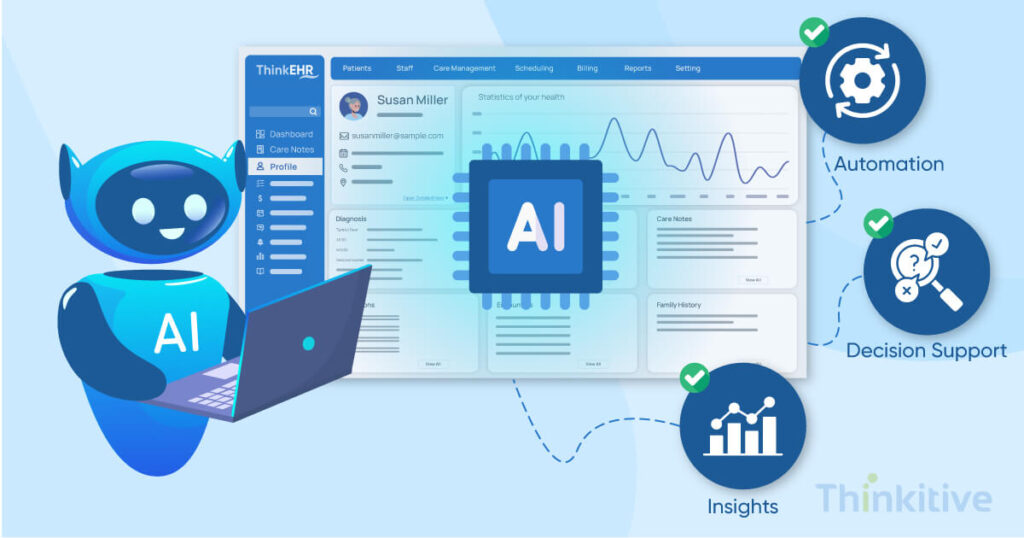
The introduction of Generative AI has transformed a lot of things for everyone. Today, many professionals rely on generic AI for their day-to-day tasks such as documentation, research, etc. Recognising this potential of AI in their businesses, many industries have already implemented this in their processes.
And this trend has even made its way to the healthcare industry. You see, a report by Becker’s Hospital Review suggests that more than 31.5% hospitals in the United States have already adopted generative AI in their EHRs in 2024, and 24.7% have already started their AI implementation in 2025.
This means, entering 2026, more than half of the hospitals will be using generative AI in their EHR system. However, generative AI is just a small part of the Artificial Intelligence landscape. And today, everybody knows it, thanks to everyone who has brought it into mainstream use.
Having said that, recently, all the clients we’ve interacted with for custom EHR software development had one single demand: ‘We want AI in custom EHR’. Which is indeed good, but most of the practitioners actually don’t know how AI can enhance their practice, productivity, and impact their healthcare software systems as a whole. And that is the reason why I decided to pen down this blog.
The role of artificial intelligence in custom EHR is that of a catalyst that speeds up the process, but it’s too broad an answer, right?
You see, the shift that is driving the healthcare industry in 2026 is to turn their passive EHRs into active AI-driven healthcare platforms. With generative AI and multimodal AI being at the helm of it, it is redefining clinician-software interaction.
On that note, let’s discuss the benefits of AI in custom EHR and the role of artificial intelligence in custom EHR in improving your system and functionality.
So, without further ado, let’s get started!
AI-Driven Data Management & Organization
Since we’re talking about an AI-enabled custom EHR, let’s begin with the basic functionality of any EHR system, which is the data management of patients and also the healthcare organization or practice. By enhancing the basic or core EHR functionality with AI, you can turn your basic EHR into an intelligent EHR solution.
Here are some of the aspects of data management that can be enhanced by AI in EHR systems:
- Intelligent Data Categorization: AI works on data, and till now, it has been trained to identify patterns and trends in the data that it is trained on. For your practice, which has tons and tons of patient data, it can easily help you categorize the data based on its type. For instance, it can categorize lab results, medical history, and medications apart from each other in different categories. This way, your providers can easily access data based on the category, enhancing data accessibility and improving system efficiency.
- Data Normalization: Clean, well-organized data is essential for achieving interoperability. With the use of AI to standardize data from different sources, clean it, and make it ready for FHIR-aligned standards. This way, your system can easily communicate with other systems and exchange data in a way that not only makes sense to your software system but also to the user.
- Reducing Data Entry Errors: Medical data entry errors are one of the reasons why many care plans fail across the globe. However, with an AI-powered EHR solution, this problem can be reduced significantly, if not eliminated. Since there will be no manual process to enter the data, in fact, with AI in custom EHR, the data once entered or updated will automatically synchronize across the systems, ensuring continuity in care and other aspects.
- Automated Mapping: One of the most pressing problems providers face during custom EHR is data migration and data mapping. This is a troublesome process because most of the healthcare systems still use legacy systems. In such cases, with AI in EHR systems, the data mapping process can be automated, and the data can be mapped to a FHIR-aligned structure to streamline and speed up the process.
The collaborative use of custom EHRs and AI can revolutionize care delivery. Though for the moment it will remain the same for patients, for providers, they will have more time to spend on patient care activities with very little chance of committing an error, and sharing data effectively and efficiently to ensure care continuity.
Predictive Analytics & Decision Support

AI models are basically trained on data, and their algorithms are great at finding patterns that exist in data, right? Well, apply the same logic to your EHR system for clinical use on patient data. In short, here is how personalized patient care through AI in EHR can be provided with AI-driven EHR systems models like predictive analytics and decision support:
- Risk Prediction: As a healthcare provider, you must know that before any major mishap, the body gives you a signal that something is wrong. And as discussed earlier, AI algorithms are great at finding patterns and trends. With AI in EHR systems, you can utilize the data analytics to predict patient risks. For instance, which patients are likely to develop chronic conditions, or which patients would shortly require readmission. It can all be predicted using AI in a custom EHR. This would help your healthcare providers to make informed decisions and provide better predictive care.
- Clinical Decision Support: Due to the growing pressure on healthcare providers, there is a high chance that they can miss a crucial pattern in patient data. In such cases, AI can offer decision support to healthcare providers by flagging potential issues and suggesting the best possible treatment for the same. You can consider CDS as a personal assistant that helps providers in highlighting risk or care gaps, so that the patient receives the best possible care without missing out on anything.
- Personalized Care: Every patient responds to every disease and medication in a different way. This can be easily observed in patient health records. However, given the pressure on healthcare providers, providing personalized care to every patient can be a little difficult, as it is a time-consuming process. Here, the use of AI can be transformative as it can suggest personalized treatment based on their data, empowering healthcare providers to make better and more informed decisions.
- Prescriptive Analytics: Another use of AI in custom EHR that can enhance your processes is assistive technology during prescriptions. Prescriptions are clinical decisions that make up a major portion of the care journey. However, with prescriptive analytics in place, you analyze patient data about their medication and prescribe medications that suit them best. This way, you can make decisions that are backed by data and not guesswork.
AI-powered custom EHRs can personalize the experience for patients and, at times, can even alert clinicians of potential issues such as medication errors and critical lab values, and improve patient safety immensely.
AI for Natural Language Processing (NLP) in EHR
Natural language processing is one of the first widely used applications of AI. Moreover, it is being used across various industries for various purposes. The same can be said about the healthcare industry. Some can even say that it is one of the early adoptions of AI in healthcare software systems. Here are some of the applications of AI in custom EHR with natural language processing that can enhance the quality of your care delivery.
- Voice Recognition and Documentation: In a scenario where you are consulting with the patient, there is a chance that you may not understand what the patient is saying. Here, with AI, the spoken words can be easily converted into text format. It not only helps in documentation but also helps in better understanding the patient, as providers don’t have to worry about documenting what the patient is saying. This improves the clinical efficiency of healthcare providers and allows them to focus more on patient consultation.
- Text Mining for Clinical Insights: While the above scenario can be an additional task for your healthcare providers, there is a way to use AI to get exactly what you want to know from those notes. By using AI to extract meaningful insights from unstructured data such as physician notes or discharge summaries, you get a brief idea about the patient’s health status and enhance the care delivery process.
- Reducing Documentation Burden: A stat says that 34% of healthcare providers spend their time on EHRs for documentation processes. To avoid that, AI-powered transcription can automate the documentation process in real time and significantly reduce the documentation time of healthcare providers.
- Real-Time Note Generation: Most providers struggle with notes; they either have to type them during consultation or dictate them after the session. This is a time-consuming process. However, with ambient clinical documentation, it can be done much faster and more accurately. You see, with AI-powered speech recognition and NLP, all you have to do is continue your consultation with the patient while your EHR system takes notes for you, giving you more time with the patient.
There are various ways in which you can use the full potential of Natural Language Processes in your AI-driven custom EHR system. For instance, it can allow your providers to interact with the software through voice commands and improve efficiency during consultations. However, the primary benefit of AI-powered custom EHRs is that they help to reduce provider burnout and save significant amounts of time for doctors that they spend on documentation and other processes.
AI in Enhancing EHR Interoperability

If you are still reading this, then at the start, we discussed enhancing EHR functionality with AI with data normalization, data categorization, and overcoming data entry challenges. Well, all these factors strengthen the base of enhancing EHR interoperability. Here, let’s see in detail how it can improve interoperability for your custom EHR software systems.
- Real-time Data Exchange: Using AI for data normalization, categorization, and manual data entry challenges, AI can facilitate seamless integration with other disparate healthcare systems. Once the systems are integrated, they can easily be used for data exchange with increased accuracy and privacy.
- Improved Data Standardization: HL7 FHIR is the industry standards that promote interoperability between healthcare systems. However, different healthcare systems use different standards and formats. In such cases, AI can ensure that the data shared between systems is consistent and aligns with the standard requirements of HL7 FHIR.
- Interfacing with Third-Party Applications: Last but not least, establishing integration with external systems like lab services, imaging, and telemedicine platforms can be promoted with AI again on the ground, as we discussed at the start.
The inclusion of AI with custom EHRs can ensure the continuity of care by not only supporting smooth data exchange but also allowing the systems to make sense of the data.
Enhancing Patient Engagement & Experience with AI
Since your custom EHR software will be the point of contact for many of your patients for receiving care, here are some of the ways in which AI-driven custom EHR systems can be used to enhance the overall patient experience and empower them to proactively engage with their care activities.
- AI-Powered Patient Portals: Patient portals are basically the point of contact for almost everything for patients, from booking appointments to requesting medication refills. Here, including AI-driven tools to provide personalized health insights, reminders, and recommendations can empower patients to proactively participate in making informed decisions and stay updated with every activity that is done in their care journey.
- Virtual Health Assistants: Healthcare providers are already burdened by a huge number of patients. And patients—especially chronic patients—are likely to connect with doctors for even minor inconveniences. In such cases, virtual health assistants such as chatbots powered by AI can help patients book their appointments, provide basic health recommendations, etc. An AI-powered EHR solution with chatbots is one of the powerful tools that can revolutionize patient engagement and experience.
- Improving Patient Communication: Reminders and personalized messages to patients about their health condition can do wonders for engagement and experience. And rather than allowing your healthcare providers to do that, you can integrate those features into your AI-powered custom EHRs. This would streamline the care journey for patients, including follow-ups and other intercassies.
Interested in developing an AI-powered EHR software system? Well, read this guide on how to develop an AI-powered EHR system with features and cost analysis to get a better idea.
Continuous Learning & System Improvements Through AI

Last but not least, your custom EHR software system will be used for years, and during that time, you will have to make several changes and improvements to the system to enable you to provide better care. In this process, you have to depend on your healthcare IT vendor, but to make their process easier, you can use AI effectively to continuously improve your system and allow it to learn from itself. Here are some of the things that you need to consider in this:
- AI for Continuous Monitoring: Rather than increasing the burden on your healthcare providers to continuously monitor patients, use the ability of AI to do that. It will not only learn from that data but will also enable real-time patient health monitoring for you. And since it will learn from itself, it will also improve system recommendations and contribute to improving patient health outcomes effectively.
- Machine Learning Algorithms: Machine learning algorithms are some of the best applications of AI and custom EHRs. After its implementation into your healthcare software, it can easily adapt to the changing nature of the healthcare landscape and help you enhance your workflows. This would significantly reduce the decision-making time and improve the overall quality of care.
- Leveraging AI for System Updates: The ability of AI that you have to leverage the most is its ability to easily identify patterns and trends. Since it will crawl your entire system, it can easily identify and suggest improvements for you. This way, it can streamline the process of continuous updates and optimize your entire healthcare software system, setting it right for future reference.
- Human-in-the-Loop AI Refinement: With all the lucrative benefits of AI in custom EHR, the concern of trusting a machine for care delivery is somewhat concerning. That is why, during the software enhancement of refinements, you need to build a feedback mechanism that keeps the human in the loop, so that the machine is refined on the basis of human intervention, insights, and updates.
Furthermore, you can even leverage the power of AI in custom EHR software development. Read this exclusive article about ‘The Impact of Artificial Intelligence on Custom EMR Software Development’ and know how.
Governance, Trust & Compliance in AI-Enabled Custom EHR
Now that you know how AI improves custom EHR systems, there are some aspects that come with using Artificial Intelligence that you need to know. These aspects are governance, trust, and compliance. Let’s discuss them one by one:
First things first, governance. The custom EHR software that you will be using will mainly deal with private, sensitive, and personal information for patients. In short, you will be dealing with their privacy, and since personal data comes under the fundamental rights of humans, you have to be extremely careful when dealing with this information.
Moreover, in the wrong hands, it can be very dangerous. That is, there are some governing bodies that set the standards and regulations for the use of such healthcare software systems. And since the healthcare industry is evolving thanks to AI, and so is the technological landscape, again, thanks to AI, the governance landscape for the healthcare industry is also changing.
Some of the most important compliances that you need to be aware of and should adhere to are HIPAA, CMS, HITECH Act, GDPR, 21st Century Cures Act, ONC, etc. Though the landscape is ever-evolving, compliance with these governing bodies will not only enhance your system but also help you navigate the legal landscape of healthcare IT.
Coming to the trust factor in AI-enabled custom EHR, here are two things that you can do:
- Explainability of AI-Generated Insights: As they say, you shouldn’t trust everything on the internet; it can be said similarly about AI, and you should not blindly trust AI as well. But if your AI-enabled custom EHR system is directly responsible for your results, trusting it blindly can be risky. That is why the explainability factor is important for AI-driven EHR systems. This will not only give the providers enough proof about the approach by which the AI gave that particular suggestion.
- Bias Detection & Mitigation: The major debate when using AI in workflows is its bias nature. Now, it is not the fault of the system, but the data that we feed it. And you need to know that humans are biased, which is directly reflected in the systems. That is why you need to remove the bias from the data and mitigate risks that are related to it.
Last but not least, HIPAA-aligned AI governance will not only cover the governance aspect but also be a sign to your patients that they use trusted systems. And keep your software audit ready so that you know every activity that is happening inside your software system.
Conclusion
If you are still reading this, then you’re in for a savage reply that you can give to someone if anyone asks you, ‘How can AI improve EHR functionality?’ Though your answer will be lengthy, you can simply pass on the link to this article to them.
Having said that, custom EHRs and AI are like pairs made in heaven. From data security in AI-enhanced EHR to the exclusive benefits of AI in healthcare data management and personalized care delivery, AI-powered custom EHRs can be the one that might be missing from your modern-day 21st-century healthcare practice.
And interestingly, you are just one step away from entering the future of AI in custom EHR. So click here and let’s see what can be done with your EHR system that can set the bedrock for the future of your healthcare practice.
Frequently Asked Questions
Artificial intelligence significantly enhances data management in custom EHR systems by automating data capture, structuring unstructured clinical information, and improving data accuracy. AI-driven EHR systems can intelligently extract insights from clinical notes, lab reports, imaging data, and patient-generated inputs, reducing manual data entry and errors. Advanced AI models also enable real-time data normalization, deduplication, and tagging, ensuring cleaner datasets that are easier to analyze and share across systems. This is one of the core ways AI improves custom EHR systems, especially in data-heavy clinical environments.
Yes, when implemented correctly, AI in custom EHR software can be highly secure. AI-enabled custom EHRs are typically built with enterprise-grade encryption, role-based access controls, audit logs, and continuous monitoring. Additionally, AI models can be trained and deployed within secure, HIPAA-compliant environments, ensuring sensitive patient data never leaves approved infrastructure. Modern AI systems also help detect anomalous access patterns or potential data breaches early, strengthening overall EHR security rather than weakening it.
Artificial intelligence in custom EHR systems is designed to augment—not replace—clinical judgment. AI supports clinicians by analyzing vast amounts of patient data and presenting evidence-based insights, risk scores, alerts, or care recommendations at the point of care. Physicians remain in full control of decisions, while AI acts as a decision-support layer that reduces cognitive load and highlights clinically relevant patterns that may otherwise be missed. This collaborative model is central to the responsible role of artificial intelligence in custom EHR development.
One of the most impactful benefits of AI in custom EHR systems is documentation automation. AI-powered tools such as ambient clinical documentation, speech-to-text, and context-aware note generation can automatically convert patient–provider conversations into structured clinical notes. This dramatically reduces time spent on manual charting, minimizes after-hours documentation, and allows clinicians to focus more on patient interaction instead of screens—addressing a major contributor to clinician burnout.
AI enables personalized care by continuously analyzing patient histories, behaviors, clinical trends, and social determinants of health. In AI-driven EHR systems, this intelligence can tailor care plans, preventive recommendations, medication reminders, and follow-up schedules based on individual patient profiles. Over time, AI models learn from outcomes and adapt recommendations, helping providers deliver more proactive, data-driven, and patient-centric care within a custom EHR environment.
When integrating artificial intelligence into custom EHRs, healthcare organizations must ensure compliance with regulations such as HIPAA, GDPR (where applicable), and local data protection laws. Key considerations include secure data storage, explainable AI models, consent management, auditability of AI decisions, and strict access controls. It’s also critical to validate AI outputs, monitor model performance, and maintain transparency in how AI-driven insights are generated—especially when they influence clinical workflows.
Common challenges include poor data quality, fragmented legacy systems, integration complexity, clinician adoption concerns, and lack of AI-ready infrastructure. Many organizations also struggle with aligning AI initiatives to real clinical and operational goals. Overcoming these challenges requires a strong data foundation, phased AI adoption, clinician involvement in design, and a custom EHR architecture that is flexible, interoperable, and scalable for future AI use cases.
Healthcare providers should begin by identifying high-impact use cases—such as clinical decision support, documentation automation, or predictive analytics—where AI can deliver measurable value. The next step is partnering with an experienced healthcare IT team to design an AI-enabled custom EHR that supports interoperability, data governance, and scalable AI integration. Starting small with pilot implementations and expanding gradually ensures smoother adoption while maximizing the long-term benefits of AI in EHR systems.


