The Role of Interoperability in Custom EHR Systems

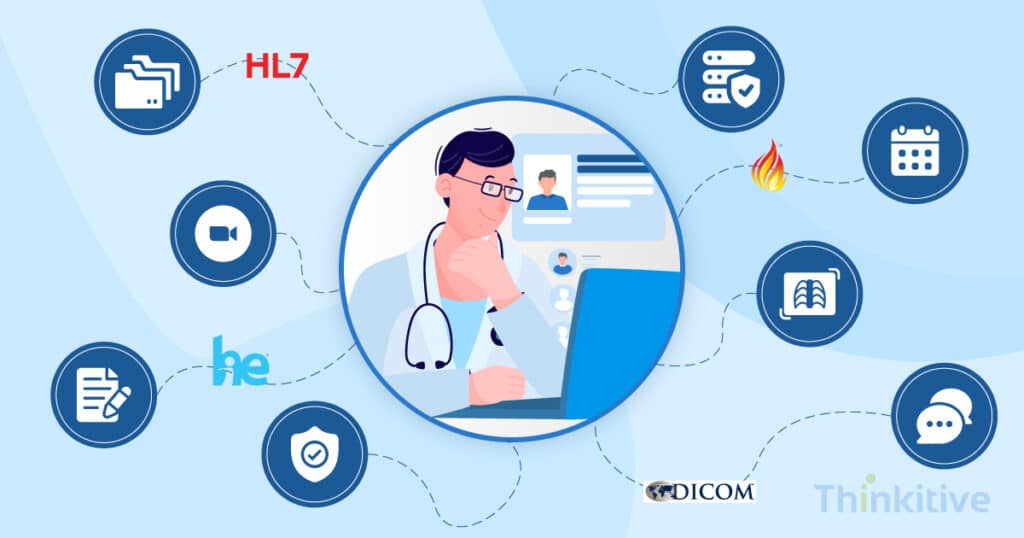
In recent years, Electronic Health Records have become the epicenter for healthcare delivery and also for data sharing between disparate systems. Today, practices are using EHRs for documentation, billing, managing resources, filing claims, etc. Other than that, some of the physicians use it as a point of reference to deliver appropriate and quality care.
For instance, some studies suggest that physicians spend 37% of their time on EHR for clinical use in both inpatient and outpatient settings. Along with that, nurses spend 22% of their time in an inpatient setting, using EHR.
This shows us the relevance of EHRs in today’s healthcare setting and their importance for both clinical and administrative activities. Interoperability with EHR systems was a challenge for many practices, but the introduction of the 21st Century Cures Act made it mandatory, further improving the processes for practices.
For instance, this act made interoperability both its goal and a mechanism through which patients, providers, payers, and health IT professionals could enable secure and timely access to exchange and use the electronic health information present in healthcare systems.
And this has driven the trend of EHR and EMR software development, as it was difficult to adhere to the Information Blocking rule under the 21st Century Cures Act. It not only presents financial risks but also compliance risks, which can damage the reputation and integrity of the practice.
As a healthcare professional, you know interoperability in custom EHR systems is crucial and plays a crucial role in care coordination. However, some of the extended benefits of EHR interoperability allow you to comply and make your system sustainable for long-term success.
On that note, in this blog, let’s discuss the role of interoperability in custom EHR systems and the different aspects of ER system interoperability that will ultimately benefit your practice.
Guide to Building an Interoperable EHR Software
Download Free GuideUnderstanding Interoperability in Custom EHR Systems
Before getting into the intricacies of EHR interoperability, let’s first understand what exactly interoperability is. Well, in a nutshell, interoperability is the ability of a healthcare software system to seamlessly exchange data and information with disparate healthcare software systems and make use of that information.
Though it sounds simple on the surface, the process is actually more complicated. So, here are the types of interoperability in healthcare that you should consider for your custom EHR systems.
- Foundational or Functional: This is the most basic level of interoperability, where systems can simply exchange data, but the receiving system may not understand the data that is being shared.
- Technical: This type of interoperability refers to the ability of different technologies used in the system to work together to share and make use of the data. This involves the system working together as one, where hardware, software, and the networks work together to communicate effectively.
- Semantic: This is the highest level of interoperability that a healthcare software system can achieve. In semantic interoperability, the systems can exchange data and understand the meaning of data without any resistance.
Now that you know some of the most commonly used types of interoperability, here are some of the benefits of interoperability.
- Improved Patient Care: EHR interoperability encourages healthcare data exchange in real-time and facilitates seamless communication between patients and providers. This helps the entire care team to be on the same page and work towards the same goal, which is to improve patient health outcomes.
- Clinical Burnout Reduction: One of the major benefits of an interoperable custom EHR system is that it facilitates real-time data exchange and seamless communication. This, coupled with automation, shifts the focus from documentation to patient care, directly contributing to improving the overall efficiency of the practice. Due to this, providers don’t have to spend much time on their EHRs, and ensure a pleasant experience while using the software.
- Reduced Costs: With seamless communication and data integration, EHR interoperability enables timely care delivery and eliminates the need for unnecessary travel, etc. This reduces unnecessary hospitalization, etc., helping healthcare practices save significantly on resources and patient care.
- Value-Based Care: As the tides in the healthcare industry are moving towards value-based care, it can be enabled with the help of EHR systems. You see, the data exchanged through the system can be used as evidence, and mapping the growth of patients becomes much easier.
Interoperability impacts some of the core aspects of your custom EHR software. Read this custom EHR interoperability, security and compliance guide, to understand the role of interoperability from a broader perspective.
One important aspect that you must understand with respect to this is attaining organizational interoperability. This is to go beyond technical standards and align your interoperability with governance structures, policies, and decision-making across healthcare entities.
For instance, by attaining organizational interoperability, multiple organizations can work together effectively and not just exchange data. Moreover, in this, you get a clearly defined governance model that determines who owns the data, who can access it, and how data-sharing decisions are made across your network.
Interoperability Standards & Regulatory Frameworks
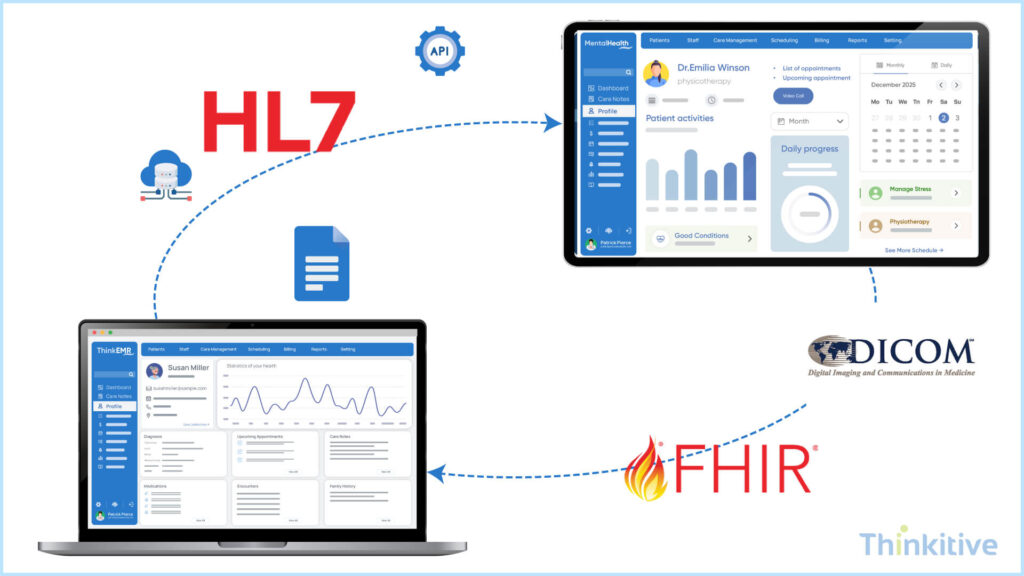
In order for your custom EHR system to achieve interoperability, there are certain standards that your system needs to follow. To give you a brief idea about these standards, here are the most commonly used interoperability standards:
HL7 Standards
Health Level Seven, also known as HL7, is the international healthcare interoperability standard used for the transfer, integration, sharing, and receiving of electronic health information. Some of the most common healthcare interoperability standards used in HL7 are:
- HL7 FHIR: This is a newer set of standards that is based on RESTful web services. It is designed in such a way that it feels more lightweight and easier to use than HL7 v2 and HL7 v3.
- HL7 v2: HL7 v2 is the most widely used healthcare interoperability standard in the world. It is a message-based standard, and the genesis of information sharing is defined on the basis of the structure and content of the message that is being exchanged between the healthcare systems.
- HL7 FHIR v5/v6: This is the latest version of interoperability standards. It enables secure, RESTful, API-driven data exchanges. What it does differently from other versions is that it improves resource consistency, gives access to bulk data, and supports real-time workflows. Due to this integration, your custom EHR software with other systems like HIEs, labs, payers, telehealth, etc., becomes much easier.
Other Healthcare Interoperability Standards
Other than the HL7 interoperability standards, here are some other interoperability standards that you can use:
- DICOM: DICOM stands for Digital Imaging and Communication in Medicine, which is an interoperability standard used in medical imaging equipment to seamlessly share information with healthcare software systems. So, if you are an orthopedic healthcare practice or a healthcare practice that highly relies on medical imaging, then using DICOM is highly recommended.
- CDA: CDA stands for Clinical Document Architecture, which again is a type of interoperability standard that allows healthcare systems to exchange clinical documents in a consistent and structured manner.
Regulatory Framework & Compliance Requirements
The regulatory framework and compliance requirements for interoperability with EHR systems have changed significantly. Here are some considerations that you must know:
- USCDI v5/v6 Compliance Requirements: United States Core Data for Interoperability sets a standardized data format for your EHR systems that supports exchange. It requires your EHR to comply with FHIR HL7 requirements as it expands data classes like social determinants, clinical notes, and assessments. This way, you can ensure that your custom EHR system is able to share complete, structured, and regulation-aligned data across systems.
- TEFCA & QHIN Participation: Trusted Exchange Framework and Common Agreement (TEFCA) and Qualified Health Information Network (QHINs) are interlinked, as TECA enables nationwide interoperability by connecting your organization to the designated QHINs. Participation in TEFCA can enhance the capabilities of your custom EHR system for treatment, payment, and public health use cases.
Importance of Adhering to Healthcare Interoperability Standards
Adhering to these healthcare interoperability standards is crucial for your healthcare practice as well as for your custom EHR systems. This is because it acts as a base for healthcare data exchange between the systems. Along with that, it also ensures that the data exchanged is accurate and consistent throughout the connected networks, which plays a major role in improving the overall quality of care that is being delivered.
Here’s a quick comparison between different healthcare interoperability approaches, so that you can make a better decision for your custom EHR software:
| Standard/Approach | Description | Strengths | Weaknesses | Best For |
| HL7 v2.x | Messaging standard for exchanging clinical and administrative data. | Widely adopted, mature, real-time messaging. | Inconsistent implementation, limited semantic interoperability. | Legacy systems and hospitals need basic data exchange. |
| HL7 FHIR (Fast Healthcare Interoperability Resources) | Modern web-based standard for exchanging healthcare information electronically. | Easy to implement, supports REST APIs, mobile & cloud-ready. | Still maturing in some areas; varies in vendor implementation. | Mobile apps, modern EHRs, patient portals, population health platforms. |
| C-CDA (Consolidated Clinical Document Architecture) | Document-based standard for structuring clinical summaries. | Supports rich clinical narratives, widely used in Meaningful Use. | Verbose is harder to parse programmatically and not in real-time. | Transition of care documents, EHR summaries, and regulatory reporting. |
| IHE (Integrating the Healthcare Enterprise) | Framework using existing standards (like HL7, DICOM) for specific healthcare use cases. | Promotes cross-vendor interoperability, focused on workflows. | Complex setup, limited adoption outside large systems. | Large hospital networks, enterprise-wide health IT systems. |
| DICOM (Digital Imaging and Communications in Medicine) | Standard for handling, storing, and transmitting medical imaging. | Essential for radiology and imaging, vendor-neutral archive support. | Limited to imaging data; needs integration with other clinical systems. | Radiology, cardiology, and other imaging departments. |
| API-Based Interoperability (using SMART on FHIR, etc.) | Application-based integrations leveraging modern APIs. | Real-time access, modular, user-friendly apps, and OAuth2 security. | Dependent on FHIR maturity and EHR vendor support. | Patient engagement tools, third-party app integration, and custom dashboards. |
Advanced Integration & Ecosystem Collaboration
Before achieving interoperability in healthcare software systems, you first need to integrate your custom EHR with disparate software systems. While there can be many software systems that you need to integrate with, here are some of the most common ones that help you provide your patients with a complete virtual healthcare experience:
- Laboratory Information Systems (LIS): As a healthcare practice, you need to highly depend on laboratories to derive test results. With EHR integration capabilities with the laboratory information system, you can automate the data transfer process and reconciliation, reducing the time to care delivery and improving the overall care delivery process.
- Radiology Information System (RIS): Along with the medical test reports, X-rays, MRI scans, etc., are also necessary for diagnosis. By integrating your custom EHR system with a radiology system, you can easily view images and reports in real-time. This is crucial not only for a smooth clinical workflow but also to reduce the turnaround time for care delivery.
- Practice Management Systems (PMS): Consolidating patient data for billing information is important, and integrating your custom EHR systems with these practice management systems can streamline the administrative processes and set the entire virtual care delivery process in motion.
SMART-on-FHIR Applications for Modular EHR Ecosystem Integration
Your practice will rely on a lot of third-party applications for administrative tasks and care delivery as well. With SMART-on-FHIR, you can directly plug these third-party applications into your EHR using standardized FHIR APIs with secure OAuth-based authorization. This modular ecosystem approach helps you in providing clinical decision support, reporting and analytics, patient engagement, etc., giving your system flexibility.
Add SDOH & Behavioral Health Data Integration
For a full patient context apart from the clinical visits, you need to integrate Social Determinants of Health (SDOH) and behavioral health data into your EHR workflows. When these data pointers are included in workflows such as intake, care planning, and risk stratification, more personalized care can be provided, with improved coordination. This can allow you to adopt value-based care delivery practices and initiate population health initiatives.
Patient-Mediated Exchange through Mobile Applications
Another important aspect of interoperability that many miss is allowing individuals to share their own health data. This gap can be covered with patient-mediated exchange through mobile applications, allowing individuals to access, control, and share their health data with providers or caregivers using digital health tools.
Data Sharing, Proactive Exchange & Governance
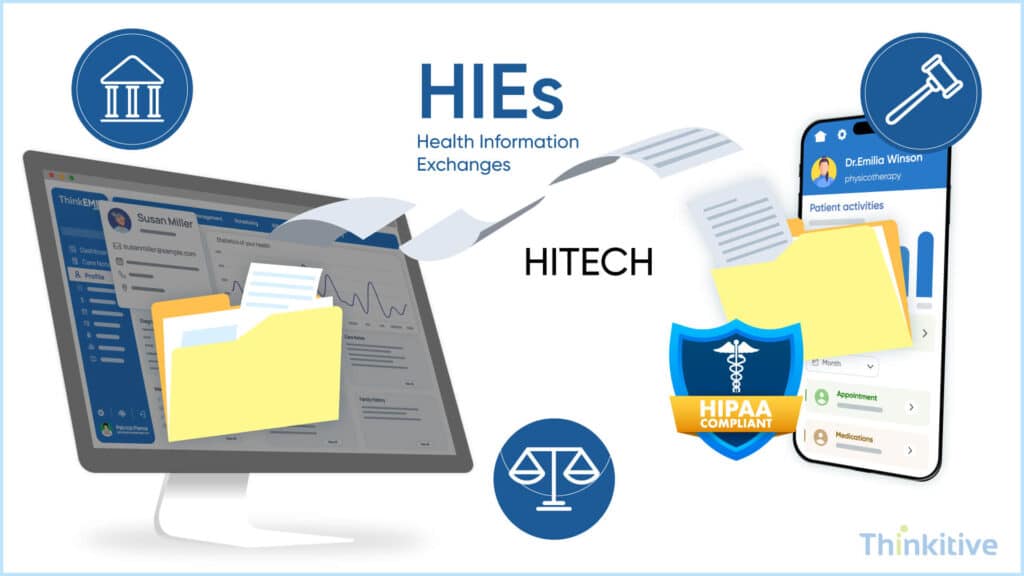
Interoperability in healthcare is the cornerstone of the modern-day healthcare landscape. While the EHR systems have become the epicenter of care delivery for healthcare practices, achieving interoperability for your custom EHR can facilitate data sharing and exchange between disparate healthcare systems for effective care delivery.
- Health Information Exchanges (HIEs): Being a healthcare provider, there might be some cases that you encounter where you would need to take second opinions from other healthcare providers. In such cases, by implementing an interoperable EHR system, you can easily and securely share patient information across providers, which would, in fact, improve care coordination and patient outcomes effectively and efficiently. Furthermore, if you’re adhering to TEFCA, then most of these sharing capabilities will be present in your custom EHR system.
- Patient Portals: Empower your patients by giving them access to their health information from your customizable EHR. By holding this data as the point of reference, patients can proactively facilitate communication with healthcare providers and participate in decision-making, etc.
- Data Analytics and Business Intelligence: Leverage the power of data to improve decision-making and identify unique trends and opportunities for improvement of care delivery. By integrating this into your custom EHR system, you can not only improve the quality of care but also instill better revenue management practices. Also, it allows better preventive care with real-time predictive insights.
- RPM Data Synchronization: Remote care delivery being one of the rising trends in the healthcare landscape, you are required to synchronize the data you collect from RPM devices, especially with home-based devices, so that the point can be delivered.
NOTE: Deep dive to the core aspects of EHR architecture, compliance and salability. Read our complete guide – A Deep Dive into Custom EHR Software Architecture, Compliance & Scalability.
Common Challenges & How to Overcome Them
While interoperability has become an integral and crucial aspect of custom EHR software, achieving it is easier said than done. Some of the most common challenges you’re likely to encounter can be troublesome. To help you overcome them more easily, here are the most common challenges and how you can overcome them:
- Data Standardization Issues: Different EHR systems use different formats and terminologies that suit them best. This makes it difficult for the disparate systems to connect, share, and interpret the data accurately, making interoperability harder. One of the best ways to overcome these issues is by adopting industry-wide standards such as HL7 FHIR, SNOMED CT, LOINC, and ICD-10. You can also use mapping tools and middleware platforms to translate the data from different formats and normalize data formats between systems for smoother exchange.
- Privacy & Security Concerns: Safeguarding data and ensuring the compliance of your system with regulatory standards is a complex process. However, some of the best ways to simplify this process are by implementing robust and comprehensive security measures like role-based access controls, data encryption, and secure authentication like OAuth 2.0. And regularly conduct risk assessments and staff training on data privacy protocols.
- Workflow Disruption: When the systems are not integrated properly, there is a high chance that data flows along with workflows can be disrupted, creating frustration and hindering adoption. However, the best way to overcome this is to keep the clinical end-users involved in the design and testing process to get proper insights. Furthermore, emphasis on adopting real-time integration solutions within existing EHR user interfaces.
- Incomplete & Inaccurate Data Exchange: The computer systems may send incomplete patient data and can also misinterpret the incoming information. In such cases, you need to implement data validation protocols and use comprehensive test cases during the EHR system integration process. Along with that, you also need to monitor the performance of your interoperability with dashboards and alerts to bridge the gaps quickly.
Assess Your EHR System Readiness for Interoperability
Get Free ConsultationTechnology Challenges in EHR Interoperability
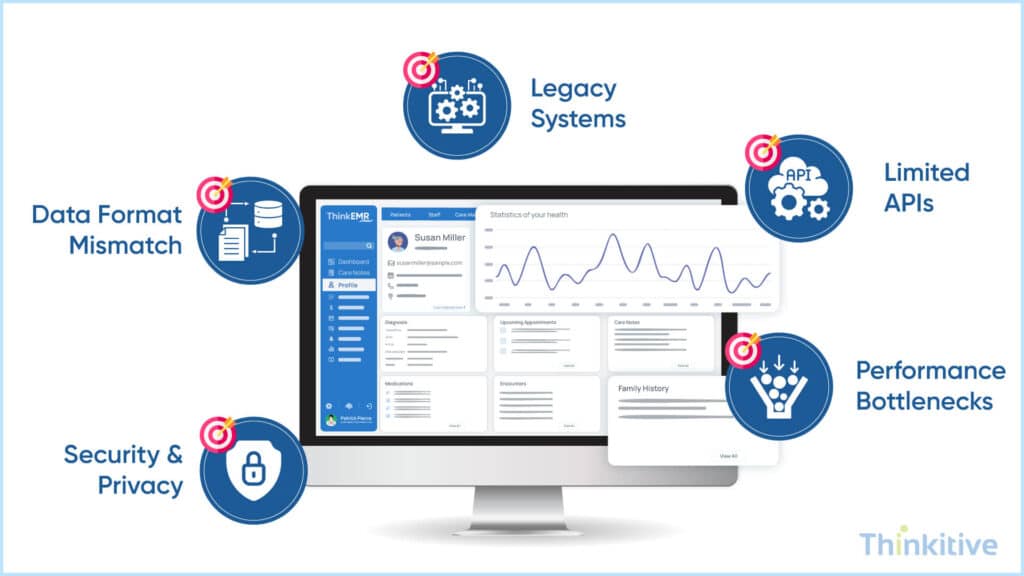
While achieving interoperability, even the technology might present you with some challenges. For instance, the first step of interoperability in data migration, and for that, you need to ensure that only quality data is being used, and here, maintaining semantic consistency becomes difficult. This is because your system draws data from multiple sources, which use different formats and standards.
Here are some of the challenges that you need to keep an eye on while making your custom EHR software interoperable.
- Addressing Regulatory Complexity: One of the major challenges is adhering to the regulatory complexity. You see, different regulatory standards have different requirements, and adhering to all of them cannot be easy. On top of that, you might also face some adoption resistance.
- AI and Machine Learning: AI and machine learning are two of the most trending technologies that many healthcare IT solutions are embracing. With AI and ML, you can use advanced data analytics to get deeper insights into practice and patient health. Furthermore, you can utilize it for automation to reduce the burden of data entry and even allow it to provide clinical decision support for providers in delivering care. Using AI and ML modules, you can drive semantic mapping and data normalization, giving you an easy way through the complex regulatory integration landscape.
- API Cybersecurity & Zero Trust Architecture: Adopting cybersecurity measures to APIs is crucial and can be a little challenging in custom EHR interoperability. On top of that, if you deploy a zero-trust architecture, then both of these can contribute to making your custom EHR solution more secure.
- Interoperability Challenges and Solutions: Challenges of interoperability in healthcare include data quality and a lack of data standardization. While these challenges can be overcome by adhering to best practices, you also need to identify and address the security and privacy concerns in the custom EHR systems.
Conclusion
In conclusion, interoperability plays a pivotal role in custom Electronic Health Record (EHR) systems. Overcoming challenges in traditional EHRs, we’ve discussed how seamless data exchange and improved communication among healthcare providers enhance patient-centric care and continuity. Emphasizing key components and benefits, we underscore the importance of standardized data formats, Health Information Exchange integration, and compatibility with external systems.
As the future trends toward evolving standards, AI integration, and patient empowerment, the conclusion encourages healthcare organizations to prioritize interoperability in EHR development, fostering a more connected and informed healthcare ecosystem for improved outcomes and efficiency. And don’t forget to properly identify the challenges and implement the necessary solutions for better performance, as suggested in the article above.
On that note, let’s start by first analyzing your healthcare software system and book your free consultation with Thinkitve’s Custom EHR expert .

Frequently Asked Questions
Interoperability in custom EHR systems refers to the ability of an EHR to securely exchange, interpret, and use health data across different systems, organizations, and care settings. This includes seamless data flow between labs, pharmacies, hospitals, payers, HIEs, and patient-facing applications—without manual intervention or data loss.
Interoperability matters because modern healthcare delivery is highly connected and collaborative. Without interoperability, patient data remains fragmented, leading to care delays, duplication of tests, and clinical blind spots. In custom EHR systems, interoperability ensures continuity of care, regulatory compliance, and scalability across networks—making it a foundational requirement rather than an optional feature.
The main aspects of EHR system interoperability include:
- Technical interoperability – Standardized APIs and data formats (e.g., FHIR, HL7) that enable system-to-system communication
- Semantic interoperability – Consistent clinical vocabularies so data retains meaning across platforms
- Organizational interoperability – Governance, policies, and workflows that support cross-organization data exchange
- Security & compliance – Role-based access, consent management, audit logs, and encryption for shared data
Together, these aspects ensure reliable, secure, and usable data exchange.
Custom EHR systems improve data sharing by using API-first architectures, standardized data models, and configurable integration layers. Unlike off-the-shelf systems, custom EHRs can be designed to integrate with specific partner networks, regional HIEs, specialty tools, and national exchange frameworks—ensuring real-time, bidirectional data flow that fits existing clinical workflows.
The benefits of EHR interoperability include:
- Improved clinical decision-making through complete, up-to-date patient records
- Reduced administrative burden by eliminating manual data entry and duplicate documentation
- Better care coordination across providers, locations, and care teams
- Enhanced patient safety by minimizing errors and information gaps
- Stronger patient engagement via access to unified health records across platforms
Overall, EHR interoperability directly improves care quality, operational efficiency, and patient outcomes.


