AI-Powered Prior Authorization: Reducing Denial Rates by 40%

There is an interesting story of Prior Authorization.
What was introduced as a feature that would simplify payments and enable care at the right time became one of the most frustrating and resource-intensive processes in healthcare today.
You see, it was brought to control costs and ensure that patients get access to the necessary care in time. However, soon after its implementation, many practices reported that it created a significant administrative burden for providers.
In fact, a survey by the American Medical Association stated that almost 93% of physicians reported delays in access to necessary information or reports due to prior authorizations.
To make the situation worse, as payers continue to introduce more complex authorization requirements, providers are struggling to keep up with evolving rules, documentation standards, and coverage criteria. This has led to denials, treatment delays, and lost revenue for minor errors, missing clinical evidence, and incomplete submissions.
To address these challenges, many practices have already started to work with AI-powered custom EHR development to enhance their PA with automated prior authorization. And this blog is a unique case, where I will share the intricacies of AI prior authorization, which helped one of our clients reduce the denial rate by 40%.
On that note, in this blog, let’s try to answer some of the basic questions that you might have, like ‘How to reduce insurance denial rate using AI?’ or ‘How to integrate prior authorization into EHR systems?’
So, without further ado, let’s deep dive into the intricacies of AI-powered prior authorization with custom EHR software development.
Assess Your System for AI-Powered Prior Authorization Capabilities –
Get Free Assessment
Why Prior Authorization Remains a Major Challenge
EHR prior authorization integration, despite being one of the critical components of the reimbursement process, still remains one of the biggest administrative challenges for practices.
You see, every authorization request requires providers to navigate payer-specific requirements, submit supporting clinical documentation, validate medical necessity, and follow evolving approval criteria. Now, this process appears to be quite straightforward, yet it can easily become time-consuming, involving multiple workflows, teams, systems, and follow-ups.
On that note, let’s try to find the reason why PA still remains one of the major challenges.
Common Causes of Prior Authorization Delays & Denials
Most of the prior authorization denials are caused by administrative inefficiencies and documentation gaps. Some of the most common reasons that our client has pointed out are:
- Missing or incomplete clinical documentation
- Incorrect diagnosis (ICD-10) or procedure (CPT) codes
- Failure to demonstrate medical necessity
- Incomplete authorization forms
- Payer-specific policy requirements are not being met
- Authorization requests submitted after deadlines
- Lack of real-time eligibility and coverage verification
Because authorization specialists often rely on manual reviews and fragmented workflows, even minor oversights can result in costly delays or denials.
The Impact on Providers, Staff & Patients
Let’s see how these inefficiencies impact different user groups:
Impact on providers:
- Increased administrative workload due to documentation and authorization requirements
- Less time available for direct patient care
- Higher risk of physician frustration and burnout
- Delays in delivering recommended treatments and procedures
Impact on administrative staff:
- Significant time spent gathering records and supporting documents
- Constant monitoring and follow-up of authorization requests
- Growing complexity due to payer-specific rules and requirements
- Increased workload from denied or resubmitted authorization requests
Impact on patients:
- Delayed access to medications, procedures, and specialist referrals
- Longer wait times for diagnosis and treatment
- Increased care abandonment due to authorization-related delays
- Reduced patient satisfaction and care experience
The Financial Cost of an Inefficient Authorization Process
Authorization delays impact patient care, but they have a direct and even more devastating impact on the practice’s revenue cycle. Look at it this way: for every denied or resubmitted authorization, you require additional effort, delayed reimbursement, and increased risk of revenue leakage.
While these account for direct losses, manual prior authorization workflows can lead to staff burnout, lower productivity, higher appeal and rising administrative costs. As authorization requirements become more complex, healthcare organizations need a smarter and more scalable approach.
Prior authorization has become one of the core features of value-based care delivery. With respect to that, read the blog – Custom EHR for Value-Based Care: Features That Drive Outcomes, to know in detail about value-based care delivery.
How Does Automated Prior Authorization Works?
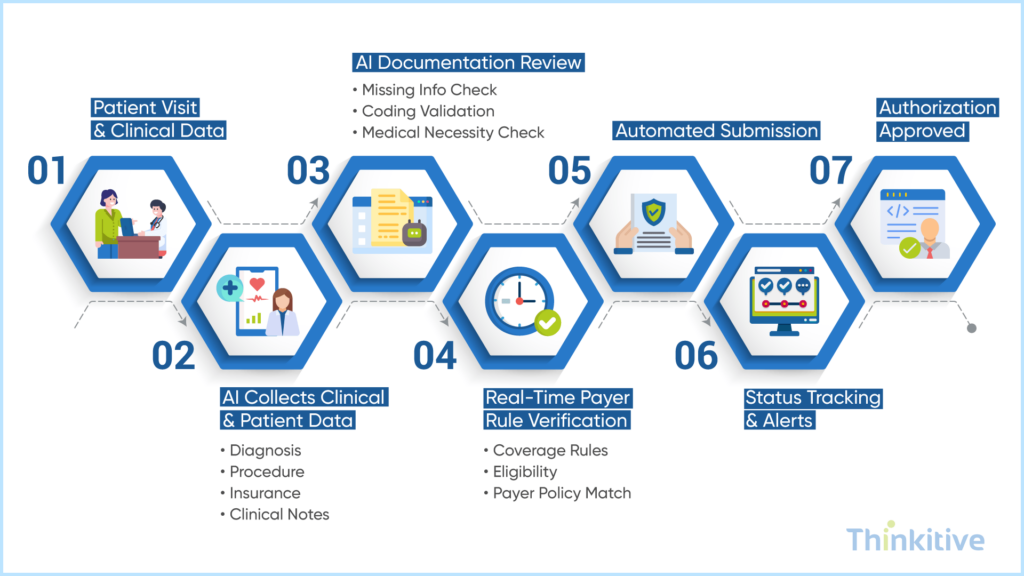
Now that you are well aware of the consequences of prior authorization, let’s see how we can process clinical documentation automation and how automated prior authorization works.
1. Collect Clinical & Patient Data
So, the process begins by automatically gathering relevant patient information, diagnosis codes, procedure details, insurance information, and clinical documentation from the EHR. This eliminates manual data entry and ensures all required information is available before submission.
2. Review & Validate Clinical Documentation
The next process is documentation analysis with AI. These AI tools can analyze clinical notes and other documents to identify missing information, coding inconsistencies, or gaps in medical necessity documentation. This way, any issues can be flagged before the authorization request is even submitted.
3. Verify Payer Rules in Real Time
During the process, the system compares the authorization request against payer-specific requirements, coverage policies, and approval criteria in real time. This helps in ensuring that the request meets the insurer’s documentation and eligibility standards.
4. Submit the Authorization Automatically
Once validated, the authorization request is automatically prepared and submitted. This allows AI to continuously track its status, send alerts for pending actions, and help staff members to respond quickly to payer requests, reducing approval delays.
5. Track Authorization Status & Respond to Requests
Once the authorization request is submitted, the system continuously monitors its status and notifies the care team whenever additional information or action is required. This enables staff to respond quickly to payer requests, avoid missed deadlines, and keep the authorization process moving smoothly until a final decision is received.
The Role of Clinical Documentation Automation
Here is the major role of clinical documentation automation.
- Better documentation leads to higher approval rates by reducing missing information, coding errors, and incomplete submissions.
- Integrated documentation and authorization workflows eliminate manual record gathering and ensure all supporting evidence is included.
- Strong medical necessity documentation helps payers quickly validate treatment requests, improving first-pass approvals and reducing denials.
How to Reduce Insurance Denial Rates Using AI
If you have observed your prior authorization system in action, then you would know that most denials by the clearinghouses or payers can actually be preventable. Most of the denials occur because of missing documentation, incomplete submissions, coding inconsistencies, or failure to meet requirements.
Now, AI-powered prior authorization shifts this process from reactive to proactive. You seem to identify the problem after a denial, and the AI helps you in detecting and resolving the issue even before submission.
On that note, let’s explore the AI capabilities that you get with the implementation of AI-powered prior authorization and how it helps you in reducing denials.
| AI Capability | How It Reduces Denials |
| Identifying Missing Information Before Submission | AI reviews patient records, clinical notes, diagnosis codes, and supporting documents to detect missing information before the authorization request is submitted. This helps prevent avoidable denials and resubmissions. |
| Reducing Manual Errors and Incomplete Requests | AI automates data extraction, validates documentation, and ensures all required fields are completed accurately, reducing human errors caused by manual workflows. |
| Using Predictive Analytics to Flag High-Risk Authorizations | By analyzing historical authorization outcomes and payer behavior, AI identifies requests that are more likely to be denied, allowing teams to address potential issues proactively. |
| Improving Submission Accuracy Across Workflows | AI standardizes authorization workflows by validating requests against payer-specific requirements, improving consistency, approval rates, and overall process efficiency. |
Business Benefits of Prior Authorization Workflow Optimization
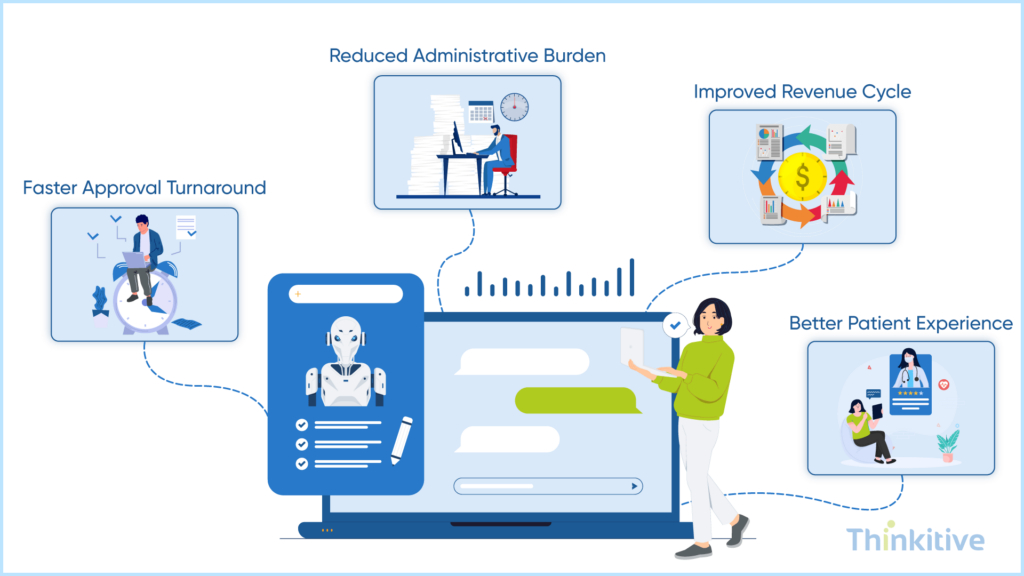
Here are some of the benefits that you can enjoy with AI-powered prior authorization optimizations:
- Faster Approval Turnaround Times: Automating documentation reviews and submissions helps accelerate authorization decisions and reduce delays in patient care.
- Reduce Administrative Burden: With the help of AI, manual paperwork, data entry, and payer follow-ups are minimized, if not eliminated. This allows your staff to focus more on tasks that actually matter.
- Improved Revenue Cycle Performance: Accurate authorization requests will naturally lead to fewer denials, faster reimbursement, and reduced revenue leakage. Improving the financial health and streamlining your revenue cycle.
- Better Patient Experience & Care Continuity: Faster approvals help patients receive treatments, medications, and specialist care without unnecessary delays.
Best Practices for Implementing AI Prior Authorization
Implementing AI prior authorization is not simple. In fact, if it were simple, there wouldn’t be surveys citing its inefficiencies. On that note, here are some of the best practices for implementing AI prior authorization and how it can benefit your practice:
| Best Practice | Why It Matters |
| Standardize Authorization Processes | Establish consistent workflows, documentation requirements, and approval procedures to improve accuracy and reduce variability. |
| Start with High-Volume Authorization Categories | Focus on frequently requested procedures, medications, or services to maximize efficiency gains and demonstrate ROI quickly. |
| Monitor Denial Trends & Workflow Performance | Track approval rates, denial reasons, turnaround times, and staff productivity to identify improvement opportunities. |
| Integrate with EHR Systems Using FHIR, CDS Hooks & Payer APIs | Enable seamless data exchange, automated documentation retrieval, and real-time authorization workflows across systems. |
| Ensure Secure & Compliant Data Exchange | Protect patient information through HIPAA-compliant workflows, secure APIs, access controls, and data encryption. |
Key Takeaways
- AI-powered prior authorization helps reduce preventable insurance denials.
- Clinical documentation automation improves first-pass approval rates.
- Real-time payer rule verification speeds up authorization decisions.
- EHR prior authorization integration streamlines clinical and administrative workflows.
- Optimized prior authorization workflows improve revenue and patient experience.
Conclusion
If you have made it here, then you must be wondering how you can help your client reduce their denial rate by 40%, right?
Well, everything that we have discussed till now has been all the activities that we did for our client. We developed a custom EHR software and then implemented AI-powered prior authorization workflows to streamline and strengthen the practice’s financial health.
And being at the transitioning stage of your healthcare infrastructure, combining automation and high-quality clinical documentation is the best investment you can make to make the work of your practice staff a little easier.
So, what are you waiting for? Get a free system assessment from our EHR expert to know the readiness of your system for AI-powered prior authorization and get started with custom EHR software development.
Frequently Asked Questions
Automated Prior Authorization is the use of AI, workflow automation, and EHR prior authorization integration to streamline the prior authorization process. It automatically collects patient and clinical data, validates medical necessity documentation, verifies payer-specific requirements, and submits authorization requests with minimal manual effort. By reducing documentation errors and administrative delays, automated prior authorization helps improve approval rates, shorten turnaround times, and optimize prior authorization workflows.
AI Prior Authorization reduces denials by identifying missing documentation, validating coding accuracy, verifying payer-specific requirements, and flagging high-risk requests before submission. This proactive approach helps healthcare organizations understand how to reduce insurance denial rates using AI while improving first-pass approval rates.
Common causes of prior authorization denials include incomplete documentation, missing supporting records, incorrect diagnosis or procedure codes, insufficient Medical Necessity Documentation, and failure to meet payer-specific requirements. Many of these denials can be prevented through automation and standardized workflows.
Clinical Documentation Automation helps ensure that patient records, clinical notes, diagnoses, and supporting evidence are complete and accurate before submission. For organizations wondering how clinical documentation affects prior authorization approvals, the answer is simple: better documentation improves medical necessity justification and increases the likelihood of approval.
Yes. Modern Automated Prior Authorization solutions can integrate with existing EHR platforms to automatically access patient demographics, clinical records, insurance information, and authorization-related documentation. Effective EHR Prior Authorization Integration eliminates duplicate data entry and streamlines workflows across clinical and administrative teams.
FHIR enables secure and standardized healthcare data exchange between EHRs, payers, and third-party applications. CDS Hooks delivers real-time clinical decision support within provider workflows. Together, they help automate data retrieval, authorization requests, payer communication, and approval tracking within prior authorization workflows.
AI Prior Authorization solutions can be HIPAA compliant when implemented with appropriate security controls, including data encryption, access management, audit logging, and secure API integrations. Compliance depends on how the solution is designed, deployed, and managed within the healthcare organization.
Prior Authorization Workflow Optimization helps healthcare organizations reduce administrative burden, improve submission accuracy, accelerate approval turnaround times, reduce preventable denials, and enhance revenue cycle performance. It also improves patient access to timely care and treatment.
Healthcare organizations can start by identifying high-volume authorization categories, standardizing authorization workflows, assessing documentation quality, and integrating automation tools into existing systems. For organizations evaluating how to integrate prior authorization into EHR systems, adopting FHIR-based workflows, CDS Hooks, and payer APIs is often the first step toward scalable AI-powered prior authorization.


