Custom EHR for Value-Based Care: Features That Drive Outcomes

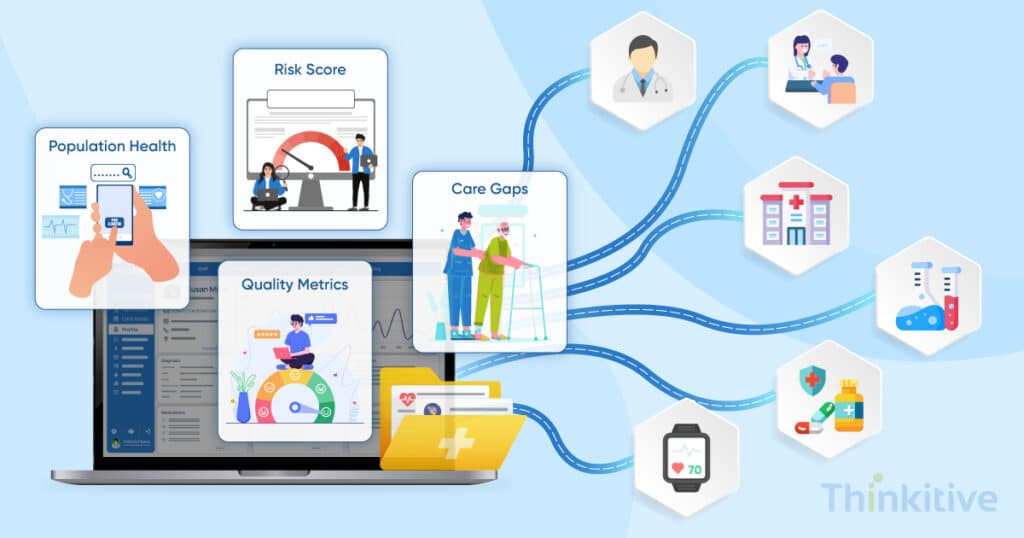
Being into healthcare, have you heard of the Medicare Shared Savings Program (MSSP)?
If you usually visit clinics when you are sick, then you probably have not. However, if you are a provider, then you might have heard of it.
But it’s always good to revisit knowledge every once in a while, right?
So, this is basically the program that encourages healthcare providers and practices to form Accountable Care Organizations (ACOs), which work together to provide well-coordinated and high-quality care to patients, reducing unnecessary costs for both parties.
From what started as a small venture with 27 ACOs, it has today reached 480 ACOs managing over 11 million patients and saving over $2.1 billion annually.
And this is the transition that the healthcare industry is going through right now. Your practices are shifting from the traditional fee-per-service models to value-based care models.
However, the problem many practices are facing with starting these programs is that these EHR software systems are simply not able to accommodate these needs. A value-based care EHR has different needs, workflows, and processes, which a simple EHR cannot accommodate.
That’s why many practices serious about opting for value-based care are seeking custom EHR development to develop the EHR features for value-based care.
So, let’s come back to the real question, ‘How much does a custom EHR for value-based care cost?’
Well, most custom EHR development projects for value-based care cost between $50,000 and $500,000+, depending on the scope of quality reporting, care coordination workflows, integrations, compliance requirements, and deployment scale. Organizations with basic MVP requirements typically fall at the lower end of the range, while enterprise platforms supporting advanced value-based care programs require a higher investment.
On that note, let’s see why you must have a value-based care EHR and transition towards holistic healthcare and support outcome-driven healthcare.
Value-Based Care Features for Your Custom EHR –
Get Free Assessment
Why Value-Based Care Requires a Different EHR
To understand why value-based care EHR requires a different EHR or a customized EHR, we first need to understand the nature of value-based care.
Again, let’s take the example of MSSP and try to draw parallels between them. So, typically, an EHR system allows you to schedule information, generate information, take notes, document, bill, and keep the data safe.
Now, for MSSP, you will be required to manage population health, conduct risk stratification, identify care gaps, coordinate care, create reports on progress with qualifying measurements, patient engagement, remote monitoring, and analytics.
In these cases, EHR development companies don’t usually build a software system with these features. That is why a custom EHR appears to be the ideal choice for developing EHR software specifically for value-based care.
Essential EHR Features for Value-Based Care
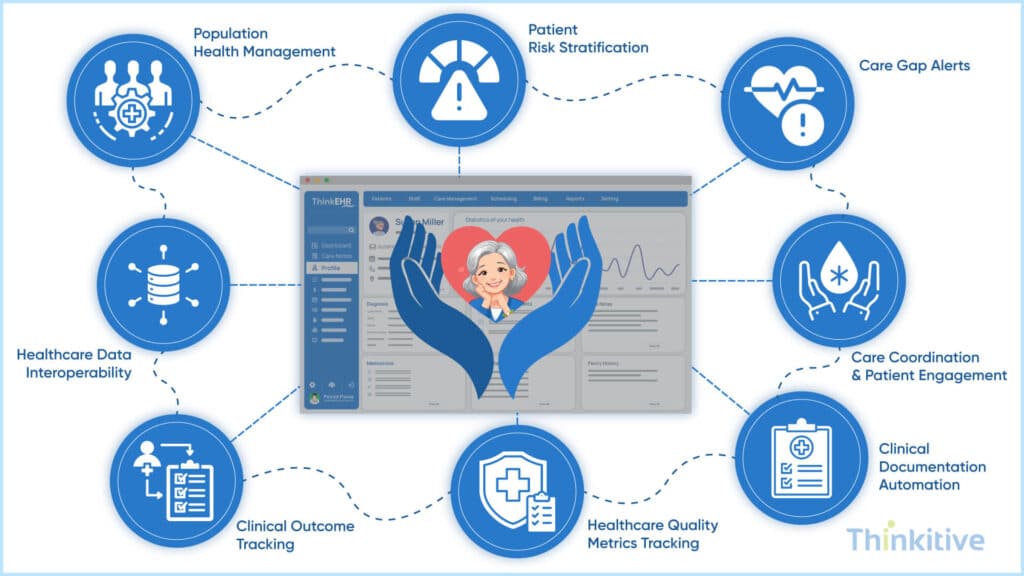
The ultimate goal of any value-based care EHR is to help providers proactively manage patient health, improve quality performance, and reduce unnecessary costs for both sides.
This requires going that extra mile beyond documentation and billing. For instance, some of the EHR features for value-based care that you require are population health management, clinical-decision support, etc.
On that note, here are some of the essential capabilities that your EHR software must have:
Population Health Management
Another name for value-based care is holistic care, which focuses on improving the healthcare of an entire patient population. That is why your EHR system should enable providers to segment patients based on chronic conditions, demographics, or risk factors and monitor them through centralized population health dashboards.
With this, your care teams can easily identify patients who need preventive care, routine follow-ups, or chronic disease management before any complications. This turns your population health management into proactive population management to reduce avoidable hospitalizations and overall healthcare costs. In simple terms, your custom EHR should also act as population health management software.
Patient Risk Stratification
It is common knowledge that not every patient requires the same level of care. This is exactly what your EHR system should tell you, by automatically analyzing clinical history, diagnoses, medications, lab results, and claims data to identify patients who are at risk.
By prioritizing these patients, you can deliver timely interventions, personalize care plans, and allocate care management resources more effectively. Furthermore, early identification of high-risk patients leads to better clinical outcomes while improving performance under value-based care programs.
Care Gap Alerts
Missing preventive screening, vaccinations, or chronic disease follow-up can negatively impact both patient data and quality score. Here, a value-based care EHR can help by always keeping a patient record and generating real-time alerts whenever a care gap is identified.
This can span from overdue annual wellness visits to diabetes screening or medication review to automated follow-up reminders, which allows for proactive care delivery, taking action before opportunities are missed.
Now, closing these care gaps will not only improve quality performance and enhance patient outcomes but also support higher reimbursements in your care models. We have done a detailed analysis on AI-powered prior authorization and how it can change the game for your practice. Read blog – AI-Powered Prior Authorization: Reducing Denial Rates by 40%.
Care Coordination & Patient Engagement
Patients receive care from providers, specialists, and different healthcare facilities. Here, without coordination, fragmented care can be delivered, which can further lead to duplicated tests, delayed treatments, and poor patient experience.
A value-based care EHR here can support shared care plans, referral management, secure messaging, telehealth, patient portals, and patient-reported outcome measures (PROMs). These capabilities keep patients engaged throughout their care journey while ensuring every member of the care team has access to the latest clinical information, resulting in better continuity of care and improved long-term outcomes.
Clinical Documentation Automation
Accurate documentation is essential for quality reporting, reimbursement, and compliance. Now, instead of relying on manual data entry, your EHR system should provide you with structured templates, smart forms, automated coding support, and workflow to capture clinical information consistently.
This is the advantage you get on the documentation side, which reduces administrative burden on providers and ensures documentation aligns with quality reporting requirements. On top of that, better documentation improves coding accuracy, simplifies compliance, and enables practices to maximize reimbursement opportunities.
Building an ambient clinical intelligence system can be a good nudge for automating your documentation process. In that context, read our detailed blog – Building an EHR with Ambient Clinical Intelligence.
Healthcare Quality Metrics Tracking
Whichever value-based care program you are starting, its success will depend on continuously monitoring the quality performance. For instance, your EHR should be able to provide you with a real-time dashboard to track important quality measures such as HEDIS, MIPS, STAR ratings, and other organizational KPIs.
This way, you don’t have to manually compile reports, identify gaps, and implement corrective measures before reporting deadlines.
EHR Clinical Outcome Tracking
Tracking these care quality metrics is only one side of the story. You also need to make the metrics visible in actual patient outcomes. That is why your EHR should be able to monitor various metrics like hospital readmissions, chronic disease progression, medication adherence, recovery, and performance through various dashboards.
These insights allow you to evaluate the effectiveness of your treatment plans, identify areas for improvement, and make data-backed decisions leading to better patient outcomes and operational efficiency.
Healthcare Data Interoperability
Now, if you have noticed this entire process or workflows, then you would know that value-based care depends on complete and accurate patient information across the entire healthcare ecosystem. Your EHR system should securely exchange data with hospitals, laboratories, pharmacies, specialties, HIEs, payer systems, and RPM devices to support coordinated care. Industry standards such as HL7 and FHIR make this interoperability possible, but the primary goal is enabling better care coordination and improved patient outcomes.
With seamless interoperability, you eliminate the possibility of information solos and improve care coordination, which reduces duplicate testing and gives you a comprehensive overview of a patient’s health journey.
All these features and functionalities together transform your EHR from a simple documentation system into a strategic platform for value-based care. Also, here it seems to be a perfect blend of intelligent workflows, real-time insights, and connected healthcare data. These features will empower providers to improve patient outcomes, enhance efficiency, and maximize success under value-based reimbursement models.
How These Features Drive Better Patient Outcomes
Now, the true value of a custom EHR lies not in its specific features but in how they all support and complement each other to improve patient care. You see, by combining population health management, risk stratification, care coordination, and real-time analytics, you can easily shift your approach from reactive treatment to proactive and holistic care.
And the entire workflow helps you with it, like with early identification of high-risk patients or missed care gaps that can streamline preventive services. This can ensure your CCM initiatives are delivered on time while reducing the risk of complications and hospitalization.
Along with that, shared care plans, interoperable data exchange and patient engagement tools enable providers across the care continuum to collaborate more effectively and deliver a more connected experience.
At the same time, real-time quality dashboard and clinical outcomes tracking will provide your practice with the necessary insights to make informed clinical decisions, improve care delivery, and meet quality reporting requirements.
Refer to this table for better understanding:
| Feature | Enables | Outcome |
| Quality Measure Tracking | Automated quality reporting | Higher quality scores and incentive payments |
| Care Coordination Workflows | Team-based patient management | Better care continuity and reduced readmissions |
| Clinical Decision Support | Evidence-based care recommendations | Improved clinical outcomes |
| Risk Stratification | Identification of high-risk patients | Proactive interventions and lower care costs |
| Patient Engagement Tools | Ongoing communication and follow-ups | Better patient adherence and satisfaction |
| Interoperability (FHIR/HL7) | Secure data exchange across systems | Complete patient records and coordinated care |
| Analytics & Population Health | Performance and population insights | Better value-based care performance |
| Automated Clinical Documentation | Faster and standardized documentation | Reduced administrative burden and improved provider productivity |
Business Benefits of a Value-Based Care EHR
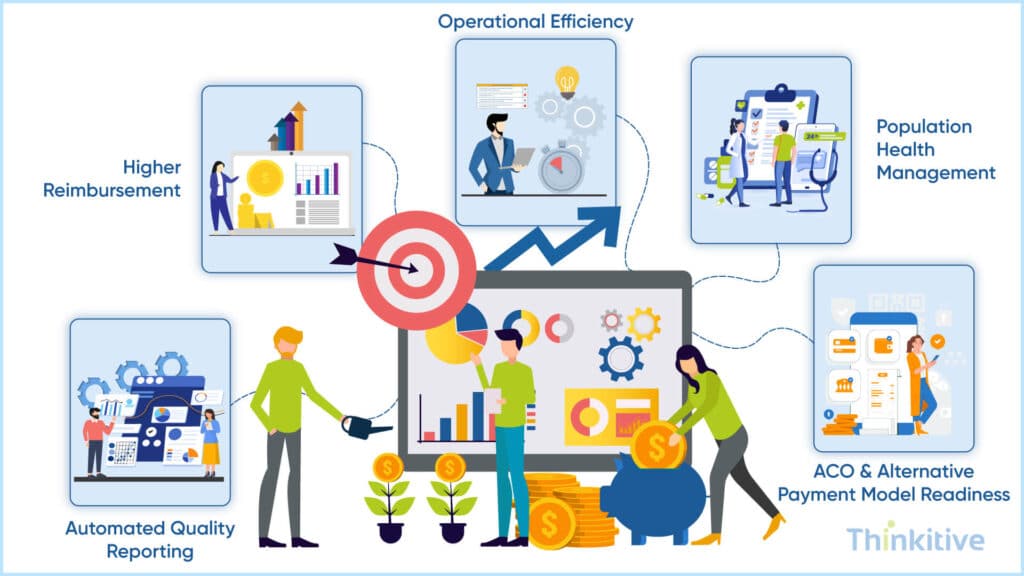
The business benefit of building a value-based care EHR goes beyond clinical outcomes. For instance, it automates quality reporting, streamlines documentation, and supports evidence-based care to help you improve your operational efficiency for long-term success.
Real-time tracking of quality measures such as HEDIS, MIPS, and STAR ratings again helps providers to identify performance gaps early, improve quality scores, and maximize reimbursement opportunities. Furthermore, with automated workflows, you can reduce manual documentation, reporting, and administrative tasks, which allows your providers to spend more time with patients and less time on paperwork.
From an organizational standpoint, population health management, predictive analytics, and care coordination tools are necessary to manage chronic conditions. These help in better care, reduce avoidable utilization, and build sustainable population health strategies.
Now, combining this with configurable workflows and interoperability, your value-based care EHR can easily adapt to Accountable Care Organizations (ACOs), bundled payment initiatives, and other alternative payment models to help your system evolve as per care models.
How Custom EHR Reduces Physician Burnout: Data-Backed Guide –
Read GuideConclusion
As healthcare continues to shift toward value-based care, your EHR systems must also evolve and move beyond simple documentation and billing to support proactive, data-driven care delivery.
This is exactly the reason why you need your value-based care EHR to have essential features like population health management, care coordination, quality reporting, and interoperability to improve patient outcomes and success under these specific value-based reimbursement models.
By aligning technology with clinical and operational goals, healthcare organizations can build a stronger foundation for delivering high-quality, cost-effective care.
So, what are you waiting for? Get your free consultation from our EHR expert and know the features you need for your value-based custom EHR software.
Frequently Asked Questions
A Custom EHR for Value-Based Care is an electronic health record system designed specifically to support healthcare organizations operating under value-based reimbursement models.
Traditional EHRs primarily focus on patient documentation, billing, and record management. A Value-Based Care EHR goes beyond these functions by supporting proactive patient monitoring, healthcare quality metrics tracking, care gap identification, and data-driven clinical decision-making, enabling providers to meet quality-based reimbursement requirements.
The most important EHR features for value-based care include population health management, patient risk stratification, care gap alerts, clinical documentation automation, healthcare quality metrics tracking, clinical outcome tracking, care coordination, patient engagement, and interoperability through HL7 and FHIR standards.
Population health management software helps providers identify and monitor patient groups based on health conditions, risk factors, and demographics. This enables proactive chronic disease management, timely preventive care, and early interventions, reducing avoidable hospitalizations and improving overall patient health.
Care gap alerts automatically notify providers when patients are overdue for preventive screenings, vaccinations, chronic disease follow-ups, or annual wellness visits. These real-time reminders help close care gaps, improve quality scores, and ensure patients receive appropriate care at the right time.
Clinical documentation automation uses structured templates, smart forms, and workflow automation to capture accurate clinical information during patient encounters. This improves documentation consistency, simplifies healthcare quality reporting, supports compliance requirements, and helps providers maximize reimbursement.
EHR clinical outcome tracking involves monitoring patient health outcomes such as hospital readmissions, chronic disease progression, medication adherence, and recovery trends. These insights help healthcare organizations evaluate treatment effectiveness, improve care delivery, and make informed clinical decisions.
HL7 and FHIR are interoperability standards that enable secure data exchange between EHRs, hospitals, laboratories, pharmacies, payer systems, and other healthcare applications. By providing a complete view of patient information, they improve care coordination, reduce duplicate testing, and support more informed clinical decisions in value-based care programs.
Yes. A custom Value-Based Care EHR can be designed to support Accountable Care Organizations (ACOs), bundled payment programs, shared savings initiatives, and other alternative payment models. Features such as healthcare quality metrics tracking, care coordination, population health management, and clinical outcome reporting help organizations meet performance goals while optimizing reimbursement.


