Collaboration and Integration: Custom EHR and Healthcare Ecosystems

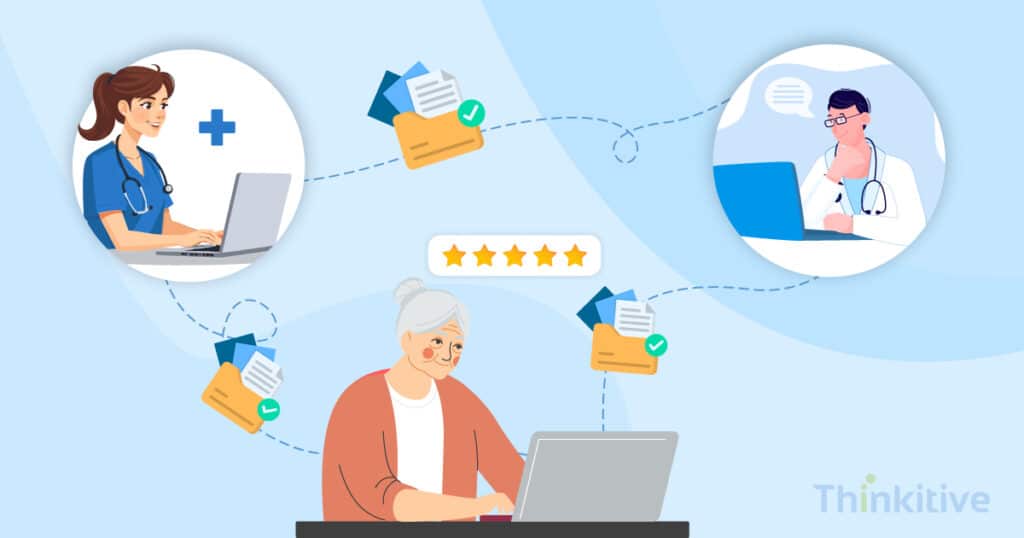
The four domains of interoperability are send, receive, find, and integrate electronic patient information. And in 2023, 70% of non-federal acute-care hospitals reported engaging in all four of these domains.
This has been a major milestone for the entire digital healthcare landscape. You see, healthcare data orchestration is directly or indirectly dependent on interoperability, and when your system covers all four domains of interoperability, collaboration with other healthcare systems is much easier.
With complete interoperability, you can create an ecosystem that enables collaboration for your physicians and admin staff. In simple words, your healthcare providers will be able to send, receive, find, and connect with other healthcare systems for both clinical and administrative needs.
As a result, the typical time gap between care delivery and other administrative tasks can be drastically reduced. On top of that, information required can be retrieved anytime on demand so that effective, evidence-based care can be provided.
However, only about 57% of large or system-affiliated hospitals engage in all four domains of interoperability. Which is already low, but compared to the independent hospitals, the percentage drops to 22%.
This is mainly because of the inefficiencies of their healthcare software systems. And the aftermath of this? Many practices are slowly shifting towards custom EHR software development.
Healthcare practices have realized that their care delivery process depends on multiple digital systems working together, such as billing platforms, pharmacies, patient-facing tools, EHRs, etc. And to avoid fragmentation of data and enhance better connectivity, custom EHR integration and ecosystem collaborations present themselves as a suitable option.
On that note, let’s see how integrating custom EHR with billing, labs, and clinical systems enhances data exchange and helps in developing a connected healthcare ecosystem.
Interoperability & Data Sharing in Healthcare: A Comprehensive Guide
Free eBookUnderstanding Integration & Interoperability in Custom EHR Software
Interoperability is the ability of your system to connect and communicate with disparate healthcare software systems both inside and outside your ecosystem. Integration is simply connecting with a system to automatically and on-demand share data with each other.
Now, your healthcare delivery process depends on these systems that are outside your ecosystem as well. To connect with these systems, you need custom EHR integration, in simple words, shaping your software system in a way that can be easily integrated into those systems, so that you can send, receive, and exchange information in real-time.
This unique need has been brought forward due to the limitations offered by off-the-shelf EHR solutions. Very little room for customization, coupled with rigid flexibility and scalability barriers, custom EHR software helps you stay a part of a connected health ecosystem.
And for your custom EHR integration and ecosystem collaboration to be a success, you need interoperability. With an interoperable custom EHR software, your integration workflows and collaboration can be mapped.
Integration in custom EHR software can be defined as the ability of the system to work together with other disparate healthcare software efficiently as one system. While many healthcare practices have adopted off-the-shelf software solutions, they have provided them with little to no flexibility, which has not allowed them to integrate with important elements from the healthcare industry, such as wearable devices, telehealth platforms, etc.
This has become one of the major reasons why many healthcare organizations are shifting to custom EHR software. Since customizable EHR offers you flexibility and scalability options, it becomes easier for EHR developers to easily integrate your custom EHR software with other healthcare systems.
All these help improve healthcare workflow efficiency and build a culture of collaboration.
Integration Within the Broader Healthcare Ecosystem
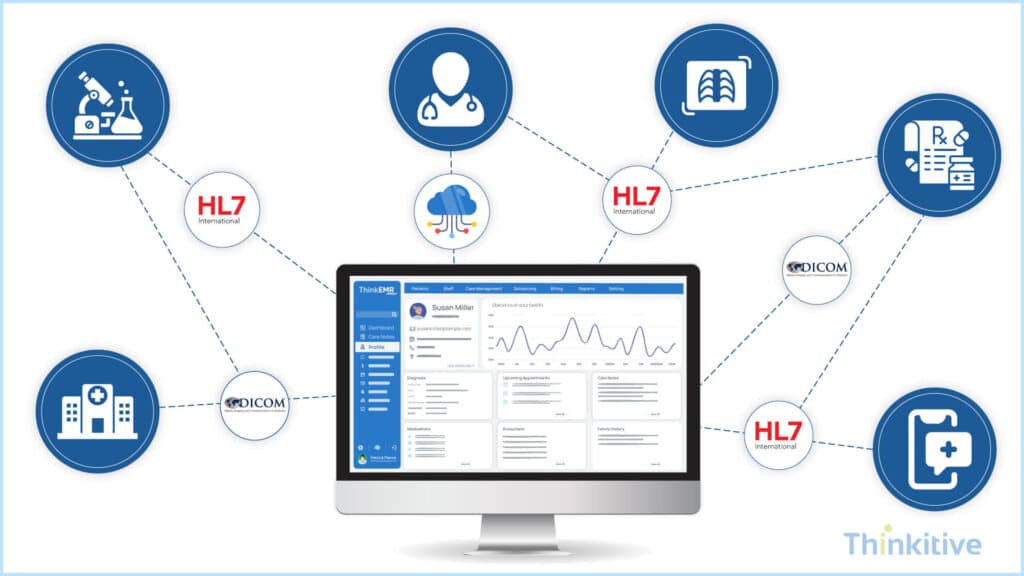
Look at the healthcare ecosystem as a large and widespread banyan tree that branched out in very different niches. And the center of it is your EHR system; you require your healthcare software systems to connect with all the branches and other disparate systems so that you can deliver the right care to the right patient and at the right time.
Appropriate care can only be provided when your EHR system is connected with multiple healthcare touchpoints. Here are some of the key ecosystem components that you need for your custom EHR from the large and widespread healthcare ecosystem integration:
- Laboratory and Imaging Integration
In some cases, you might need to rely on test laboratories or health imaging services for X-rays, MRI scans, etc., right? In such cases, your system needs to communicate with the system of that particular healthcare professional to directly update the result in the patient’s EHR. That is why integration with laboratory and imaging is required in your custom EHR to enhance patient care collaboration.
- ePrescription Integration
Rather than handing out a physical note for a prescription to the patient to take medication, you can directly send the prescription list to the patient and pharmacists. This will help you in reducing errors and ensure the right medications are prescribed to the patients. All you need for that is to integrate your system with your custom EHR system.
- Telemedicine Integration
If you are offering virtual care services to your patients, then rather than developing a separate telehealth platform, you can directly integrate it into your custom EHR. This will bridge the accessibility gap between patients and providers, which will allow you to connect with the patients anytime and anywhere, and that too from your custom EHR.
- Patient Portal and Messaging Integration
To enhance patient engagement, you need some features that should be specific to patients only. This is where the patient portal comes into the picture. Here, integration with patient portals and messaging systems enables you to easily empower patients in the care journey and equip them with the necessary channels to instantly connect with their healthcare providers. Due to this communication can be streamlined and real-time exchange can also be made possible.
One of the major benefits that you get with this is secure messaging and access to health information almost instantly. By closing the major communication gaps between healthcare providers and patients, you encourage patients to take an active part in their care journey and get the desired results.
- Device & Remote Patient Monitoring Integration
If you are providing virtual consultations and still if the patient has to come to your clinic for their vital collection, then it’s really pointless, isn’t it?
Well, that is where integration with remote patient monitoring devices comes into the picture. It will allow your software to instantly collect and transmit the collected vitals readings to your EHR system. This module can be enhanced with automatic collection and transmission of vital data to the necessary system. It is often seen as an excellent supporting tool for virtual and continuous care models that define the modern-day healthcare ecosystem.
- Electronic Health Information Exchanges (HIEs)
The healthcare professionals working in your practice need to communicate and exchange data with other healthcare providers, physicians, nurses, etc. With just a system, the security of the data can be at risk. However, with the HIE system, you can allow your healthcare providers to seamlessly exchange information with their systems or vice versa.
Some of the technological considerations for achieving this seamless integration are HL7 FHIR standards and robust APIs.
- AI-Powered Clinical & Operational Tool Integration
With the winds of AI showering over every industry, the healthcare industry is one of those industries that can benefit highly from this. For instance, by integrating AI tools such as clinical documentation assistants, predictive analytics, and decision support systems directly into the workflows, documentation can be streamlined, some aspects can be predicted, and decisions can be made on the basis of evidence and careful consideration.
However, during this, you need to ensure that the AI-generated insights flow directly into patient records, billing processes, or care coordination modules. By reducing tool fragmentation and embedding AI outputs within your EHR system, you don’t have to rely on software systems or platforms that are connected with your EHR system.
Read our blog – A Deep Dive into Custom EHR Software Architecture, Compliance & Scalability – and understand the role it plays in secure integrations and collaboration.
Benefits of Collaboration & Integration
Let’s see some real-life benefits of integrated EHR and how it promotes collaboration to improve patient care.
- Enhanced Care Coordination Across Different Providers:
With custom EHR integration, patient care coordination can be seamless for your healthcare providers, and that too in real-time. For instance, when a healthcare provider updates the test results, it can be directly reflected in the EHR system, which your care provider can assess and provide care instantly. This improves collaboration between two separate healthcare institutions and minimizes the time needed for care delivery.
- Improved Medication Management and Reduced Medication Errors:
When your custom EHR software is integrated with the pharmacy system, it helps your healthcare providers and patients to easily manage their medications, such as refills, etc. On the other hand, the margin of humans is almost minimized to zero, promoting better practices.
- Real-time Access to Patient Data for Informed Decision-making:
Implementing an EHR integration solution helps the entire care team access patient data in real-time and make informed decisions quickly and effectively, further bridging the gap between care delivery.
- Increased Patient Engagement and Empowerment:
With an inclusive and well-connected healthcare ecosystem that allows patients to take control of their health, you directly or indirectly increase patient engagement and empower them to participate proactively in their care journey to improve their health outcomes.
Integration Challenges & Solutions
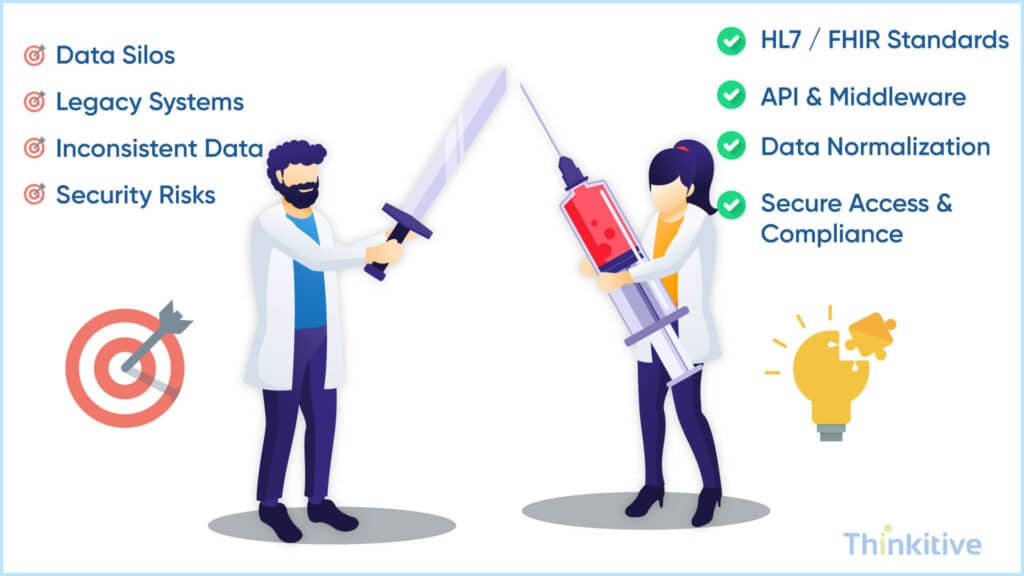
While the benefits of integration improve patient care activities, operational efficiency, and data accessibility, there are still certain challenges that come up in building the integration bridge between healthcare systems. Here are some common challenges that you’re most likely to face, and let’s explore how you can overcome them:
- Data Quality Issues: Data quality issues in healthcare software systems are the biggest concern for healthcare organizations. Issues like inconsistent, incomplete, inaccurate, and isolated data can lead to a variety of errors. The best way to overcome these issues is by implementing common data models to standardize and harmonize data. Furthermore, you also need to validate, cleanse, and monitor data constantly to ensure the data quality is not compromised.
- Outdated Legacy Systems: Integrating your system with legacy systems often requires custom development and workarounds. These systems use outdated technologies, which increases the project complexity and risk. Some of the tried and tested ways in this include using API gateways and custom adapters to translate data formats. If not, you can also use a middleware and integration platforms to build the integration bridge.
- Security Constraints: During integration, security constraints like adherence to regulatory compliance, data encryption, audit trails, and interoperability are most likely to be encountered. However, you can overcome this by using the HIPAA rule book as your guide or using a security-by-design approach for building the bridge. And to ensure security, you need to conduct regular security audits and penetration testing to always know what is happening in your system.
- Balancing Open Integration with Secure Data Exchange: One of the major challenges that many organizations looking for custom EHR integration and ecosystem collaboration face is balancing open integration with secure data exchanges. You see, you want your system to be a part of the connected healthcare ecosystem to exchange, but also ensure the security of your system. This EHR integration solution allows you to be a part of a healthcare collaboration ecosystem, such as labs, pharmacies, payers, HIEs, and third-party clinical tools, to protect sensitive data. One of the best ways to overcome this is by enforcing strong encryption, authentication, role-based access controls, and detailed audit logs. And a well-balanced custom EHR treats interoperability and security as complementary, not in conflict.
Guide to Building a Connected Healthcare Ecosystem
Download Free GuideConclusion
The blog has unveiled the power of interoperability, showcasing how custom EHRs improve patient care and overcome the challenges of fragmented healthcare. Imagine a healthcare system seamlessly connecting doctors, specialists, and patients, eradicating information silos. The importance of integration within custom EHRs cannot be overstated, offering flexibility, scalability, and improved healthcare workflow efficiency.
Now, it’s time to embark on this transformative journey. Picture a future where healthcare thrives on collaboration, fueled by integrated EHRs. Ready to experience the revolution? Explore how custom EHRs can bridge gaps, enhance communication, and redefine patient-centric care in this exclusive guide to EHR software development or interoperability, security and compliance of custom EHR software guide.
On that note, let this blog be your guide for your healthcare integration project by addressing the common challenges to help you make the most out of your integrated system. But you will still need a partner to make this happen, right? Well, click here and let’s see how we can enhance collaboration at your practice with integration.
Frequently Asked Questions
Custom EHR integration refers to connecting an EHR system with external healthcare applications—such as labs, pharmacies, billing platforms, and patient engagement tools—to enable seamless data flow. In modern healthcare ecosystems, this integration is essential for eliminating data silos, enabling real-time access to patient information, and supporting coordinated, value-based care across multiple stakeholders.
Custom EHR systems integrate with third-party platforms using secure APIs, interoperability standards, and event-driven workflows. These integrations allow lab results, medication orders, and pharmacy updates to flow directly into the EHR in near real time, reducing manual entry, improving accuracy, and accelerating clinical decision-making.
The most common challenges include outdated data formats, limited API availability, inconsistent data quality, and legacy system constraints. Custom EHR integration often requires data mapping, middleware, and phased modernization strategies to ensure continuity of care without disrupting ongoing clinical operations.
Integrated EHRs provide clinicians with a unified, real-time view of patient data across care settings. This enables faster diagnoses, more informed treatment decisions, reduced duplication of tests, and smoother handoffs between providers—ultimately improving outcomes and care continuity.
Secure EHR integration typically relies on standards such as HL7, FHIR, and OAuth-based authentication frameworks. These standards ensure structured data exchange, interoperability, and compliance with regulatory requirements while maintaining strong security controls.
Custom EHR integration enables patient portals, mobile health apps, remote patient monitoring, and telehealth platforms to connect directly with clinical records. This supports continuous care beyond clinical settings, improves patient engagement, and allows providers to monitor outcomes, adherence, and risks in real time.


