Advanced Analytics & Predictive Modeling for Custom EHR

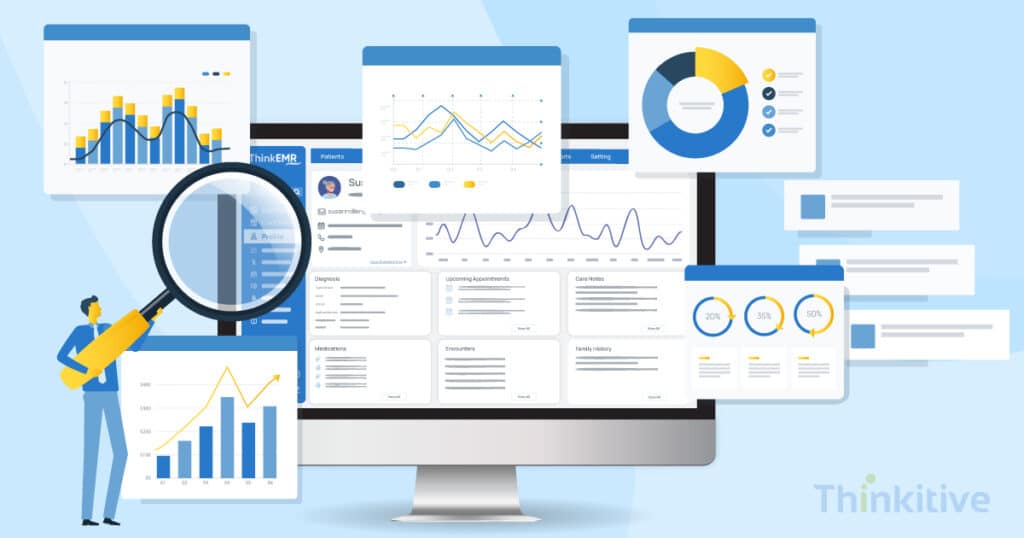
There is a unique trend in the healthcare industry that is dictating the future of healthcare technology and how we see care delivery as a whole. And can you guess which system is at the center of it?
Well, yes, it’s the electronic health records system.
You see, most of the healthcare providers or institutions have transitioned to EHR software systems in some way or another. Some stats from 2021 suggest that 96% adoption of healthcare practices have adopted EHR software systems. Since then, the number has seen an upward growth arc, almost nearing that 100% mark.
Now, the adoption of EHR systems has transitioned healthcare practices from service-based to data-based healthcare practices. However, this has led to passive record-keeping; in simple terms, a lot of data is being generated but not being used effectively.
And interestingly, healthcare providers and professionals are taking a hint about this. Recognising the importance of data in healthcare, and with the help of advanced technology, they are looking to improve their care delivery process, administration, and turn their practice into evidence-based practice.
Moreover, today, most healthcare providers are looking to do the same. Hence, the demands in healthcare practices looking for Custom EHR development are demanding advanced analytics, reporting, and predictive modeling in their custom EHR.
On that note, in this blog, let’s discuss the EHR analytics predictive modeling in custom EHR briefly, along with the intricacies of making your EHR intelligent with an AI-powered EHR architecture.
So without further ado, let’s get started and see how you can transition from passive record-keeping to analytics, reporting, and predictive EHRs.
Assess Your EHR System AI Readiness
Get Free AssessmentThe Building Blocks of an Intelligent Custom EHR
Advanced analytics in custom EHR development is built on multiple capabilities working together. Reporting organizes healthcare data, Business Intelligence (BI) connects information across systems, advanced analytics uncovers meaningful patterns, and predictive modeling helps forecast future clinical and operational outcomes.
This guide provides an overview of how these capabilities work together in a custom EHR. If you’re looking for implementation-specific guidance, explore the resources below before continuing.
| Explore Related Analytics Guides | Covers |
| Custom EHR Reporting | Custom reports and healthcare dashboards |
| Business Intelligence (BI) Integration | Unified healthcare data and analytics layers |
| Building Meaningful Reports | Designing reports for clinical and operational decisions |
The sections below explain how these capabilities work together to transform a traditional EHR into an intelligent, analytics-driven healthcare platform.
Why Traditional EHR Data Visibility Falls Short
Before getting started with the intricacies of advanced analytics, reporting, and predictive modeling in a custom EHR, let’s quickly have a look at the traditional EHR systems and why they fall short for data visibility.
First things first, every generic EHR software system uses generic dashboards and provides static reports. This way, aligning your practice’s unique workflows with the software becomes very difficult.
On top of that, it offers very limited role-based and specialty visibility. This creates a gap in data accessibility, which not only disrupts the care delivery process but also prevents quality care from being provided.
Furthermore, a lack of visibility in data leads to early barriers to external analytics and BI access. This way, making sense and getting the hidden insights from the data becomes even more difficult.
These visibility challenges are the foundation for implementing advanced analytics and predictive modeling in a custom EHR.
Building a Strong Data Foundation for Advanced Analytics
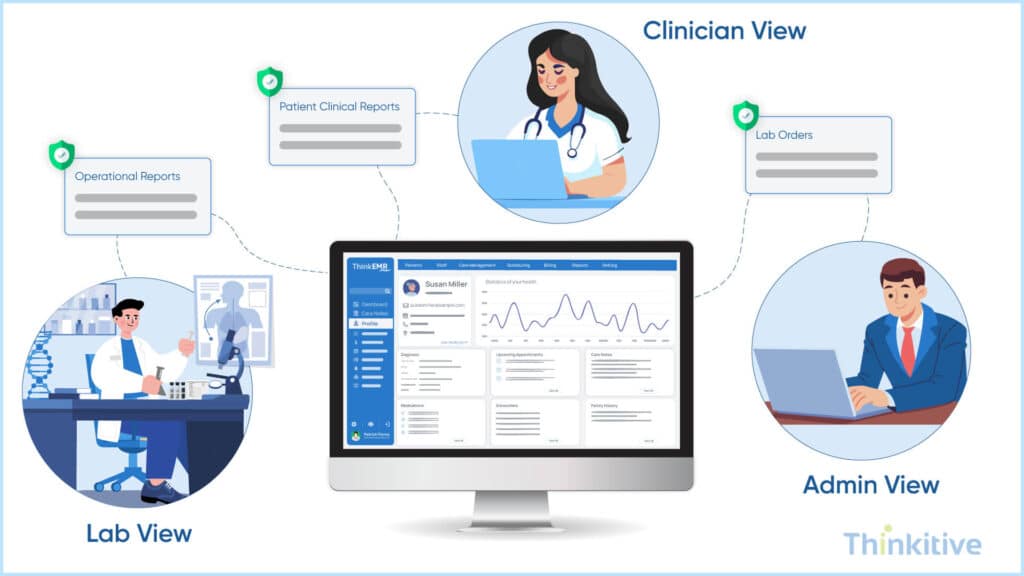
One of the biggest challenges healthcare organizations face is turning large volumes of clinical and operational data into information that supports decision-making. While traditional EHRs often make data difficult to access, custom EHR development allows organizations to structure data around their workflows, creating a strong foundation for advanced analytics and predictive modeling.
Structured reporting becomes the first step toward advanced analytics by organizing healthcare data into formats that are easier to analyze and interpret.
By organizing information around specialty-specific workflows and role-based access, custom EHRs create consistent, high-quality data that supports reporting, analytics, and AI-driven decision-making.
Connecting Healthcare Data for Better Analytics
Advanced analytics is only as effective as the quality and accessibility of healthcare data. When information is spread across EHRs, billing systems, laboratories, and third-party applications, generating meaningful insights becomes difficult. A unified data layer helps eliminate these silos and prepares data for advanced analytics and predictive modeling.
By consolidating data from multiple healthcare systems into a unified analytics layer, organizations gain consistent, analytics-ready information that supports clinical decision-making, operational monitoring, and predictive models.
Unified data enables analytics across clinical, operational, and financial workflows without requiring users to manually combine information from multiple systems.
How Does Advanced Analytics Improve Decision-Making in Custom EHR Development?
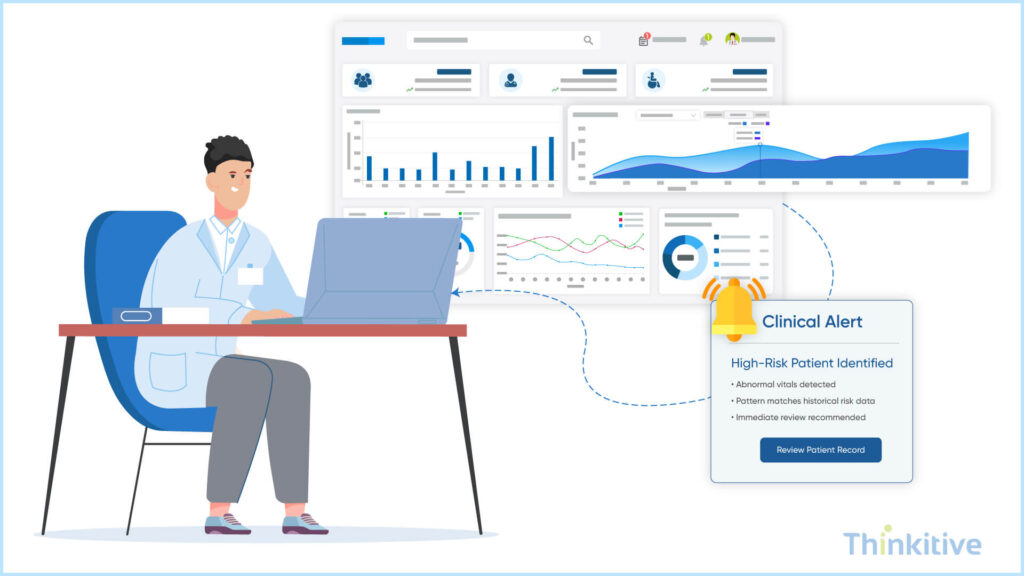
Once healthcare data is organized and connected, advanced analytics transforms it into actionable intelligence. Instead of simply displaying historical information, advanced analytics identifies trends, uncovers hidden patterns, and delivers insights that help clinicians and administrators make faster, more informed decisions.
- Real-Time Insights: Advanced analytics continuously evaluates clinical and operational data to identify trends, highlight anomalies, and surface relevant information at the point of care. Instead of waiting for periodic reports, providers receive timely insights that support faster diagnoses, better treatment decisions, and improved patient outcomes.
- Descriptive to Action-Oriented Analytics: Traditional EHR analytics explains what has already happened. Advanced analytics goes a step further by identifying why events occurred and recommending possible next steps. This enables clinicians and administrators to move from reactive decision-making to proactive care delivery and operational planning.
Designing meaningful reports is the first step toward effective analytics and is explored in our dedicated report-building guide.
The Role of Artificial Intelligence in EHR Analytics
When we talk about advanced analytics or advanced technologies in the healthcare IT space, then most probably we’re talking about the integration of Artificial Intelligence in these systems. It is the AI that makes your EHR system intelligent. And the role of AI in custom EHR analytics cannot be ignored. Let’s see why:
- AI as an Enabler: AI in custom EHR analytics acts as an enabler to better analytics and reporting. For instance, it helps in analytics by uncovering patterns, predicting risks, and highlighting actionable insights that are difficult to detect. AI in custom EHR analytics helps providers in understanding the WHY behind the actions. This enables providers to take a proactive approach to make informed clinical and operational decisions.
- Supporting Clinicians: One of the major misconceptions in the healthcare industry is that AI replaces clinicians. However, quite the contrary, AI helps clinicians in making their jobs easier. For instance, with AI in custom EHR analytics, providers can get relevant insights, prioritize alerts, and automate routine analysis. This helps them in making better decisions on the basis of data, which can be hard to analyze.
Artificial intelligence is a broad topic in itself. We explore AI-powered clinical documentation, automation, and decision support in our dedicated guide on AI in Custom EHR.
Here is one of the analytical dashboard that can help you in knowing how your dashboard should be.

Predictive Intelligence in EHR Systems
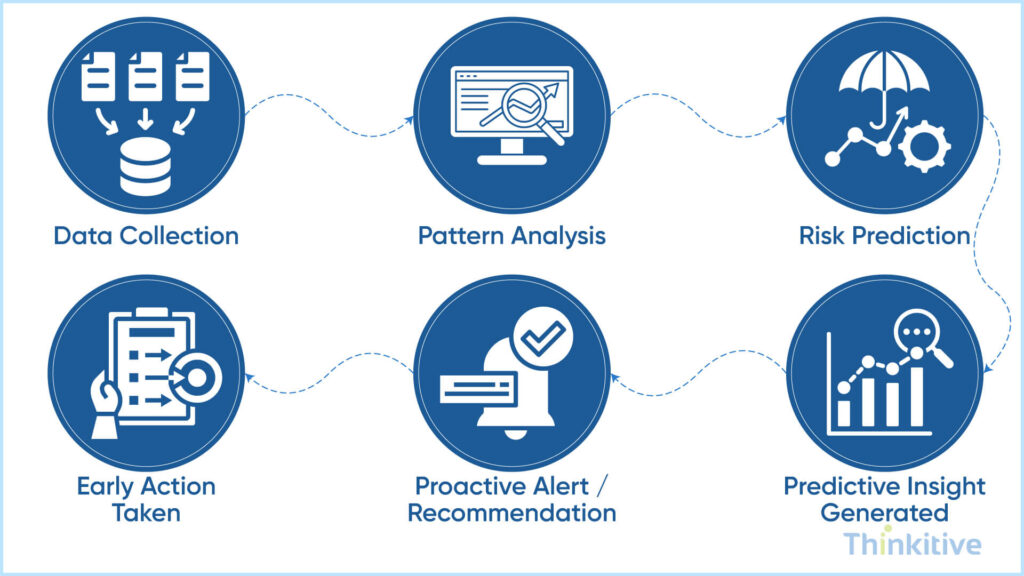
Predictive modeling represents the highest maturity level of healthcare analytics. Rather than explaining historical performance, predictive models analyze historical and real-time data to forecast future clinical and operational events before they occur.
Let’s see some of the examples of use cases of healthcare predictive analytics in custom EHR software and how practices can benefit from it.
- Early Risk Identification: This is one of the most sought-after use cases of predictive modeling in EHR software. You see, AI and machine learning modules are excellent in analyzing patterns and drawing conclusions on the basis of that. This way, your EHR system can go in-depth to analyze data and mark certain indicators to identify risks before the situation of patient health escalates.
Let’s see how predictive modeling is used in EHR systems.
The first thing that these models do is analyze historical and real-time clinical data. Along with this, it also analyzes operational, financial, and other data types to identify risks and trends. This can be used to predict patient condition deterioration, which we have discussed earlier, missed appointments, readmission likelihood, and care gaps.
To help you understand this better, here is a table that will help you understand the impact of healthcare predictive analytics for your practices:
| Predictive Model | Purpose | Healthcare Impact |
| Readmission Prediction | Identifies patients likely to be readmitted after discharge | Reduces avoidable hospital readmissions and improves follow-up care |
| Chronic Disease Risk Scoring | Detects patients at higher risk for chronic conditions | Enables proactive care planning and early intervention |
| No-Show Prediction | Forecasts missed appointments using historical behavior | Improves scheduling efficiency and resource utilization |
| Claim Denial Prediction | Identifies billing and coding risks before claim submission | Reduces claim denials and improves revenue cycle performance |
| Sepsis Risk Detection | Monitors patient vitals and clinical indicators in real time | Supports early detection and faster clinical response |
| Staffing Demand Forecasting | Predicts workforce requirements based on patient trends | Optimizes staffing allocation and operational planning |
On top of that, healthcare predictive analytics in custom EHR can also help you in forecasting the future demands that your practice might have to face. For instance, with the use of predictive analytics, your practice can forecast patient volumes, staffing needs, and resource utilization based on the season trends, population health data, etc. This way, you can always stay one step ahead and be prepared for what’s coming.
You can have a look at this workflow to help you understand how healthcare predictive analytics works:

Assess Your EHR System for AI Readiness
Get Free AssessmentEnhancing Clinical Workflows with Analytics-Driven Intelligence
One of the best things that you can do with your custom EHR system is to enhance your clinical workflows with analytics-driven intelligence. Let’s discuss some of its use cases below:
- Clinical Decision Support Through Analytics: The use cases of advanced analytics go beyond just reporting. It also helps in delivering real-time context-aware insights with clinical workflows. In workflows, it can be crucial as it can identify and point out gaps in point of care, prioritize high-risk patients, optimize clinical pathways, and monitor quality measures. This way, clinicians can act on data and care simultaneously, all from their EHR system.
- Reducing Administrative Burden: While risk identification is one of the most sought-after features, many healthcare providers have already adopted advanced analytics in their custom EHR software to reduce the administrative and cognitive burden on the providers.
Engineering a Scalable Analytics & AI-Ready EHR Architecture
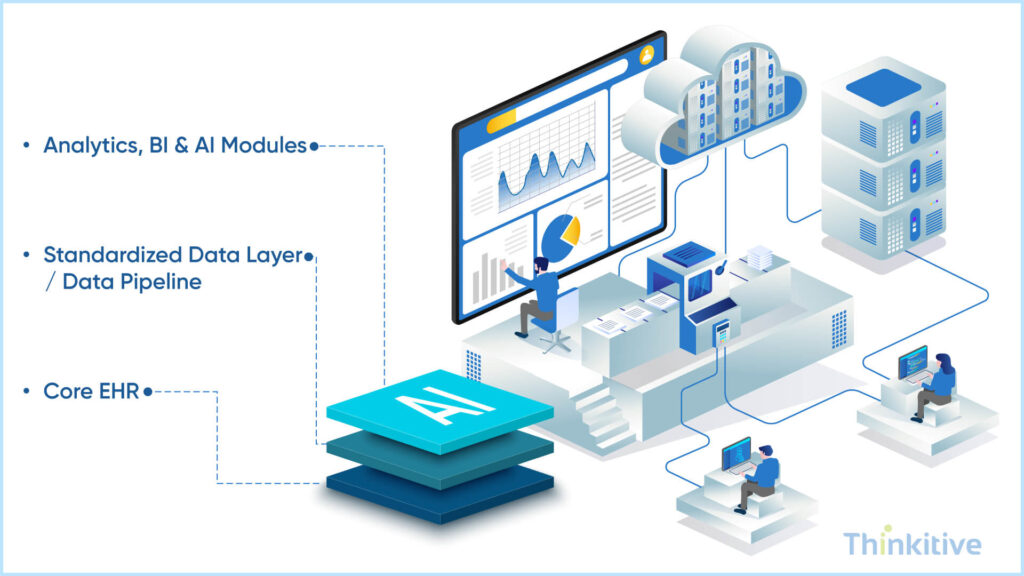
The benefits of advanced analytics, reporting, and predictive modeling in custom EHR are lucrative in nature. However, engineering a scalable analytics and AI-powered EHR architecture is easier said than done. Here are some things to consider when engineering such an architecture:
- Data Foundation Challenges for Advanced Analytics: Traditional reporting struggles involved inconsistent data models, fragmented schemas, and delayed data availability. Due to poor normalization across various aspects of datasets, such as clinical, financial, and operational, cross-functional reporting becomes difficult. On top of that, with high latency from batch-based exports, the availability of timely insights can be missed. These are some of the things to consider.
- AI-Powered EHR Architecture for Scalable Analytics: A scalable AI-powered EHR architecture addresses these challenges by separating transactional workflows from analytics workloads while enabling real-time insights and predictive intelligence. This is because it separates transactional workflows from analytics and AI workloads using standardized data layers, streaming pipelines, and scalable compute. This approach supports impactfully in real-time analytics, predictive modelling, and future applications of AI into your system, without impacting the core EHR performance.
Some of the most anticipated AI-powered EHR features have been in headlines for a while now. And being at the stage where you are curating your own EHR, read our modern EHR features blog – AI Scribe, AI Coder & AI Clinical Decision Support — Modern EHR Features.
Measuring ROI & Trust in Analytics-Driven EHRs
If you have made it this far, then I guess you’re one of those providers who have made up their minds to get advanced analytics, reporting, and predictive modeling in their custom EHR. However, the only reason you’re taking any action is because of the ROI confusion and trust factor for these advanced analytics in custom EHR, right?
Well, let’s see how you can measure ROI and actually trust the data you collect through these systems:
- Clinical Efficiency & Outcome Improvements: The first indicator of your returns on investments is an increase in clinical efficiency and improvement in outcomes, both on the patient’s side as well as the practice side. You see, when clinicians are able to make better decisions more quickly, you can see that your custom EHR has been a success. On the other hand, if your administrative staff is able to do their tasks without disruption, it can also be an indicator of better ROI.
- Operational & Financial Impact: With features like healthcare predictive analytics and advanced analytics, your operations can be streamlined. On top of that, with AI-powered features, it can even do most of their jobs for them. The impact of this can be reflected in the practice’s balance sheet, with streamlined finances, better claims submission, reduction in claims denial, and improved financial health of your practice.
- Governance, Bias Control, Explainability & Trust: Coming to the factor of trust, there are some things that can help you in gaining trust. The first thing is governance. With rising technologies changing the landscape of healthcare, you need to adhere to your custom EHR with necessary compliances like HIPAA, HITECH Act, ONC, 21st Century Cures Act, etc. This gives your patients trust in the systems that you use. On top of that, some of the controls that you need to take are to remove bias control from the data, so that any AI suggestions are made bias-free. Other than that, for every suggestion, the model should be able to explain things properly and effectively.
Having said that, a question that you might get is, ‘How can you develop an AI-powered EHR system?’ Well, read this detailed blow to know how – How to Develop an AI-powered EHR System?
Calculate ROI Of Your Custom EHR Development
Calculate ROIKey Takeaways
- Advanced analytics transforms EHR data into actionable clinical and operational insights.
- Predictive modeling enables healthcare organizations to anticipate risks instead of reacting to them.
- Artificial intelligence strengthens analytics by identifying patterns and automating decision support.
- A scalable custom EHR architecture allows analytics, AI, and predictive models to grow without affecting system performance.
- Reporting, BI integration, and report design are foundational capabilities that support advanced analytics and are explored in dedicated guides.
Conclusion
If you’re still here, then I hope you got a brief idea about how advanced analytics, reporting, and predictive modeling in custom EHR can transform your practice completely. However, one of the major things that you need to understand while developing this is that your analytics, reporting, BI, and prediction models must work together in synchronization.
This is because right from reporting to analyzing and predicting, everything is interconnected. And custom EHR development is the best way to set the foundation for changing your healthcare approach from reactive to proactive. On that note, I hope I have managed to help you understand the intricacies of advanced analytics, reporting, and predictive modeling in a custom EHR.
And this is the high time you should modernize your EHR system. Get your free consultation from our EHR expert for custom EHR development and know how your entire system can be improved.
Frequently Asked Questions
Advanced analytics in custom EHR development uses clinical, operational, and financial data to uncover trends and support better decision-making. Predictive modeling extends these capabilities by using historical and real-time data to forecast future events such as readmissions, patient deterioration, staffing needs, and operational risks, enabling healthcare organizations to take proactive action.
Traditional EHR systems rely heavily on static, historical reports that show what already happened. Analytics-driven custom EHRs go further by enabling real-time data processing, trend analysis, and predictive insights. This shift allows healthcare organizations to proactively manage patient outcomes, operational efficiency, and financial performance instead of reacting after issues occur.
Advanced analytics transforms large volumes of EHR data into meaningful, decision-ready insights. Clinicians gain visibility into patient risk patterns and care gaps, while administrators can analyze throughput, staffing efficiency, and cost drivers. This leads to faster, more accurate decisions that improve both care quality and operational sustainability.
Traditional EHR reporting is often limited by rigid templates, delayed data refresh cycles, and isolated data views. These systems struggle to correlate clinical, operational, and financial data, making it difficult to identify root causes, emerging trends, or improvement opportunities in real time.
Role-based reporting ensures that clinicians, administrators, finance teams, and executives each receive insights relevant to their responsibilities. By tailoring dashboards, KPIs, and alerts to user roles, custom EHRs reduce information overload and help every stakeholder act confidently on data that matters to them.
Without BI integration, healthcare data remains fragmented across EHR modules, billing systems, labs, and third-party tools. BI integration unifies these datasets into a centralized analytics layer, enabling cross-functional visibility, enterprise-wide reporting, and more accurate healthcare analytics.
Locked or proprietary data exports restrict access to underlying EHR data, limiting advanced analysis and external BI integration. Analytics teams often face delays, incomplete datasets, and manual data preparation, which reduces agility and slows insight generation.
Advanced analytics uses data normalization, real-time processing pipelines, and intelligent dashboards to convert raw clinical and operational data into actionable insights. This enables healthcare teams to monitor performance, detect anomalies, and respond to issues as they occur—not weeks later.
Predictive modeling refers to building statistical or AI models using historical EHR data. Predictive analytics applies those models in real-world scenarios—embedding predictions into dashboards, alerts, and workflows to guide clinical and operational decisions.
Predictive insights are integrated directly into EHR screens through risk scores, alerts, and contextual recommendations. This allows clinicians to act on insights at the point of care without switching systems or interpreting complex analytics reports.
Healthcare predictive analytics can detect early warning signs such as patient deterioration, readmission risk, appointment no-shows, staffing shortages, capacity constraints, and revenue leakage. Early identification allows healthcare organizations to intervene before issues escalate.
AI enhances EHR analytics by identifying complex patterns, improving forecasting accuracy, and automating insight generation. It also enables advanced capabilities such as natural language querying, anomaly detection, and continuously improving analytics models.
Clinicians must understand why a prediction or recommendation is generated to trust and act on it. Explainable analytics provides transparency into model logic, supporting clinical confidence, regulatory compliance, and safer patient care.
An analytics-ready EHR architecture includes normalized data models, event-driven or streaming pipelines, scalable cloud infrastructure, API-first BI integration, and AI-compatible data layers. These foundations ensure performance, flexibility, and future scalability.
ROI is measured through improved clinical outcomes, reduced readmissions, operational cost savings, optimized staffing, increased revenue capture, and faster, data-driven decision-making across the organization.
Effective governance includes role-based access control, audit logs, data validation, model performance monitoring, and strict adherence to HIPAA and regulatory standards. These safeguards ensure analytics outputs remain accurate, compliant, and trustworthy.


