Building an EHR with Ambient Clinical Intelligence

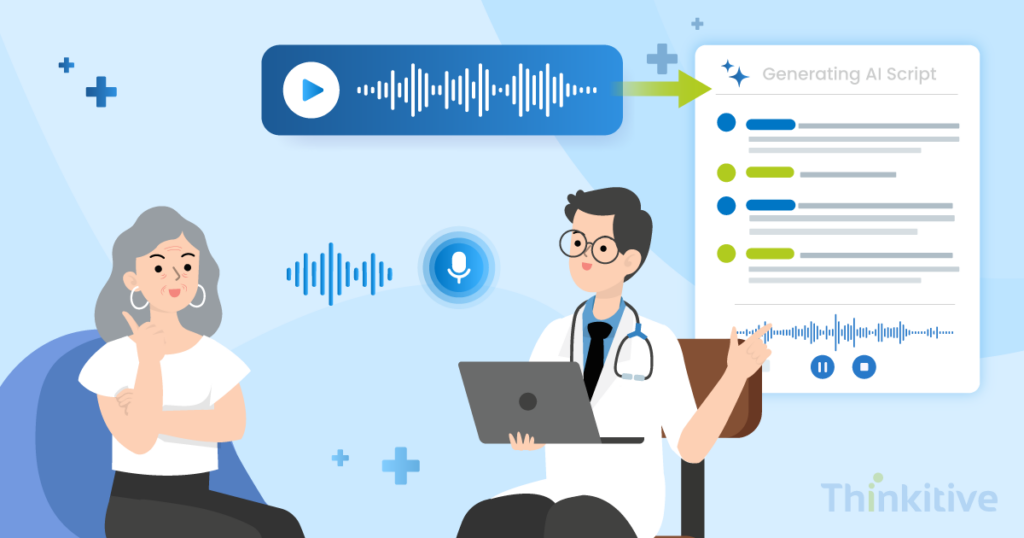
Do you know, being in the core of custom EHR and EMR software development, what is the biggest problem we are trying to solve?
We might sound professional and say efficiency and productivity, but what we are really trying to do is reduce or, in fact, eliminate the pajama time of our healthcare professionals.
Let me explain, this ‘Pajama Time’ is usually referred to as the time a physician spends after clinic, completing EHR documentation. Documentation is an important part, and it should be done.
However, the problem is when these physicians start spending hours on that, and the worst part of it all, bringing it home. Data proves it! An article published in Nature suggested that almost 1 to 2 hours are spent by physicians in pajama time.
And that is the problem we are trying to solve!
However, finding the right solution is easier said than done. Given the setup a physician is in, the solutions should not only be intelligent but also accurate. And naturally, talking about accuracy and intelligence, only Ambient Clinical Intelligence EHR could meet all the necessary requirements.
A report by Jama Network suggested that Ambient AI can reduce the 0.9 hours of after-documentation on average. But now the question remains: how to build an EHR with ambient AI capabilities?
Well, that’s exactly what we’re trying to figure out in this blog, along with other intricacies that you need to know about it.
So, without further ado, let’s get started!
Assess Your System for Ambient Clinical Intelligence Capabilities –
Get Free Assessment
How Does Ambient Clinical Intelligence Work?
Let’s start with the basics: how this Ambient Clinical Intelligence actually works. The best way to describe this would be an assistant that sits in your system and goes through every patient visit you attend.
This assistant will intelligently listen to the conversation, understand the context, document like you would in your notes, and update the EHR. This allows clinicians to focus more on the patient and the care that they are providing, and not on what they are writing.
And since documentation is also taken care of by the system, no, for now, say, less pajama time. Now let’s see how it works.
Step 1: Listening Without Interrupting Care
You can keep this auto or manual depending on your convenience. Suppose you are on the system during consultation, then healthcare conversational AI will capture the conversation through the microphone or telehealth platform if done online.
Here, unlike other NPL platforms, you don’t have to dictate separately or give a command for anything in between. It will let you give your consultation and gather all the information and context to document accurately and effectively.
Step 2: Understanding What Matters Clinically
After the consultation, the AI will analyze the discussion and identify clinically relevant information like symptoms, diagnoses, medication, allergies, examination findings, and treatment plans.
So, rather than getting a transcript, the clinical context is gathered, and only important information is handpicked for documentation.
Step 3: Preparing Documentation Automatically
Now, once the clinical context is gathered, the system itself will generate your SOAP notes, process reports, referral letters, discharge summaries, etc. This way, your need to document things is reduced significantly, if not eliminated.
Step 4: Review, Approve & Update EHR
Now that the machine has shown its magic, it’s time for you to get to work. All you have to do is review the generated documents, report, etc., and perform any edits if required, and give your final approval.
Only after your final approval, the document will be automatically updated in the EHR and can be shared across healthcare networks with interoperability standards like FHIR.
Flow from Conversation to Clinical Records
This is how the flow of this entire workflow would look:
Patient Consultation
↓
Ambient AI Captures Conversation
↓
AI Understands Clinical Context
↓
Structured Documentation Generated
↓
Physician Reviews & Approves
↓
EHR Updated with Structured Clinical Data
Note: This entire process happens in minutes, reducing documentation burden, and the talk of efficiency and productivity is encouraged.
Core Architecture of an Ambient Clinical Intelligence EHR
Now, from a physician’s standpoint, Ambient Clinical Intelligence embedded into the EHR system might feel effortless. All the system has to do is listen to the conversation and structure the clinical notes.
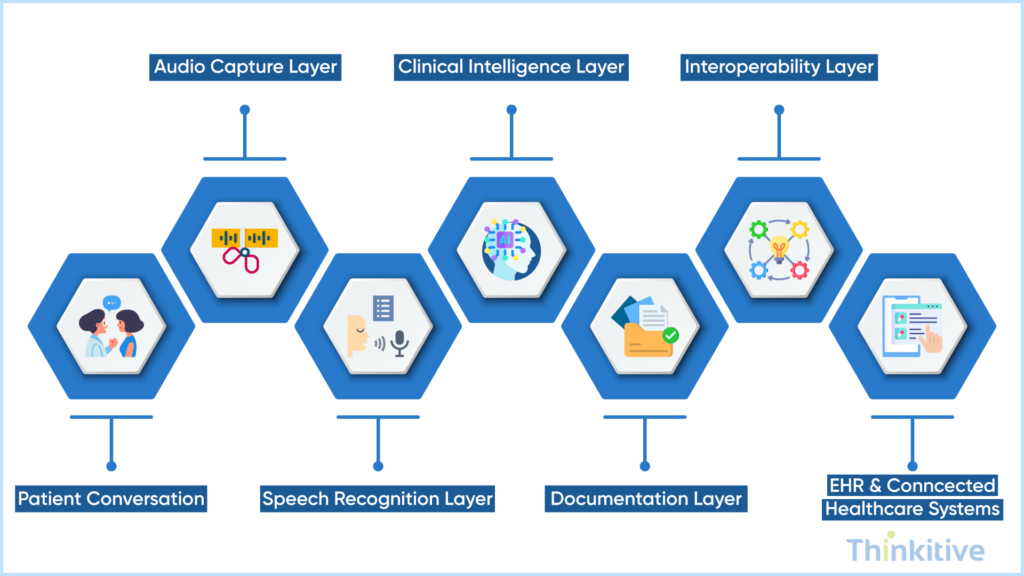
However, the BTS is quite complicated. It involves multiple AI and healthcare technologies working together to listen and document. Here are some of the well-designed Ambient AI EHRs, typically consisting of these six core architectural layers.
1. Audio Capture Layer
Captures and securely streams patient-provider conversations from in-person visits or telehealth consultations, ensuring high-quality audio for downstream AI processing. Here are the key capabilities:
- Real-time audio streaming
- Multi-speaker recognition
- Noise reduction
- Secure audio processing
2. Speech Recognition Layer
Converts spoken conversations into accurate medical transcripts using speech recognition models trained on clinical terminology and specialty-specific vocabulary.
- Medical speech recognition
- Clinical vocabulary support
- Speaker diarization
- Real-time transcription
3. Clinical Intelligence Layer
Analyzes conversations to extract symptoms, diagnoses, medications, procedures, and other clinical entities while understanding the context behind the discussion. Here are the key capabilities:
- Clinical NLP
- Entity extraction
- Intent recognition
- Context-aware reasoning
4. Documentation Layer
Automatically transforms extracted clinical information into structured documentation such as SOAP notes, progress notes, and referral letters. Here are the key capabilities:
- SOAP note generation
- Progress notes
- Referral letters
- Structured documentation
5. Interoperability Layer
Maps clinical data into standardized formats, enabling seamless integration with EHRs and other healthcare systems through FHIR and HL7. Here are the key capabilities:
- FHIR APIs
- HL7 integration
- SMART on FHIR
- Standardized clinical data exchange
6. Security & Governance Layer
Protects patient data with enterprise-grade security while ensuring every AI-generated note is reviewed and approved before being added to the EHR. Here are some of the key capabilities:
- End-to-end encryption
- Role-based access control
- Audit logging
- Human review and approval
Now, bring it all together here like this:
How to Build an EHR with Ambient Clinical Intelligence
Building an ambient clinical intelligence EHR isn’t about just one AI model. It is about synchronization of multiple AI models and other technologies to seamlessly work into your clinical and administrative workflows.
So, what would be the practical roadmap for developing an AI-powered EHR for ambient clinical intelligence:
| Step | Development Focus | Implementation Best Practice |
| 1 | Map the Clinical Workflow First | Identify every documentation touchpoint—from patient intake to chart completion—and determine where Ambient AI should capture conversations without changing the provider’s existing workflow. |
| 2 | Build a Multi-Layer AI Pipeline | Combine medical speech recognition, clinical NLP, LLMs, and documentation services instead of relying on a single AI model. Each layer should perform a dedicated task for higher accuracy and reliability. |
| 3 | Generate Structured Clinical Documentation | Design the AI to produce SOAP notes, progress notes, referral letters, and encounter summaries using configurable templates rather than storing raw conversation transcripts. |
| 4 | Develop for Interoperability from Day One | Build FHIR-first APIs and support HL7 integrations so clinical data flows seamlessly between EHRs, hospital systems, laboratories, pharmacies, imaging platforms, and billing applications. |
| 5 | Implement Human-in-the-Loop Validation | Every AI-generated note should pass through clinician review before being committed to the patient’s record. This improves documentation quality while reducing the risk of AI-generated inaccuracies. |
| 6 | Design for Enterprise-Scale Healthcare | Build secure, cloud-native services with encryption, audit logs, role-based access, monitoring, and low-latency processing to support thousands of concurrent clinical encounters. |
Building an Ambient Clinical Intelligence EHR is as much about understanding healthcare workflows as it is about implementing AI. The most successful solutions automate documentation while ensuring clinicians remain at the center of every clinical decision.
Some of the practices have recognized ambient clinical intelligence as one of their core features for delivery value-based care. Read our blog – Custom EHR for Value-Based Care: Features That Drive Outcomes, to know more in detail.
Essential AI Capabilities Every Ambient-Enabled EHR Should Have
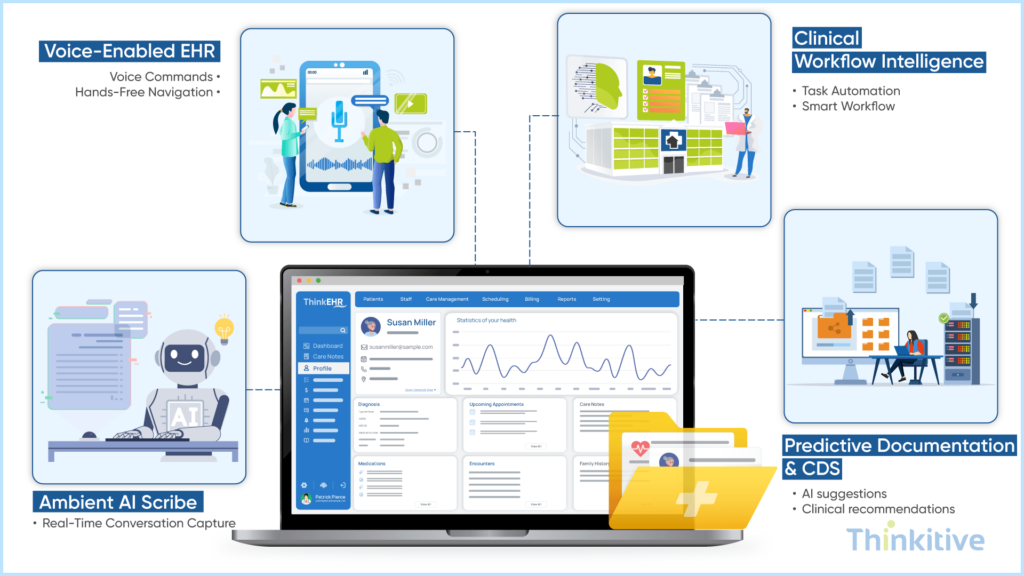
While Ambient Clinical Intelligence starts with automated documentation, a truly intelligent EHR combines multiple AI capabilities that simplify clinical workflows, reduce administrative burden, and support better decision-making. On that note, here are some capabilities that you must consider:
- Ambient Clinical Documentation: Automatically captures patient-provider conversations and generates structured clinical documentation in real time, eliminating the need for manual note-taking.
- Voice-Enabled EHR: Allows clinicians to navigate records, retrieve patient information, and complete routine tasks using natural voice commands.
- Clinical Workflow Intelligence: Uses AI to automate repetitive administrative tasks and streamline day-to-day clinical operations.
- Predictive Documentation & Clinical Decision Support: Analyzes clinical context to suggest documentation, surface patient insights, and provide guideline-based recommendations during care delivery.
Watch Your Custom EHR’s Ambient Clinical Intelligence in Action –
Book Free DemoBenefits of Ambient Clinical Intelligence in Healthcare
Ambient Clinical Intelligence is more than a documentation tool; it is a fundamental shift going forward about how practices will deliver care here forward. Reducing administrative burden and embedding AI into everyday clinical workflows helps improve efficiency, documentation quality, and the overall provider experience.
- Reduce Clinical Documentation Burden: Ambient Clinical Intelligence automates clinical documentation, allowing providers to spend less time typing notes and more time caring for patients. Reducing after-hours charting helps minimize physician burnout and improve work-life balance.
- Improve Documentation Quality & Consistency: AI-generated documentation follows standardized formats and captures key clinical information consistently across patient encounters. This improves documentation quality while supporting accurate coding, compliance, and continuity of care.
- Enhance Patient-Provider Engagement: With fewer distractions from screens and keyboards, clinicians can focus on meaningful conversations with patients. This leads to better communication, stronger patient relationships, and a more personalized care experience.
- Increase Operational Efficiency & Provider Satisfaction: By automating repetitive administrative tasks and accelerating documentation, Ambient AI streamlines clinical workflows. Healthcare organizations benefit from improved productivity, faster chart completion, and greater provider satisfaction.
- Prepare Organizations for AI-Driven Healthcare: Ambient Clinical Intelligence creates the foundation for adopting advanced AI capabilities such as predictive analytics, intelligent clinical decision support, and workflow automation. This helps healthcare organizations stay prepared for the future of digital healthcare.
Key Takeaways
- Ambient Clinical Intelligence reduces after-hours clinical documentation.
- Healthcare Conversational AI captures patient conversations automatically.
- Voice-enabled EHR software enables hands-free clinical documentation.
- Human review ensures AI-generated documentation remains accurate.
- FHIR-enabled integration allows Ambient AI to work seamlessly with modern EHR systems.
Conclusion
In a nutshell, ambient clinical intelligence has already been implemented in many healthcare practices. And it is expected that it will reshape the modern EHR system and ultimately change the way we deliver healthcare.
However, something that you need to know for this is that having AI-native capabilities in your system right now can be a great relief for later updates. As the healthcare platforms grow, AI capabilities will be leading the way.
On that note, let’s see what the future of intelligent, voice-enabled clinical documentation holds for your healthcare practice. Get your system assessed with our custom EHR subject matter expert and start your custom EHR development.
Frequently Asked Questions
Ambient Clinical Intelligence (ACI) is an AI-powered technology that automatically captures, understands, and documents patient-provider conversations during clinical encounters. By combining speech recognition, Healthcare Conversational AI, and Clinical Documentation Automation, it creates structured clinical notes while allowing clinicians to focus on patient care instead of manual documentation.
Traditional dictation simply converts speech into text and still requires clinicians to organize and edit the final note. In contrast, Ambient Clinical Intelligence understands the clinical context, extracts relevant medical information, and automatically generates structured documentation such as SOAP notes. It functions as an intelligent assistant rather than just a traditional medical dictation software.
To understand how to build an EHR with ambient AI capabilities, organizations should combine medical speech recognition, Healthcare Conversational AI, Clinical Documentation Automation, FHIR-based interoperability, and human-in-the-loop validation. The system should also support secure data exchange, scalable AI services, and seamless integration with existing clinical workflows.
Ambient Clinical Documentation Integration enables an EHR to automatically capture patient-provider conversations and convert them into structured clinical documentation in real time. Instead of relying on manual note-taking, the AI prepares documentation for clinician review, helping reduce documentation burden while maintaining clinical accuracy.
Healthcare Conversational AI goes beyond speech recognition by understanding medical conversations and extracting clinically relevant information such as symptoms, diagnoses, medications, and treatment plans. This improves documentation accuracy, reduces administrative work, and helps clinicians spend more time interacting with patients.
An ambient-enabled EHR should include capabilities such as Ambient Clinical Documentation, Voice-Enabled EHR Software, Clinical Documentation Automation, Healthcare Conversational AI, workflow automation, predictive documentation, and AI-assisted clinical decision support. Together, these capabilities create a more intelligent and efficient clinical workflow.
FHIR APIs enable Ambient Clinical Intelligence solutions to exchange structured clinical data securely with EHRs, hospitals, laboratories, pharmacies, and other healthcare systems. This interoperability ensures AI-generated documentation integrates seamlessly into existing healthcare workflows without creating data silos.
Some of the key benefits of Ambient Clinical Intelligence in healthcare include reduced clinician documentation burden, improved documentation quality, enhanced patient-provider engagement, increased operational efficiency, and better provider satisfaction. It also prepares healthcare organizations to adopt future AI-driven clinical workflows.
Yes. By automating documentation and reducing administrative tasks, Ambient Clinical Intelligence allows physicians to spend more time with patients and less time completing EHR documentation. This improves productivity, supports better patient interactions, and helps reduce physician burnout while maintaining high-quality clinical records.


