Custom EHR vs Epic vs Cerner: Total Cost of Ownership Comparison

One of the most significant investments you can make for your practice in 2026 is in the Electronic Health Records system. Though this investment is purely from a technological standpoint, it can change your practice for the better.
However, the total cost of ownership still becomes the point of conversation every now and then, and for good reasons. You see, its true financial impact can extend beyond its initial purchase, as it involves licensing fees, implementation services, workflow customization, integration, and the list goes on.
And for most of the practices, the decision typically drops down to two: Epic vs Cerner comparison. But what if I present you with another option and tell you that it will make you the complete owner of your EHR platform?
You see, enterprise EHRs offer mature functionality and thrive in their ecosystem. But the custom EHR development would not only offer you greater flexibility and ownership but also the ability to evolve as your practice grows.
But given the huge market share of Epic and Cerner, 43.7% and 21.9%, respectively, the talks about custom EHR cost are bound to put you in a dilemma. While the upfront investment varies depending on project scope, a Custom EHR can provide a lower long-term total cost of ownership than enterprise EHR platforms for many organizations.
Let’s explore the EHR total cost of ownership for your practice and see the custom EHR vs Epic vs Cerner cost comparison to help you make the right decision.
So, without further ado, let this blog be your guide to EHR total cost of ownership and let’s get started.
Key Takeaways
- Total Cost of Ownership (TCO) includes implementation, licensing, maintenance, integrations, upgrades, and long-term operational costs—not just the initial purchase price.
- Comparing Custom EHR, Epic, and Cerner based on TCO provides a clearer picture of long-term value than comparing upfront costs alone.
- Enterprise EHRs typically involve recurring licensing and vendor support costs, while Custom EHRs provide greater ownership and flexibility.
- Hidden implementation costs such as data migration, integrations, training, and workflow disruption significantly impact long-term ROI.
- Evaluating long-term ownership, scalability, and operational goals helps organizations choose the right EHR investment.
Understanding EHR Total Cost of Ownership
Let’s start with the basics of understanding the cost of ownership for an EHR system.
So, when you are evaluating an EHR for its cost, many healthcare practices focus on the upfront investment, and they are not wrong. As a buyer, anyone would consider the purchasing price as the total cost of ownership.
But the total cost of ownership (TCO) represents the complete cost of owning, operating, and maintaining an EHR until it is functioning. In short, the EHR total cost of ownership is not only the initial investment but also the recurring expense that comes with it.
Here you might ask, ‘What does EHR total cost of ownership include?’
Let’s break down the cost into two parts: one-time investments and recurring expenses. Here is what is included in both of them:
One-time cost includes:
- Software licensing or custom development
- Implementation and deployment
- Data migration
- Initial integrations
- Staff training
Recurring costs include:
- Annual licensing or subscription fees
- Maintenance and technical support
- Software upgrades
- Security and compliance updates
- Cloud hosting and infrastructure
- Additional integrations and user training
Apart from these factors, practices should also consider indirect costs such as workflow, inefficiencies, productivity loss during implementation, and ongoing customization requirements.
Why does Total Cost of Ownership matter?
Knowing the complete cost for owning the EHR system would look expensive at first, but in the long run, it can change everything, especially with a custom EHR. This becomes important because two solutions with similar implementation costs can have significantly different ownership costs depending on licensing models, customization needs, integration complexity, maintenance requirements, and vendor support.
Understanding these factors helps healthcare organizations evaluate whether a custom EHR, Epic, or Cerner offers the best long-term value, not just the lowest upfront cost.
Custom EHR vs Epic vs Cerner: Side-by-Side Comparison
To help you understand the difference between the three prominent choices that you have, here is a quick comparison table:
| Comparison Criteria | Custom EHR | Epic | Cerner (Oracle Health) |
| Best Fit | Specialty practices, digital health companies, and organizations requiring tailored workflows | Large health systems, integrated delivery networks, and academic medical centers | Mid-to-large hospitals, health systems, and government healthcare organizations |
| Customization | Highly customizable | Moderate customization | Moderate customization |
| Ownership Model | Organization-owned | Vendor-owned | Vendor-owned |
| Vendor Dependency | Low | High | High |
| Integration Flexibility | High (supports custom APIs, HL7, FHIR, and third-party integrations) | High (extensive integration capabilities within the Epic ecosystem) | High (strong interoperability with enterprise healthcare systems) |
| Scalability | Flexible and business-driven | Enterprise-scale | Enterprise-scale |
| Upgrade Control | Organization-controlled | Vendor-controlled | Vendor-controlled |
| Implementation Timeline | Varies by project scope (typically months) | Long enterprise implementation (often 12–24+ months) | Moderate to long implementation (typically several months to over a year) |
Now, for the table, you can easily see that each platform offers unique advantages in its own way. And the right choice ultimately depends on your practice’s size, clinical workflows, customization requirements, budget and long-term goals.
Here, rather than focusing solely on features, healthcare practices should evaluate the total cost of ownership over the system’s lifecycle.
The Hidden Costs of EHR Implementation
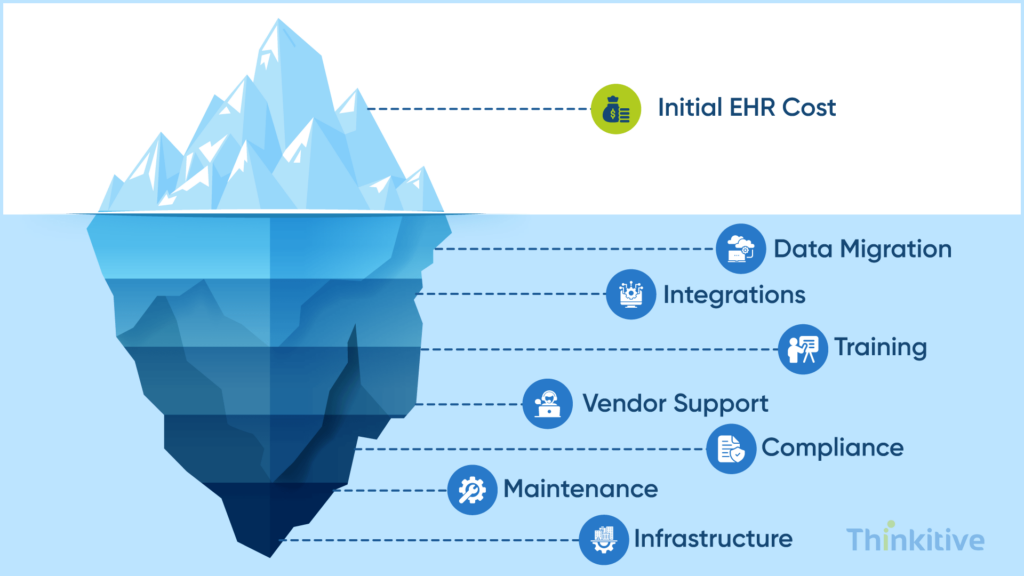
By now, you must have known that the initial implementation cost is only one part of the EHR investment. However, many healthcare practices underestimate the additional expenses that come up during deployment and continue throughout the entire EHR lifecycle.
On that note, let’s identify these hidden costs early and see how they can help you prevent budget overruns and unexpected operational challenges.
- Data Migration & System Integration: Migrating patient records from legacy systems and integrating EHR with other systems like billing, laboratories, pharmacies, telehealth, and other third-party applications often require significant time and technical expertise, which again adds up to the overall implementation cost.
- Training & Workflow Disruption: Adopting a new EHR system requires staff training and changes to existing clinical and administrative workflows. During this transition, your system can experience reduced productivity as staff and users adapt to a new system.
- Customization & Vendor Support: Enterprise EHRs frequently require vendor or third-party consultants for workflow customization, report development, and ongoing support. These services can substantially increase long-term ownership costs, especially as organizational needs evolve.
- Compliance, Infrastructure & Maintenance: Maintaining an EHR also involves recurring investments in security updates, regulatory compliance, infrastructure, software upgrades, backups, and technical support. Now, while these costs may not be part of the initial implementation budget, they contribute significantly to the total cost of ownership over time.
Comparing Long-Term Value & ROI
To help you compare your prominent options for long-term value and ROI, here is a table that will help you compare:
| Cost Category | Custom EHR | Epic | Cerner (Oracle Health) |
| Initial Investment | High (development and implementation) | High (enterprise licensing and implementation) | Moderate to High (depending on deployment scope) |
| Licensing | No recurring vendor licensing fees | Recurring vendor licensing fees | Recurring vendor licensing fees |
| Implementation | Project-based investment tailored to organizational requirements | Enterprise-scale implementation with consulting and deployment costs | Enterprise implementation with consulting and deployment costs |
| Maintenance | Managed by the organization or a technology partner | Vendor maintenance contracts and support | Vendor maintenance contracts and support |
| Upgrades | Organization-controlled and scheduled | Vendor-managed upgrade cycles | Vendor-managed upgrade cycles |
| Long-Term Ownership Cost | Depends on maintenance strategy, enhancements, and organizational growth | Higher recurring ownership costs due to licensing, support, and upgrades | Moderate to high recurring ownership costs depending on licensing and support agreements |
Evaluating an EHR investment goes beyond comparing software prices or implementation costs. Healthcare organizations should consider the long-term return on investment by assessing factors such as operational efficiency, clinical documentation automation, workflow flexibility, ownership, scalability, and ongoing operating expenses. While enterprise EHRs may be the right fit for large health systems with standardized processes, a custom EHR can deliver greater long-term value for organizations that require tailored workflows, greater control over their platform, and the flexibility to adapt as their clinical and business needs evolve.
Choosing the Right EHR Investment
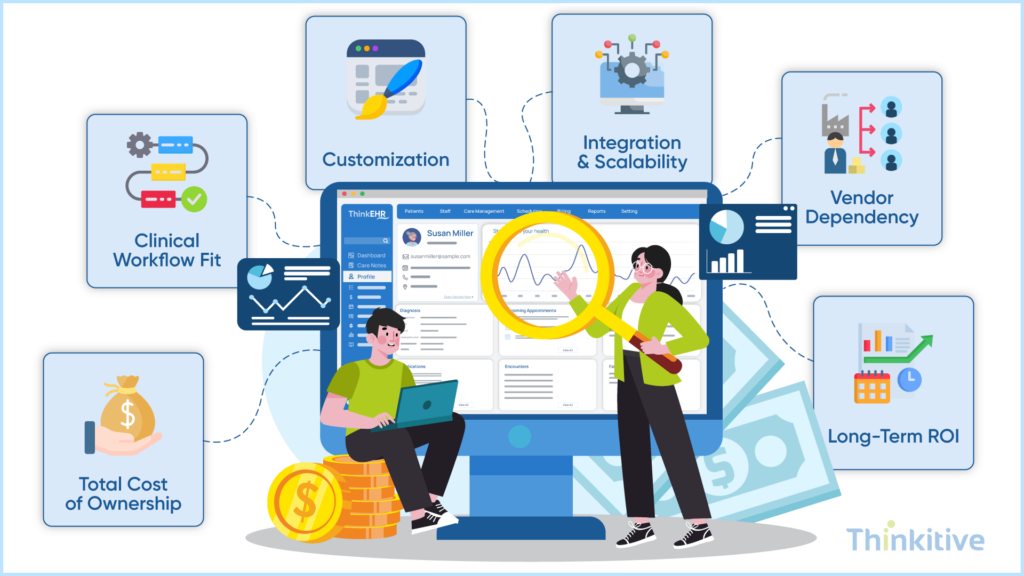
Selecting the right EHR is not about finding the right EHR software system, but the one that fits the practice in the long term. Before making an investment, you must evaluate both the financial and operational impact of the solution over the system’s entire lifecycle.
On that note, here is how to evaluate the total cost of ownership of an EHR
1. Calculate the total implementation and long-term operating costs.
2. Evaluate whether the platform supports your current and future clinical workflows.
3. Assess the level of customization your organization requires.
4. Verify integration capabilities with existing healthcare systems.
5. Determine whether the platform can scale as your organization grows.
6. Consider the level of vendor dependency you’re comfortable with.
7. Compare the expected ROI against the total cost of ownership.
By aligning your EHR strategy with your organization’s goals, budget, and growth plans, you can choose a solution that delivers long-term value while supporting better clinical and operational outcomes.
Conclusion
If you have been following this article or just scanning it for major pointers, then you must have known the core difference between custom EHR, Epic, and Cerner. And when choosing between the prominent choices that you have, the total cost of ownership must be the factor that should drive your investment decision.
You see, owning an EHR system involves owning the code, IP, and data that the software holds. Apart from that, it also involves the features, functionality, long-term success, and, most importantly, its alignment with your practice.
So, keeping all these things in mind, let this blog be your guide to choosing the right EHR system between custom EHR, Cerner, and Epic on the basis of long-term clinical, operational, and financial goals.
And if you want to know the complete estimated cost of your custom EHR system, then talk with our EHR expert and know your EHR expert custom EHR development cost.
Frequently Asked Questions
EHR Total Cost of Ownership (TCO) is the total expense of owning, operating, and maintaining an Electronic Health Record system throughout its lifecycle. It includes software licensing or development, implementation, data migration, integrations, staff training, maintenance, upgrades, security, compliance, infrastructure, and ongoing support. Evaluating the EHR Total Cost of Ownership helps healthcare organizations understand the long-term financial impact of an EHR investment rather than focusing only on the initial purchase price.
The total cost of ownership depends on your organization’s size, workflows, customization requirements, and long-term goals. While Epic and Cerner involve recurring licensing, vendor support, and enterprise implementation costs, a Custom EHR can offer lower long-term ownership costs for organizations that prioritize flexibility, ownership, and reduced vendor dependency. Comparing implementation, maintenance, upgrades, integrations, and ongoing operational costs provides a more accurate basis for decision-making.
A custom EHR vs Epic vs Cerner cost comparison depends on an organization’s size, workflows, and long-term goals. Epic and Cerner provide mature enterprise platforms with extensive features and recurring licensing models, making them well suited for large health systems. A Custom EHR offers greater flexibility, complete ownership, tailored workflows, and no recurring vendor licensing fees, making it an attractive option for specialty practices, digital health companies, and organizations with unique operational requirements.
The hidden costs of EHR implementation extend beyond software licensing and deployment. They often include data migration, third-party integrations, workflow redesign, staff training, productivity loss during implementation, customization, vendor consulting, infrastructure upgrades, compliance updates, and ongoing maintenance. Accounting for these expenses provides a more accurate estimate of the total cost of ownership.
To calculate electronic health record implementation costs, consider both one-time and recurring expenses. One-time costs include software licensing or custom development, implementation, data migration, integrations, and staff training. Recurring costs include maintenance, technical support, software upgrades, cloud hosting, compliance, security, and infrastructure. Including these factors provides a realistic estimate of the overall investment required.
The total cost of ownership for enterprise EHR systems includes software licensing, implementation services, consulting, workflow customization, data migration, system integrations, staff training, infrastructure, maintenance, vendor support, security updates, compliance, and recurring software upgrades. Organizations should also consider indirect costs such as workflow disruption and productivity changes during implementation.
There is no single answer. Custom EHR cost depends on the project’s scope, customization requirements, and ongoing maintenance strategy, while Epic and Cerner involve recurring licensing, vendor support, and enterprise implementation costs. For organizations with specialized workflows and long-term growth plans, a Custom EHR can provide greater long-term value by reducing vendor dependency and offering complete ownership. However, large health systems may find enterprise platforms more suitable due to their mature functionality and established ecosystems.
Clinical Documentation Automation reduces the time clinicians spend on manual documentation by automating charting, clinical notes, coding support, and documentation workflows. This can improve provider productivity, reduce administrative burden, enhance documentation accuracy, and allow healthcare professionals to spend more time on patient care, contributing to better long-term operational efficiency.
The biggest factors influencing EHR Total Cost of Ownership include the licensing model, implementation complexity, customization requirements, data migration, system integrations, maintenance, upgrades, compliance, infrastructure, staff training, vendor support, and scalability. Evaluating these factors together provides a more accurate understanding of the long-term financial commitment.
A Custom EHR is often the best fit for specialty practices, behavioral health providers, digital health companies, telehealth organizations, value-based care programs, and growing healthcare businesses that require tailored workflows and greater flexibility. Organizations seeking complete ownership, easier customization, and the ability to scale their platform over time can often realize greater long-term value from a Custom EHR compared to traditional enterprise systems.


