Microservices vs Monolithic Architecture for EHR Development

Over the past few months, most of the clients we encountered had one question in their questionnaire that they wanted to ask us.
‘Which EHR architecture is better, microservices or monolithic?’
Though we answered the question honestly, it got me thinking, and I started researching the EHR system architecture. And some of the results were as surprising as the question itself.
You see, most of the major vendors providing off-the-shelf EHR platforms are made up of monolithic architecture. This includes Epic, Oracle Health (Cerner Millennium), and others.
While there is no problem with using a monolithic architecture for your Electronic Health Record development, they have majorly formed the core architectural blueprint for hospital and healthcare systems.
However, upon digging deeper, it was found that these systems have a monolithic architecture with tightly integrated modules sharing one data model, even as deployment patterns. This makes the ecosystem look more modular, but the problems it brings with itself trouble you during EHR software design updates, or connecting different modules inside your system together, and most importantly, during scalability.
This made it clear why most of our clients were keenly asking cloud-native EHR development and what to choose: microservices vs monolithic architecture for EHR systems, along with EHR software architecture comparison for their custom EHR.
And this is the reason why I decided to pen down this blog for you today.
On that note, let’s deep dive into EHR software architecture comparison and help you in making a better choice for your custom EHR architecture for healthcare modernization.
Know Which Architecture Suits Your EHR Development
Get Free AssessmentEHR Software Architecture Comparison: Microservices vs Monolithic
Given the base of each architecture module that each approach adopts, here are some of the key differences between microservices vs monolithic architecture for EHR systems. Refer to the table below:
| Comparison Factor | Monolithic Architecture | Microservices Architecture |
| Scalability model | Scales the entire application as a single unit, even if only one module needs more resources. | Enables service-level scaling, allowing specific EHR modules (billing, scheduling, AI) to scale independently. |
| Reliability & fault isolation | A failure in one component can impact the entire system, creating a single point of failure. | Failures are isolated to individual services, improving overall system resilience and uptime. |
| Deployment & release cycles | Centralized releases require redeploying the full EHR system for even minor updates. | Independent deployments allow teams to update services without disrupting the entire platform. |
| Performance under load | Performance degrades uniformly under high load, even if only one module is stressed. | Targeted optimization ensures only high-demand services are scaled or tuned for performance. |
| Maintenance & technical debt | Tightly coupled code makes changes riskier and increases long-term technical debt. | Modular services improve maintainability, faster updates, and cleaner long-term architecture. |
| AI integration flexibility | AI features are tightly coupled, making updates or experimentation complex and risky. | AI services can be deployed, upgraded, or replaced independently without affecting core EHR workflows. |
| Long-term cost of ownership | Lower upfront development cost but higher costs over time due to scaling inefficiencies. | More efficient long-term scaling and infrastructure usage, reducing total cost of ownership as the system grows. |
What Are Monolithic and Microservices Architectures in EHR Development?
Most of you who have come here by the mercy of the internet must know what a software architecture is. However, for those who don’t, let me explain that to you in simple terms. So, a software architecture, or in this case, an EHR software architecture, is nothing but a blueprint that defines how different components of the software, like clinical modules, database, integrations, user interfaces, and security layers, are designed and connected. Other than that, it also determines how your EHR software works behind the scenes.
Now, there are two types of EHR software architecture: monolithic architecture and microservices architecture. While healthcare microservice adoption is on the rise, the healthcare industry still relies on monolithic EHR systems for its day-to-day activities.
On that note, let’s discuss the intricacies of the traditional architecture that is monolithic architecture.
Monolithic EHR Systems: The Traditional Architecture
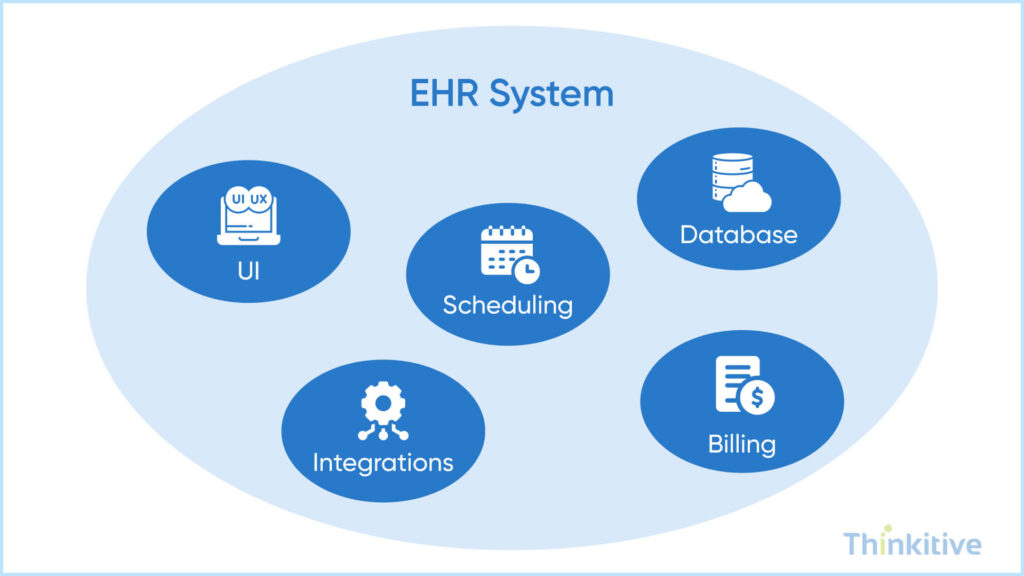
Traditionally, almost all software systems were built on a monolithic architecture. In simple words, it is a traditional software design approach where all the components of the software are built, deployed, and run as a single unified unit.
The core components of the software architecture, like user interface, business logic, data access, and integrations, are tightly coupled within one codebase and one deployment package. The advantages that you get with a monolithic EHR system are as follows:
- Simple to develop initially
- Easier to test and debug
- Single deployment
- Lower initial infrastructure complexity
With all these considerations, monolithic EHR systems make a perfect choice for practices that are just starting out, or for MVP (Minimum Viable Product) development, or for those who have a limited scope.
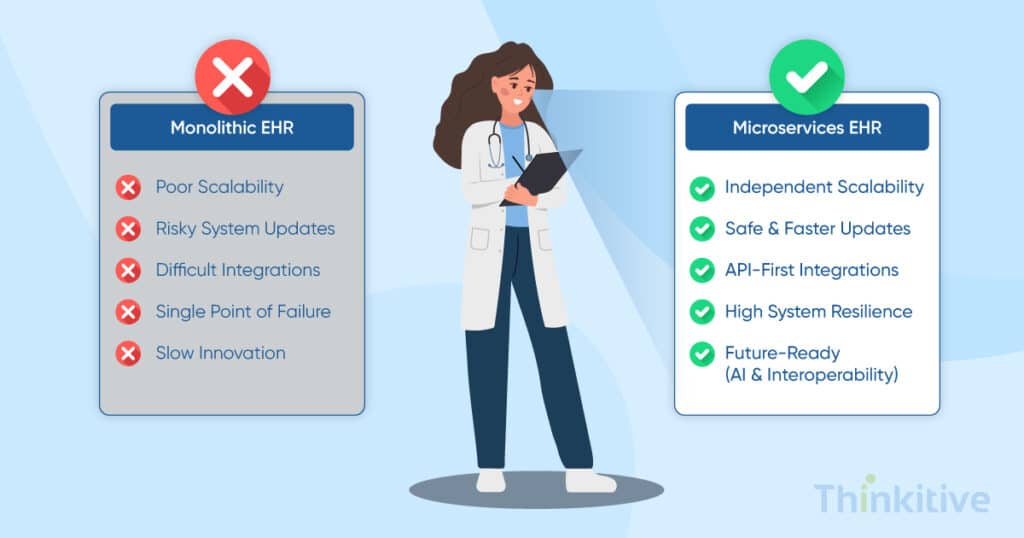
Despite these benefits, there are some limitations in monolithic EHR systems that are forcing healthcare providers to make a shift to microservices in healthcare IT. On that note, here are some limitations of a monolithic EHR system:
- Poor scalability due to a unified and single module
- High risk during updates, as a complete revamp of the system is required
- Difficult integration due to system architectural complexity
- Slower innovation
- Vulnerabilities have a larger security impact
Now that you know briefly about monolithic architecture, let’s have a look at microservices in healthcare IT, a modular EHR architecture approach.
Microservices in Healthcare IT: A Modular EHR Architecture
One of the approaches that many of our clients insisted on adopting has been microservices in healthcare IT. In this approach, the EHR system is built as a collection of small and independent services or components, where each microservice is responsible for a specific function.
In simple words, instead of building one large application, a modular EHR using microservices operates as loosely coupled services communicating with each other using secure APIs. To give you an example, for instance, different components of your EHR system, like patient records, scheduling, billing, lab integrations, etc., are built separately and connected with your system through APIs.
By adopting this healthcare software modernization approach, here are some of the key benefits that you get:
- Scalability by design
- Faster innovation and updates, which are critical for a fast-paced, evolving healthcare landscape
- Stronger interoperability with an API-first architecture approach
- Improved reliability and resilience
- Easier specialty-specific customization
However, with healthcare microservices adoption, you gain a competitive edge; some of the core requirements for this are operational complexity and higher engineering maturity. On top of that, with microservices in healthcare IT, you can build an AI-ready architecture that can give your EHR systems the capabilities that support core modules like CDS, predictive analytics, and ambient documentation, all this without impacting the core EHR workflows of your software.
Microservices Readiness Checklist for Your EHR System
Free DownloadLegacy EHR Modernization Using Microservices
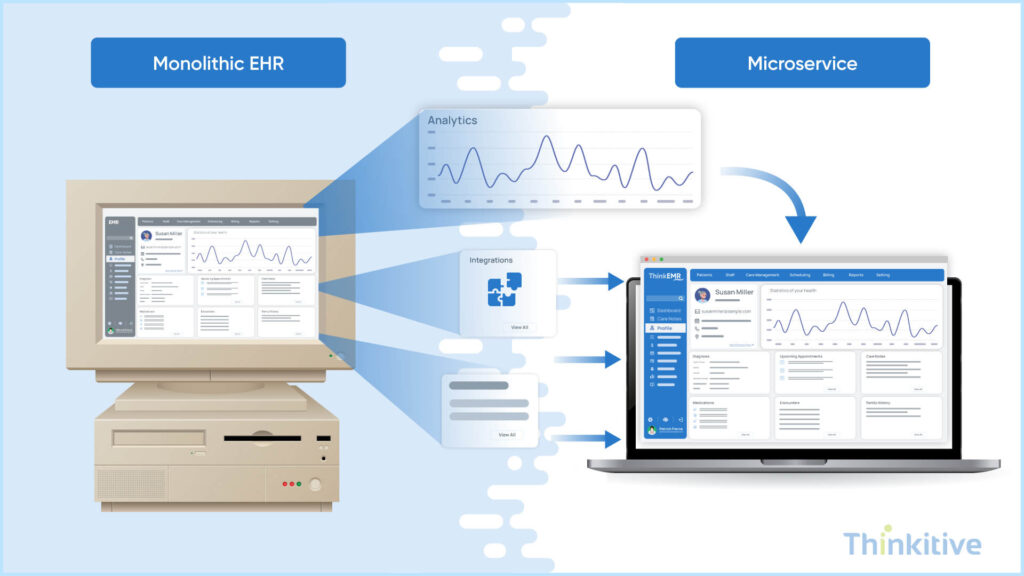
Since most of the systems in the healthcare industry are predominantly using legacy systems with monolithic software architecture, many of the clients we have encountered are looking for their legacy EHR modernization using microservices.
This demand has come into the picture because, during the initial adoption of EHRs, the focus was on digitizing records. However, as time passed, the demands changed to interoperability, real-time data exchange, etc. And this is one of the major reasons why most of the legacy systems were built using a monolithic system architecture.
The challenges that many practices faced came at the time of scaling. These legacy systems with monolithic architecture simply struggled to scale efficiently. For instance, if you want to add new users, locations, or specialties, the performance of your system would be drastically impacted.
On top of that, integrations with modern labs, telehealth platforms, patient apps, or analytics tools become complex and fragile as they are tightly coupled code.
This is the reason why many providers are looking for legacy EHR modernization using microservices. You see, microservices in healthcare IT allow your practice to modernize selectively; instead of replacing the entire EHR system, you can replace or upgrade a specific component of your system. This way, the other activities can function without interruptions, which reduces dependency and minimizes disruption and risk.
Hybrid & Incremental Approaches: Practical Modernization Paths
With the adoption of this incremental approach, you can enable continuous improvement to your EHR system, support regulatory updates, and spread modernization costs over time. However, one of the major benefits that this approach offers is a realistic balance by preserving existing clinical operations while steadily transitioning towards a modern and future-ready flexible EHR ecosystem.
Legacy EHR Modernization Roadmap: From Monolith to Microservices
Free GuideWhich EHR Architecture is Better for Your Organization?
To answer the question that many of our clients have been asking us, then clearly, microservices in healthcare IT or microservices architecture of your EHR software is the better choice.
However, when it comes to specific to your healthcare practices or organization, then the better option clearly depends on your needs and requirements. On that note, let’s see which one to choose for your custom EHR software development, to help you make better decisions.
When Monolithic EHR Architecture is the Right Choice
Monolithic EHR architecture is the right choice when your workflows are limited, and integration needs are minimal. Meaning, if you are a small clinic or an early-stage healthcare organization that requires MVP deployments, then monolithic EHR architecture is the right choice for you.
Furthermore, a few things that you need to know with regard to this are that this architecture works well when the user base is small, changes in the software blueprint are rare, and rapid initial development is required rather than long-term scalability.
When Microservices Become Necessary for Scale & Resilience
Microservices in healthcare IT become essential for your healthcare systems when your system grows in users, locations, data volume, and integration complexity. For instance, large or multi-specialty organizations require independent scaling, high availability, and frequent updates without downtime. This can be done with healthcare microservices adoptions, which enable isolated failures, faster innovation, and API-driven interoperability.
Now that you know when to choose which software architectural approach, there are some other factors that you should consider when making a decision. For instance, factors like organizational size, growth trajectory of your practice, technical maturity of your software, and the budget must be considered.
However, for this you need to have a better understanding of system architecture, on that note read our blog – A Deep Dive into Custom EHR Software Architecture, Compliance & Scalability.
Key Takeaways
- Choose Monolithic for Simplicity: Best suited for MVPs, smaller healthcare organizations, and applications with limited scalability and integration requirements.
- Adopt Microservices for Growth: Microservices enable independent scaling, faster deployments, and greater resilience as healthcare platforms expand.
- Modernize Legacy EHRs Incrementally: Replace high-impact modules with microservices to reduce risk and avoid costly full-system rewrites.
- Build an API-First Architecture: Simplify AI adoption, third-party integrations, and long-term healthcare software modernization.
- Align Architecture with Business Goals: Evaluate scalability, technical maturity, integration complexity, and future growth before making a decision.
Conclusion: Choosing the Right EHR Architecture for the Future
If you have made it till here in the quest for your custom EHR software development research, then for your electronic health record development, you get two architectural choices: microservices vs monolithic architecture for EHR systems.
While one offers quick development, the other offers long-term scalability and flexibility. And given the rising and ever-evolving nature of the healthcare and healthcare technology landscape, choosing the right architecture is the most important because the scalability, modernization, and AI-readiness of your system are directly based on this.
On this note, I hope this blog will help you make the right choice for your custom EHR software development. And if you want to know something specific about your practice, then click here to get your first free consultation from Thinkitive’s EHR expert and start your custom EHR development journey.
Frequently Asked Questions
The most common EHR software architecture comparison evaluates monolithic and microservices architectures across scalability, deployment, security, maintenance, interoperability, AI readiness, and modernization. While monolithic architectures are suitable for smaller or early-stage healthcare organizations, microservices provide greater flexibility, resilience, and long-term scalability for growing healthcare systems.
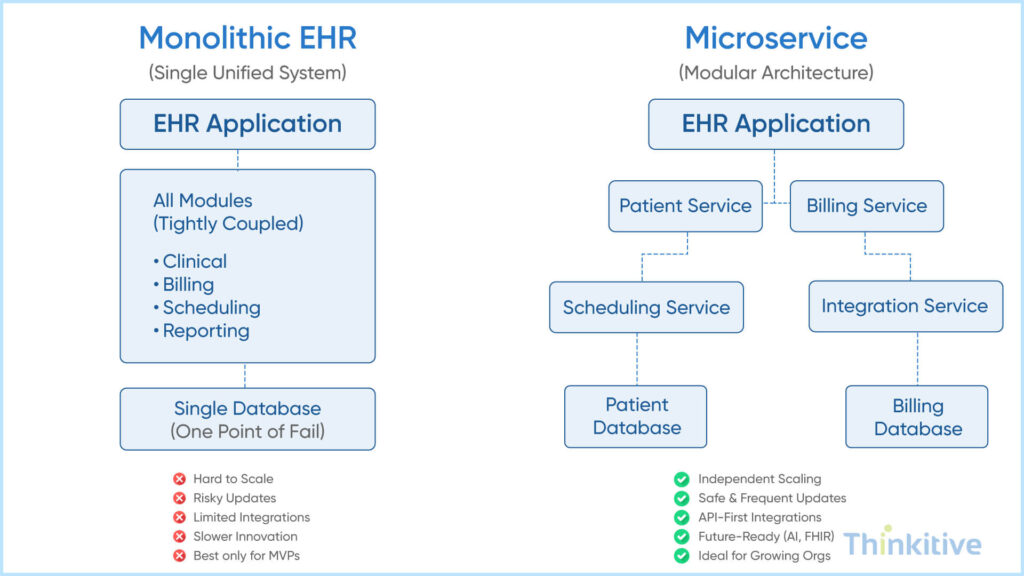
A monolithic EHR architecture is built as a single, tightly coupled application where clinical, billing, scheduling, and reporting modules are deployed together.
A microservices EHR architecture breaks these functions into independent services—each with its own APIs, database, and deployment lifecycle.
In practice, monoliths prioritize simplicity, while microservices prioritize flexibility, scalability, and long-term adaptability.
A monolithic EHR is often the right choice when:
- The product scope is limited or well-defined
- Speed to market matters more than future extensibility
- The user base is small and predictable
- Integration and AI needs are minimal in the short term
For early-stage startups or pilot deployments, monoliths reduce architectural complexity and upfront cost.
Microservices allow service-level scaling, meaning high-load components like e-prescribing or patient portals can scale independently.
They also improve fault isolation—if one service fails, others (like clinical documentation or scheduling) continue to operate.
In clinical environments, this translates to higher uptime, better performance during peak hours, and reduced system-wide outages.
Both architectures can be HIPAA-compliant if designed correctly.
However, microservices offer finer-grained security controls such as:
- Service-specific access policies
- Isolated data stores
- Independent audit logging and monitoring
Monolithic systems rely more heavily on centralized security controls, which can become harder to manage as the system grows.
Yes—and this is increasingly common.
Healthcare organizations often adopt incremental modernization, where high-impact modules (APIs, integrations, analytics) are extracted from the monolith and rebuilt as microservices.
This approach avoids risky full-system rewrites while enabling gradual transition toward a modern, modular EHR ecosystem.
Microservices significantly accelerate AI and interoperability adoption by:
- Allowing AI models to be deployed as standalone services
- Supporting API-first designs aligned with FHIR standards
- Enabling faster iteration of analytics, CDS, and automation features
Monolithic EHRs can support AI and FHIR, but updates are slower and tightly coupled, limiting experimentation and rapid innovation.


