How to Build a Fully Interoperable EHR

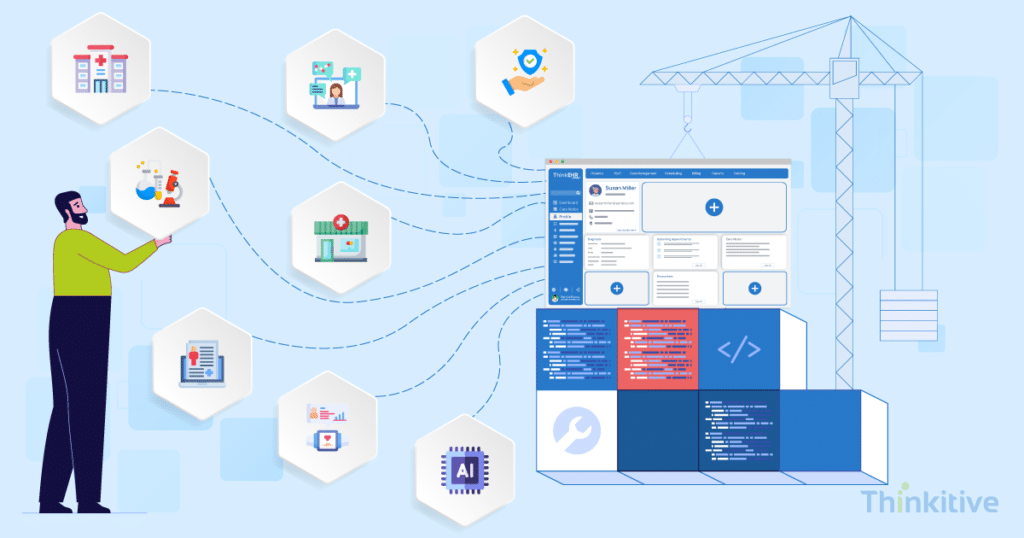
Did you know that 70% of US hospitals are engaged in all four domains of interoperability, which are to send, receive, find, and integrate healthcare information?
According to the Office of the National Coordinator of Health Information Technology, hospital interoperability increased from 23% in 2014 to 70% in 2023. One of the major reasons for this is the reliability of healthcare practices of disparate healthcare systems for information.
This is the reason why building your own EHR and EMR with interoperable capabilities is one of the top priorities of healthcare practices, as they build their own EHR to achieve healthcare data interoperability. With FHIR-based EHR development, these healthcare practices are trying to create a connected ecosystem, breaking the loops of disconnected healthcare data and siloed systems.
Understanding the standards that enable healthcare interoperability is the first step toward building a connected and future-ready EHR ecosystem.
By building an interoperable EHR, practices can easily connect with various systems like providers, labs, pharmacies, payers, etc., and share data in real-time, improving care coordination and other aspects of care.
However, how to build a fully interoperable EHR system is something that every healthcare provider asks.
On that note, let’s see some of the best practices for EHR interoperability development and know the intricacies that you need to know about this.
Assess Your EHR System’s Interoperability Readiness –
Assess My Readiness
Understanding Healthcare Data Interoperability & Industry Standards
Before building a fully interoperable EHR, it is important to understand what healthcare data interoperability actually means and the standards that make it possible.
In simple terms, healthcare data interoperability refers to the ability of different healthcare systems, applications, and organizations to exchange, access, and use patient information seamlessly. Whether it is a provider sharing records with a specialist, a laboratory sending test results to an EHR, or a pharmacy receiving prescription information electronically, interoperability ensures that healthcare data moves efficiently between systems without manual intervention.
However, interoperability is not simply about transferring data from one system to another. The receiving system must also be able to understand, interpret, and use that information correctly. This is where industry standards play a critical role.
For years, healthcare organizations have relied on HL7 standards to facilitate communication between healthcare applications. HL7 messaging remains widely used for workflows such as patient admissions, discharges, transfers, laboratory reporting, and clinical data exchange. At the same time, modern healthcare systems are increasingly adopting FHIR because it enables healthcare applications to exchange information through standardized APIs and structured data formats.
In fact, many healthcare organizations today operate in hybrid environments where both HL7 and FHIR work together. While HL7 supports numerous legacy integration workflows, FHIR provides the flexibility required for modern interoperability initiatives, including patient access applications, care coordination platforms, remote patient monitoring solutions, and third-party healthcare applications.
Another important factor driving interoperability is regulatory compliance. The 21st Century Cures Act introduced information-blocking requirements designed to give patients and healthcare providers easier access to health information. As a result, healthcare organizations are expected to support secure and timely data sharing while eliminating barriers that prevent authorized access to patient records. Building an interoperable EHR, therefore, helps organizations not only improve care delivery but also align with evolving regulatory expectations.
This is why standardized data exchange has become a foundational requirement for modern healthcare systems. Without common standards, healthcare organizations often face fragmented workflows, duplicate records, data inconsistencies, and communication gaps across care settings. On the other hand, standardized interoperability enables providers, laboratories, pharmacies, payers, and other stakeholders to exchange information consistently and securely, creating a more connected healthcare ecosystem.
Understanding these interoperability principles and standards is the first step toward building an EHR capable of supporting seamless healthcare data exchange at scale. The following table summarizes the major interoperability standards used in modern healthcare and when each one is typically required.
| Standard | What It Does | When You Need It |
| HL7 v2 | Enables messaging between healthcare systems for admissions, discharges, transfers, lab results, and orders. | Integrating with legacy hospital systems and existing healthcare infrastructure. |
| FHIR R4 | Uses standardized RESTful APIs and healthcare resources to enable real-time data exchange. | Building modern EHRs, patient portals, mobile apps, and API-based integrations. |
| USCDI | Defines the standardized clinical data classes and elements that should be exchanged across healthcare systems. | Supporting standardized patient data exchange and regulatory requirements. |
| C-CDA | Provides structured clinical documents such as discharge summaries, referrals, and continuity of care documents. | Exchanging clinical documents between providers and healthcare organizations. |
| SMART on FHIR | Enables secure third-party applications to connect to EHRs using FHIR APIs and standardized authentication. | Integrating provider apps, patient-facing applications, and digital health solutions. |
| TEFCA | Establishes a nationwide framework for trusted health information exchange across networks. | Sharing healthcare information across multiple organizations and health information networks. |
How FHIR Enables EHR Interoperability in Healthcare
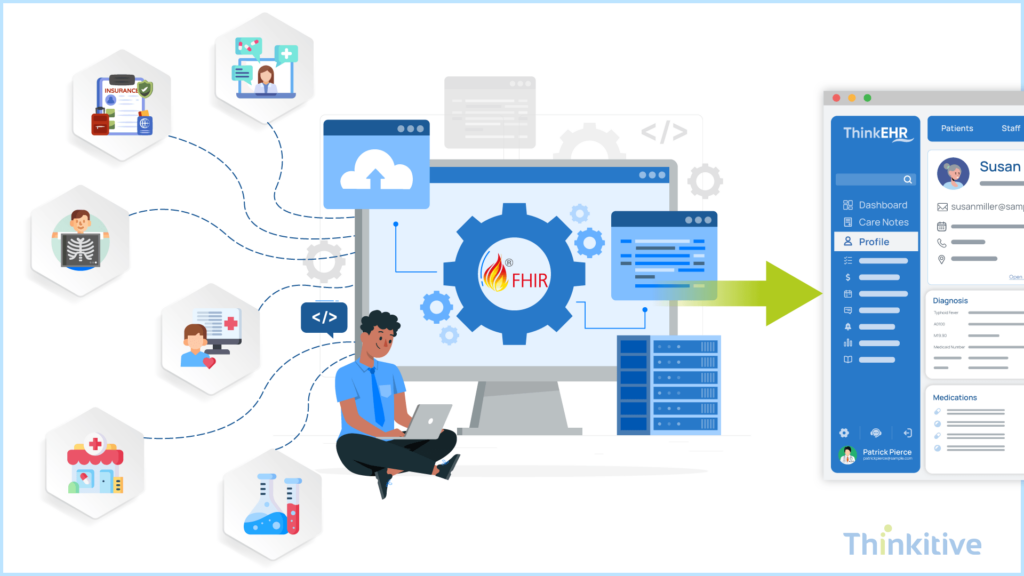
When discussing modern healthcare interoperability, FHIR is often at the center of the conversation. In fact, many healthcare organizations pursuing interoperable EHR development are adopting FHIR because it provides a standardized framework for exchanging healthcare information across different systems and applications.
Unlike traditional healthcare integration methods that often rely on complex interfaces and custom data mappings, FHIR enables healthcare systems to exchange information through standardized APIs. This allows authorized applications to access and share patient data securely and in real time, making healthcare information more accessible across the care continuum.
Healthcare organizations rarely operate within a single technology ecosystem. A modern EHR must exchange information with laboratories, pharmacies, payers, imaging systems, and other healthcare applications. FHIR simplifies these integrations by providing a standardized approach to healthcare data exchange, reducing the complexity of connecting multiple systems.
While FHIR is one of the key standards that enables healthcare interoperability, successfully implementing a FHIR-based EHR involves much more than selecting an interoperability standard. It requires careful planning around FHIR resources, API architecture, security, compliance, and system scalability. To explore these implementation considerations in detail, read our complete guide on How to Build a FHIR-Based EHR System.
See How Connected Healthcare Systems Work in Real-Time –
Book DemoCommon Challenges & Best Practices for EHR Interoperability Development
While the benefits of interoperability are significant, building a fully interoperable EHR comes with several technical, operational, and regulatory challenges. Understanding these challenges early can help healthcare organizations avoid costly implementation issues and accelerate interoperability success.
One of the most common obstacles is integrating legacy healthcare systems. Many healthcare organizations still rely on older applications that use different data formats, proprietary interfaces, or outdated interoperability standards. As a result, organizations often face challenges related to data mapping, duplicate records, and inconsistent clinical information during integration projects.
Security and compliance also require careful attention. Since interoperable EHRs exchange sensitive patient information across multiple systems, organizations must implement strong security measures to protect healthcare data. This includes maintaining HIPAA compliance, encrypting data during transmission, controlling user access, and monitoring system activity through audit logs.
To overcome these challenges, healthcare organizations should follow several interoperability best practices. Adopting standards-based architectures, leveraging FHIR APIs, establishing clear data governance policies, and standardizing clinical terminologies can significantly improve integration outcomes. In addition, conducting thorough interoperability testing before deployment helps identify potential issues before they affect clinical workflows.
At the same time, organizations should avoid common implementation mistakes such as relying heavily on custom integrations, overlooking data quality issues, neglecting security requirements, or failing to plan for future scalability. These decisions often create interoperability barriers that become increasingly difficult to resolve as healthcare ecosystems grow.
By addressing these challenges proactively and following proven best practices, healthcare organizations can build interoperable EHR systems that support secure, reliable, and scalable healthcare data exchange.
AI-Assisted Interoperability & Data Exchange
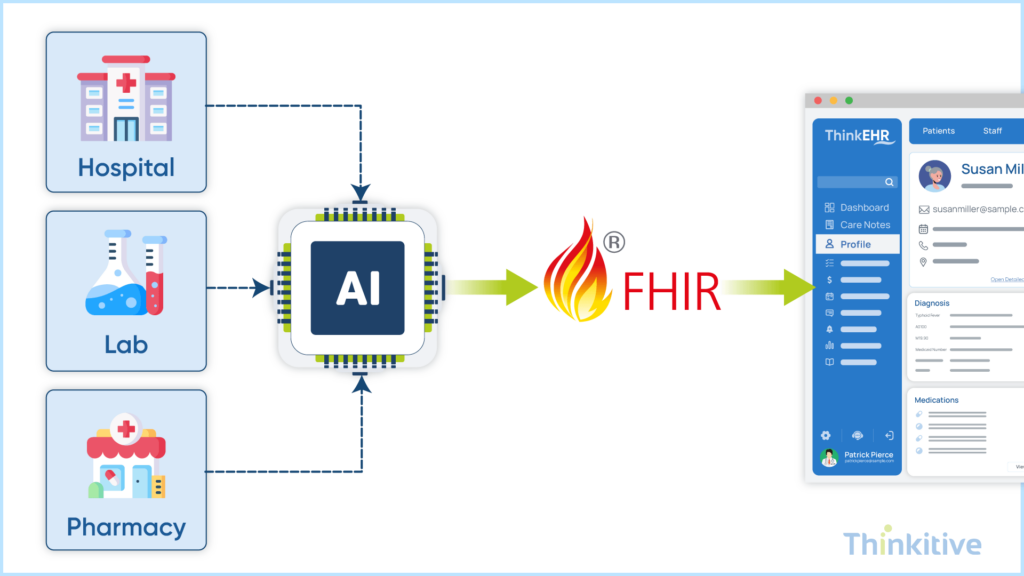
As healthcare ecosystems become increasingly connected, managing interoperability manually can quickly become complex and resource-intensive. This is where AI-assisted interoperability is beginning to play a valuable role in modern EHR development.
One of the biggest challenges in healthcare data exchange is ensuring that information coming from different systems is mapped correctly and remains accurate throughout the integration process. Since healthcare organizations often use different workflows, terminologies, and data structures, manual data mapping can be time-consuming and prone to errors. AI-powered tools can help identify inconsistencies, automate data mapping tasks, and validate incoming healthcare information before it is integrated into the EHR.
In addition, AI can automate many interoperability workflows that traditionally require significant human involvement. For example, AI models can monitor data exchange processes, detect missing or incomplete records, identify anomalies, and flag potential integration failures before they affect clinical operations. This helps organizations maintain higher levels of data quality while reducing operational overhead.
Another advantage of AI-assisted interoperability is its ability to reduce manual integration efforts. Instead of relying solely on custom configurations and repetitive administrative tasks, healthcare organizations can use AI-driven automation to streamline onboarding, optimize data transformation processes, and improve interoperability efficiency across connected systems.
While AI does not replace interoperability standards such as FHIR or HL7, it can significantly enhance how organizations manage and scale healthcare data exchange. As interoperability requirements continue to evolve, AI-assisted processes will become increasingly important for maintaining reliable, efficient, and intelligent healthcare integrations.
Get Your EHR Integration Planning Toolkit –
Get ToolkitTesting & Optimizing Interoperability Performance
Building an interoperable EHR is only part of the process. Healthcare organizations must also ensure that interoperability workflows perform reliably under real-world conditions. Without proper testing and optimization, even well-designed integrations can experience data inconsistencies, delayed information exchange, or workflow disruptions.
A critical first step is validating API performance and data accuracy. Organizations should verify that healthcare data is exchanged correctly between connected systems, that clinical information remains consistent throughout the process, and that APIs perform efficiently under varying workloads. Testing should also cover error handling, authentication workflows, and security controls to ensure reliable operation across all integration points.
Beyond initial testing, organizations should continuously monitor interoperability workflows. Since EHR systems often connect with laboratories, pharmacies, payers, health information exchanges, and third-party applications, monitoring tools can help identify bottlenecks, failed transactions, latency issues, and data synchronization problems before they impact patient care.
Long-term scalability is equally important. As healthcare organizations grow and adopt additional technologies, interoperability demands often increase significantly. Systems that perform well today may struggle when transaction volumes rise or new integrations are introduced. For this reason, organizations should regularly evaluate system performance, optimize infrastructure, and plan for future expansion.
Ultimately, interoperability should be viewed as an ongoing capability rather than a one-time implementation project. Continuous testing, monitoring, and optimization help ensure that EHR platforms remain reliable, scalable, and ready to support future healthcare interoperability requirements.
Planning a Future-Ready Interoperable EHR Platform
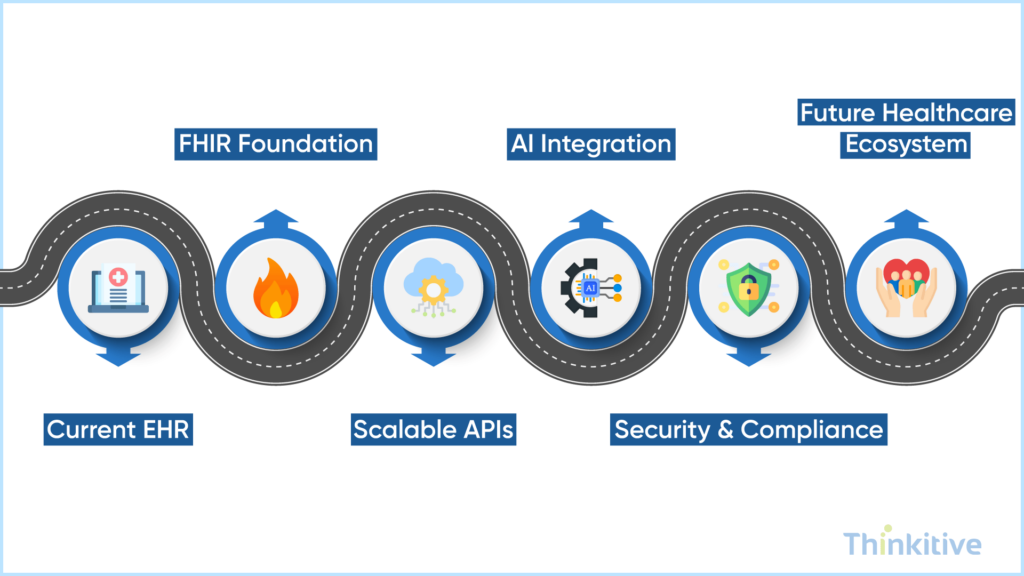
Successfully building a fully interoperable EHR requires more than implementing APIs and integration standards. Organizations must adopt a long-term strategy that supports evolving healthcare technologies, regulatory requirements, and interoperability expectations.
The process begins by prioritizing interoperability requirements during the planning phase. Rather than treating interoperability as an add-on feature, healthcare organizations should incorporate it into the core architecture of the EHR. This includes selecting appropriate standards, defining data governance policies, planning security controls, and ensuring that future integrations can be supported without major redevelopment efforts.
At the same time, development goals should align with broader organizational objectives. Whether the focus is improving care coordination, enabling patient access, supporting value-based care, or integrating emerging digital health solutions, interoperability initiatives should directly support these outcomes. This helps organizations maximize the long-term value of their EHR investments.
Healthcare interoperability requirements will also continue to evolve. New regulations, data-sharing frameworks, healthcare applications, and AI-driven technologies will create additional demands on healthcare systems. Organizations that build flexible, standards-based architectures today will be better positioned to adapt to future changes without disrupting operations.
Ultimately, future-ready interoperable EHR platforms are built on a combination of interoperability standards, scalable architecture, strong security practices, and continuous innovation. By planning for both current and future requirements, healthcare organizations can create connected systems capable of supporting seamless healthcare data exchange for years to come.
Conclusion
Building a fully interoperable EHR requires a strategic combination of healthcare interoperability standards, modern APIs, secure data exchange frameworks, and scalable system architecture. From understanding standards such as HL7 and FHIR to implementing secure integrations, addressing interoperability challenges, leveraging AI-assisted workflows, and continuously optimizing performance, each step plays a critical role in creating connected healthcare systems.
As healthcare organizations increasingly depend on real-time information exchange, interoperability has become essential for improving care coordination, reducing administrative burdens, enhancing patient experiences, and supporting better clinical outcomes. Healthcare providers can no longer rely on isolated systems that limit access to critical patient information.
This is why successful interoperable EHR development requires a balanced approach that combines standards, security, compliance, performance, and long-term scalability. Organizations that invest in interoperability today are better equipped to meet evolving regulatory requirements, integrate emerging technologies, and support future healthcare innovation.
By building future-ready interoperable EHR platforms, healthcare organizations can move beyond fragmented data environments and create connected healthcare ecosystems that enable secure, seamless, and efficient healthcare data exchange across the continuum of care.
On that note, let’s assess your system’s readiness for interoperability, get your system assessed by our EHR expert and let’s start your journey with EHR and EMR software requirements gathering.
Frequently Asked Questions
To build interoperable EHR systems means creating electronic health record platforms that can securely exchange, access, interpret, and use patient information across different healthcare systems and organizations. An interoperable EHR enables seamless communication between providers, laboratories, pharmacies, payers, and third-party healthcare applications, helping eliminate data silos and improve care coordination.
The most widely adopted EHR interoperability standards include HL7, FHIR, CDA, and healthcare terminology standards such as SNOMED CT, LOINC, and RxNorm. Among these, FHIR has become the preferred standard for modern healthcare data exchange because it supports API-based interoperability. Together, these EHR interoperability standards help healthcare organizations exchange clinical information consistently and securely.
Healthcare data interoperability improves patient care by ensuring that accurate and up-to-date patient information is available wherever care is delivered. Providers can access medical histories, laboratory results, medications, and treatment records from multiple sources, reducing duplicate testing, minimizing errors, improving care coordination, and supporting better clinical decision-making.
HL7 and FHIR for EHR interoperability help healthcare systems exchange information using standardized formats. HL7 is commonly used for traditional healthcare messaging and integration workflows, while FHIR supports modern API-based communication and real-time data exchange. Many healthcare organizations use both standards together to connect legacy systems with modern healthcare applications.
FHIR enables EHR interoperability by providing standardized resources and APIs that allow healthcare applications to exchange information securely and efficiently. It simplifies integration between EHRs, laboratories, pharmacies, payers, patient portals, and third-party applications. This is why understanding how FHIR enables EHR interoperability in healthcare environments is essential for organizations pursuing modern interoperability initiatives.
Organizations looking to understand how to build a fully interoperable EHR system should start by adopting interoperability standards such as FHIR and HL7, implementing secure APIs, standardizing clinical data, and establishing strong governance practices. Successful interoperability also requires scalable architecture, regulatory compliance, comprehensive testing, and ongoing performance monitoring to support long-term healthcare data exchange.
Some of the best practices for EHR interoperability development include using standards-based architectures, implementing FHIR APIs, maintaining data quality, standardizing clinical terminologies, prioritizing security and HIPAA compliance, and conducting extensive interoperability testing. Organizations should also plan for future scalability to support evolving healthcare interoperability requirements.
Common challenges affecting healthcare data interoperability projects include integrating legacy systems, managing inconsistent data formats, ensuring data accuracy, maintaining regulatory compliance, addressing security risks, and supporting multiple interoperability standards. Without proper planning and governance, these challenges can increase implementation complexity and limit interoperability success.
FHIR-based EHR development plays a critical role in achieving healthcare interoperability because it provides a standardized framework for secure and scalable healthcare data exchange. By leveraging FHIR APIs and standardized healthcare resources, organizations can connect disparate systems, simplify integrations, improve care coordination, and create future-ready healthcare ecosystems that support seamless information sharing.


