How to Build FHIR-Based EHR Systems (Step-by-Step)


The rise of technology in healthcare has increased immense pressure on practices to proactively share patient data across providers, payers, patients, and other third-party applications.
These advancements have indeed made healthcare a connected venture, yet fragmented data silos, custom integrations, and legacy interoperability approaches have made these exchanges slow, expensive, and difficult to scale.
These inefficiencies have forced healthcare providers to question – How to build an EHR system. And for good reasons, you see, with almost 90% of the hospitals in the US providing patient access through APIs, which has formed the backbone of Fast Healthcare Interoperability Resources (FHIR).
On top of that, the adoption of FHIR has been steady, with reports suggesting almost 71% of countries are adopting FHIR. FHIR data standards are designed in such a way that simplifies data exchange through standardized APIs and reusable data models, beating traditional integration approaches.
And while the healthcare industry is transitioning to a completely digital landscape, making this shift now can be a strategic priority for practices to be part of this connected healthcare ecosystem.
Moreover, by building an interoperable EHR powered by FHIR APIs for your system, it can improve care coordination, patient access initiatives, and easy adoption of new-age healthcare technologies like AI.
On that note, in this blog, let’s look at how to build a FHIR-based EHR system step by step. This will include defining clinical requirements and selecting the right FHIR resources to implement APIs, security controls, and interoperability testing.
So, without further ado, let’s get started!
FHIR-Based EHR Development Readiness Assessment –
Get Assessment
Understanding the Core Architecture of FHIR-Based EHR Systems
Before you actually make any decision, it’s important to understand the basics that form the foundational components that make your EHR system interoperable, scalable, and future-ready.
FHIR is basically a standard that helps in organizing healthcare information into standardized resources such as patient encounter, observation, and medication. These resources are then exchanged through RESTful APIs, enabling seamless communication between EHRs, healthcare applications, labs, and other systems.
At the core of this architecture is a FHIR server that stores standardized healthcare resources and exposes them through secure RESTful APIs. These APIs allow EHRs, patient applications, laboratories, pharmacies, and third-party healthcare systems to exchange data using a common structure, reducing the complexity of custom integrations.
Then you need to design a scalable and modular healthcare platform with FHIR-based architecture. Here, you need to separate data, APIs, and application layers to make it easier to add new features, integrate third-party applications, and scale as your practice needs in the future.
Other than this, FHIR also provides structured and standardized data that can be leveraged by AI-powered solutions such as CDS, AI scribes, predictive analytics, care coordination tools, and workflow automation systems.
And if you are just starting out by building your own EHR, then you must focus on interoperability, security, compliance, scalability, and API-first design from the very beginning. This will help you in building a solid FHIR foundation that reduces technical debt and simplifies long-term product growth.
Planning the Foundation for FHIR-Based EHR Development
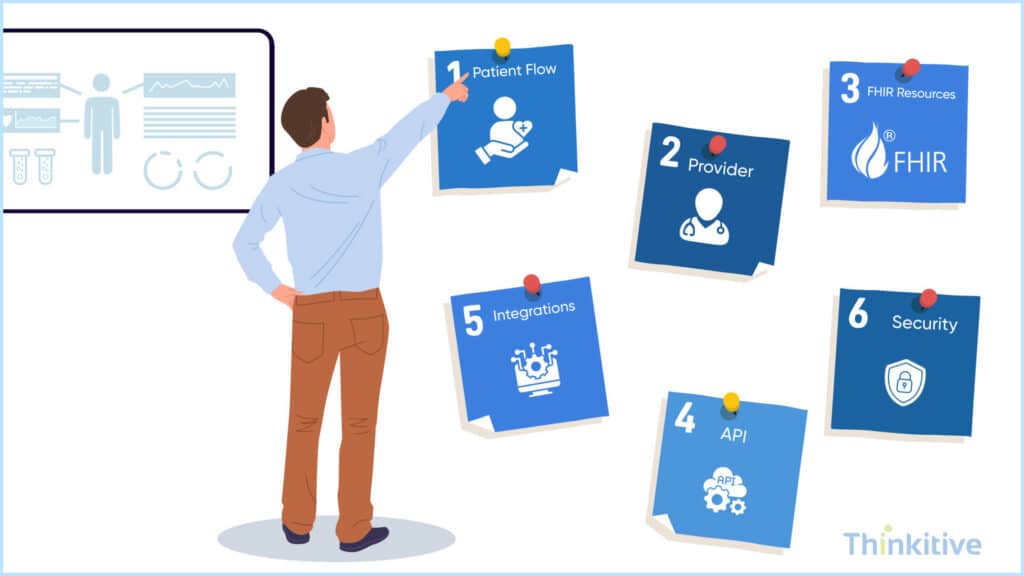
Now that you have understood the basics, you need to start with the planning of a FHIR-based EHR. Here you need to establish clear business, clinical, and interoperability needs. So, let’s look at some of the core components in this:
Defining Interoperability Goals & Healthcare Workflow Requirements
First things first, start by identifying the intricacies of your healthcare workflows that your system must support. This includes patient management, clinical documentation, care coordination, and patient engagement. Once you are done with that, define how data should flow between different systems like providers, patients, payers, and external healthcare systems.
Choosing Healthcare Standards, APIs, & Integration Priorities
After you have the workflow, you need to determine which interoperability standards and integration frameworks—including FHIR, HL7, SMART on FHIR, and external healthcare APIs—your platform will support.
TIP: Prioritize your integrations purely based on your business objectives and user needs.
Planning Scalable Healthcare Data Exchange & API Connectivity
With time, your practice and everything inside it are bound to grow. This is why you need to design a strategy for secure data exchange that can support increasing transaction volumes, multiple healthcare partners, and future interoperability requirements without any significant architectural changes.
Building the Technical Roadmap for FHIR-Based EHR Development
By curating a scalability plan, you are almost done with planning, with only the execution roadmap remaining. For this, you need to outline architecture, developing planning, resource modeling, API development, security implementation, testing, deployment, and future enhancements. This road map is crucially important as it tells what you want to do and reduces the risks while keeping the development process aligned with the previously defined goals.
FHIR API & Interoperability Planning Checklist –
Request ChecklistBuilding FHIR API Integration for Electronic Health Record Systems
If you are done with the planning, now it’s time to build the FHIR API for EHR systems, as this will serve as the foundation for making your EHR system truly interoperable.
The very first thing that you need to do in this is to design FHIR APIs around standardized healthcare resources such as Patient, Encounter, Observation, Medication, and Practitioner. Structuring APIs around these resources ensures consistent healthcare data exchange while simplifying future integrations with external healthcare applications.
FHIR APIs enable real-time access to patient information. This allows healthcare practices to exchange clinical data, care updates, and treatment information instantly across connected platforms and care settings.
When you build a FHIR-based integration framework, it allows your EHR system to connect with laboratories, pharmacies, billing platforms, patient engagement tools, and other healthcare applications through standardized APIs and interoperability protocols.
On top of that, you can also leverage AI-assisted healthcare data mapping and workflow automation to improve your interoperability. These AI-powered tools can help you in data mapping between legacy systems and FHIR resources. Along with that, it can also automate integration workflows, improve data quality, and reduce manual effort for other healthcare interoperability initiatives.
How to Build a Fully Interoperable EHR
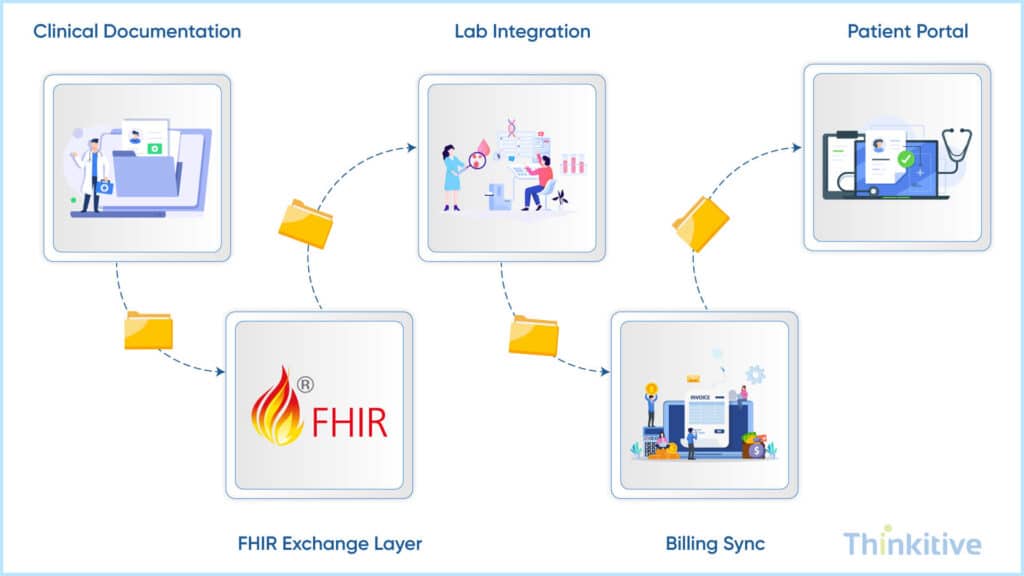
With interoperability becoming one of the major focuses of FHIR-based EHR development, let’s now discuss the intricacies of how to build an interoperable EHR using FHIR.
Supporting HL7, FHIR, SMART on FHIR & Third-Party Healthcare Integrations
A fully interoperable EHR must support multiple interoperability standards and integration frameworks. This includes HL7, FHIR, and SMART on FHIR, as different healthcare practices use different formats to store, share, and manage healthcare information. By supporting these healthcare standards and integration frameworks, you can ensure seamless connectivity with healthcare providers, payers, labs, pharmacies, and other third-party applications.
Enabling Secure Healthcare Data Exchange Across Providers & Healthcare Networks
The next step in this involves implementing secure APIs, authentication mechanisms, encryption, and access controls to facilitate trusted data exchange between healthcare organizations while maintaining regulatory compliance and patient privacy.
Improving Care Coordination Through Interoperable Healthcare Workflows
Timely access to patient information across care settings is what clinicians need, and that is exactly what an interoperable EHR system provides them. When all your systems are connected and able to communicate and share information with each other, you can improve care coordination, reduce duplicate data entry, minimize information gaps, and support better clinical decision-making.
For detailed information about building an interoperable EHR system read our guide on How to Build a Fully Interoperable EHR.
Need Help Designing Your EHR Architecture?
Book Free Strategy CallBuilding Security into Your FHIR-Based EHR Development Process
Given the sensitive nature of healthcare data, security should be integrated into every stage of FHIR-based EHR development rather than treated as a post-development activity. Since modern EHR systems rely on APIs, third-party integrations, and connected healthcare ecosystems, implementing security controls early helps protect patient information while supporting interoperability and regulatory compliance.
As you build FHIR APIs and integrate external healthcare systems, your platform should include secure authentication, encrypted communication, access controls, and API security measures. Addressing these considerations early in development helps create an interoperable EHR while protecting patient data, maintaining system integrity, and supporting regulatory compliance.
Since EHR platforms manage Protected Health Information (PHI), security implementation should align with regulations such as HIPAA and HITECH. Development teams should incorporate capabilities like role-based access control (RBAC), encryption, audit logging, consent management, and continuous monitoring as part of the overall system architecture.
For a detailed breakdown of healthcare cybersecurity risks, compliance strategies, and best practices, read our complete guide on EHR Security Risks When Building Healthcare Software.
Planning Your FHIR-Based EHR for ONC Certification
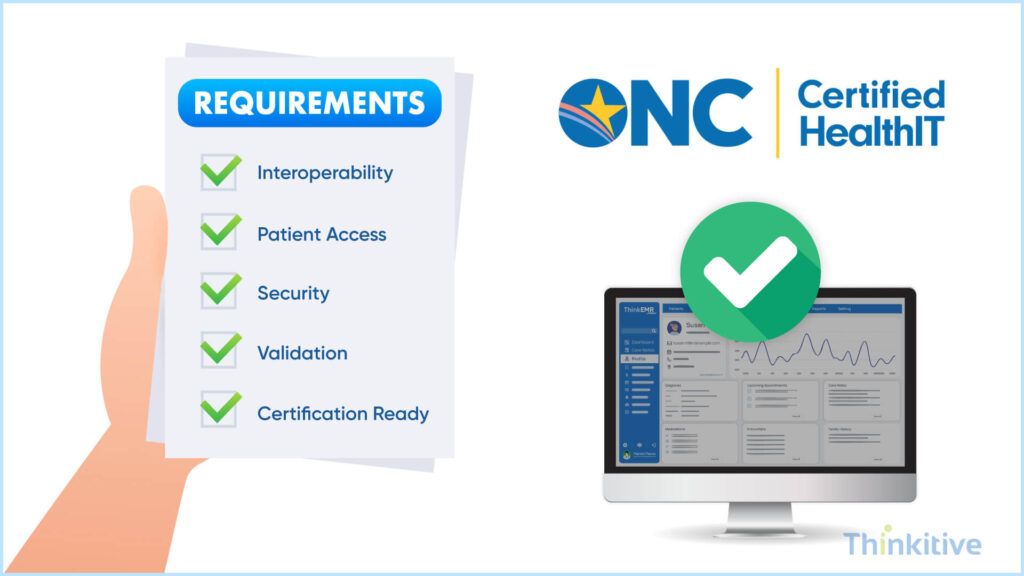
If you are building an EHR system for the United States healthcare market, then planning for ONC certification early in the development process can help you avoid costly architectural changes later. Since ONC certification validates an EHR’s ability to support interoperability, patient access, security, and regulatory compliance, aligning your development roadmap with these requirements from the outset can simplify future certification efforts.
While designing your FHIR-based EHR, you should account for core interoperability requirements such as standardized healthcare data exchange using USCDI, secure patient access through FHIR APIs, electronic prescribing, and support for essential clinical workflows. Building these capabilities into your platform from the beginning makes it easier to scale your product while meeting evolving industry expectations.
However, achieving ONC certification involves much more than implementing technical capabilities. It requires validating compliance controls, meeting certification criteria, and demonstrating interoperability across multiple healthcare scenarios.
For a detailed breakdown of ONC certification requirements, compliance workflows, and implementation best practices, read our complete guide on How to Build an EHR That Passes ONC Certification.
7 Step-by-Step Guide to FHIR-Based EHR Development
| Step | Focus Area | Key Activities | Outcome |
| Step 1 | Define Requirements | Identify clinical workflows, user roles, specialty needs, compliance requirements, and interoperability goals | Clear project scope and MVP definition |
| Step 2 | Plan FHIR Architecture | Select FHIR resources, design data models, define API strategy, and establish integration requirements | Scalable and interoperable system architecture |
| Step 3 | Build Core EHR Modules | Develop patient management, scheduling, documentation, billing, and clinical workflows | Functional MVP EHR platform |
| Step 4 | Implement FHIR APIs | Create standardized APIs for patient, encounter, medication, observation, and other resources | Real-time healthcare data exchange |
| Step 5 | Integrate External Systems | Connect laboratories, pharmacies, payers, patient apps, and third-party healthcare platforms | Expanded interoperability ecosystem |
| Step 6 | Implement Security & Compliance | Configure encryption, RBAC, audit logs, consent management, HIPAA safeguards, and security monitoring | Secure and compliant EHR platform |
| Step 7 | Test Interoperability | Validate FHIR resources, APIs, integrations, performance, and data exchange workflows | Reliable and production-ready interoperability |
| Step 8 | Scale & Optimize | Enhance automation, AI capabilities, analytics, monitoring, and enterprise integrations | Future-ready FHIR-based EHR system |
Conclusion
If you have made it this far, then you know almost everything about building an interoperable EHR with FHIR API integration for electronic health records systems. Right from the requirements gathering to understanding the security and compliance requirements for FHIR-based EHR platforms.
On that note, let this blog be your step-by-step guide to FHIR-based EHR development and make your EHR system interoperable, secure, compliant, and scalable. And this is the right time for you to build a FHIR-based EHR system.
If you don’t know where to get started, then talk to our integration expert and get your system assessment to build EHR and EMR from scratch.
Frequently Asked Questions
FHIR-based EHR development is the process of designing and building electronic health record systems using the Fast Healthcare Interoperability Resources (FHIR) standard. It enables healthcare organizations to create interoperable platforms that support standardized data exchange, API-driven integrations, patient access, and connected healthcare workflows.
To build an interoperable EHR using FHIR, organizations should define clinical workflows, identify required FHIR resources, design a scalable architecture, implement standardized APIs, integrate external healthcare systems, and establish security and compliance controls. A FHIR-first approach simplifies healthcare data exchange across providers, patients, payers, and third-party applications.
A FHIR API for EHR systems should support standardized healthcare resources, RESTful API operations, secure authentication, role-based access controls, audit logging, and real-time data exchange. Effective API design is essential for interoperability, patient access, and seamless healthcare integrations.
Interoperability enables healthcare organizations to securely exchange patient information across providers, healthcare networks, and digital health applications. It improves care coordination, reduces data silos, enhances clinical decision-making, and supports a better patient experience throughout the care journey.
Common EHR security risks when building healthcare platforms include unauthorized access, API vulnerabilities, ransomware attacks, data breaches, third-party integration risks, and insufficient access controls. Organizations should implement encryption, authentication, monitoring, and audit trails to protect patient information.
ONC-certified EHR requirements focus on interoperability, patient access, security, data exchange, and compliance with federal healthcare regulations. EHR systems seeking certification must support standardized healthcare data, secure information sharing, and capabilities aligned with current certification criteria.
AI can improve interoperability by automating healthcare data mapping, validating data quality, identifying integration issues, and streamlining workflow automation. When combined with FHIR API integration for electronic health record systems, AI helps reduce manual effort and improves the efficiency of healthcare data exchange.
The security and compliance requirements for FHIR-based EHR platforms typically include HIPAA compliance, patient privacy protections, secure API access, audit logging, consent management, data encryption, and breach response procedures. Compliance should be incorporated throughout the development lifecycle.
A step by step guide to FHIR-based EHR development typically includes requirements gathering, architecture planning, FHIR resource mapping, API development, interoperability implementation, security controls, compliance validation, integration testing, deployment, and ongoing optimization. These phases help organizations build FHIR-based EHR step by step while maintaining scalability and compliance.
SMART on FHIR enables third-party healthcare applications to securely connect with EHR systems using standardized APIs and modern authentication frameworks. This approach simplifies application integration, improves data accessibility, and expands healthcare connectivity across the digital health ecosystem.
Scalable FHIR-based healthcare systems typically require cloud infrastructure, secure API gateways, FHIR servers, databases, identity and access management tools, monitoring solutions, and integration services. The infrastructure should support growing transaction volumes, interoperability requirements, and future healthcare innovations.
FHIR-based EHR architecture for healthcare startups should prioritize interoperability, scalability, security, compliance, and rapid product development. Startups often begin with core clinical workflows and standardized APIs, then expand integrations and advanced capabilities as the platform grows.
APIs are the foundation of modern healthcare interoperability. They enable healthcare applications to exchange information securely, support patient access initiatives, facilitate integrations with external systems, and improve the flow of healthcare data across connected platforms.


