Cloud-Based EHR: AWS vs Azure vs GCP Comparison

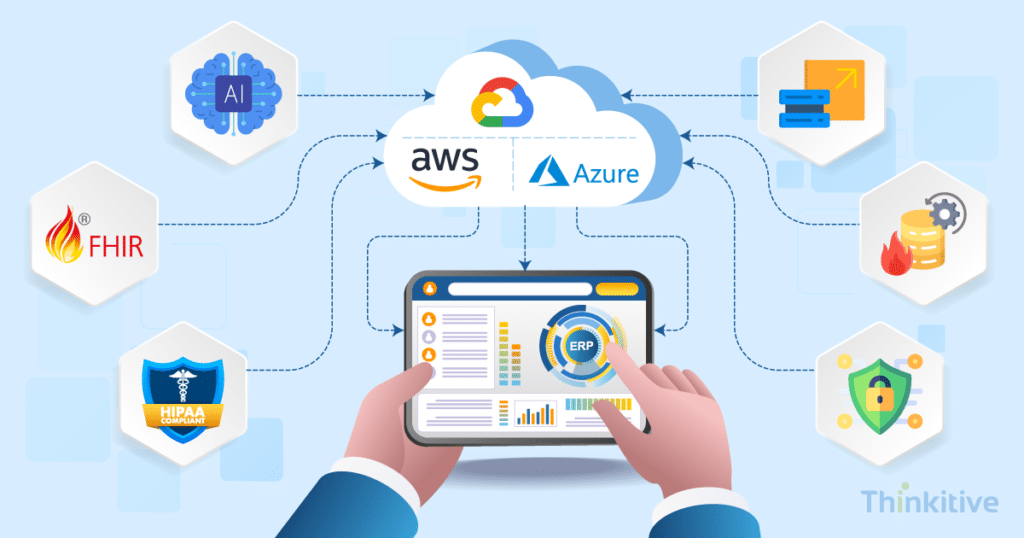
Do you know what the biggest trend that is dictating the terms of the future of healthcare is?
I don’t think you have noticed, but this underlying trend is slowly turning out to be the bedrock for every future endeavor in healthcare systems. Yes, we are talking about healthcare cloud infrastructure.
Over the years, almost more than 80% of healthcare executives have already adopted the cloud with their applications running on it, according to a KLAS Research study published on Healthcare IT News. On top of that, cloud-native EHR architecture is one of the highest priorities of 88% healthcare providers, according to Yahoo Finance.
And given the demands of modern-day healthcare, it is only natural. You see, the current-day needs of healthcare practices revolve around delivering better patient experience, supporting interoperability, enabling AI-driven workflows, and scaling digital health services.
The major disadvantage in this is the increasing operational complexity, which the traditional on-premise EHR systems are simply not able to keep up with. And this is what makes cloud adoption the accelerator of these things. It’s flexible, uses microservices, and has API-first frameworks that make it better.
However, as the rate of cloud adoption amidst healthcare practices is increasing, the question arises, ‘How to build a cloud-native EHR system?’
Well, let’s be honest, there are only three dominant choices that you get with developing a cloud-native EHR platform: Amazon Web Services (AWS), Microsoft Azure, and Google Cloud Platform (GCP).
Now, while they all might look similar on the outside, choosing the right one requires you to understand your needs and requirements clearly.
On that note, let this blog be your guide to building a cloud-based EHR and help you choose the best cloud-native EHR architecture approach for your custom EHR.
So, without further ado, let’s get started!
Assess Your System for Cloud Platform Selection –
Get Free Assessment & Consultation
Understanding Cloud-Native Architecture
Let’s start with the basics and clear the doubts for once and for all, cloud-native EHR architecture refers to designing Electronic Health Record systems specifically for cloud environments using microservices, containers, APIs, and managed cloud services. This approach delivers greater flexibility, scalability, reliability, and operational resilience than traditional on-premise architectures.
With the adoption of cloud native EHR platforms, healthcare practices can adapt to changes quickly to the load and growing data. Along with that, adhering to the regulatory requirements also becomes a lot easier and gives you enough freedom to start your own digital health initiatives.
Your cloud-native EHR architecture must be designed with utmost care to support mission-critical healthcare operations. The system should be able to accommodate high availability, automated backups, disaster recovery, data encryption, access controls, and compliance-ready security frameworks.
These capabilities help you to meet certain healthcare regulatory requirements like HIPAA, HITRUST, etc., and the biggest advantage you get in this is that this EHR tech stack allows you to maintain your business continuity. Cool, right?
Having said that, the cloud-native EHR architecture also serves as the foundation for your future trends and digital healthcare initiatives. By supporting interoperability standards like HL7 and FHIR, integrating with third-party applications can be easy, and you can build a well-connected, intelligent, and AI-powered future-ready healthcare ecosystem.
Essential Requirements for Healthcare Cloud Infrastructure
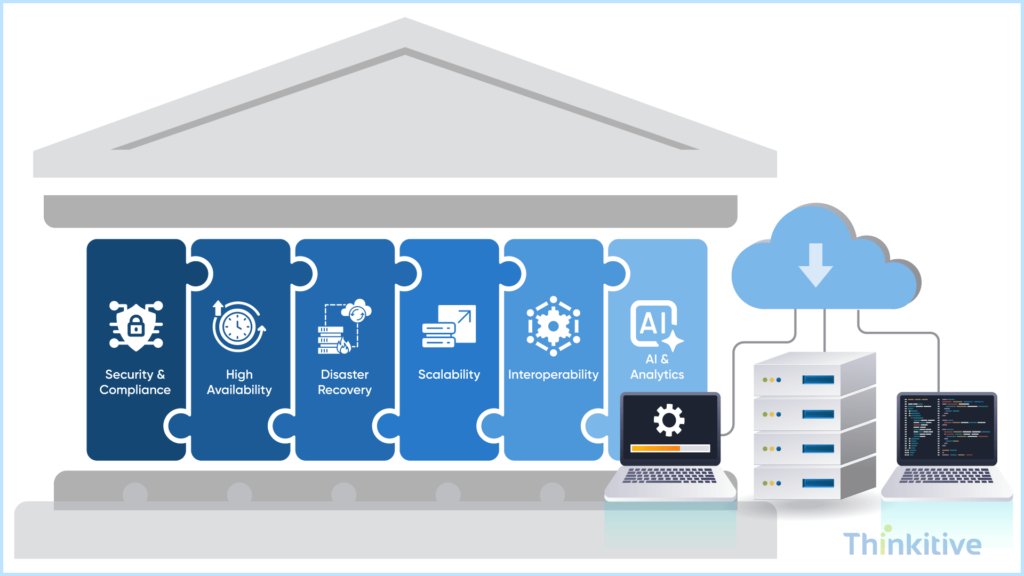
Given the sensitive nature of data and information you deal with, your healthcare cloud infrastructure must meet the core requirements for security, reliability, and performance. This is done to ensure access to patient information and that the clinical workflow is uninterrupted.
That is the reason why cloud-native EHR platforms are expected to have high availability, low latency, robust access controls, and continuous monitoring while protecting sensitive health data from unauthorized access or breaches.
One such major requirement is HIPAA-compliant hosting support. Being one of the top requirements of the US government, it requires you to provide your cloud platform with necessary security controls and HIPAA-eligible services.
Let’s explore some of the essential requirements for your EHR healthcare cloud infrastructure:
Security & Compliance: These requirements help you to protect patient data and support regulatory compliance.
- HIPAA-compliant hosting capabilities
- Data encryption
- Identity and access management
- Audit logging
High Availability & Reliability: Ensures continuous access to critical healthcare systems.
- Uptime guarantees
- Multi-zone deployment
- Fault tolerance
Disaster Recovery & Business Continuity: Minimizes downtime and data loss during disruptions.
- Automated backups
- Geographic redundancy
- Failover support
Scalability & Performance: Maintaining performance as healthcare operations expand to different devices, ecosystems, and locations.
- Auto-scaling capabilities
- Support for growing patient volumes
- High transaction processing
Interoperability Support: These requirements help you enable seamless connectivity across healthcare systems.
- HL7 and FHIR compatibility
- API management
- Healthcare data exchange
AI & Analytics Readiness: These requirements provide your EHR system with a foundation for data-driven healthcare innovation.
- Machine learning services
- Predictive analytics capabilities
- Clinical AI integration support
NOTE: When evaluating AWS, Azure, and GCP, you must review each provider’s Business Associate Agreement (BAA) coverage, HIPAA-eligible services, security certifications, and support for HITECH compliance requirements. This can be important for your current regulatory obligations and future healthcare security needs.
AWS vs Azure vs GCP for EHR: Core Platform Comparison
On the basis of the capability of AWS vs Azure vs GCP for EHR, here is a quick evaluation table to make decision-making easier for you.
| Evaluation Factor | AWS | Microsoft Azure | Google Cloud Platform (GCP) |
| Healthcare Adoption | Widely Adopted | Widely Adopted | Growing Adoption |
| HIPAA Compliance Support | Comprehensive Coverage | Comprehensive Coverage | Comprehensive Coverage |
| FHIR & Healthcare Services | Mature Healthcare Services | Healthcare-Focused Platform | Healthcare & Data Platform |
| Scalability | Enterprise-Scale | Enterprise-Scale | Enterprise-Scale |
| AI & Analytics Capabilities | AI-Ready Infrastructure | Integrated AI Ecosystem | AI & Analytics Leader |
| Enterprise Integration | Broad Integration Options | Deep Microsoft Integration | API-Driven Integration |
| Startup Friendliness | Flexible but Complex | Familiar Enterprise Environment | Startup-Friendly Ecosystem |
| Cost Optimization | Usage-Based Optimization | Hybrid Cost Management | Cost-Efficient Scaling |
| Global Infrastructure | Largest Global Footprint | Extensive Global Presence | Expanding Global Network |
- AWS: Choose AWS if your current needs are scalability, flexibility, and a mature healthcare cloud ecosystem. Perfectly suited for an enterprise-grade EHR platform. AWS offers healthcare-specific services such as AWS HealthLake, Amazon Comprehend Medical, and HealthImaging.
- Microsoft Azure: Azure can be a great choice when your practice is already invested in Microsoft technologies and ecosystem. Azure provides Azure Health Data Services, FHIR Service, and deep integration with the Microsoft healthcare ecosystem.
- Google Cloud Platform (GCP): GCP can be the perfect choice when you require AI, advanced analytics, and data-driven healthcare innovations for the growth of your platform. Google Cloud includes the Cloud Healthcare API, Vertex AI, and BigQuery for healthcare analytics.
Choosing the Best Cloud Platform for HIPAA Compliant EHR
Trust me, we have been there, and the cloud EHR AWS, Azure, GCP comparison is quite difficult. All three cloud providers offer strong security, compliance, and infrastructure capabilities required to support HIPAA-compliant EHR deployments.
Now, the right choice depends less on compliance itself and more on factors like scalability, existing investments, AI ambitions, interoperability goals, and long-term operational strategy.
Here are some considerations that you should keep in mind:
- Security & Compliance Considerations: Evaluate HIPAA support, security controls, and BAA coverage to ensure regulatory compliance.
- Scalability, Cost & Operational Complexity: Consider growth requirements, infrastructure costs, and operational overhead before selecting a platform.
- Interoperability & Healthcare Standards: Prioritize support for HL7, FHIR R4, and API-driven healthcare integrations.
- AI & Future Innovation Requirements: Assess AI and analytics capabilities based on your long-term healthcare innovation goals.
So, which cloud platform is right for your EHR?
This can be our recommendation:
| If Your Priority Is… | Recommended Platform |
| Enterprise-scale EHR deployment and flexibility | AWS |
| Seamless Microsoft ecosystem integration | Azure |
| AI, analytics, and healthcare innovation | GCP |
| Broad healthcare cloud adoption and ecosystem support | AWS |
| Hospital and enterprise IT environments | Azure |
| Data-driven healthcare platforms and startups | GCP |
Rather than asking which cloud platform is best overall, healthcare organizations should focus on which platform best aligns with their technical requirements, compliance strategy, interoperability goals, and long-term product vision. A well-designed cloud-native EHR can succeed on AWS, Azure, or GCP when the platform choice is aligned with the organization’s business and healthcare objectives.
How to Build a Cloud-Native EHR System Successfully
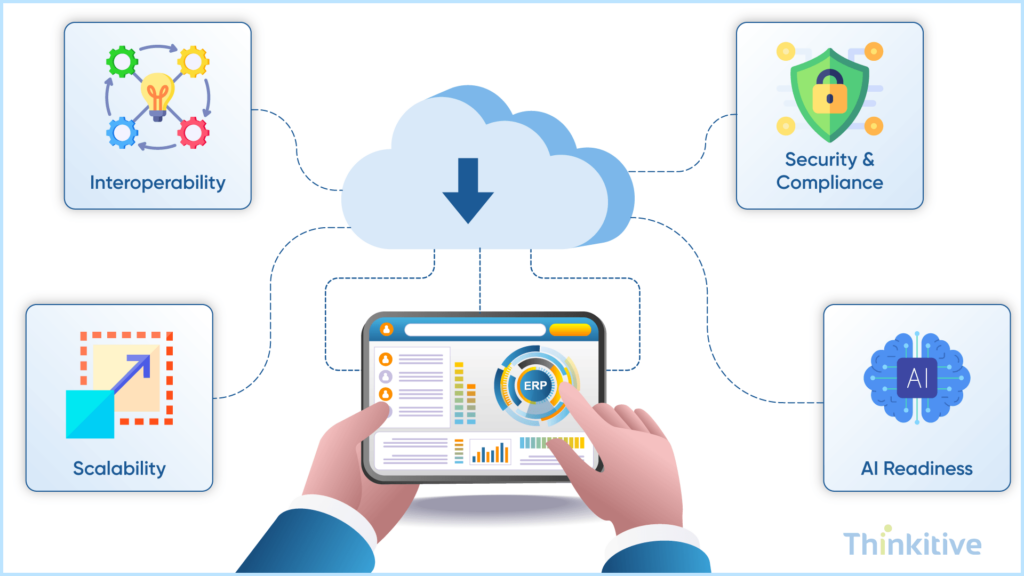
To be honest, you don’t need someone to tell you how to build a cloud-native EHR. In fact, you can adopt these best practices so that all the different aspects of development are covered.
- Design for Scalability from Day One: Build healthcare applications using cloud-native principles such as microservices, APIs, and containerized workloads. It allows you to scale independently as your system and patient volume grow.
- Prioritize Interoperability & Data Architecture: Plan your data models, APIs, and integrations around standardized standards like HL7, FHIR R4, and SMART on FHIR. This will help you in reducing integration challenges and support future compliance requirements.
- Embed Security & Compliance into the Architecture: Implement security controls, encryption, access management, audit logging, and disaster recovery mechanisms as early as possible in the development process. Retrofitting compliance later can be costly and even complex.
- Build for Future Healthcare Innovation: Choose the cloud services and architecture that can support AI, analytics, RPM services, and evolving healthcare workloads. Future-ready design decisions help in costly rearchitecting as technology requirements change.
Watch How Cloud-Based Would Work for You –
Book Free DemoConclusion: Making the Final Cloud Platform Decision
Going forward, for all the modern EHR systems, the foundation of scalability, interoperability, and future-readiness will be formed by the cloud-native EHR architecture. Even though AWS, Azure, and GCP all offer the capabilities needed to support HIPAA-compliant deployments, the choice usually depends on your priorities, technical ecosystem, and long-term innovation goals.
Having said that, your final decision should be based on which cloud platform offers the most, but which platform aligns with your needs and requirements the best. These requirements should be compliance, interoperability, scalability, and an AI roadmap.
By selecting the right cloud foundation and adopting cloud-native design principles, healthcare organizations can build HIPAA-compliant EHR systems that are secure, resilient, and prepared for the next generation of healthcare innovation.
On that note, let’s start with your requirements assessment from our EHR expert.
Frequently Asked Questions
A cloud-native EHR architecture is an Electronic Health Record system built specifically for cloud environments using technologies such as microservices, APIs, containers, and managed cloud services. Unlike traditional systems, cloud-native EHR architecture enables greater scalability, reliability, interoperability, and faster innovation.
Cloud-native EHR platforms offer improved scalability, high availability, reduced infrastructure costs, faster software updates, and seamless integration capabilities. They also provide a strong foundation for AI, analytics, interoperability, and future healthcare innovation.
Yes. Major cloud providers such as AWS, Azure, and GCP offer enterprise-grade security features including encryption, identity and access management, audit logging, threat detection, and disaster recovery capabilities. When properly configured, cloud environments can securely support healthcare applications and sensitive patient data.
HIPAA-compliant cloud hosting for EHR systems requires security controls such as data encryption, access management, audit trails, backup and disaster recovery, and a signed Business Associate Agreement (BAA) with the cloud provider. Compliance also depends on how the EHR application and healthcare data are managed within the cloud environment.
The answer depends on your organization’s priorities. AWS is often preferred for scalability and a mature healthcare ecosystem, Azure is ideal for organizations invested in Microsoft technologies, while GCP excels in AI, analytics, and data-driven healthcare applications. When evaluating AWS vs Azure vs GCP for EHR, healthcare organizations should consider compliance, interoperability, scalability, and long-term business goals.
There is no single best cloud platform for HIPAA-compliant EHR deployments. AWS, Azure, and GCP all provide HIPAA-eligible services and strong security frameworks. The best choice depends on your technical requirements, healthcare cloud infrastructure strategy, integration needs, and future innovation plans.
To understand how to build a cloud-native EHR system, organizations should focus on scalability, interoperability, security, compliance, and future readiness. Adopting cloud-native design principles, FHIR-based integrations, robust security controls, and AI-ready infrastructure helps create a resilient and future-proof EHR platform.
AWS provides healthcare-focused AI services such as HealthLake and Comprehend Medical, Azure integrates AI across its healthcare and enterprise ecosystem, and GCP is known for advanced analytics through BigQuery and Vertex AI. Organizations focused on healthcare analytics and machine learning often evaluate these capabilities as part of their EHR tech stack decisions.
When selecting healthcare cloud infrastructure, organizations should evaluate security and compliance, scalability, interoperability support, disaster recovery capabilities, AI services, operational complexity, and total cost of ownership. Choosing the right platform ensures long-term success for cloud-native healthcare applications and EHR systems.


