What Do You Need Before You Build Your Own EHR?

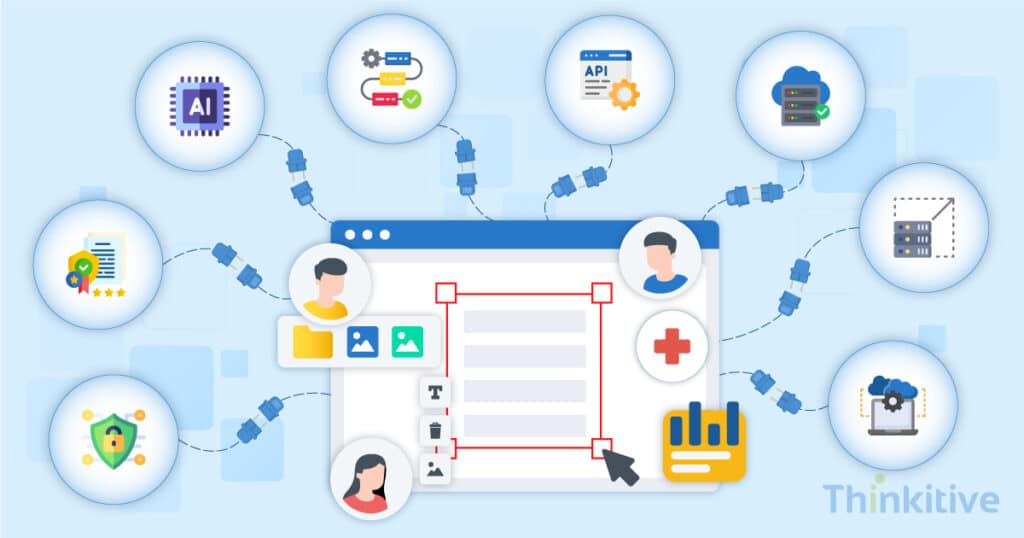
Given the growing needs of the healthcare industry and clinics, the number of practices looking to build an EHR system for their practice is increasing every day. However, in this shift, there is a common problem that many practices still face.
You see, most of these practices are already using off-the-shelf EHR systems, and when they enter the market in search of a custom EHR, vendors may successfully build a custom EHR, but without clearly documenting requirements before development begins, projects often experience scope changes, operational inefficiencies, and costly rework.
Long story short, most practices, in their quest to build their own EHR, end up building an extended version of the EHR system with a few additional features. This has a trickle-down effect that impacts every aspect of development. Leading to common operational, compliance, and scalability risks.
Moreover, given the latest trends and updates in the healthcare IT landscape, interoperability, security, and AI-readiness are something that these practices must consider during custom development. And this is exactly what they fail at.
That is why knowing EHR software requirements before actually starting the process becomes crucially important. It not only defines the scope of your EHR development but also covers other aspects of EHR software like security, interoperability, and AI-readiness.
Having said that, the practices are not to be blamed completely for poor planning. Most of the time, the intricacies of the EHR features and functionality can only be known to them if they have an EHR planning checklist. This checklist not only acts as a blueprint for development but also helps stakeholders make informed planning and implementation decisions.
On that note, in this blog, let’s answer the question, ‘What do you need before building an EHR system?’ and try to clearly define the pre-development requirements for electronic health records software for your practices.
So, without further ado, let’s dive deep into the EHR software development requirements, and this blog acts as a build your own EHR software guide.
Checklist to Everything to Build Your Own EHR –
Download Checklist
What Do You Need Before You Build an EHR?
The very first thing that you need when planning your EHR development is to know and define clinical and operational workflows. One of the best ways to do that is to identify the operational inefficiencies and bottlenecks in your current workflows.
Once identified, redefine the workflows, removing the existing bottlenecks and addressing the inefficiencies of your system. For this, you will need input from the people who are actually using this software. Discuss these workflows with your clinicians, administrative teams, and billing staff, so that no stone is left unturned and workflows cater to the activities that your users actually need.
Apart from just defining these workflows, you also need to define measurable clinical and operational success metrics so that you can measure the success of your custom EHR.
Coming to the business objectives of your practice, there are certain things that you need to address and plan. For instance, with time, your practice is bound to increase, and this will increase the load on your system as well. To address this beforehand, plan your development for scalability and long-term healthcare transformation.
As you know, the healthcare and healthcare technological landscape is ever-changing; keeping your system flexible and scalable can go a long way. It not only makes including new features into the software easier but also lowers the cost and rework by a huge margin.
And last but not least, you would need to make technological decisions at this stage as well. The best way to make these decisions is by aligning them with your patient care aspects and expected operational outcomes.
Understand Medical Software Compliance Standards
Your healthcare system will be dealing with data that is sensitive in nature and comes under the fundamental rights of the individual. This is why a lot of importance is given to securing your system and keeping your data safe at all times.
Some of the regulatory requirements for this are from HIPAA and HITECH. And that must be planned beforehand so that your EHR system stays compliant with these compliance requirements.
Apart from HIPAA and HITECH compliance requirements, you also need to get a certificate from ONC and adhere to the 21st Century Cures Act, so that you not only make your system secure but also navigate through the regulatory landscape effortlessly.
Also, one of the core requirements of the 21st Century Cures Act is to have FHIR API-based interoperability. In that sense, you need to plan for FHIR R4 API compliance during this stage only. Along with that, know all the other interoperability requirements so that you can make your system interoperable right from the start.
Some of the other security measures that you need to consider are role-based access controls, which only allow authorized personnel to access the information that is useful for them. Other than this, you may need to plan for data encryption to add another layer of security to your data when it is at rest and in transit. And last but not least, plan for audit trails to monitor every activity that is happening in your system.
Know about these compliance and regulatory requirements in detail in the table below:
| Compliance Requirement | What It Covers | Why It Matters |
| HIPAA Compliance | Patient data privacy, PHI protection, secure access, and data security standards | Helps protect sensitive healthcare information and maintain regulatory compliance |
| HITECH Compliance | Electronic health record security, breach notifications, and secure health information exchange | Strengthens digital healthcare data protection and accountability |
| ONC Certification | EHR usability, interoperability, patient access, and healthcare IT standards | Improves market readiness and ensures alignment with healthcare regulations |
| 21st Century Cures Act Compliance | Patient data accessibility, interoperability, and information blocking prevention | Supports transparent and connected healthcare data exchange |
| FHIR R4 API Compliance | Standardized healthcare API integrations and interoperable data exchange | Enables seamless communication between healthcare systems |
| Role-Based Access Controls | User-specific access permissions and authorization management | Restricts sensitive data access to authorized personnel only |
| Data Encryption | Protecting data at rest and in transit | Adds an additional layer of healthcare data security |
| Audit Trails | Monitoring user activities and system actions | Helps track system usage and detect suspicious activities |
Create a Technical Specifications Checklist for Custom EHR
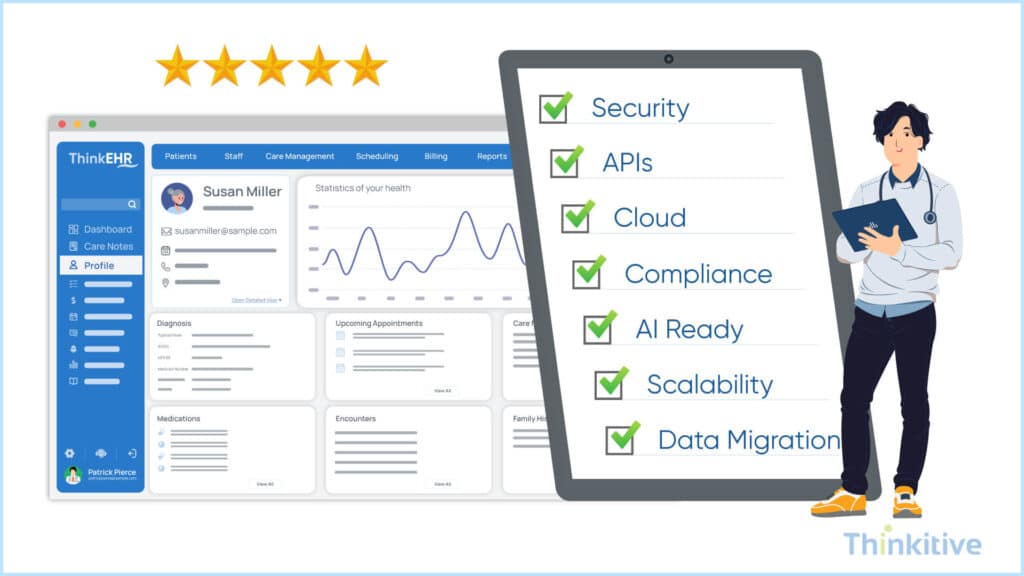
If you follow the two steps mentioned above, then you will understand your clinical and administrative workflows along with the regulatory compliance and standards requirements. However, just knowing about them is not enough; you also need to plan your development processes in accordance with them.
And the best way to do that is to create an EHR planning checklist. So, let’s see what the things that this technical specification checklist for custom EHR must include.
- Selecting the Right Tech Stack & Infrastructure Model: Your technical specification will revolve around the technology stack, and it is what makes the most of your checklist. This will include choosing the right infrastructure models, backend and frontend technologies, cloud infrastructure, etc. This checklist must be created after consultation with your vendor, and it should align with your clinical and operational needs.
- Planning Data Capacity, Uptime & Scalability Requirements: Since your EHR system will continuously handle growing volumes of patient records, clinical documentation, imaging data, billing information, and integration traffic. Creating a checklist for this is crucially important because without planning for scalability, system performance, and reliability can quickly become operational challenges.
- Understanding HL7 & FHIR Integration Standards: Interoperability is another critical section that must be included in this checklist. Modern EHR systems must support standards like HL7 and FHIR for seamless communication with other systems like labs, pharmacies, hospitals, billing systems, RPM devices, and third-party healthcare applications. Planning for this simplifies your future connectivity and compliance efforts.
- Defining API & Third-Party Integration Requirements: While you’re planning for interoperability, you also need to define your API and third-party integration requirements. It must include patient portals, telehealth platforms, payment gateways, insurance clearinghouses, pharmacy systems, analytics tools, and AI-powered healthcare solutions. Knowing these requirements and including them in your checklist will help in creating a more flexible and integration-ready EHR architecture.
Now, creating a detailed technical specification checklist for a custom EHR before you start development ensures that your system will be secure, scalable, interoperable, and prepared for long-term operational growth.
Get Assessment to Build Your Own EHR –
Get Free AssessmentPreparing Healthcare Data Architecture & Migration Readiness
Before you actually start coding to build your own EHR, you must prepare a strong data architecture and migration strategy. Since your EHR system will continuously manage records, documentation, billing processes, etc., without proper planning, you can face potential challenges that can vary from scalability issues to poor interoperability, migration, and even long-term performance.
And a well-structured healthcare data foundation helps ensure your EHR system remains scalable, interoperable, AI-ready, and operationally stable as your organization grows. On that note, let’s talk about data architecture planning briefly below:
Data Architecture Planning
The very thing that you structure a scalable healthcare data architecture that can support current workflows while also preparing for long-term expansion. For this, your EHR system must be capable of handling growing patient volumes, multi-location operations, third-party integrations, and the ever-evolving compliance requirements without affecting performance or accessibility.
Now, to achieve this, you must prioritize interoperability from the very beginning because your system will heavily rely on a connected ecosystem, where information seamlessly flows from your system to labs, pharmacies, hospitals, etc. This is supported by standards like HL7 and FHIR, which help you create a future-ready and integration-friendly EHR infrastructure.
At the same time, organizations should also prepare for their system to support AI-enabled healthcare workflows. Identify the features that you want to include, such as AI-assisted documentation, predictive analytics, CDS, automation, etc. Once identified, these features will require a clean structure and accessible healthcare data, and if you have a scalable architecture, adoption of AI becomes much easier and more effective.
Migration Readiness Planning
Apart from architecture planning, data is also something that matters the most in the success of your EHR development. This is why you must prepare for data migration readiness before development even begins. Since many providers still use legacy systems, migration of this data with proper planning is important to remove duplicate records, incomplete patient histories, compliance issues, and even operational disruptions.
The first thing you need to do in this is to evaluate legacy healthcare data quality, standardization, completeness, and compatibility. This will help in simplifying migration and improving long-term data accuracy.
Refer to the table below to know about the prospects of data architecture and migration better:
| Planning Area | What Needs to Be Prepared | Why It Matters |
| Scalable Healthcare Data Architecture | Structured patient data storage, modular databases, cloud infrastructure, and scalability planning | Supports long-term system performance and future operational growth |
| Interoperability Readiness | Support for HL7 and FHIR standards, APIs, and third-party integrations | Enables seamless healthcare data exchange across connected systems |
| AI-Ready Infrastructure | Structured clinical data, analytics support, and scalable processing capabilities | Prepares the EHR for AI-powered healthcare workflows |
| Legacy Data Evaluation | Reviewing duplicate records, incomplete data, and outdated formats | Improves migration accuracy and data reliability |
| Healthcare Data Migration Planning | Migration mapping, validation, testing, and backup strategies | Reduces migration errors and operational downtime |
| Risk & Continuity Planning | Rollback strategies, audit logging, and migration monitoring | Helps maintain continuity of care during transition |
And while you’re at it, here’s a quick healthcare data migration readiness checklist:
- Audit legacy patient records and existing healthcare systems
- Identify duplicate, outdated, or incomplete data
- Standardize healthcare data formats and structures
- Map legacy workflows to the new EHR environment
- Validate migration accuracy before deployment
- Create backup and rollback plans for migration safety
- Test interoperability and third-party integrations beforehand
Finalize Resource Planning & Governance Structure
For a tight plan, you also need a clear resource planning and governance strategy for its success. Moreover, this needs to be done even before you start the development practice. You see, building your own EHR system requires collaboration between healthcare professionals, operational leaders, compliance experts, and technology teams to ensure the platforms align with both clinical and business requirements.
The very first decision that you need to make is to hire an internal development team or partner with external development vendors. This decision must be taken after carefully evaluating their technical expertise, domain knowledge, compliance capabilities, and long-term support.
At the same time, you also need to plan the budget for EHR development carefully. Certain aspects of development must be clearly defined, such as development, testing, infrastructure, compliance implementation, integration, scalability, etc. These areas are the most important components of your system, and ignoring them can lead to delays and other unforeseen challenges during implementation.
Last but not least, you need to establish a strong governance structure with clearly defined ownership, responsibilities, workflows, and timelines. This helps in improving accountability, decision-making, project visibility, and overall execution efficiency throughout the development cycle.
Here is a quick EHR planning checklist for execution readiness:
| Planning Area | What Needs to Be Defined |
| Team Structure | Clinical, operational, compliance, and technical stakeholders |
| Development Approach | Internal team, external partner, or hybrid model |
| Budget Planning | Development, testing, compliance, infrastructure, and maintenance costs |
| Governance Structure | Roles, ownership, approvals, and decision-making responsibilities |
| Project Timeline | Development phases, milestones, and delivery expectations |
| Risk Management | Compliance risks, operational challenges, and contingency planning |
Plan for AI Readiness & Future Scalability
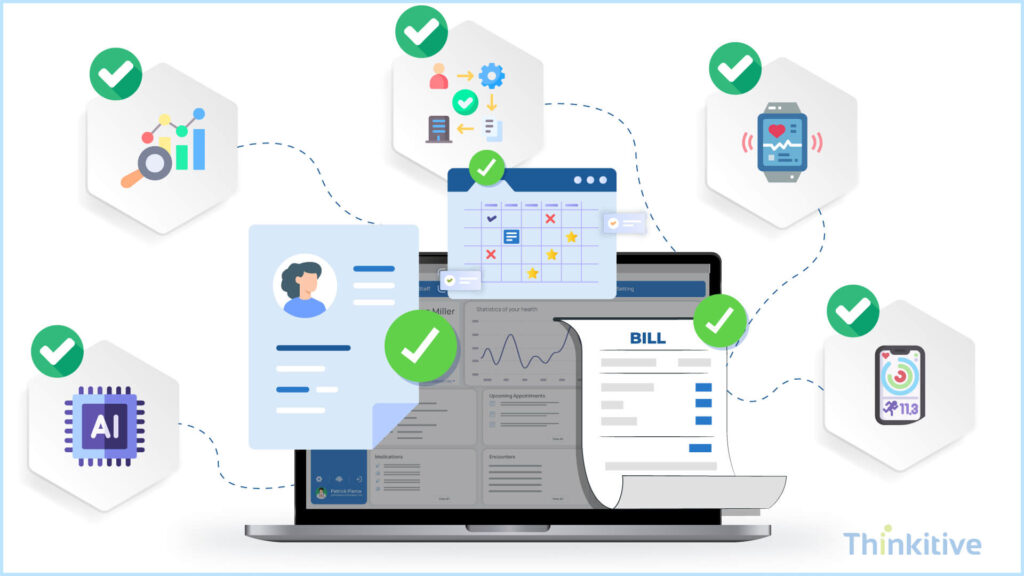
Given the rise of AI in healthcare delivery and operations, it makes sense to plan your system for AI-readiness now. Moreover, it is the right time, as after this, it will soon be a part of this infrastructure.
So, prepare for AI-assisted healthcare workflows by choosing the right tech stack and planning for AI-embedding from the start. Apart from that, harness the core capabilities of AI in your EHR system with predictive analytics and automation.
The most important part in this is that of data. For that, you need to structure your healthcare data for future AI integration and align it with your future needs as well. And still, AI is here to stay. Plan for a scalable infrastructure for long-term healthcare innovation.
Conclusion
Pre-development requirements for electronic health records can define the future scope of your EHR system, and they ensure that the EHR is built exactly the way you want it. Moreover, structured planning not only reduces operational and compliance risks but also ensures scalability without moving away from your business and clinical goals.
When planning or gathering requirements before building EHR, align your infrastructure, interoperability, security, and governance right from the start. Planning these requirements before development helps ensure your EHR is secure, interoperable, scalable, and aligned with your clinical and business objectives from day one.
So, do you have your EHR software development requirements? If not, click here to consult our EHR development expert and start your project with EHR project planning.
Frequently Asked Questions
Some of the most important EHR software development requirements include workflow planning, compliance preparation, interoperability requirements, technical infrastructure planning, healthcare data architecture, migration readiness, scalability planning, and governance structure definition. Understanding these pre-development requirements for electronic health records helps organizations reduce implementation risks and improve long-term system performance.
Before starting development, healthcare organizations should define clinical workflows, operational goals, integration requirements, compliance obligations, security measures, technical architecture, and resource planning strategies. Understanding what you need before building an EHR system helps organizations create a more scalable, compliant, and operationally efficient platform.
A technical specifications checklist for custom EHR helps healthcare organizations define infrastructure requirements, scalability expectations, interoperability standards, API integrations, security architecture, and deployment strategies before development begins. This reduces technical bottlenecks, improves planning accuracy, and supports long-term EHR scalability.
Some of the most important medical software compliance standards for EHR systems include HIPAA, HITECH, ONC certification requirements, the 21st Century Cures Act, and interoperability standards like FHIR and HL7. These regulations help ensure healthcare data privacy, interoperability, patient accessibility, and system security.
Healthcare organizations should build a scalable healthcare data architecture that supports interoperability, future integrations, AI-enabled workflows, analytics, and long-term data management. Planning healthcare data architecture early helps improve system performance, data accessibility, and operational scalability across healthcare environments.
Poor EHR planning can lead to compliance failures, workflow inefficiencies, interoperability limitations, migration issues, budget overruns, user adoption challenges, and long-term scalability problems. Following a structured EHR planning checklist helps healthcare organizations minimize operational and technical risks before development begins.
Healthcare organizations should prepare for FHIR R4 API compliance, standardized healthcare data exchange, API connectivity, and interoperability workflows before development starts. Along with FHIR, organizations should also support HL7 standards to simplify integrations with labs, pharmacies, billing systems, hospitals, and third-party healthcare platforms.
The budget for EHR pre-development planning depends on project complexity, compliance requirements, interoperability needs, architecture planning, workflow analysis, and integration scope. Organizations building enterprise-grade systems typically allocate budgets for technical consulting, compliance assessments, infrastructure planning, UI/UX research, and healthcare workflow discovery during the planning phase.
Healthcare organizations can choose internal teams, external healthcare technology partners, or hybrid models depending on their technical expertise, healthcare domain knowledge, compliance capabilities, and project scale. Many organizations following a build your own EHR software guide prefer experienced healthcare development partners to reduce compliance risks, accelerate planning, and improve execution readiness.


