 +1 (405) 638-3126
  hello@thinkitive.com


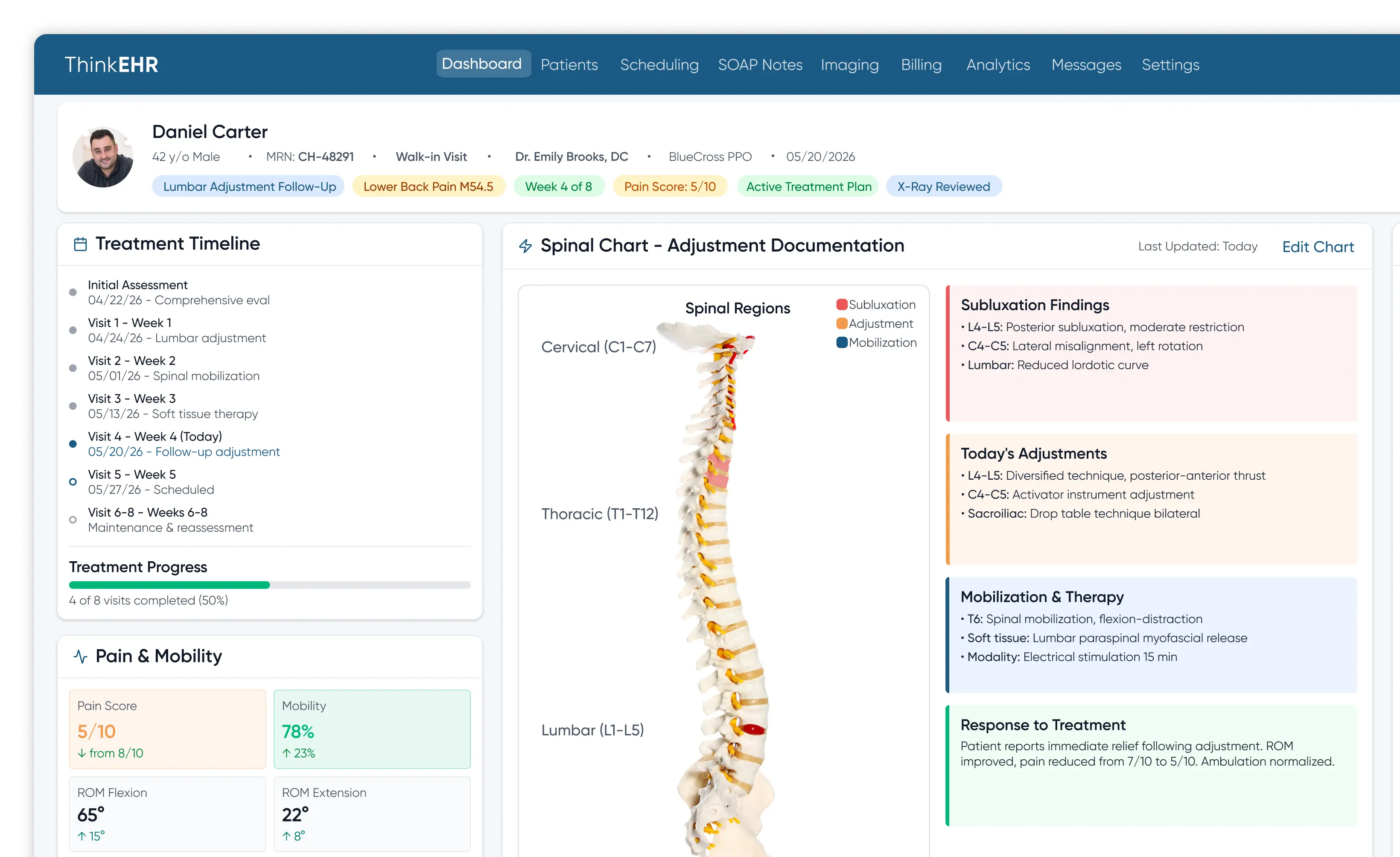

"Our documentation process used to take longer than the actual patient visit. With this chiropractic EHR, SOAP notes and spinal charting are streamlined, and we can complete documentation quickly without disrupting patient care."
Support chiropractic care and clinic operations with custom features designed for spinal charting, SOAP documentation, treatment planning, patient scheduling, and integrated billing.

AI Assist

Scheduling

Charting

Imaging

Patient

eRx

Billing

Admin
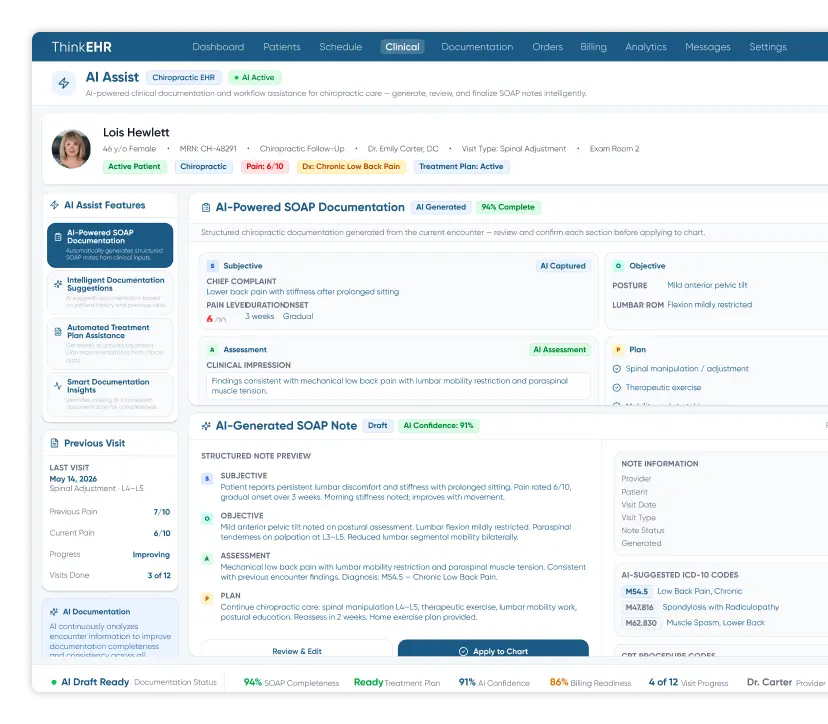
AI-Powered Clinical Documentation Support.
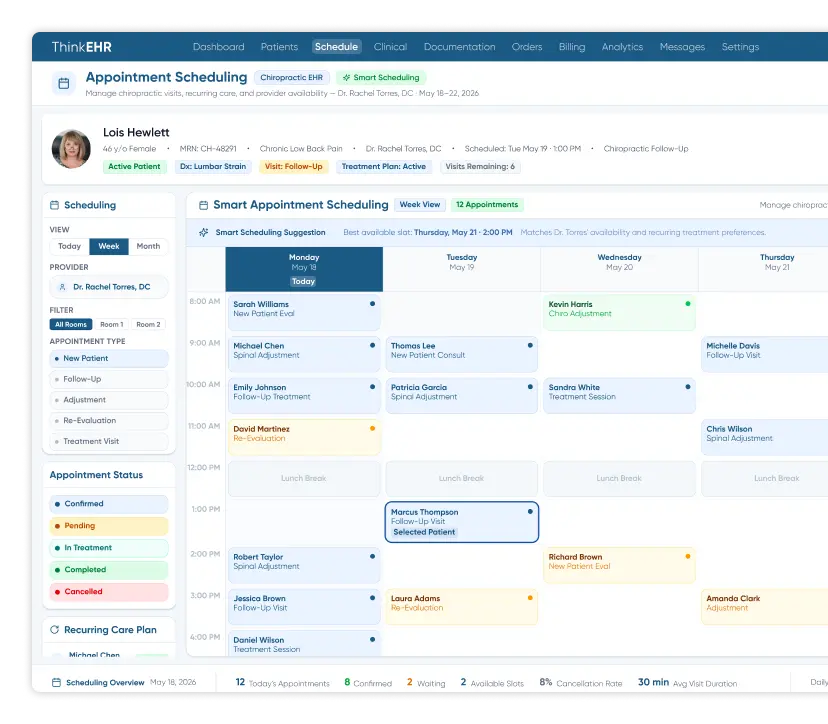
Smart Chiropractic Appointment Scheduling.
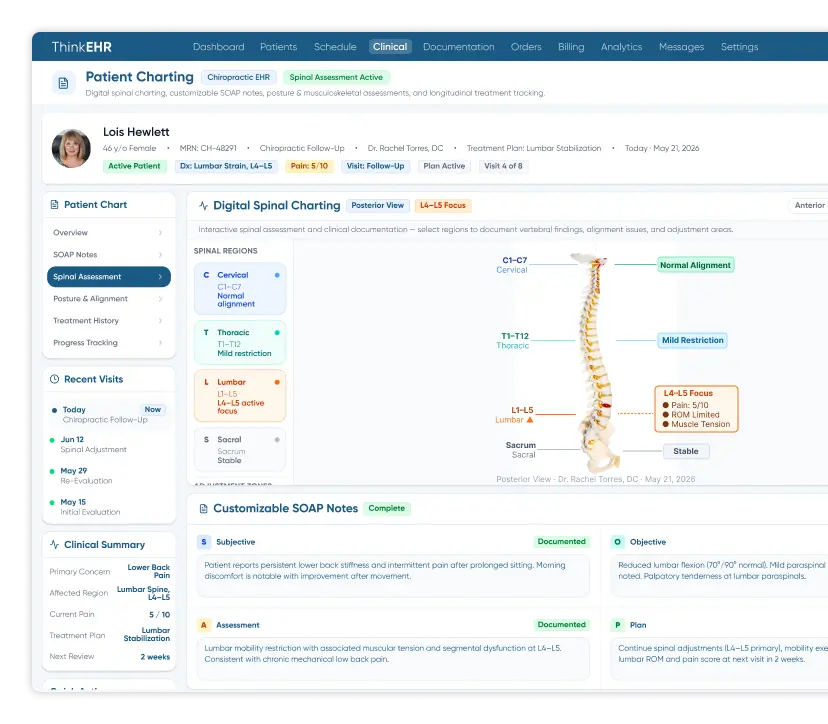
Digital Spinal Charting & SOAP.
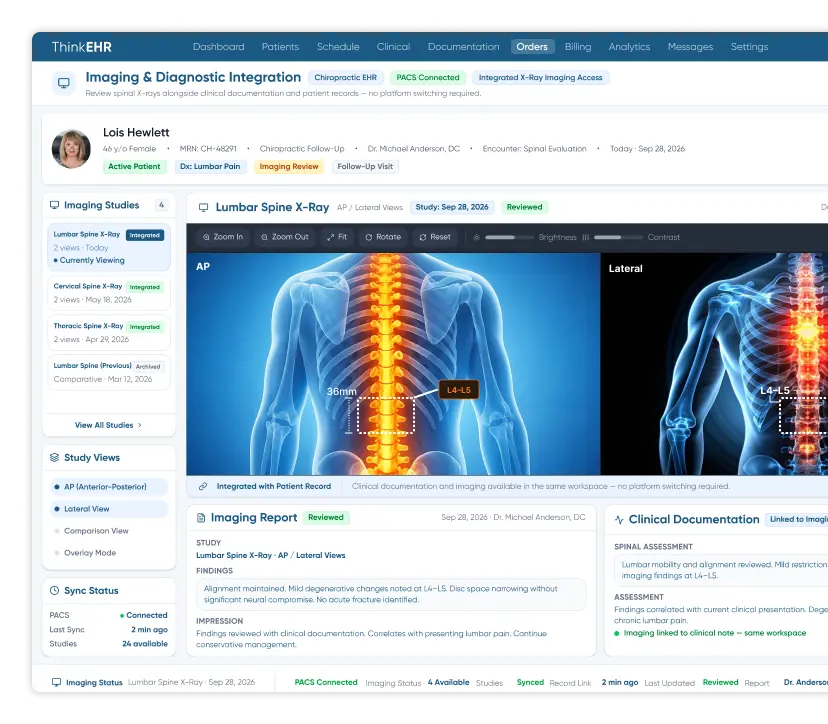
Integrated X-Ray Imaging Access.
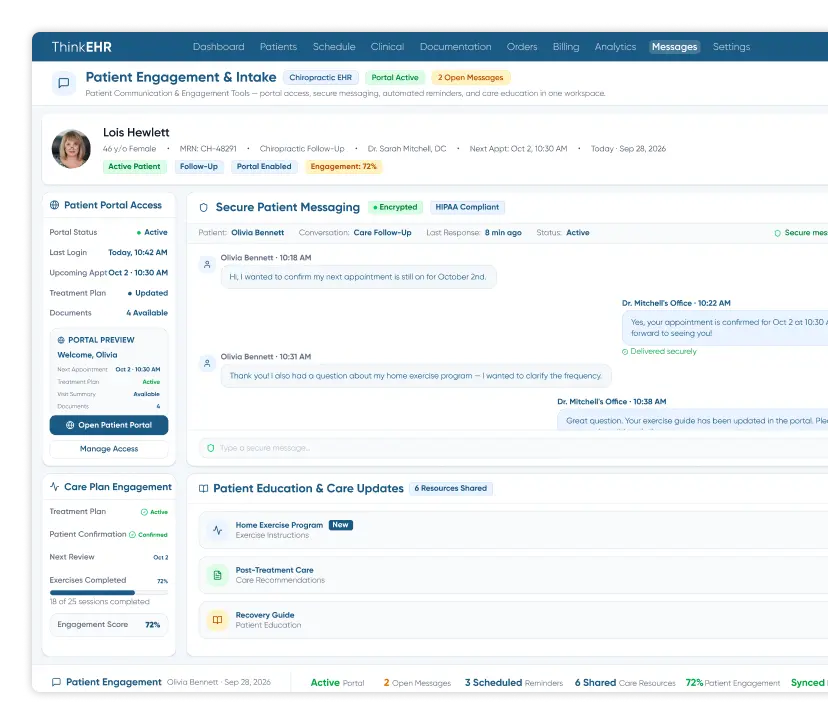
Patient Communication & Engagement Tools.
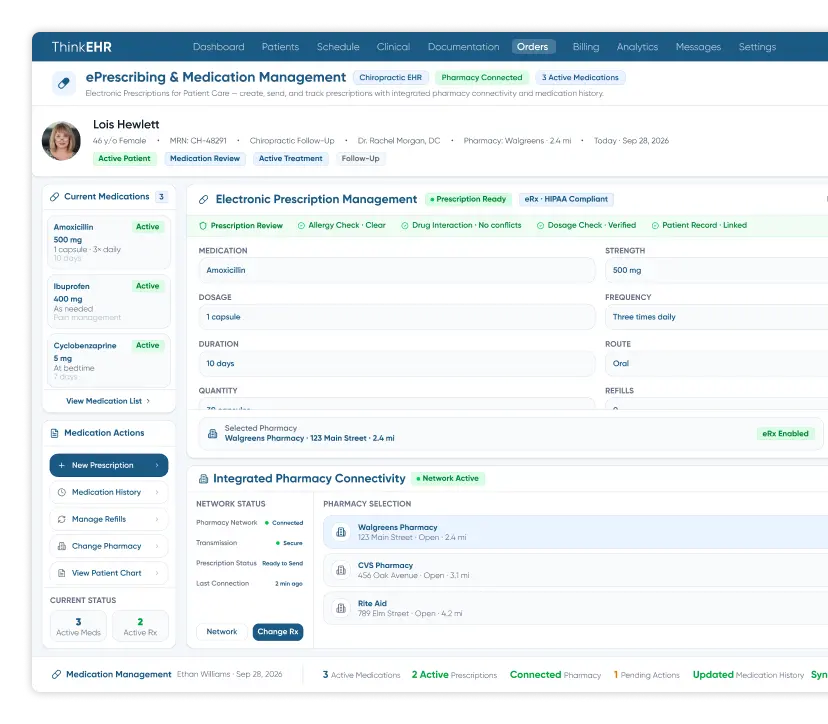
Electronic Prescriptions for Patient Care.
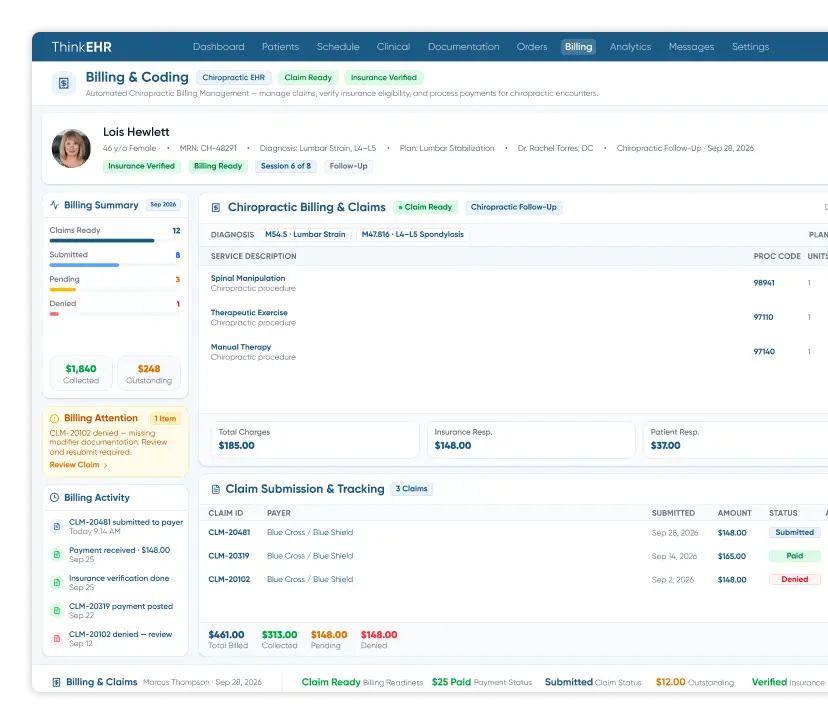
Automated Chiropractic Billing Management.
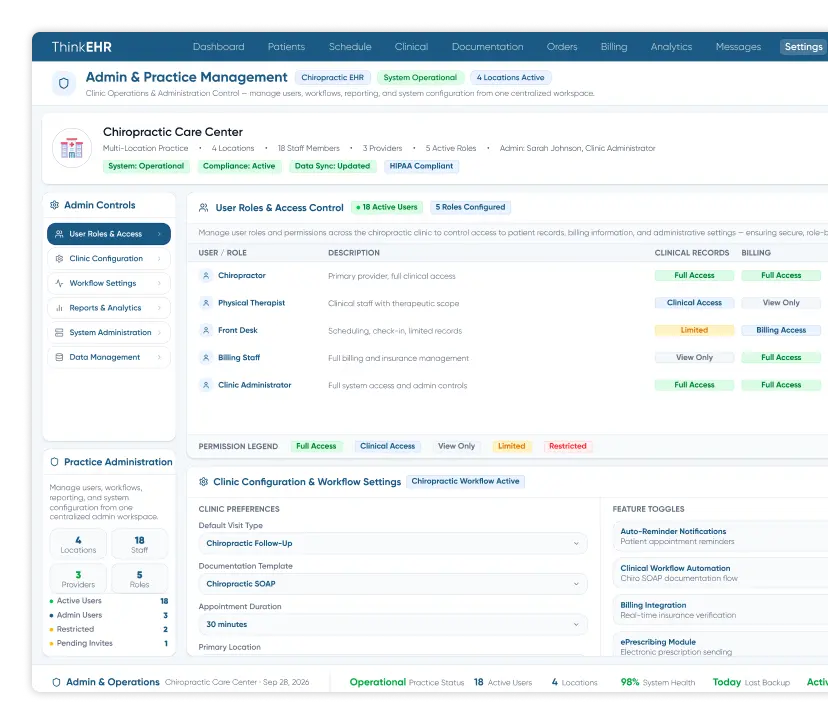
Clinic Operations & Administration Control.

CLIENT TESTIMONIALS
See why 125+ chiropractic practices trust our custom chiropractic EHR software to support efficient, patient-focused care.
"Our documentation process used to take longer than the actual patient visit. With this chiropractic EHR, SOAP notes and spinal charting are streamlined, and we can complete documentation quickly without disrupting patient care."
Previous EHR: Generic EHR System


"Managing recurring chiropractic visits and treatment plans was extremely difficult with our previous system. This EHR makes scheduling follow-ups and managing patient treatment programs effortless."
Previous EHR: Legacy Practice Management System
"Billing and insurance claims were always time-consuming and error-prone. Since switching to this chiropractic EHR, our billing workflow is smoother and claims are processed much faster."
Previous EHR: Standalone Billing Software

Streamline SOAP notes, appointments, and billing to improve efficiency across your chiropractic practice.


Leverage our proven, tried and tested healthcare-ready modules to accelerate delivery while maintaining performance, security, and compliance.
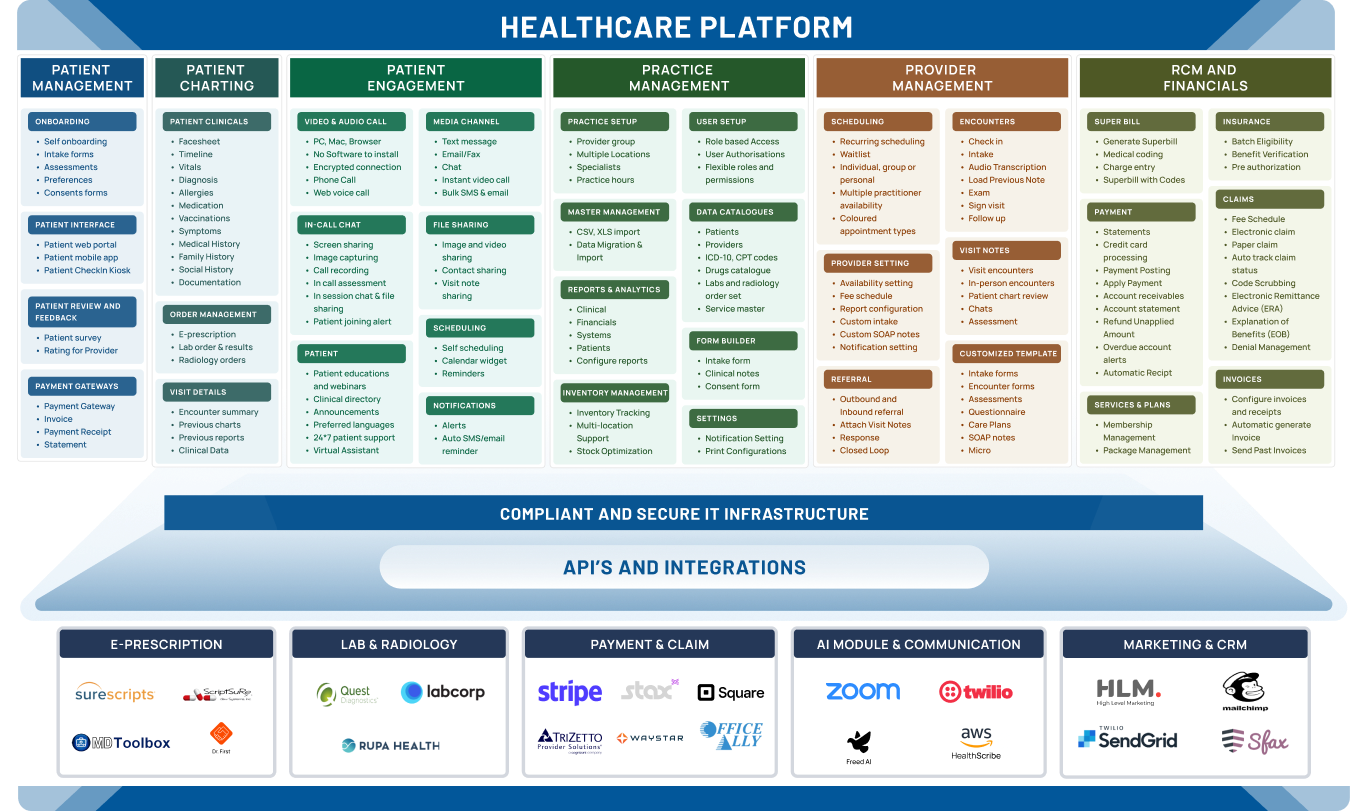
Ensure smooth data flow by seamlessly integrating your chiropractic EHR with billing, imaging, and other essential healthcare systems.
ePrescription & Labs Integration
Seamlessly integrates with leading ePrescribing networks ... and laboratory providers to ensure secure medication workflows, faster diagnostic turnaround, and coordinated patient care within a unified chiropractic patient management system with your EHR software for chiropractors.

Surescripts
Integrate Surescripts with your cloud-based Chiropractic EHR ... to enable secure electronic prescribing, medication history access, and pharmacy connectivity, helping chiropractors streamline prescriptions while maintaining accurate patient records within their chiropractic clinic management software.
Billing & Payment
Integrate enterprise-grade chiropractic EHR software with ... leading clearinghouses and payment platforms to streamline claims processing, reduce denials, and accelerate reimbursements — fully embedded within your chiropractic practice management software.

Waystar
Integrate Waystar with your Chiropractic EHR and billing software to streamline claims processing, eligibility verification, and payment tracking, helping chiropractic clinics improve reimbursement workflows and manage billing efficiently within their chiropractic practice management software.
Communication
Integrate your cloud-based chiropractic EHR with ... secure fax, telehealth, messaging, and patient engagement platforms to streamline referrals, improve patient communication, and strengthen care coordination within your chiropractic patient management system.

Sfax
Sfax integration enables secure HIPAA-compliant fax communication directly within your cloud-based Chiropractic EHR, allowing clinics to send referrals, share patient records, and exchange documents while maintaining secure communication workflows.

Calculate Your Chiropractic EHR System Cost & ROI in 2 Minutes
Discover chiropractic EHR system cost and its return on investment. Our calculator is based on real data from 500+ implementations.
Every phase is guided by clinical insight, technical rigor, and deep expertise in chiropractic EHR development.


We Become You
Understand chiropractic workflows, requirements, integrations, and project scope.

Key Deliverables

Resource Allocation
Practice-Specific Designing
Design intuitive chiropractic EHR workflows, UI, architecture, and data models.
Key Deliverables
Resource Allocation
Bringing Your EHR to Life
Develop chiropractic EHR modules, integrations, and core system functionality.
Key Deliverables
Resource Allocation
Validating What Matters Most
Validate system functionality, security, performance, and clinical workflows.
Key Deliverables
Resource Allocation
Launch With Confidence
Deploying your chiropractic EHR with seamless transition and support.
Key Deliverables
Resource Allocation

See How Your Custom Chiropractic
EHR Software Feels & Works
Explore case studies highlighting how our chiropractic EHR solutions improve workflows, documentation, and patient care.

The client is a highly esteemed chiropractic specialist and a well-known...
 Track lab orders and results. 7E-prescribe to pharmacies. Reduce errors, boost accuracy. Enhance treatment timelines.
The client is a prominent chiropractic specialist and a leading healthcare...
e-Prescribe with pharmacy links. Allergy and drug interaction alerts. Dosage templates, minimized friction. Digital signatures for authentication. 
The client is a distinguished chiropractic specialist and a prominent healthcare...
Three locations transitioned to EMR. Implemented telehealth and portals. Streamlined scheduling and billing. Super-admin portal for multi-site management. Build a secure and compliant orthopedic EHR system that meets industry standards while protecting patient data and ensuring reliable workflows.
HIPAA Compliance
Protect patient health information by adhering to strict privacy and security safeguards.

Fines & Penalties

Why It’s Required

Process
Our HIPAA Compliance Partners


ONC Certification
Ensures that your healthcare software meets federal standards for safety, usability, and interoperability.
Certification Criteria
Why It’s Required
Process
Our Partners


FHIR/HL7
The modern backbone of real-time, interoperable healthcare data exchange.
Interoperability Standards
Why It’s Required
Implementation Process
Our FHIR-HL7 Compliance Partners


21st Century Cures Act
Empowers patients with data access and drives interoperability across systems.
Information Blocking Rules
Why It Matters
Implementation Steps
Our 21st Century Cures Act Compliance Partners
Medical Coding Standards
Standardizes clinical language to ensure accurate billing, reporting, and care.
Clinical Coding Systems
Advantages
Process
Our Medical Coding Standards Adherence Partners


SOC 2 Type II
Validates your system’s operational security, availability, and data integrity controls.
Trust Service Criteria
Why Does It Matters?
Process We Follow
Our SOC 2 Type II Compliance Partners


ISO 27001
Demonstrates a globally recognized commitment to managing healthcare data risks.
Information Security Management System (ISMS)
Why Is It Required?
Certification Process
Our ISO 27001 Certification Partners


FDA 510(k) Clearance
Proves your software is safe and effective for clinical use under FDA regulations.
Medical Device Clearance
Why Is It Required?
Clearance Process
Our FDA 510 (k) Compliance Partners


Move beyond limited scalability, rigid workflows, and reduced clinical efficiency. With chiropractic EHR development, gain full control through purpose-built features, seamless integrations, and workflows designed around how your organization delivers care.

Tailored to Your Needs
Thinkitive’s first step to developing ... chiropractic EHR software is to understand your unique needs and requirements. Based on that, our development team develops a customized software solution to meet your requirements and solve your problems.

Ready-to-Use Components
With our ready-to-use technology components ... like video conferencing, appointment, scheduling, and SOAP notes, fasten your custom EMR for the chiropractic software development process.

Third-Party Integration
Integrate your custom chiropractic EHR software ... with multiple third-party systems like Telemedicine, RPM Devices, Labs, Radiology, etc., to build a complete virtual healthcare ecosystem.

Affordable EHR Solutions
With our ready-to-use base EHR software framework, ... we give you an affordable custom EHR software solution specifically designed for your healthcare practice.

In-Depth Domain Expertise
With our ready-to-use base EHR ... software framework, we give you an affordable custom EMR software solution specifically designed for your healthcare practice.

Timely Delivery
We have curated a development process ... that covers all the aspects of your healthcare practice’s unique needs and requirements with transparency for on-time delivery.
Healthcare industries are evolving with newly introduced technology...

In chiropractic practice, it is not the same for all providers. It should be customizable...

We know that not all chiropractic EHRs are the same; each chiropractic...
Still have Questions ?