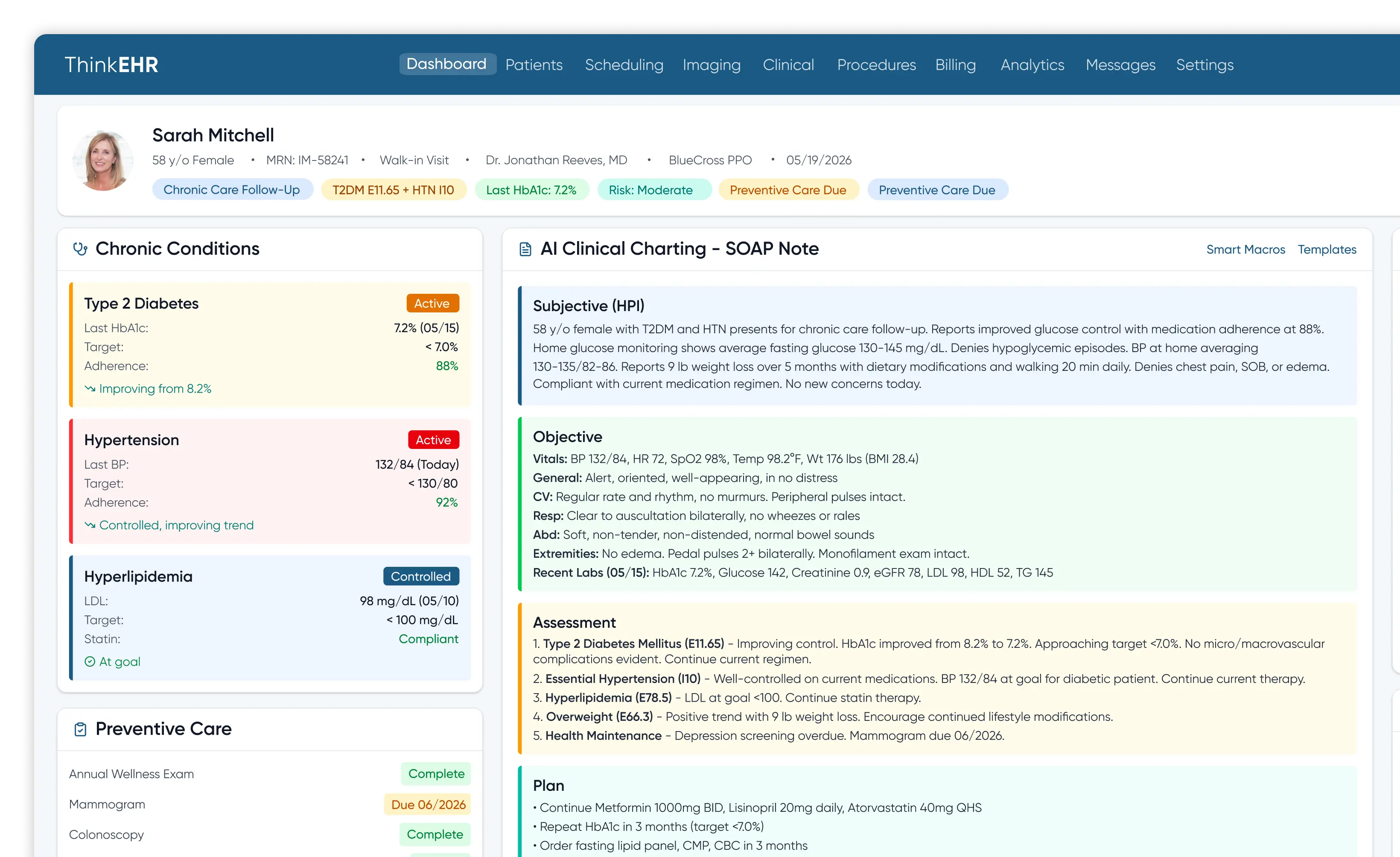
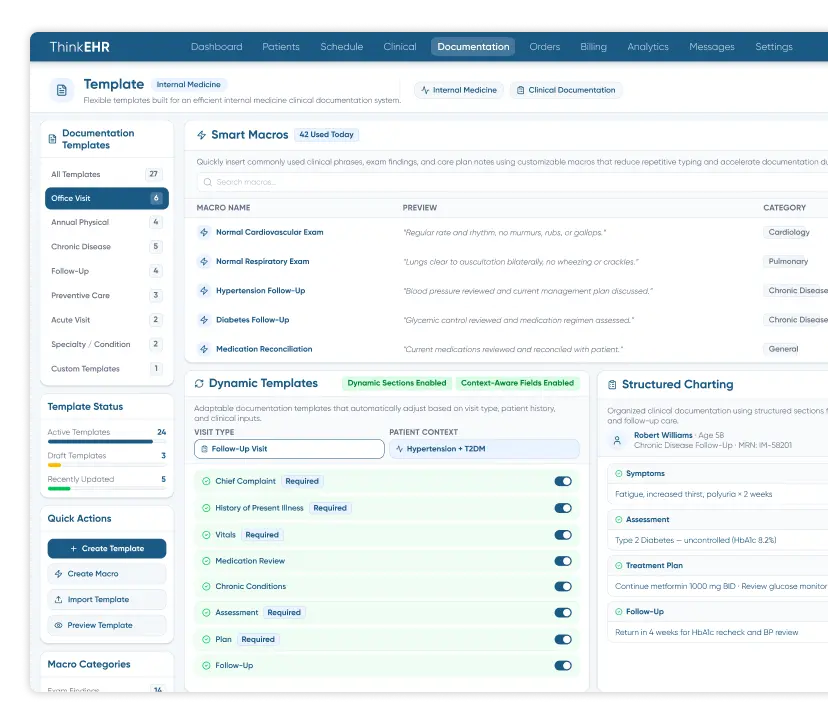
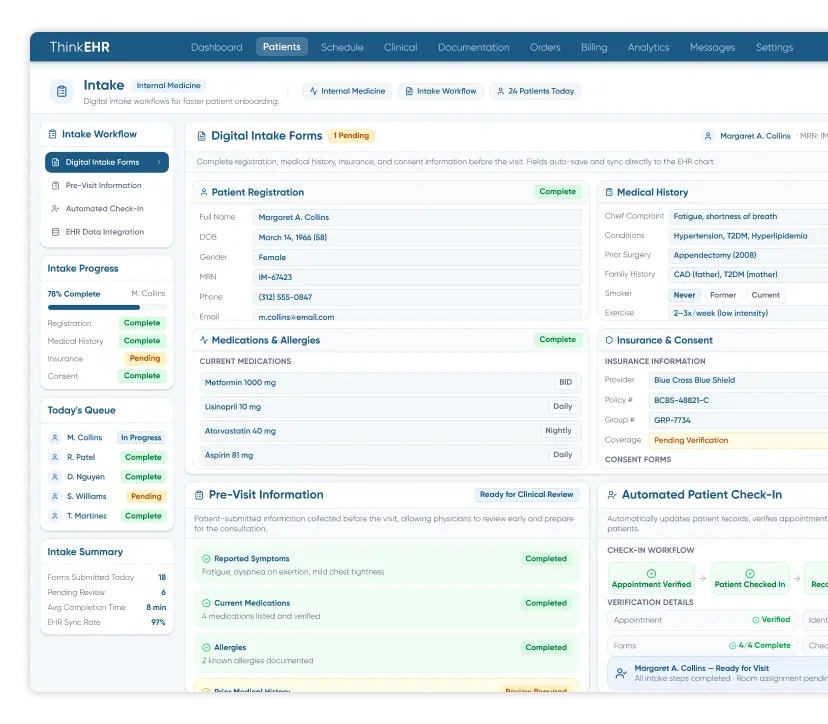
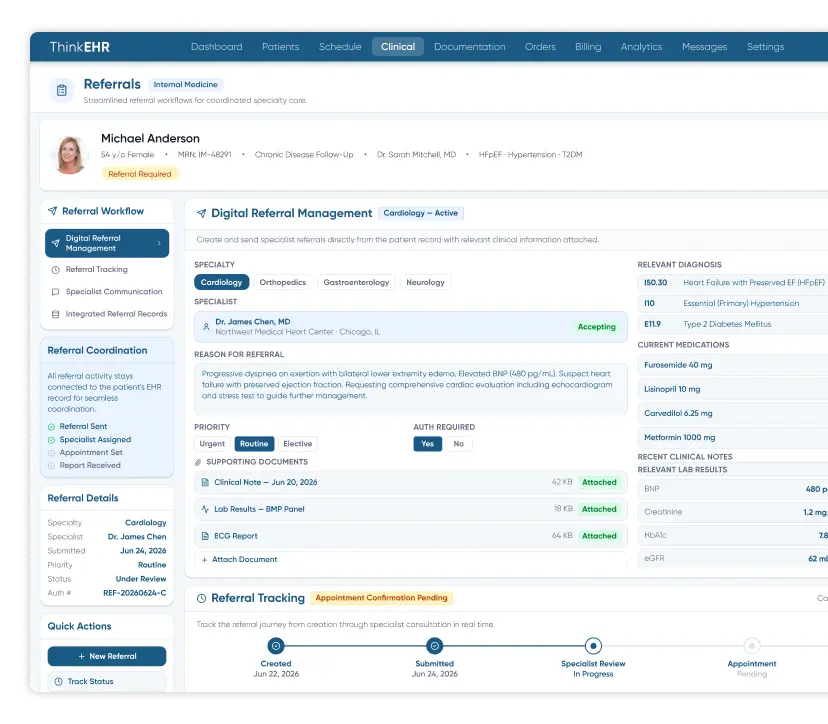
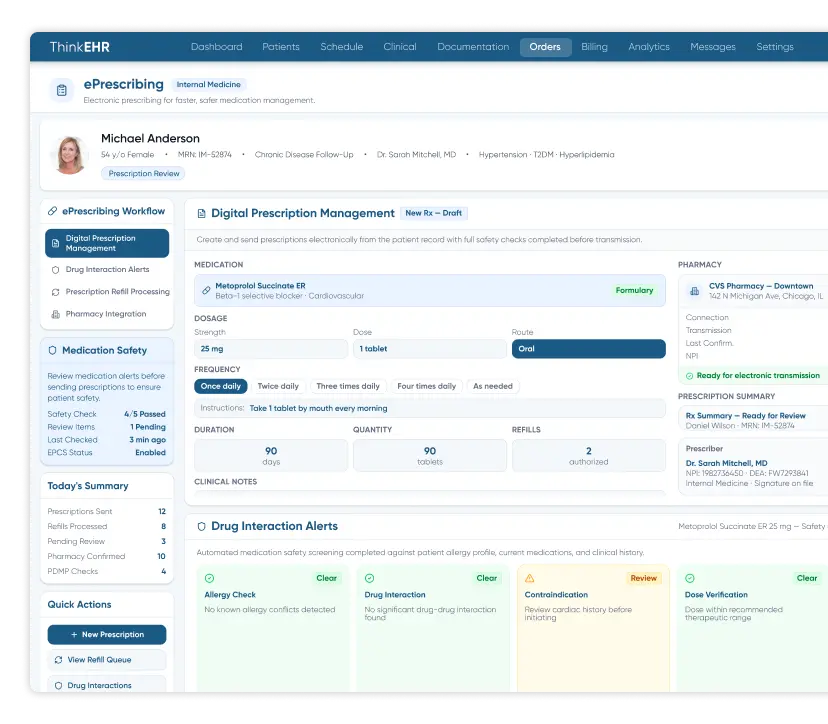
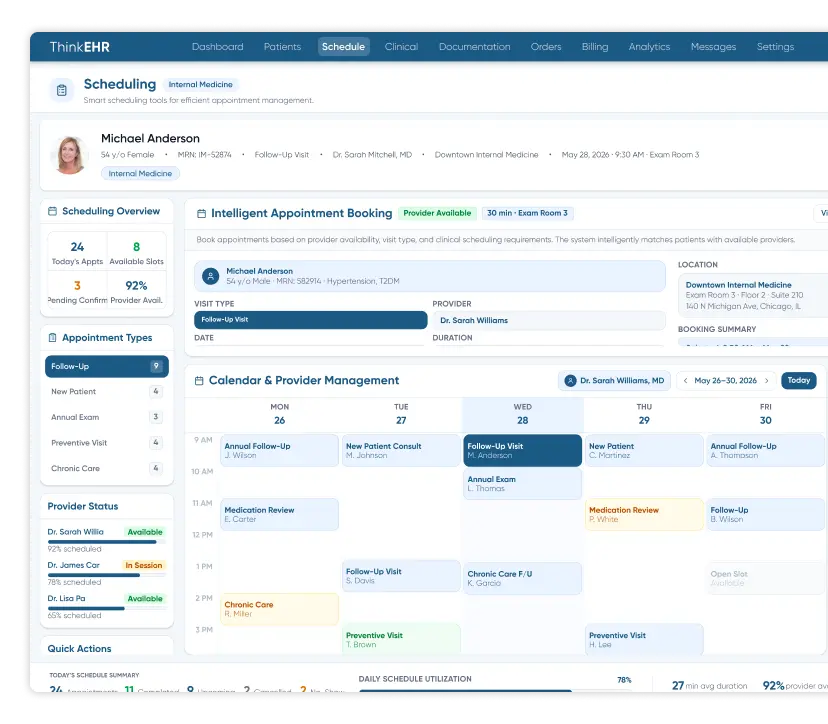
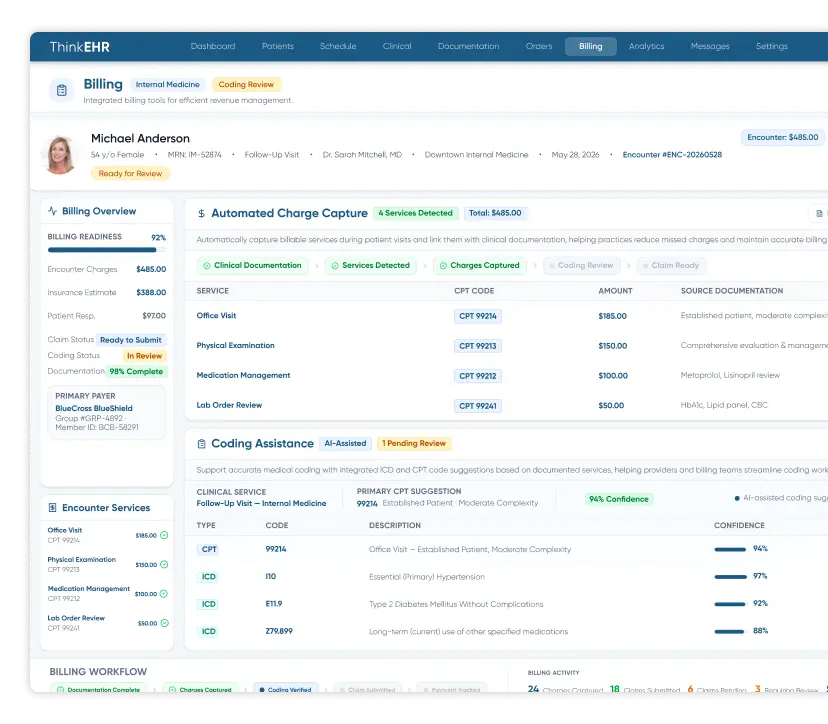
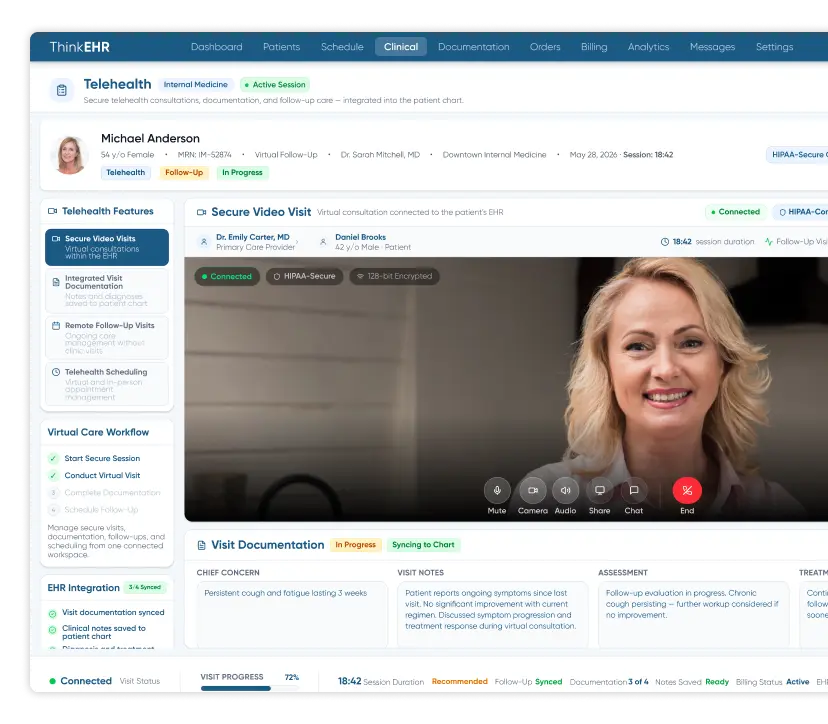
"Before implementing the custom EHR, our physicians spent too much time documenting visits and managing fragmented patient records. Thinkitive built an internal medicine-focused system that streamlined charting, lab tracking, and prescription management. Our clinic now handles more patient visits without increasing administrative workload."
Specialized EHR for Internal Medicine Physicians for Faster Clinical Documentation & Interoperability
Designed for internal medicine practices, our EHR automates workflows, simplifies clinical documentation, and supports efficient management of chronic and preventive care.
CLIENT TESTIMONIALS
What Internal Medicine Practices Achieve with Our Custom EHR
Discover how internal medicine practices streamline workflows, improve patient care, and achieve success with our custom EHR software solutions.
Start Building Your Custom Internal Medicine EHR
Build a custom EHR tailored to your workflows for faster documentation and better patient care.
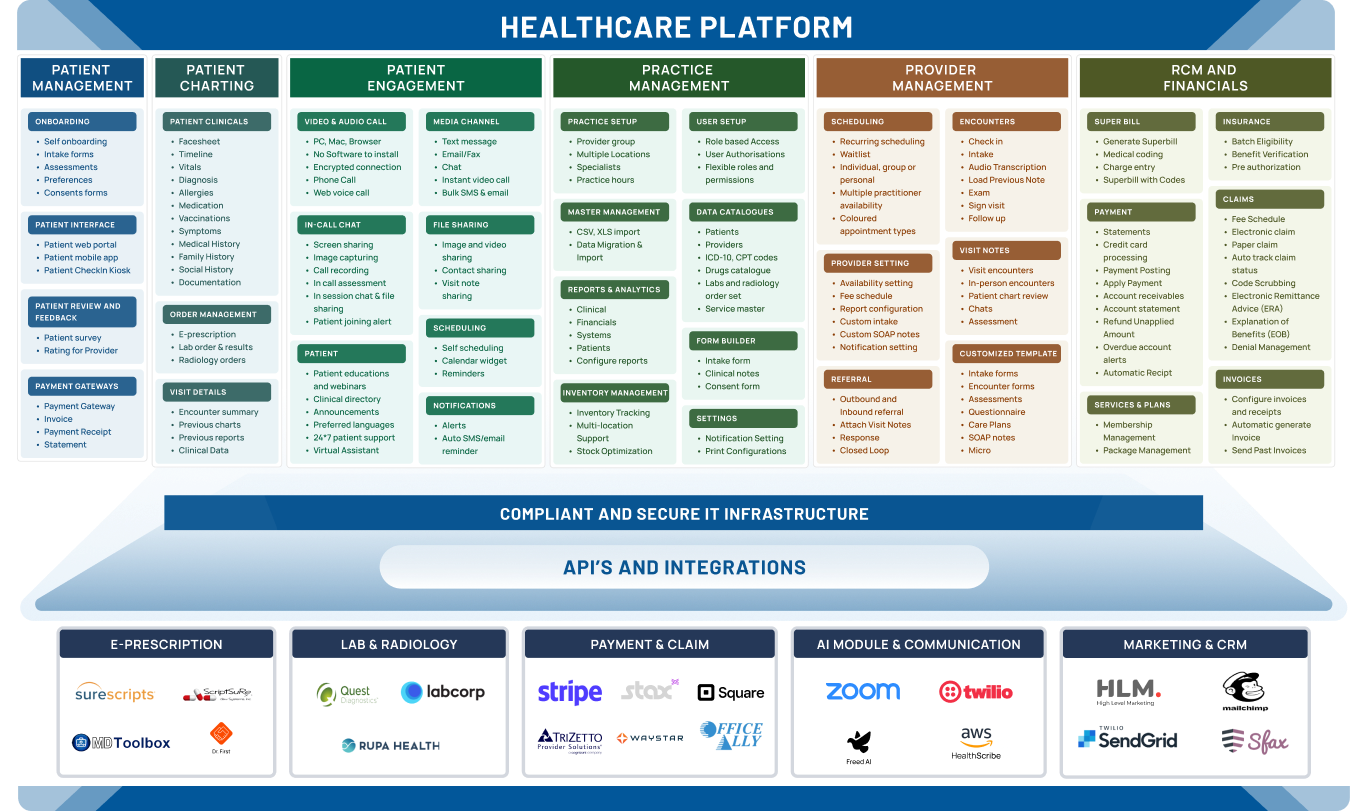
Speed Up Custom Internal Medicine EHR Software Development with Pre-Built Healthcare Components
Use pre-built healthcare components to develop internal medicine EHR software faster without compromising customization.
Integrate Your Internal Medicine EHR with Labs, Pharmacies, and Healthcare Systems
Ensure smooth connectivity across labs, pharmacies, and healthcare systems with our internal medicine EHR software for seamless data flow and coordinated care.
ePrescription & Labs Integration
Integrate leading ePrescription and lab platforms into ... your internal medicine EHR system to streamline orders, results, and refills—supporting internal medicine EHR workflow automation, accurate documentation, and connected care across clinics and care centers.
Surescripts
Enable secure ePrescribing within your EHR software for ... Internal medicine clinics, improving medication accuracy, refill workflows, and care continuity while supporting internal medicine clinical documentation system workflows across clinics.
Billing & Payment
Connect leading billing and payment platforms with ... your internal medicine practice management software to streamline claims, payments, and revenue workflows—supporting internal medicine clinic management software, faster reimbursements, and seamless financial operations across clinics.
Waystar
Integrate Waystar with your internal medicine EHR system to streamline eligibility checks, claims submission, and payment posting—supporting faster reimbursements and efficient revenue workflows for clinics.
Communication
Enable secure, multi-channel communication within your ... internal medicine EHR system to support referrals, virtual visits, patient education, and coordinated care—strengthening internal medicine EHR interoperability across clinical, operational, and patient-facing workflows.
Sfax
Integrate Sfax with your internal medicine EHR software to securely exchange referrals, reports, and clinical documents, reducing manual processes while supporting compliant communication across internal medicine clinics.
Calculate Your Internal Medicine EHR System Cost & ROI in 2 Minutes
Discover internal medicine EHR system cost and its return on investment. Our calculator is based on real data from 500+ implementations.
From Planning to Implementation: Our Proven Approach to Developing Your Internal Medicine EHR System
Each stage is driven by clinical expertise, robust engineering practices, and a deep understanding of internal medicine workflows and care delivery.
Understanding Your Practice
Gain a clear understanding of your clinical workflows, patient management processes, and internal medicine practice operations.
- Stakeholder Interviews & Workshops
- Current System Analysis & Audit
- Clinical Workflow Mapping & Documentation
- Success Criteria Definition
Key Deliverables
- Feature Requirements Document
- Stakeholder Analysis Report
- Current State Assessment
- Gap Analysis Report
Resource Allocation
- 2 Business Analysts
- 1 Internal Medicine Domain Consultant
- 1 UX Strategist
- 1 QA Engineer
Workflow-Centered System Design
Transform discovery insights into intuitive experiences and scalable architecture tailored for internal medicine EHR software workflows.
- User Experience (UX) Design
- Internal Medicine Workflow Prototyping
- System Architecture Design
- Design Validation & Feedback
Key Deliverables
- UX Wireframes & Interactive Prototypes
- Workflow Design Specifications
- System Architecture Blueprint
- Design Validation Summary
Resource Allocation
- 2 UX Designers
- 1 Solution Architect
- 1 Ophthalmology Domain Consultant
- 1 QA Engineer
Developing Your Internal Medicine EHR
Develop and configure internal medicine EHR software to support clinical workflows, integrations, and secure patient management.
- Custom EHR Development
- Workflow Configuration & Automation
- Integration Implementation
- Continuous Testing & Quality Assurance
Key Deliverables
- Configured Ophthalmology EHR Modules
- Integrated Third-Party Systems
- Automated Workflow Configurations
- Test & Quality Assurance Reports
Resource Allocation
- 5 Full-Stack Developers
- 2 Integration Engineers
- 1 QA Engineer
- 1 Project Manager
Ensuring System Reliability
Validate internal medicine EHR software performance, usability, and security to ensure readiness for real-world clinical environments.
- Comprehensive System Testing
- User Acceptance Testing (UAT)
- Deployment & Go-Live Support
- Role-Based Training & Enablement
Key Deliverables
- Tested & Deployment-Ready EHR System
- User Acceptance Testing Sign-Off Go-Live & Deployment Plan
- Training Materials & Documentation
Resource Allocation
- 2 QA Engineers
- 1 DevOps Engineer
- 1 Implementation Specialist
- 1 Training Lead
Supporting Long-Term Success
Stabilize and optimize internal medicine EHR software performance while supporting clinical workflows and continuous improvement.
- Post-Go-Live Monitoring & Support
- Workflow Optimization & Enhancements
- Performance & Security Optimization
- Feature Enhancements & Roadmap Planning
Key Deliverables
- Ongoing Support & Maintenance Plan
- Performance & Optimization Reports
- Workflow Improvement Recommendations
- Feature Enhancement Roadmap
Resource Allocation
- 1 Support Lead
- 1 QA Engineer
- 1 DevOps Engineer
- 1 Product Manager
Build an Internal Medicine
EHR That Works the Way You Do
Internal Medicine EHR Software Development Case Studies
Explore real-world success stories showcasing how our custom Internal Medicine EHR software improves workflow, patient care, and practice efficiency.
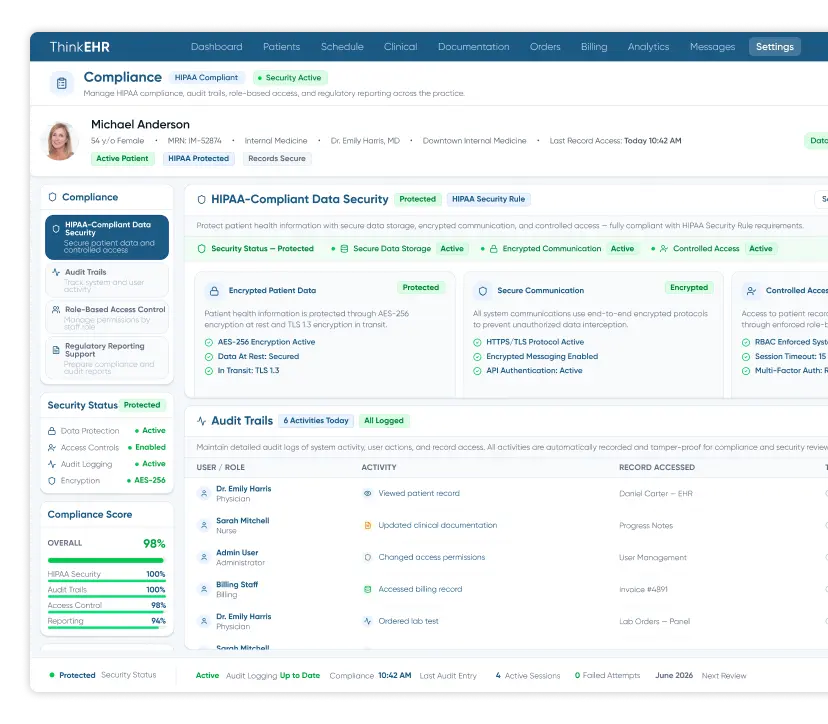
Build an Internal Medicine EHR System That is Secure, Standard, & Compliant
Ensure your Internal Medicine EHR system meets industry standards with robust security, regulatory compliance, and best practices for safeguarding patient data while streamlining clinical workflows.
HIPAA Compliance
Protect patient health information by adhering to strict privacy and security safeguards.
Fines & Penalties
- Civil penalties up to $1.5M annually
- Risk of data breaches and lawsuits
- Damage to provider reputation and trust
- Potential loss of business licenses
- Increased malpractice insurance premiums
Why It’s Required
- Safeguards patient privacy and data security
- Ensures legal and regulatory compliance
- Builds provider and patient trust
- Enables secure system interoperability
- Positions you for future regulations
Process
- Encrypt PHI at rest and in transit
- Role-based access control implementation
- Audit logs for all system interactions
- Regular HIPAA compliance audits and checks
- Staff training on HIPAA best practices
Our HIPAA Compliance Partners
ONC Certification
Ensures that your healthcare software meets federal standards for safety, usability, and interoperability.
Non-Compliance Risks
- Ineligibility for federal healthcare programs
- Loss of credibility among providers
- Limited adoption by hospitals and practices
- Risk of software rejection in the U.S. market
- Competitive disadvantage against certified vendors
Why It’s Required
- Validates usability, safety, and interoperability
- Enables providers to qualify for incentives
- Ensures EHR/healthcare systems meet federal standards
- Builds market acceptance and trust
- Enhances nationwide interoperability initiatives
Process
- Develop per ONC-ACB certification criteria
- Conduct usability and safety testing
- Ensure integration with certified APIs
- Align with ONC interoperability requirements
- Maintain certification through updates and audits
Our Partners
FHIR/HL7
The modern backbone of real-time, interoperable healthcare data exchange.
Non-Adhrence Risks
- Inability to exchange clinical data
- Regulatory compliance failures
- Patient care delays due to poor data access
- Loss of partnerships with health systems
- Missed opportunities in health app integrations
Why It’s Required
- Enables real-time healthcare data exchange
- Standardizes communication across EHRs and apps
- Enhances care coordination and interoperability
- Supports patient-centric, connected care ecosystem
- Facilitates integration with health apps and wearables
Implementation Process
- Implement FHIR APIs for modern apps
- Enable HL7 v2/v3 messaging protocols
- Ensure compatibility with third-party systems
- Test interoperability across multiple vendors
- Update systems for evolving HL7 standards
Our FHIR-HL7 Compliance Partners
21st Century Cures Act
Empowers patients with data access and drives interoperability across systems.
Fines & Penalties
- Penalties for information blocking ($1M per violation)
- Legal action by regulators or patients
- Loss of provider partnerships
- Increased compliance monitoring costs
- Negative press for non-transparent practices
Why It Matters
- Gives patients secure access to health records
- Promotes data sharing without barriers
- Prevents anti-competitive practices in healthcare IT
- Improves transparency in patient care
- Encourages innovation through open access
Implementation Steps
- Enable patient-facing APIs and portals
- Ensure no artificial data blocking practices
- Maintain open data access policies
- Regularly review compliance with Cures Act rules
- Integrate audit logs to prove compliance
Our 21st Century Cures Act Compliance Partners
Medical Coding Standards
Standardizes clinical language to ensure accurate billing, reporting, and care.
Non-Compliance Consequences
- Incorrect billing and revenue losses
- Claim denials and payment delays
- Legal risks from fraudulent coding errors
- Loss of payer/provider trust
- Regulatory audits leading to penalties
Advantages
- Ensures accurate clinical documentation
- Standardizes reporting for billing/reimbursement
- Facilitates research and analytics accuracy
- Enables smooth payer-provider coordination
- Supports population health and outcomes research
Process
- Integrate ICD-10, CPT, SNOMED, LOINC codes
- Automate coding with validation tools
- Train staff for coding compliance
- Update codes with regulatory changes
- Perform audits to catch coding errors
Our Medical Coding Standards Adherence Partners
SOC 2 Type II
Validates your system’s operational security, availability, and data integrity controls.
SOC 2 Non-Certification Risks
- Loss of enterprise and B2B contracts
- Increased data breach risks
- Failure to meet client audit requirements
- Damaged reputation with healthcare clients
- Loss of business insurance coverage
Why It Matters?
- Validates security, availability, and confidentiality
- Builds trust with enterprise healthcare clients
- Proves robust data management practices
- Ensures operational transparency and control
- Aligns with modern data protection laws
Process We Follow
- Implement strong security and monitoring controls
- Conduct independent SOC 2 audits annually
- Continuous monitoring of system availability
- Document and enforce data access policies
- Maintain incident response and recovery plans
Our SOC 2 Type II Compliance Partners
ISO 27001
Demonstrates a globally recognized commitment to managing healthcare data risks.
Non-Certification Risks
- Increased vulnerability to cyberattacks
- Loss of international market opportunities
- Reputational damage in global healthcare
- Non-compliance with security standards globally
- Barriers to working with multinational clients
Why It’s Required?
- Provides a global framework for information security
- Ensures confidentiality, integrity, and availability of data
- Demonstrates international security compliance
- Essential for global healthcare software vendors
- Reduces risks of operational downtime
Certification Process
- Establish Information Security Management System (ISMS)
- Conduct risk assessments and mitigation plans
- Follow ISO 27001 certification guidelines
- Regular audits and continuous improvements
- Employee awareness and security training programs
Our ISO 27001 Certification Partners
FDA 510(k) Clearance
Proves your software is safe and effective for clinical use under FDA regulations.
Risks of FDA 510(k) Non-Clearance
- Prohibition from marketing or selling the product
- FDA warnings, recalls, or legal action
- Financial losses and delayed launches
- Severe patient safety risks
- Mandatory product redesign or withdrawal
Why It’s Required?
- Validates the safety and effectiveness of solutions
- Mandatory for SaMD and clinical devices
- Builds trust with hospitals and clinicians
- Enables legal U.S. market clearance
- Prevents patient harm from unsafe tools
Clearance Process
- Determine device/software classification
- Conduct clinical risk and safety assessments
- Prepare and submit FDA 510(k) documentation
- Support post-market surveillance and reporting
- Maintain compliance with FDA updates and recalls
Our FDA 510 (k) Compliance Partners

Why Build Custom Internal Medicine EHR Software for Your Practice?

Build an internal medicine EHR software platform designed around your clinical workflows, integrations, and operational needs to improve efficiency, documentation accuracy, and patient care delivery.

Tailored to Your Needs
Thinkitive’s first step to developing ... internal medicine EHR software is understanding your clinic’s workflows, patient management processes, and operational requirements. Our team then builds a tailored solution designed to solve your practice’s unique challenges.
Ready-to-Use Components
Accelerate development with ready-to-use ... healthcare components such as video consultations, appointment scheduling, patient intake workflows, and SOAP-based documentation tools designed for internal medicine EHR systems.
Third-Party Integration
Integrate your internal medicine EHR software ... with telehealth platforms, RPM devices, labs, pharmacies, billing systems, and other healthcare tools to create a connected clinical ecosystem.
Affordable EHR Solutions
Our ready-to-use base EHR framework ... enables the development of cost-effective internal medicine EHR software, helping practices reduce development time and implementation costs.
In-Depth Domain Expertise
With our ready-to-use base EHR ... software framework, we give you an affordable custom EMR software solution specifically designed for your healthcare practice.

Timely Delivery
We have curated a development process ... that covers all the aspects of your healthcare practice’s unique needs and requirements with transparency for on-time delivery.