Trophy Logo

CLIENT TESTIMONIALS

A Token of Appreciation About Our Custom Dermatology EHR Software

See why 125+ dermatology practices rely on our custom EHR software to simplify workflows, improve patient care, and manage specialty-specific needs efficiently.

CTA Background

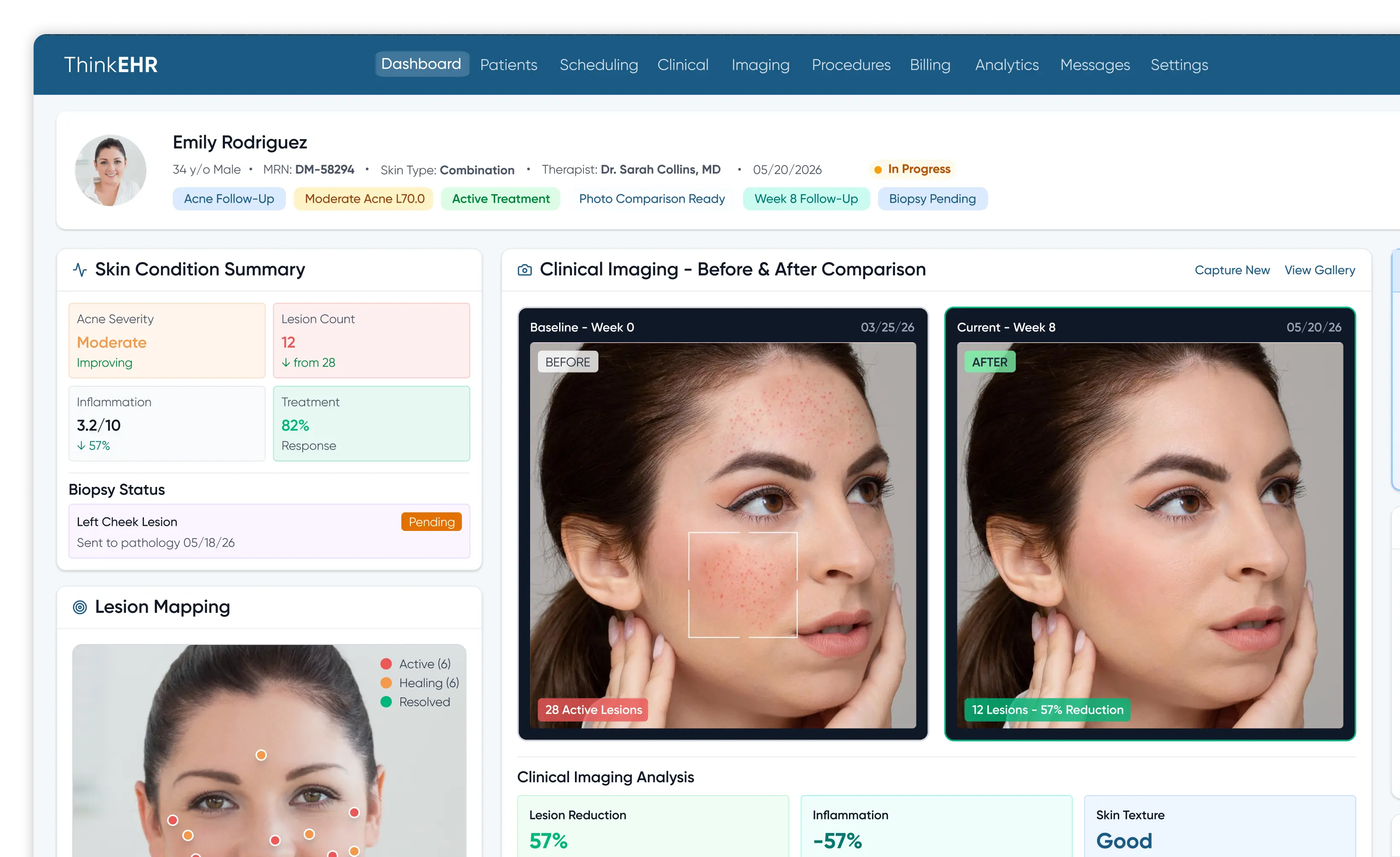
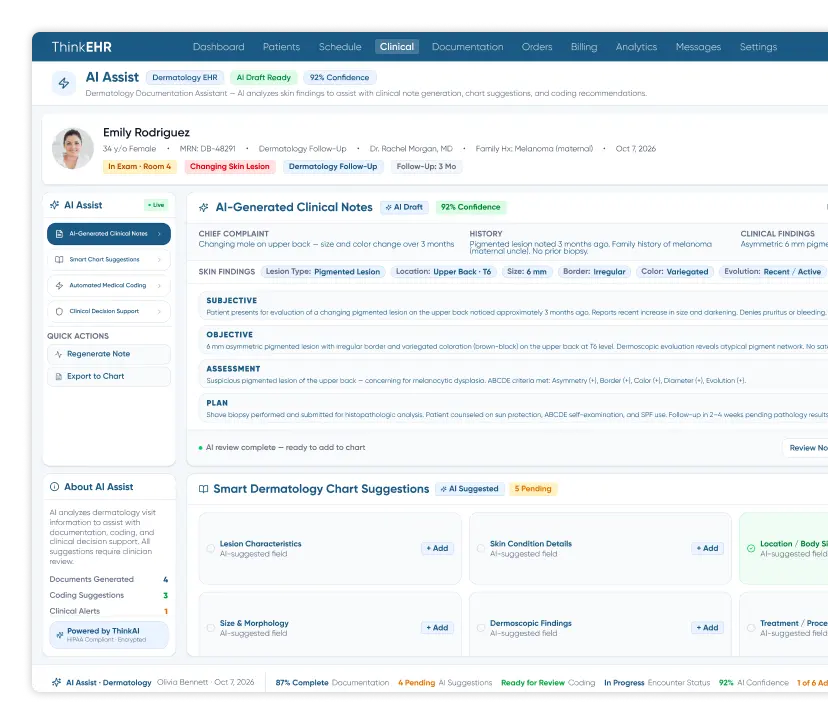
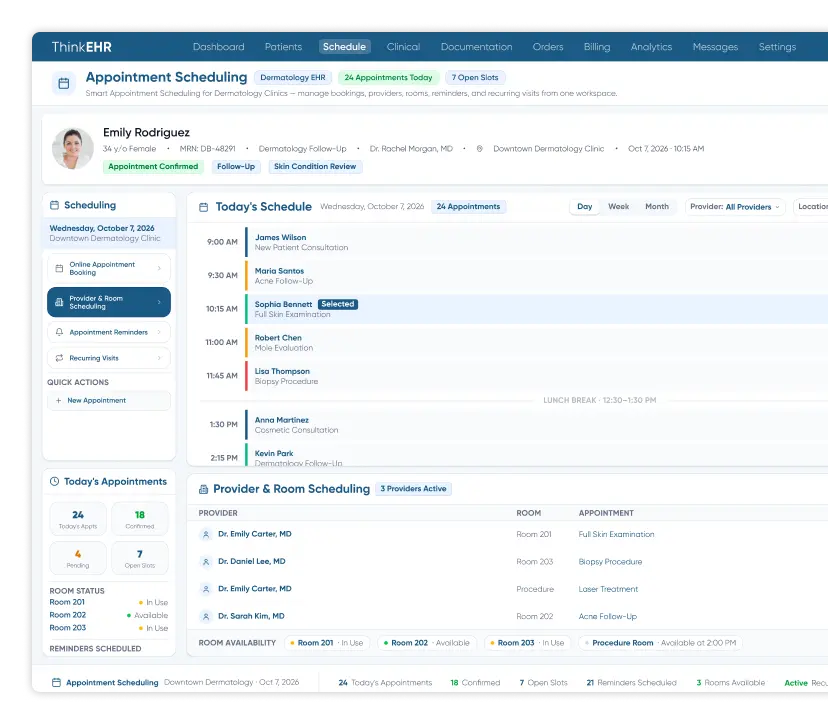
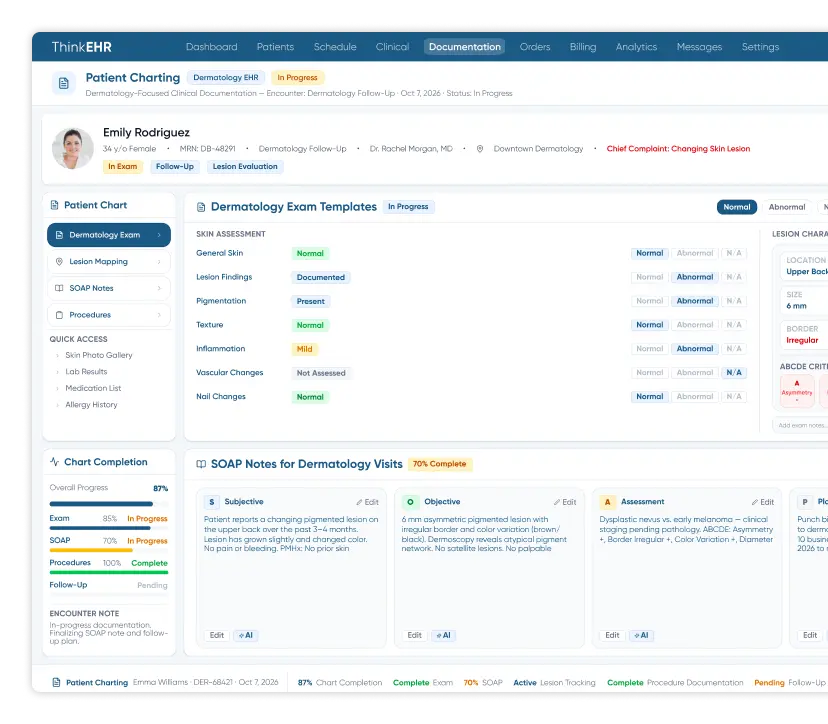
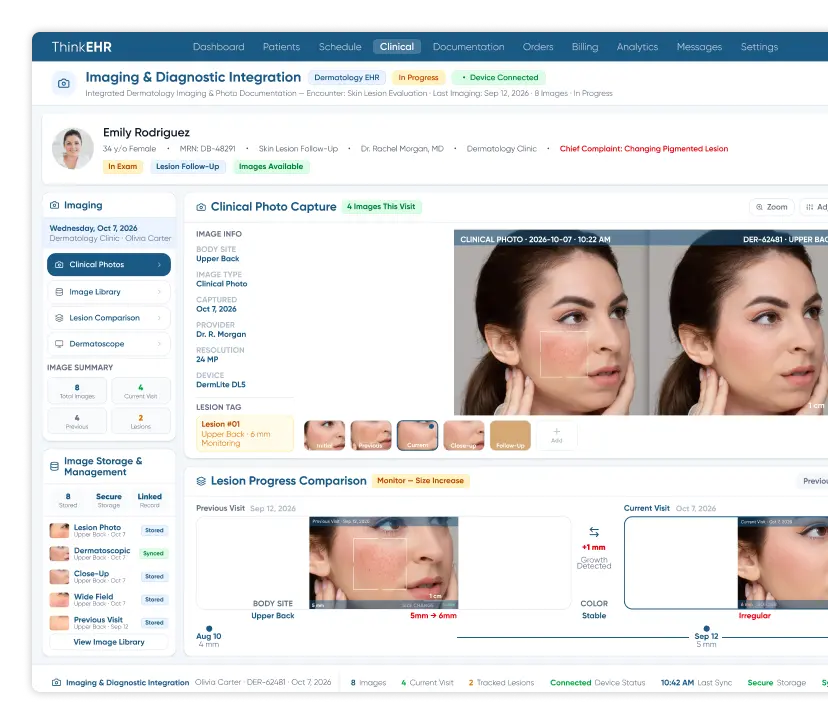
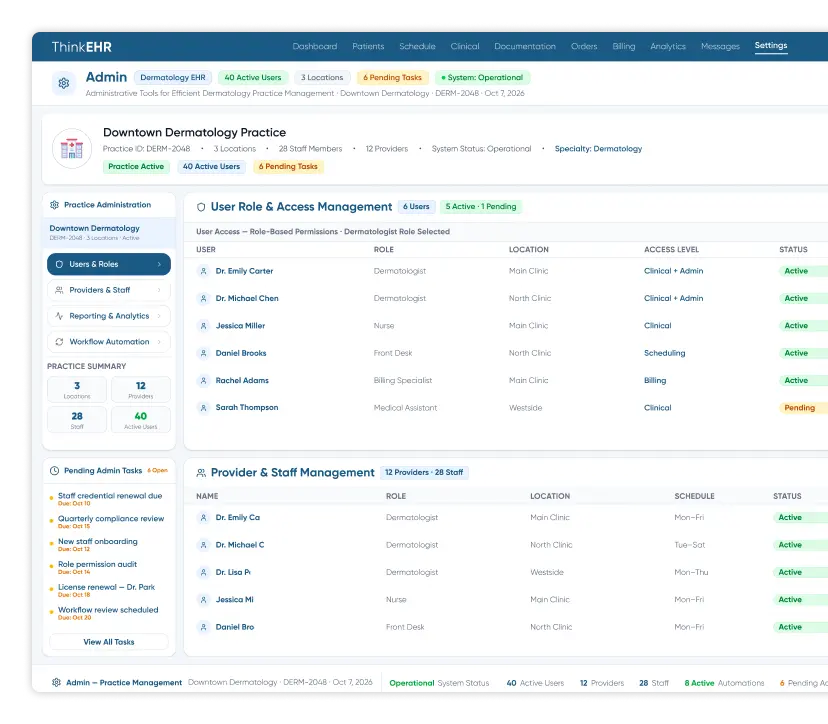
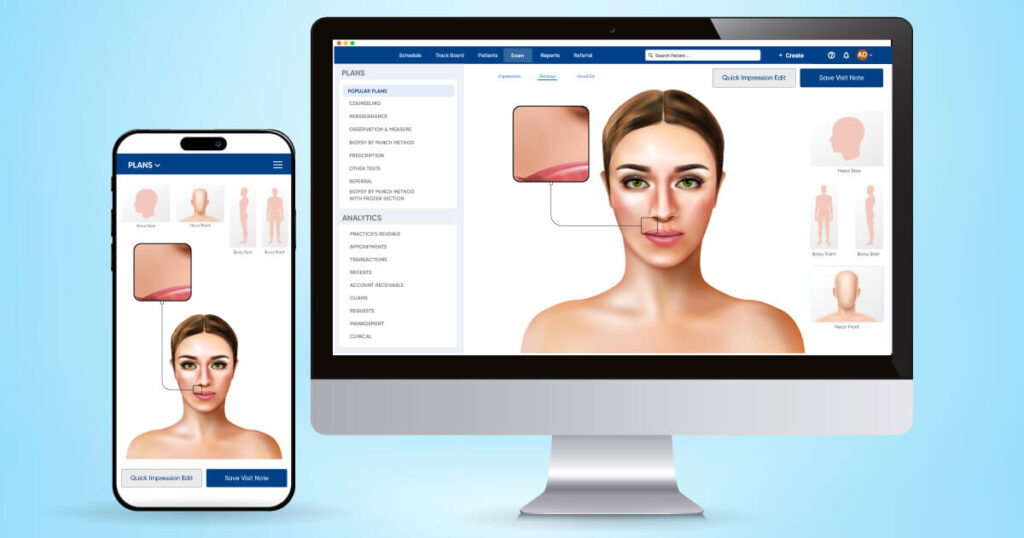
Simplify Dermatology Documentation with Smart EHR

Streamline image capture, lesion tracking, and clinical notes without slowing down your workflow.

A doctor
A doctor
healthcare provider
healthcare provider
A happy patient with her child having a conversation with the provider
two healthcare providers handshaking over successful care delivery

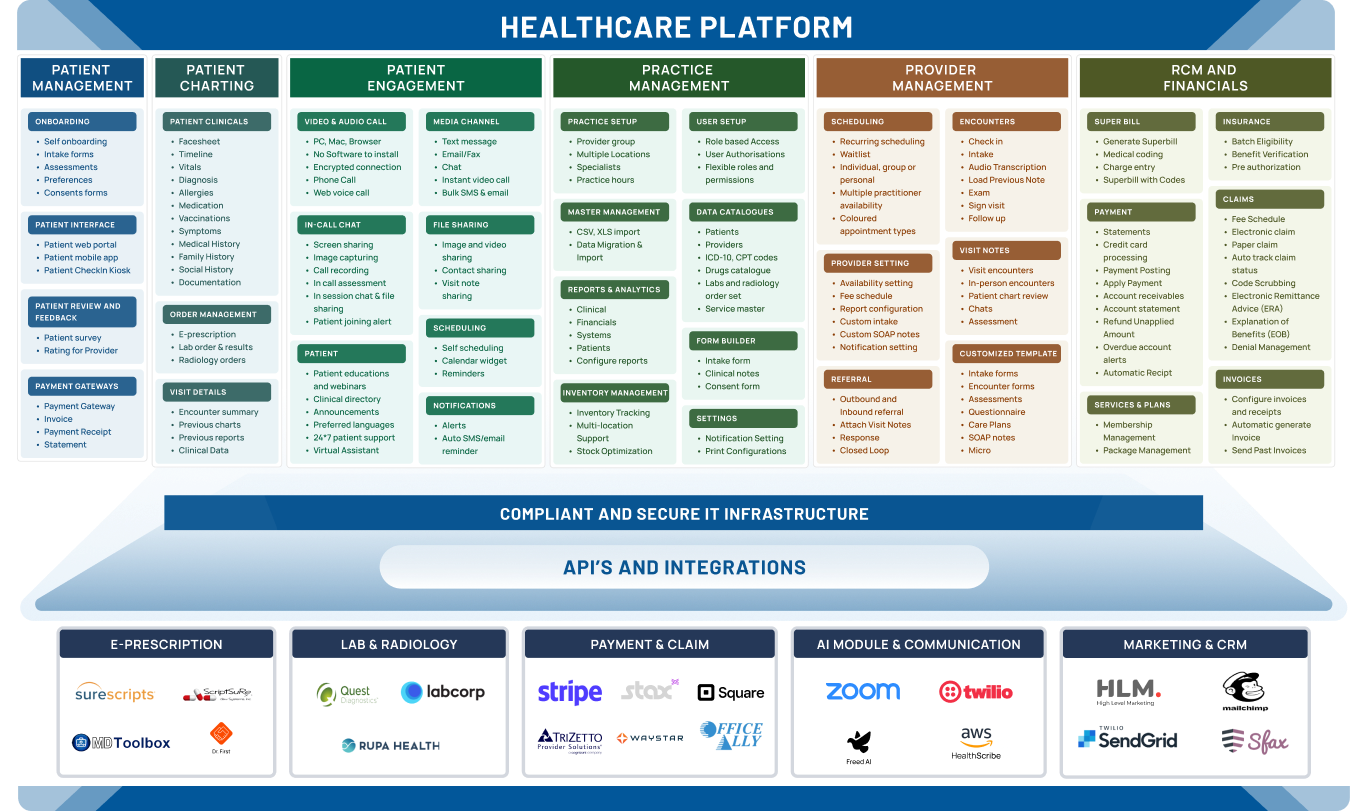
Speed-up Development of Your Dermatology EHR Software with Our Pre-Built Components

Leverage our proven, tried and tested healthcare-ready modules to accelerate delivery while maintaining performance, security, and compliance.

a tree diagram explaining the potential of custom EMR software development with necessary integrations

Connect Your Dermatologist EHR Software with Essential Healthcare Systems

Ensure smooth data flow by integrating your Dermatology EHR with labs, imaging, and other healthcare systems for efficient clinical operations.

ePrescription & Labs Integration

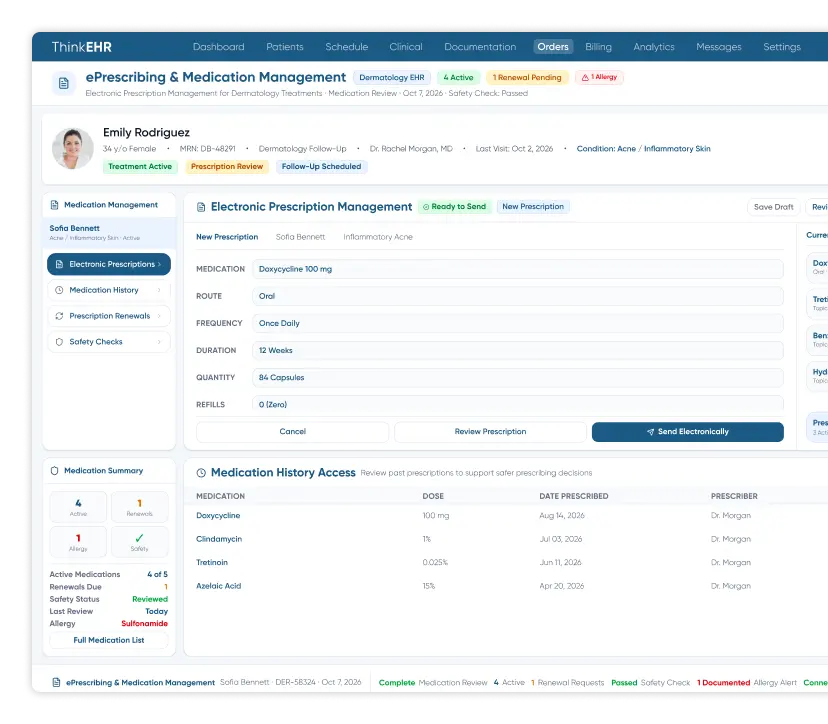
Seamlessly integrates with leading ePrescribing networks ... and laboratory providers to ensure secure medication workflows, faster diagnostic turnaround, and coordinated patient care within a unified dermatology patient management system with your EHR software for dermatologists.

surescripts Logo

Surescripts

Integrate Surescripts with your custom dermatology EHR ... software to enable secure electronic prescribing, medication history access, and pharmacy connectivity. This integration helps dermatologists streamline prescriptions while supporting dermatology clinical workflow automation within a modern dermatology EHR system.

Billing & Payment

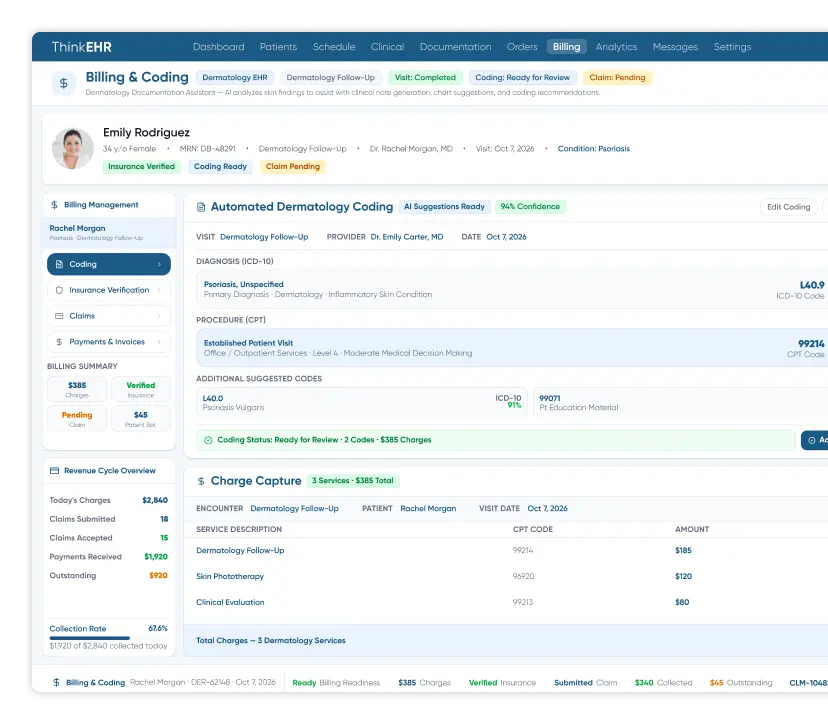
Integrate enterprise-grade dermatology EHR software with ... leading clearinghouses and payment platforms to streamline claims processing, reduce denials, and accelerate reimbursements — fully embedded within your dermatology practice management software.

WAYSTAR Logo

Waystar

Integrate Waystar with your custom dermatology EHR software to automate claims submission, eligibility verification, and payment tracking. This integration strengthens dermatology billing and RCM software capabilities while improving financial workflows in an enterprise dermatology EHR software environment.

Communication

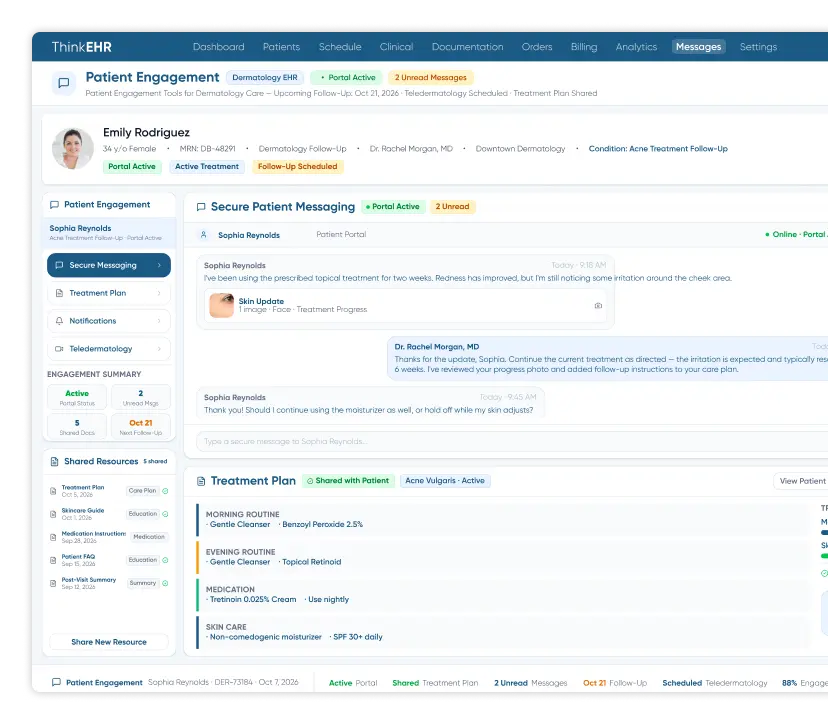
Integrate your cloud-based dermatology EHR with ... secure fax, telehealth, messaging, and patient engagement platforms to streamline referrals, improve patient communication, and strengthen care coordination within your dermatology patient management system.

Sfax Logo

Sfax

Sfax integration enables secure, HIPAA-compliant fax communication within your custom dermatology EHR software, allowing dermatologists to exchange referrals, clinical documents, and pathology reports while supporting dermatology clinical workflow automation in a modern dermatology EHR system.

Engagement Model Background

Calculate Your Dermatology EHR System Cost & ROI in 2 Minutes

Discover dermatology EHR system cost and its return on investment. Our calculator is based on real data from 500+ implementations.

From Discovery to Deployment: Our Tried & Tested Process to Build Your dermatology EHR System

Every phase is guided by clinical insight, technical rigor, and deep expertise in dermatology EHR development.

1. Discovery
1-2 weeks
2. Design
2-3 weeks
3. Build
8-12 weeks
4. Testing
1-2 weeks
5. Go Live
2-3 weeks
discovery-icon
1. Discovery

We Become You

Understand dermatology workflows, requirements, and system goals.

  • Identify dermatology practice workflows and challenges
  • Gather functional and technical requirements
  • Define compliance, interoperability, and integration needs
  • Analyze dermatology clinical documentation and imaging workflows
key-logo

Key Deliverables

  • Product requirement documentation (PRD)
  • Workflow and process analysis report
  • Integration and interoperability requirements
  • Project scope and development roadmap
key-logo

Resource Allocation

  • Healthcare Business Analyst (1)
  • Solution Architect (1)
  • Product Manager (1)
  • Clinical Workflow Consultant (1)
discovery-icon
2. Design

Practice-Specific Designing

Design intuitive UI and scalable system architecture.

  • Create user experience and interface design
  • Define dermatology charting and workflow structure
  • Design system architecture and database models
  • Plan integrations and interoperability standards
key-logo

Key Deliverables

  • UI/UX wireframes and design prototypes
  • System architecture documentation
  • Database schema and workflow diagrams
  • Integration architecture plan
key-logo

Resource Allocation

  • UI/UX Designer (2)
  • Solution Architect (1)
  • Product Manager (1)
  • Technical Lead (1)
discovery-icon
3. Build

Bringing Your EHR to Life

Develop core dermatology EHR modules and integrations.

  • Develop dermatology EHR modules and workflows
  • Implement integrations with labs, pharmacies, and billing
  • Build dermatology imaging and lesion tracking capabilities
  • Develop APIs and interoperability features
key-logo

Key Deliverables

  • Functional dermatology EHR application modules
  • Integration APIs and services
  • Configurable dermatology charting templates
  • Initial internal release version
key-logo

Resource Allocation

  • Backend Developers (3)
  • Frontend Developers (2)
  • Integration Engineer (1)
  • Technical Lead (1)
discovery-icon
4. Testing

Validating What Matters Most

Ensure system reliability, security, and clinical accuracy.

  • Perform functional and integration testing
  • Validate dermatology workflows and documentation accuracy
  • Conduct security and compliance testing
  • Perform user acceptance testing (UAT)
key-logo

Key Deliverables

  • QA testing reports and issue logs
  • Security and compliance validation reports
  • Performance testing results
  • User acceptance testing approval
key-logo

Resource Allocation

  • QA Engineers (2)
  • Security Specialist (1)
  • Product Manager (1)
  • Clinical Workflow Reviewer (1)
discovery-icon
5. Go Live

Launch With Confidence

Deploy dermatology EHR and support production launch.

  • Deploy the system to production environment
  • Configure integrations and migrate existing data
  • Train dermatology clinic staff and administrators
  • Monitor system performance and provide launch support
key-logo

Key Deliverables

  • Production-ready dermatology EHR deployment
  • Data migration and system configuration
  • Staff training materials and documentation
  • Post-launch monitoring and support plan
key-logo

Resource Allocation

  • DevOps Engineer (1)
  • Implementation Specialist (1)
  • Technical Support Engineer (1)
  • Product Manager (1)
Engagement Model Background

See How Your Custom Dermatology
EHR Software Feels & Works

Dermatology EHR Software Development Case Studies

Explore case studies highlighting how our dermatology EHR solutions improve workflows, documentation, and patient care.

Build dermatology EHR System That is Secure, Standard, & Compliant

Develop a dermatology EHR system that meets industry standards, ensures patient data security, and maintains full regulatory compliance.

HIPAA Compliance
ONC Certification
FHIR/HL7
Cures Act
Coding Standard
SOC 2 Type II
ISO 27001
FDA 510(k)

HIPAA Compliance

Protect patient health information by adhering to strict privacy and security safeguards.

fines-logo

Fines & Penalties

  • Civil penalties for unauthorized PHI disclosure
  • Tiered violation penalties based on negligence levels
  • Maximum annual penalties reaching $1.5 million
  • Criminal penalties for intentional PHI misuse
  • Reputational damage and legal liabilities for providers
fines-logo

Why It’s Required

  • Secure storage and transmission of patient health information
  • Role-based access control for sensitive clinical data
  • Encryption standards protecting PHI across systems
  • Audit trails for tracking user access activity
  • Administrative policies for healthcare data security
fines-logo

Process

  • Conduct HIPAA security risk assessment regularly
  • Implement technical safeguards for PHI protection
  • Establish access control and authentication protocols
  • Train staff on healthcare data privacy practices
  • Perform continuous monitoring and compliance audits

Our HIPAA Compliance Partners

AWS Logo A Cloud Logo ISO Logo HITRUST Logo Compliance Group Logo

ONC Certification

Ensures that your healthcare software meets federal standards for safety, usability, and interoperability.

fines-logo

Certification Criteria

  • Certified EHR meets ONC health IT standards
  • Supports clinical data exchange and interoperability requirements
  • Includes patient access and data transparency capabilities
  • Enables standardized clinical quality reporting functionalities
  • Meets security, privacy, and usability certification benchmarks
fines-logo

Why It’s Required

  • Compliance with ONC Health IT Certification Program
  • Support interoperability using standardized healthcare data formats
  • Provide secure patient data access and sharing
  • Implement clinical quality measure reporting capabilities
  • Maintain privacy, security, and audit control mechanisms
fines-logo

Process

  • Evaluate EHR functionality against ONC certification criteria
  • Implement interoperability and patient data access features
  • Perform testing through ONC authorized certification bodies
  • Validate system security, usability, and data standards
  • Submit documentation and obtain official certification approval

Our Partners

DRUMMOND Logo ICSA labs Logo SLI Logo INFO GARD Logo LU Solution Logo

FHIR/HL7

The modern backbone of real-time, interoperable healthcare data exchange.

fines-logo

Interoperability Standards

  • Standardized healthcare data exchange between clinical systems
  • Enables interoperability across EHRs, labs, and hospitals
  • Supports structured clinical data sharing using HL7 formats
  • FHIR APIs enable modern healthcare application integrations
  • Facilitates real-time patient data exchange across systems
fines-logo

Why It’s Required

  • Implement HL7 messaging for healthcare data exchange
  • Support FHIR APIs for interoperable healthcare applications
  • Maintain standardized patient, clinical, and encounter records
  • Enable secure data sharing between healthcare systems
  • Ensure consistent data formats for clinical interoperability
fines-logo

Implementation Process

  • Design interoperability architecture using HL7 and FHIR
  • Develop APIs for secure healthcare data exchange
  • Map clinical data to standardized interoperability formats
  • Test integrations with external healthcare systems
  • Monitor interoperability performance and data exchange reliability

Our FHIR-HL7 Compliance Partners

HL7 FHIR Logo Rakun Logo Smile CDR Logo 1up Health Logo Redox Group Logo

21st Century Cures Act

Empowers patients with data access and drives interoperability across systems.

fines-logo

Information Blocking Rules

  • Prohibits blocking patient access to electronic health information
  • Requires transparent and timely health data sharing
  • Ensures patients can easily access their medical records
  • Prevents unnecessary restrictions on healthcare data exchange
  • Promotes interoperability across healthcare information systems
fines-logo

Why Does It Matters?

  • Provide patients access to their electronic health information
  • Enable secure data sharing through standardized APIs
  • Avoid practices that intentionally restrict health data access
  • Support interoperability between healthcare providers and systems
  • Maintain compliance with federal information blocking regulations
fines-logo

Implementation Steps

  • Implement patient data access and sharing capabilities
  • Develop APIs supporting secure electronic health information exchange
  • Review workflows to eliminate potential information blocking
  • Monitor compliance with Cures Act interoperability requirements
  • Maintain documentation supporting regulatory compliance efforts

Our 21st Century Cures Act Compliance Partners

AWS Logo A Cloud Logo ISO Logo HITRUST Logo Compliance Group Logo

Medical Coding Standards

Standardizes clinical language to ensure accurate billing, reporting, and care.

fines-logo

Clinical Coding Systems

  • Use standardized ICD codes for diagnosis documentation
  • Apply CPT codes for medical procedure reporting
  • Support HCPCS codes for healthcare services billing
  • Ensure accurate coding for insurance claim processing
  • Maintain standardized clinical documentation for reimbursement
fines-logo

Advantages

  • Implement ICD, CPT, and HCPCS coding support
  • Ensure accurate clinical documentation for coding compliance
  • Maintain standardized formats for medical coding records
  • Enable coding validation during clinical documentation workflows
  • Support coding updates aligned with regulatory changes
fines-logo

Process

  • Integrate coding libraries within clinical documentation systems
  • Map clinical documentation to appropriate coding standards
  • Validate coding accuracy during documentation and billing
  • Update coding databases based on regulatory revisions
  • Monitor coding compliance through audits and reporting

Our Medical Coding Standards Adherence Partners

IMO Health Logo IMO Logo 3M Science Applied to Life Logo Optum Logo

SOC 2 Type II

Validates your system’s operational security, availability, and data integrity controls.

fines-logo

Trust Service Criteria

  • Ensures security, availability, and data processing integrity
  • Protects sensitive healthcare data through strict controls
  • Maintains system availability and operational reliability
  • Safeguards confidential patient and organizational information
  • Enforces privacy controls for sensitive health data
fines-logo

Why Does It Matters?

  • Implement strong access control and authentication mechanisms
  • Maintain continuous monitoring of system security controls
  • Protect sensitive healthcare data through encryption practices
  • Establish documented security policies and operational procedures
  • Ensure secure infrastructure for healthcare software platforms
fines-logo

Process We Follow

  • Conduct internal security and compliance readiness assessment
  • Implement controls aligned with SOC trust service criteria
  • Perform independent third-party SOC 2 Type II audit
  • Monitor system controls continuously throughout audit period
  • Maintain compliance documentation and regular security reviews

Our SOC 2 Type II Compliance Partners

PWC Logo Deloitte Logo A-Lign Logo Schellman Logo

ISO 27001

Demonstrates a globally recognized commitment to managing healthcare data risks.

fines-logo

Information Security Management System (ISMS)

  • Establish structured framework for information security management
  • Identify and manage organizational information security risks
  • Implement security controls protecting sensitive healthcare data
  • Maintain policies governing data protection and access control
  • Continuously improve organizational security management practices
fines-logo

Why Is It Required?

  • Implement ISO-compliant information security management framework
  • Conduct risk assessments for organizational information assets
  • Establish security policies and access control mechanisms
  • Protect healthcare data using encryption and security controls
  • Maintain documentation supporting information security governance
fines-logo

Certification Process

  • Perform organizational information security risk assessment
  • Define and implement ISMS security policies and controls
  • Train staff on information security management practices
  • Conduct internal audits to validate ISO compliance
  • Undergo external certification audit for ISO approval

Our ISO 27001 Certification Partners

bsi Logo TUV Logo ISO Logo Lloyds Register Logo DNV Logo

FDA 510(k) Clearance

Proves your software is safe and effective for clinical use under FDA regulations.

fines-logo

Medical Device Clearance

  • Demonstrates substantial equivalence to existing approved medical devices
  • Required for software classified as medical device
  • Ensures safety and effectiveness before market distribution
  • Applies to certain clinical decision support systems
  • Required before commercial launch of regulated software
fines-logo

Why Is It Required?

  • Identify predicate device with similar intended use
  • Demonstrate substantial equivalence through technical documentation
  • Provide safety and performance validation evidence
  • Submit detailed device description and software documentation
  • Maintain regulatory documentation for FDA review
fines-logo

Clearance Process

  • Determine if software qualifies as medical device
  • Identify appropriate predicate device for comparison
  • Conduct safety testing and performance validation
  • Prepare and submit FDA 510(k) premarket notification
  • Respond to FDA review and obtain clearance

Our FDA 510 (k) Compliance Partners
EMERGO Logo NAMSA Logo Medicept Logo
Engagement Model Background

WHY CUSTOM EHR SOFTWARE DEVELOPMENT FOR DERMATOLOGY?

Move beyond limited scalability, rigid workflows, and reduced clinical efficiency. With dermatology EHR development, gain full control through purpose-built features, seamless integrations, and workflows designed around how your organization delivers care.

Icon of blocks forming a system to indicate custom EMR software development

Green tick iconTailored to Your Needs

Thinkitive’s first step to developing ... dermatology EHR software is to understand your unique needs and requirements. Based on that, our development team develops a customized software solution to meet your requirements and solve your problems.

Icon of different blocks indicating ready-to-use custom EMR development aspects

Green tick iconReady-to-Use Components

With our ready-to-use technology components ... like video conferencing, appointment, scheduling, and SOAP notes, fasten your custom EMR for the dermatology software development process.

Four puzzle icon

Green tick iconThird-Party Integration

Integrate your custom dermatology EHR software ... with multiple third-party systems like Telemedicine, RPM Devices, Labs, Radiology, etc., to build a complete virtual healthcare ecosystem.

Wallet icon

Green tick iconAffordable EHR Solutions

With our ready-to-use base EHR software framework, ... we give you an affordable custom EHR software solution specifically designed for your healthcare practice.

Global icon

Green tick iconIn-Depth Domain Expertise

With our ready-to-use base EHR ... software framework, we give you an affordable custom EMR software solution specifically designed for your healthcare practice.

Timely delivery icon

Green tick iconTimely Delivery

We have curated a development process ... that covers all the aspects of your healthcare practice’s unique needs and requirements with transparency for on-time delivery.

Dermatology EMR Software Development Blogs

temp1 ...


temp2 ...

temp3 ...

temp4 ...