How to Build an EHR with Automated Coding & Charge Capture

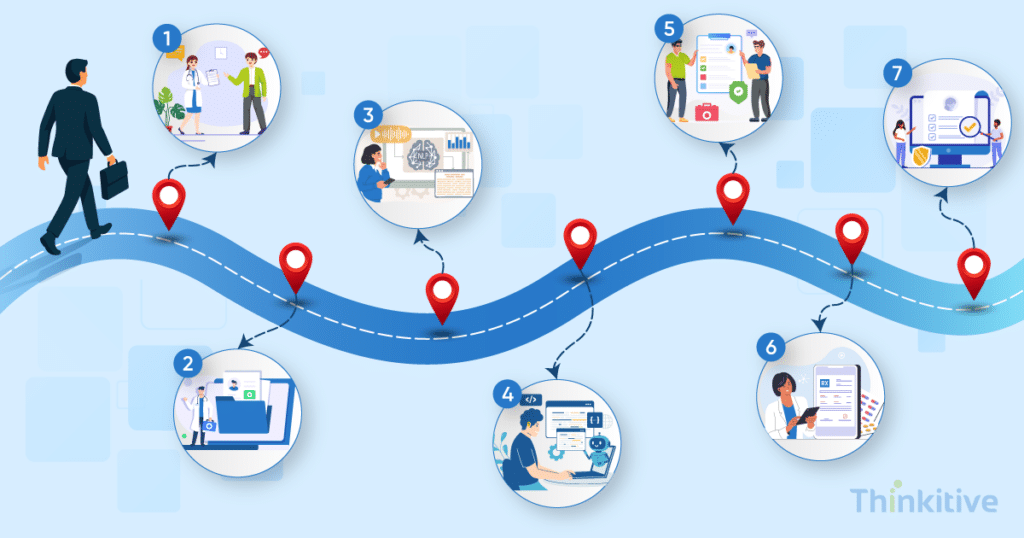
Do you know the estimate of improper payments in healthcare?
Well, the number will shock you; according to CMS, improper payments account for almost 10.3%, estimated at $3.9 billion. These errors not only result in delayed reimbursements but also increase administrative work, compliance risks, and lost revenue.
This might give you an idea about one of the biggest challenges in healthcare revenue cycle management. But wait, this is just the start. In the 2024 reporting period, CMS reported that incorrect coding accounted for 49.1% of improper Medicare Evaluation & Management (E/M) payments.
Given the inefficiencies of billing workflows, many practices—like yourself—are looking beyond manual coding workflows. You see, modern EHR systems are being designed with AI-powered documentation, automated medical coding, and intelligent charge capture capabilities.
By building an EHR automated coding system, your EHR system can transform clinical documentation into billing-ready codes with much better speed and consistency.
But the main question here is, ‘How to build a custom EHR with automated medical coding?’
Before answering that question, you need to understand that when building a custom EHR for your practice, you need to integrate automated coding and charge capture for improving revenue cycle performance and reducing clinical burden.
On that note, in this blog, let’s explore how to build automated medical coding in EHR platforms and everything that you need to know about it, right from process to best practices.
So, without further ado, let’s get started!
Assess Your EHR System for AI Readiness & Capabilities –
Get Free Assessment
Understanding Automated Coding & Charge Capture in an EHR
To ensure timely reimbursements, reduce claims denials, and maintain compliance, practices rely on accurate medical coding and charge capture. Now, traditionally, these tasks were performed manually by reviewing clinical documentation and assigning standardized billing codes.
The misconception with this process is that it is an effective process. However, the downside is its time-consuming nature, with enough room for human errors leading to delays.
A customized EHR system can automate most of the aspects of this process by combining structured clinical documentation, AI, NLP, and coding intelligence. Here, the process will happen in real-time where the EHR will analyze documentation, suggest appropriate medical codes, and capture billable services at the same time. This way, the process becomes much faster and more accurate between clinical care and reimbursement.
What is Automated Medical Coding?
In simple words, automated medical coding is the process where software analyzes clinical documentation and recommends standardized medical codes such as ICD-10, CPT, and HCPCS.
Some advancements in this system have combined traditional computer assisted coding (CAC) with AI-assisted coding to interpret the clinical context correctly and improve the accuracy in coding, while reducing manual efforts.
How Does Automated Charge Capture Work?
The process of recording every billable service provided during a patient encounter is called charge capture. Now, an automated charge capture system continuously monitors diagnoses, procedures, medications, laboratory orders, imaging results, and other clinical activities in the EHR.
The system will intelligently link these services to the appropriate billing codes and prepare them for claim generation, reducing missed charges and streamlining the entire revenue cycle workflows.
Now, automated coding and charge capture are crucial because they create a direct connection between clinical documentation, coding, and reimbursement. So, when integrated into your EHR, they can help your providers spend less time on administrative work, enable quick and easy code reviewing, and improve accuracy in billing.
Hence, it will result in faster claims processing, fewer coding errors, improved compliance, and a more efficient revenue cycle.
Core Components Required to Build Automated Coding & Charge Capture
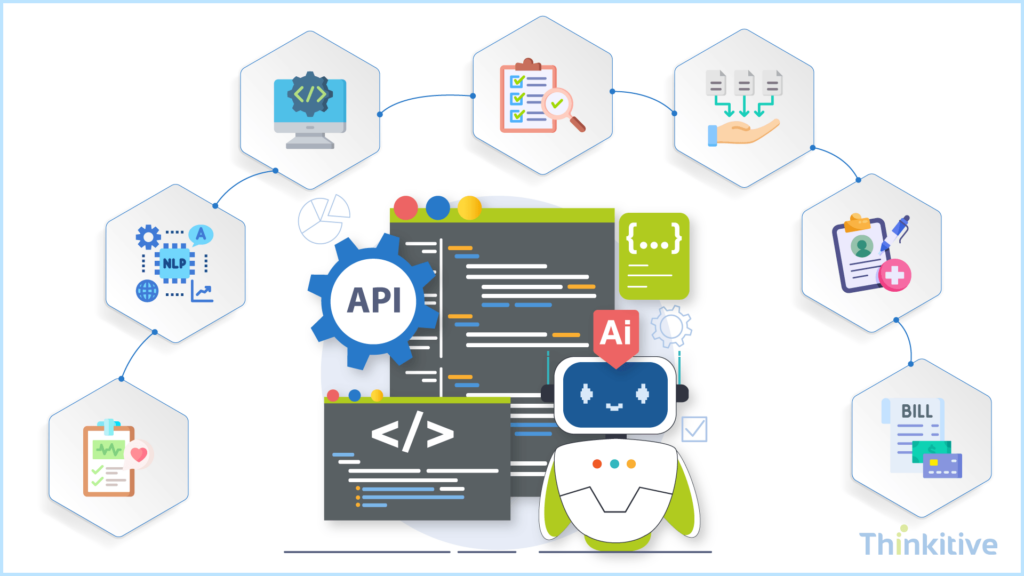
Building an automated coding and charge capture will require multiple interconnected modules working together within the EHR system. You see, each component contributes to transforming clinical documentation into accurate medical codes and billing-ready claims while maintaining compliance and improving revenue cycle efficiency.
Here are some of the core components that you require for this:
Clinical Documentation Capture
This component is the first layer in this mechanism that provides the clinical data required for accurate coding. Here is what it helps with:
- Capture structured and unstructured clinical documentation
- Support AI scribes, voice-to-text, and manual documentation
- Record diagnoses, procedures, medications, and encounter details
- Standardize data for AI and coding engines
- Integrate with clinical templates and patient records
Clinical Coding Software (ICD-10, CPT & HCPCS)
The clinical coding software acts as a coding engine that converts clinical documentation into standardized medical codes. Here are some of the things that it supports:
- Support ICD-10 diagnosis coding
- Support CPT procedure coding
- Support HCPCS coding for supplies and services
- Keep code libraries updated with annual revisions
- Enable specialty-specific coding configurations
AI-Assisted Code Recommendation Engine
AI acts like a catalyst that analyzes clinical documentation and recommends the most appropriate medical codes. Here is how AI-assisted coding can help you with:
- Extract clinical entities using NLP
- Interpret clinical context with AI and LLMs
- Recommend diagnosis and procedure codes
- Assign confidence scores to coding suggestions
- Learn from approved coding decisions over time
Charge Capture & Validation Module
This module converts documented services into billable charges and validates them with the codes to check their accuracy. Here are a few things that this module contributes to:
- Detect billable clinical activities automatically
- Identify missing or duplicate charges
- Validate modifiers and medical necessity
- Flag documentation gaps before claim submission
- Reduce revenue leakage and billing errors
Coding Review & Approval Workflow
AI-powered EHR systems can be accurate, but still need human intervention to maintain coding quality and regulatory compliance. Here are a few things that it helps with:
- Route coding suggestions for review
- Allow coders to approve, modify, or reject recommendations
- Maintain audit trails for compliance
- Track coding changes and user actions
- Support role-based access and approvals
Integration with Billing & Revenue Cycle Management
Automated coding should seamlessly connect with downstream financial workflows. Here are a few things this module helps you with:
- Generate billing-ready claims
- Integrate with revenue cycle management (RCM) systems
- Connect with clearinghouses for claim submission
- Support payment posting and reconciliation
- Improve denial management and reimbursement tracking
Witness Automated Coding & Charge Capture in Action –
Book a DemoChoosing the Right Automated Coding Technology
The choice of the right coding technology depends entirely on your needs. That is why it is recommended to assess your organization’s clinical workflows, specialty requirements, scalability goals, and implementation strategy.
Now, typical rule-based engines are suitable for standardized coding scenarios, whereas computer-assisted coding (CAC) and AI-powered coding platforms improve coding accuracy, automate charge capture, and streamline revenue cycle operations.
Here is a quick comparison table to help you understand the key differences between the three approaches that you typically have to choose from. On the basis of this, you can choose the approach that suits you best:
| Evaluation Criteria | Rule-Based Coding Engine | Computer-Assisted Coding (CAC) | AI Coding & Charge Capture Platform |
| Coding Accuracy | High for predefined coding rules | High with coder validation | Very high through contextual AI analysis |
| Clinical Context Understanding | Keyword and rule matching | NLP-assisted interpretation | Understands full clinical context using AI |
| ICD-10/CPT/HCPCS Support | Standard code mapping | Standard code mapping with suggestions | Intelligent multi-code recommendations |
| Automated Charge Capture | Not supported | Partial automation | Automatically detects billable services |
| Learning Capability | Static rule updates | Limited learning | Continuously improves from coding feedback |
| Customization | Rule configuration | Workflow customization | AI models, rules, and specialty workflows |
| Implementation Complexity | Easy to implement | Moderate integration effort | Requires AI, NLP, and workflow integration |
| Best Use Case | Standardized coding workflows | Coding assistance with human review | End-to-end intelligent coding and revenue optimization |
Designing an Automated Coding & Charge Capture Workflow
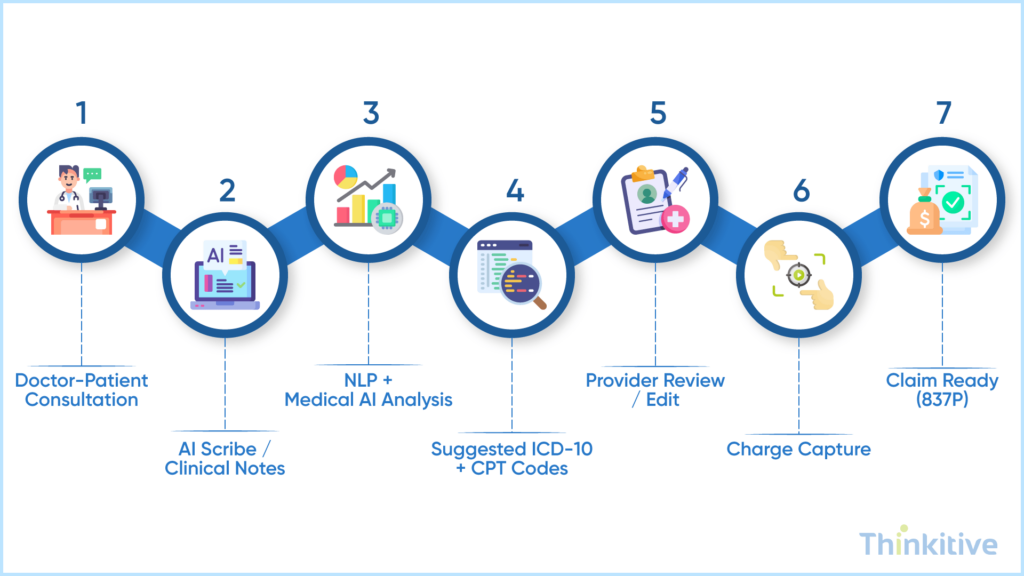
The difference between a good automated coding workflow and a great automated coding workflow is that a great automated medical coding in EHR converts clinical documentation into accurate medical codes and billing-ready claims with minimum manual interventions.
So, rather than treating coding as a separate administrative task, your customizable EHR system integrates documentation, AI analysis, coding, validation, and other RCM tasks into a continuous workflow.
Here is a step-by-step breakdown of these components and how they work together:
Step 1: Capture Structured Clinical Documentation
The process begins with collecting complete and standardized clinical information from provider notes, AI medical scribes, voice detection, clinical templates, laboratory results, medications, and encounter summaries. Well-structured documentation provides the foundation for accurate code recommendations and downstream billing workflows.
You can read more about building your own EHR system with AI scribe capabilities in our exclude blog – Build Your Own EHR with AI Scribe Integration.
Step 2: Analyze Documentation & Recommend Medical Codes
Once the documentation is available, the AI coding engine comes into the picture. It uses natural language processing (NLP), clinical rules, and machine learning models to identify diagnoses, procedures, medication, and other billable clinical activities to analyze and on the basis of that recommends appropriate ICD-10, CPT and HSPCS codes.
Step 3: Validate Coding Recommendations
Before the claims are generated and filed, they need to be validated against payer rules, modifier requirements, documentation completeness, and medical necessity. In this process, this is also done by the system, and due to automated processes, it helps in identifying coding inconsistencies and reduces the likelihood of rejected or denied claims.
Step 4: Capture Billable Services Automatically
The charge capture engine at this point converts documented clinical activities into billable charges. From procedures to mediation and every other activity are automatically linked to the appropriate billing codes, preventing missed revenue opportunities.
Step 5: Integrate with Billing & Revenue Cycle Management
After coding and charge validation are complete, the billing data is then transferred to the RCM system for claim creation, submission, payment tracking, and denial management. Here, seamless integration eliminates duplicate data entry and accelerates reimbursement.
Step 6: Support Coding Review & Exception Handling
Automation handles routine coding tasks; exceptional cases still require human oversight. However, the workflow should allow certified coders to review AI-generated recommendations, resolve coding exceptions, approve final codes, and maintain comprehensive audits for compliance.
Common Challenges in Automating Medical Coding & Charge Capture
Automated coding and charge capture can significantly improve efficiency and reimbursement accuracy. However, successful implementation requires addressing several technical, operational, and compliance challenges.
That is why you must anticipate these issues early and use best practices to ensure reliable coding performance and long-term scalability.
Here is a table to nudge you in the right direction on what challenges you can expect and how you can overcome them:
| Challenge | Impact on Coding & Revenue Cycle | Recommended Solution |
| Incomplete or Inconsistent Clinical Documentation | Missing or inaccurate documentation can result in incorrect code recommendations, missed charges, and delayed reimbursements. | Standardize documentation templates, implement AI medical scribes, and encourage real-time clinical documentation. |
| Coding Errors & Claim Denials | Incorrect codes, missing modifiers, or documentation gaps increase claim denials and reimbursement delays. | Validate codes using AI and rule-based checks before claim submission, with coder review for high-risk cases. |
| Specialty-Specific Coding Requirements | Generic coding logic may not capture specialty-specific documentation and billing requirements accurately. | Configure specialty-specific coding rules, templates, and AI models tailored to each clinical workflow. |
| Balancing AI with Human Oversight | Fully automated coding may overlook complex clinical scenarios or compliance requirements. | Adopt a human-in-the-loop workflow where certified coders review and approve AI-generated recommendations. |
| Measuring Coding Performance & ROI | Without performance metrics, it’s difficult to evaluate coding accuracy, reimbursement outcomes, or operational improvements. | Track KPIs such as coding accuracy, first-pass claim acceptance, denial rates, reimbursement turnaround time, and coder productivity. |
Conclusion
Building an EHR automated coding system requires more than just AI integration. It requires a well-designed ecosystem that connects clinical documentation, intelligent coding, charge validation, and revenue cycle management.
So, by combining standardized workflows, AI-assisted code recommendation, and human oversight, you can improve coding accuracy, reduce claim denials, and accelerate reimbursement.
Whether you’re developing a custom EHR for a specialty practice, hospital, or healthcare startup, investing in the right architecture and automation strategy will help create a scalable, compliant, and future-ready coding workflow that supports both better clinical outcomes and stronger financial performance.
On that note, now that you know how to build automated medical coding in EHR platforms, let us help you build your own EHR. Get your free consultation from our EHR expert.
Frequently Asked Questions
To build EHR automated coding functionality means integrating technologies that automatically analyze clinical documentation, recommend standardized medical codes such as ICD-10, CPT, and HCPCS, capture billable services, and prepare claims for reimbursement. A modern solution combines clinical coding software, AI, workflow automation, and revenue cycle integration to reduce manual coding effort and improve billing accuracy.
Automated coding workflows begin by capturing structured clinical documentation from provider notes, AI medical scribes, or voice-to-text solutions. AI and computer assisted coding (CAC) technologies then analyze the documentation, recommend ICD-10, CPT, and HCPCS codes, validate coding accuracy, capture billable services, and send the approved data to billing and revenue cycle management systems for claim generation.
AI medical coding in EHR uses artificial intelligence, natural language processing (NLP), and machine learning to interpret clinical documentation and recommend accurate diagnosis and procedure codes. Unlike traditional rule-based systems, AI understands clinical context, helping improve coding consistency, reduce manual effort, and support faster reimbursement workflows.
To build automated medical coding in EHR platforms, organizations should implement structured clinical documentation, integrate clinical coding software supporting ICD-10, CPT, and HCPCS, deploy an AI-assisted coding engine, automate charge capture, establish coder review workflows, and connect the solution with billing and revenue cycle management systems. This approach creates a scalable and compliant coding workflow.
EHR charge capture automation helps healthcare organizations identify billable services in real time, reduce missed charges, improve coding accuracy, accelerate claim submission, and minimize revenue leakage. It also reduces administrative workload by automating repetitive coding and billing tasks while supporting more efficient revenue cycle management.
AI-powered charge capture analyzes clinical documentation to detect billable diagnoses, procedures, medications, and services that may otherwise be overlooked. By validating documentation completeness and recommending accurate codes before claims are submitted, AI-powered medical coding software for EHR helps reduce coding errors, improve first-pass claim acceptance rates, and accelerate reimbursements.
Clinical documentation is the foundation of automated medical coding in EHR. Complete, accurate, and standardized documentation enables AI and coding engines to identify the correct diagnoses and procedures, while incomplete or inconsistent records can result in coding errors, missed charges, and reimbursement delays.
Automated coding systems should support HIPAA compliance, role-based access controls, audit trails, and secure data handling. They should also maintain current ICD-10, CPT, and HCPCS code sets, apply payer-specific coding rules where appropriate, and allow certified coders to review AI-generated recommendations to support regulatory compliance and coding accuracy.
Healthcare organizations can reduce coding errors and missed charges by implementing automated ICD-10 CPT coding software, standardizing clinical documentation, using AI-assisted coding recommendations, validating codes before claim submission, and incorporating human review for complex cases. Combining AI with robust clinical coding software and automated charge capture creates a more accurate and efficient revenue cycle workflow.


