Build Your Own EHR with AI Scribe Integration

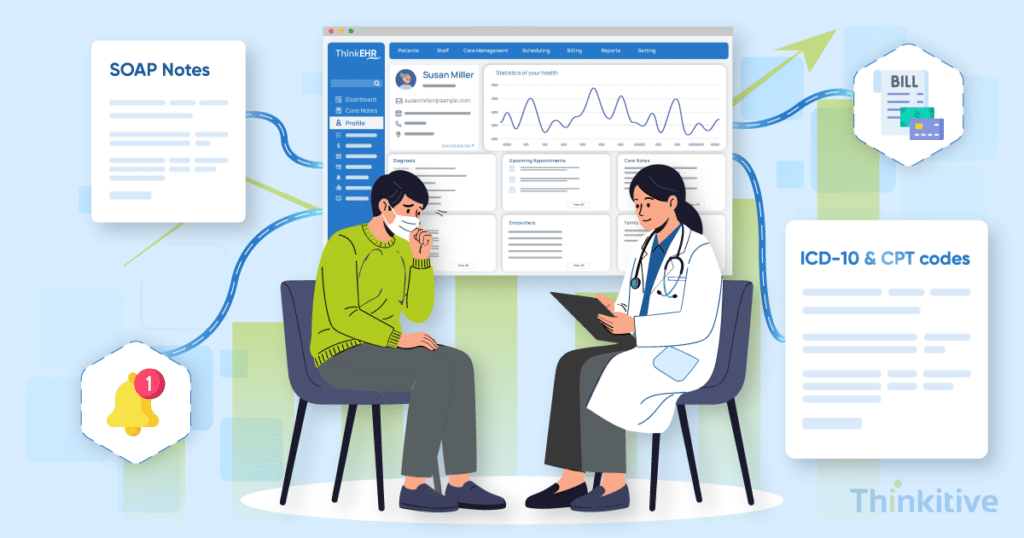
According to a report by the American Medical Association, summarized by Time, more than 45% of physicians who experience burnout say documentation is one of the most contributing factors.
In fact, clinical documentation has become one of the biggest challenges in modern healthcare. Due to this, physicians are forced to spend a considerable portion of their time on noting patient encounters, updating records, and completing administrative tasks over direct patient interaction.
To address this challenge and free some of their physicians’ time, healthcare organizations are turning to AI-powered medical scribes. And the result seems to be promising. You see, a 2025 multi-site study across six US healthcare systems found that clinical burnout dropped from 51.9% to 38.8% in just 30 days of ambient AI scribe implementation.
Another report suggests similar stats, with 97% of clinicians experiencing less documentation burden while 94% reported a reduction in cognitive load, shifting the focus back to patient care.
Despite the results favoring healthcare providers at every stage, many practices make the mistake of treating AI scribe as just another integration that can be connected as a third-party application.
Now, thinking about it in that way is indeed natural; however, it can only automate the note-taking process. The drawback in this is that it leaves clinical workflows fragmented and an increasing manual verification process.
On the other hand, when you build your own EHR with AI scribe integrated into its core architecture, it can do much more than just generate clinical notes. You see, with this AI-powered module embedded into the core architecture, it can understand patient context, populate structured data fields, suggest diagnoses and codes, along with streamlining documentation workflows to support downstream processes from billing to follow-up care.
With these benefits of AI scribe in EHR development, let this blog be your guide to build an EHR with AI scribe, its architecture and features to consider, etc.
So, without further ado, let’s get started!
See How AI Scribe Integration Would Work In Your EHR –
Book a DemoWhy AI Scribes Are Becoming the Foundation of Modern EHR Systems
Ever since the introduction of digital systems in healthcare, clinical documentation has been one of the biggest pain points. And there are a lot of reasons contributing to this. One of the most common is that growing patient volumes, evolving regulatory requirements, and reporting obligations make the documentation process rigid and time-consuming.
Now, providers building EHRs with AI scribes are changing this. Unlike traditional voice dictation tools, modern AI scribes understand clinical conversations, generate structured notes, capture key medical information, and assist with coding in real time.
By automating the repetitive documentation tasks, you basically allow clinicians to spend more time delivering care and less time completing charts. Simply integrating a third-party AI scribe with an existing EHR only addresses a specific part of the challenge.
And this is why healthcare practices are actively looking to build EHRs with AI scribe capabilities. Embedded into the core EHR architecture allows the AI module to access patient context, populate structured data fields, support clinical coding, and automate workflows across documentation, billing, referrals, and follow-up care.
Although both support clinical documentation, ambient AI scribes deliver a far more intelligent and streamlined workflow than conventional voice-to-text dictation.
| Feature | Voice-to-Text Dictation | Ambient AI Scribe |
| What the provider does | Speaks directly to the system and structures the note while dictating. | Conducts the patient consultation naturally without changing the conversation flow. |
| What is captured | The provider’s dictated words. | The complete provider-patient conversation and clinical context. |
| What is produced | A text transcript that requires formatting and organization. | A structured clinical note (e.g., SOAP note) ready for provider review. |
| Effort after capture | Manual editing, formatting, and populating EHR fields. | Quick review, minor edits if needed, and provider sign-off. |
| Underlying technology | Speech recognition (ASR). | Speech recognition combined with clinical NLP and generative AI. |
Core Components Required for AI Scribe Integration
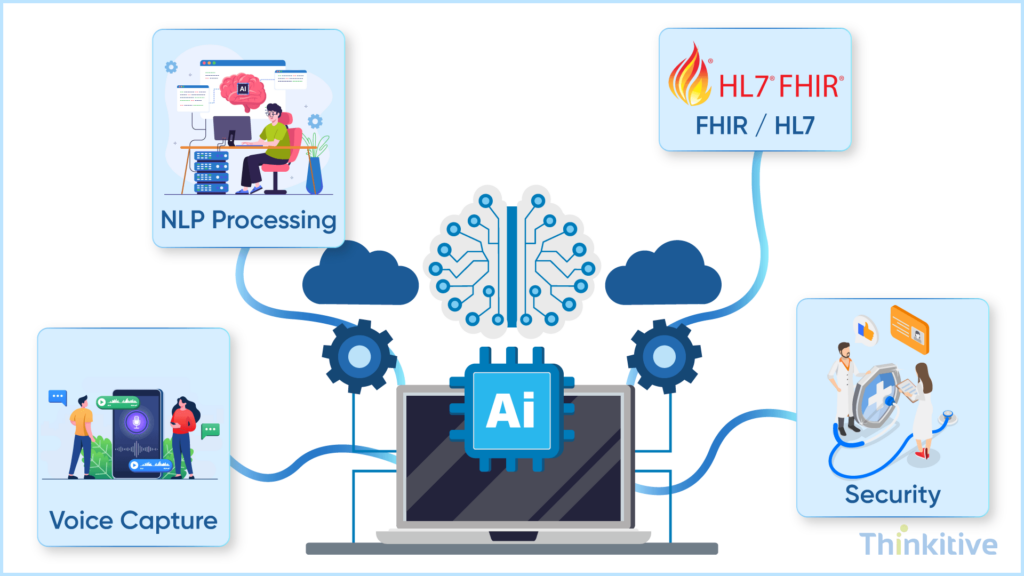
Building EHR voice-to-text features is just one part of it. To generate accurate, secure, and clinically useful documentation, your AI scribe must work alongside several core technologies that support the entire documentation workflow.
Here are some of the core components that you must have for AI scribe integration embedded into your custom EHR:
- Voice Capture & Speech Recognition: This is the first layer, and it captures conversations between providers and patients through secure audio processing. Advanced speech recognition models convert these conversations into text while correctly identifying medical terminology, speaker roles, and contextual cues. High transcription accuracy is essential, as every downstream AI process depends on this.
- Natural Language Processing (NLP) & Clinical Note Generation: Once the conversation is transcribed, NLP analyzes the clinical context to extract symptoms, diagnoses, medications, procedures, and other relevant medical information. This enables the AI scribe to generate structured SOAP notes, populate patient records, and suggest ICD-10 or CPT codes for provider review.
- FHIR & HL7 Interoperability: AI-generated documentation must seamlessly integrate with the rest of the EHR system. This means it should support interoperability standards like FHIR and HL7 to ensure that clinical notes, patient data, orders, referrals, and billing information can be exchanged across the connected networks without disrupting the workflows.
- Security, Compliance & Scalability: Since AI scribes process PHI, security must be something that is to be built into every layer of the architecture. Certain aspects of security like end-to-end encryption, role-based access control, audit trails, HIPAA compliance, and secure cloud infrastructure are essential for protecting patient data.
All these components together create the foundation of an AI-native EHR where documentation is not only automated but also accurate, interoperable, secure, and ready to support clinical workflows beyond note generation.
Assess Your System for AI-Readiness –
Get Free AssessmentBuilding Voice-to-Text Clinical Documentation Workflows
Building an EHR with an AI scribe that is effective begins with a seamless voice-to-text workflow that captures provider-patient conversations in real-time. Here, instead of documenting every visit manually, clinicians can focus on patient care while the AI can listen, transcribe, and organize all information that is medically relevant throughout the consultation.
Coupling this with advanced speech recognition and natural language processing (NLP), the system converts conversations into structured clinical documentation. So, rather than generating notes in plain text, the system can identify key details such as symptoms, diagnoses, medication, and treatment plans to automatically create SOAP notes, update patient charts, and assist with coding.
By building an EHR with voice-to-text capabilities, the documentation process itself becomes a part of the clinical workflows instead of an isolated transcript. This way, providers can simply review, edit if necessary, or approve the notes before they’re saved into the patient’s record.
Read our details about how you can build an EHR with voice-to-text clinical notes capabilities. Here you can explore several facets that goes into the intricacies of it.
Connecting AI Documentation to Revenue Cycle Management
AI-generated clinical documentation doesn’t just improve patient records; it strengthens the entire revenue cycle. You see, by capturing complete and structured clinical information at the point of care, healthcare organizations can reduce manual effort, improve coding accuracy, and accelerate reimbursement.
So, the main question here arises: how to build an EHR RCM module that is supported with AI documentation. Well, here are some AI documentation capabilities that you can harness and the benefits that you can get:
| AI Documentation Capability | RCM Benefit |
| Structured clinical notes | Creates documentation that’s ready for coding and billing. |
| Automatic diagnosis & procedure capture | Supports more accurate ICD-10 and CPT code selection. |
| Complete encounter documentation | Reduces missing information that can lead to claim denials. |
| Standardized clinical records | Improves claim quality and reimbursement accuracy. |
| Reduced manual data entry | Saves time for coding and billing teams. |
| Integrated EHR + RCM workflow | Enables faster claim submission and smoother revenue cycle operations. |
If you want to learn in detail about the building an EHR with Revenue Cycle Management module for your practice, then read this explicit guide on – How to Build EHR Revenue Cycle Management Module.
Supporting Automated Coding & Charge Capture
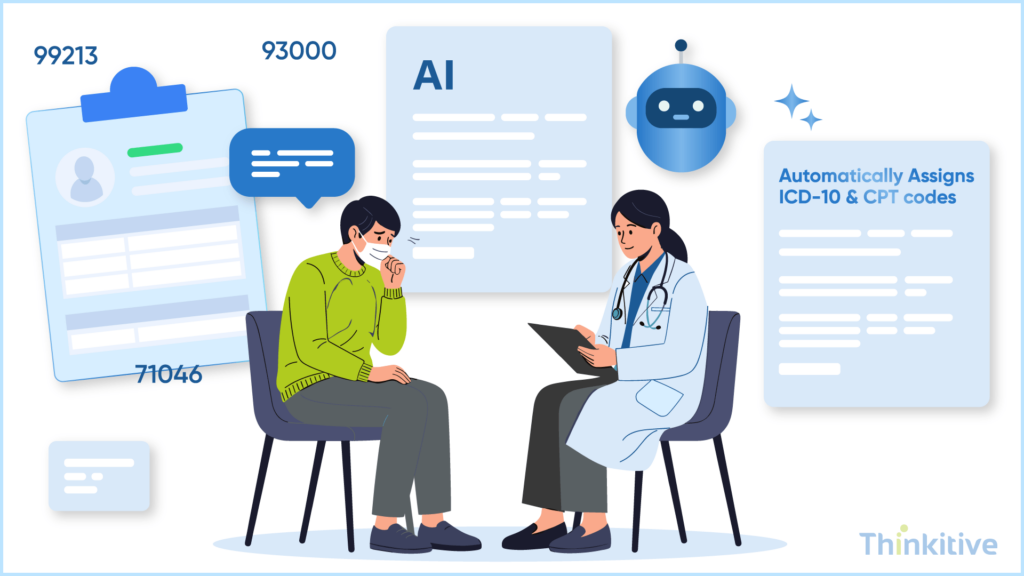
Accurate coding begins with complete clinical documentation. You see, when providers document encounters manually, details can be missed with constant inconsistencies in the notes. This can result in incorrect coding, missed charges, and delayed reimbursement.
However, by building an EHR with automated coding powered by AI, this bridge can be closed, transforming clinical documentation into structured, coding-ready information.
So, how does AI support coding and charge capture? Well, here is how:
- Extracts Billable Clinical Information: Identifies diagnoses, procedures, medications, and services documented during the encounter.
- Assists ICD-10 & CPT Code Selection: Uses clinical context to recommend appropriate diagnosis and procedure codes for provider review.
- Improves Charge Capture: Reduces missed billable services by ensuring supporting documentation is captured during the consultation.
- Minimizes Documentation Gaps: Identifies and addresses incomplete or missing clinical information before claims move to billing.
- Accelerates Coding Workflows: Provides coding teams with structured, review-ready documentation, reducing manual effort and turnaround time.
For more details about its workflows and how you can build this entire module, read our blog – How to Build EHR with Automated Coding & Charge Capture.
Consult EHR Expert for Automated EHR Workflows –
Book a Consultation
Enable Real-Time Clinical Alerts & Decision Support
When AI-generated documentation is directly integrated into the EHR, the entire system becomes more than just a record keeping system and starts capturing the entire patient encounter. On top of that, it becomes a source of truth for providing actionable clinical intelligence.
So, by continuously analyzing structured clinical data, the system can identify potential risks, trigger real-time alerts, and provide decision support while the provider is still consulting with the patient. This ensures fast interventions, reduced likelihood of missed clinical information, and supports safer, more informed care decisions.
Here is how building an EHR with an AI scribe can support:
- Drug Interaction Alerts: Warns providers about potential medication interactions or contraindications.
- Clinical Risk Notifications: Identifies abnormal symptoms, vital signs, or lab values that require immediate attention.
- Evidence-Based Recommendations: Suggests appropriate care pathways based on patient history and clinical guidelines.
- Preventive Care Reminders: Prompts providers about overdue screenings, vaccinations, or follow-up visits.
- Real-Time Decision Support: Delivers relevant insights during the consultation to support faster and more informed clinical decisions.
Explore how you can build an EHR with real-time clinical alerts and notification in this detailed guide.
Leveraging AI Documentation for Population Health & Analytics
AI-generated clinical documentation creates standardized, structured health data that extends beyond individual patient encounters. Now, when integrated with population health analytics, this data helps healthcare organizations identify care gaps, monitor quality measures, stratify patient risks, and make more informed decisions for proactive care management.
And this is how AI documentation supports population health:
| AI-Generated Clinical Data | Population Health Outcome |
| Structured diagnoses and problem lists | Improves patient risk stratification and cohort identification |
| Standardized clinical documentation | Supports quality reporting and regulatory compliance |
| Chronic disease documentation | Enables proactive care management and follow-up planning |
| Medication and treatment history | Identifies adherence trends and care gaps |
| Aggregated clinical insights | Helps track population health trends and support value-based care initiatives |
Analytics is crucially important and with practices and regulatory bodies prioritizing value-based care, healthcare organizations are actively looking to build EHR with Population Health Analytics Dashboard. Learn how you can build this into your EHR system by reading this guide here.
Consent, Attestation, & Governance for AI-Generated Documentation
AI can assist with clinical documentation; however, it can’t be brought in or introduced as a replacement for your providers. You see, it can not replace a real provider’s judgment or legal responsibility.
That is why you must review everything that these systems generate and move forward only after final overview. This attestation confirms that the medical record accurately reflects the patient encounter and satisfies regulatory and legal requirements.
To ensure compliant AI documentation workflows, you should also establish governance policies covering patient consent, auditability, data security, and responsible use of AI.
Here is a table for a quick overview:
| Governance Area | Purpose |
| Provider Attestation | Confirms clinician review and approval of AI-generated documentation. |
| Patient Consent | Ensures transparency regarding AI-assisted documentation where applicable. |
| Audit Trails | Maintains a record of AI-generated content, edits, and approvals. |
| HIPAA & HITECH Compliance | Protects patient data through secure storage, access controls, and encryption. |
| ONC & 21st Century Cures Act Alignment | Supports interoperability, data accessibility, and compliant health information exchange. |
| AI Governance Policies | Defines responsible AI use, validation, monitoring, and accountability. |
Prior authorization and consent management are some of the most prominent requirements of healthcare providers looking to modernise their EHRs. Read our exclusive guide – Build EHR with Consent Management & Patient Authorization, for detailed understanding.
Conclusion
Building an EHR with AI scribe integration is about much more than automating clinical documentation. It is more about creating an intelligent platform that streamlines clinical, operational, and financial workflows. From generating structured notes and supporting medical coding to improving revenue cycle management and clinical decision-making, and providing reports that provide you with actionable healthcare intelligence.
However, to realize these benefits, your AI scribe must be built into the core EHR architecture rather than a standalone integration. With the right foundation, you can reduce administrative burden, improve provider efficiency, enhance documentation quality, and deliver better patient outcomes.
So, what are you waiting for? Watch this free demo of how AI-scribe would work in your custom EHR and learn how to create EHR software specifically designed for your practice.
Frequently Asked Questions
To build EHR with AI scribe capabilities means designing an Electronic Health Record system where AI-powered clinical documentation is integrated into the core workflow rather than added as a third-party tool. The AI captures provider-patient conversations, generates structured clinical notes, assists with coding, and supports downstream workflows such as billing, clinical decision support, and population health analytics.
The benefits of AI scribe in EHR development extend beyond faster documentation. AI scribes reduce manual charting, improve documentation consistency, support ICD-10 and CPT coding, streamline clinical workflows, reduce physician burnout, and allow providers to spend more time with patients. When integrated into the EHR, AI also improves operational efficiency across clinical and administrative processes.
FHIR interoperability enables AI-generated clinical documentation to integrate seamlessly with other healthcare systems and applications. By supporting FHIR APIs and HL7 standards, AI scribes can populate structured patient records, exchange clinical data securely, and ensure documentation flows smoothly between providers, laboratories, pharmacies, and other healthcare platforms.
A build EHR voice-to-text workflow captures provider-patient conversations in real time and converts them into structured clinical documentation. Unlike traditional dictation, AI-powered voice-to-text solutions understand clinical context, generate SOAP notes, and populate patient records, significantly reducing manual charting while improving documentation accuracy.
When organizations build EHR automated coding capabilities alongside AI documentation, structured clinical notes can support ICD-10 and CPT code selection, reduce documentation gaps, and improve charge capture accuracy. This helps coding teams work more efficiently while reducing claim denials caused by incomplete documentation.
Yes. When healthcare organizations build EHR clinical alerts into their AI-powered workflows, structured documentation can trigger real-time notifications such as drug interaction warnings, abnormal clinical findings, preventive care reminders, and evidence-based treatment recommendations. These alerts help providers make faster and safer clinical decisions during patient care.
AI-generated documentation creates standardized clinical data that can be analyzed across patient populations. Organizations that build EHR population health analytics capabilities can use this data for risk stratification, chronic disease management, quality reporting, care gap identification, and value-based care initiatives, enabling more proactive population health management.
When organizations build EHR consent management workflows, they ensure patients are informed about AI-assisted documentation where required and that providers maintain appropriate oversight. Consent management also supports transparency, regulatory compliance, and responsible use of AI while protecting patient privacy and trust.
The best AI scribe features for modern EHR platforms include real-time voice capture, ambient clinical documentation, automatic SOAP note generation, structured data extraction, AI-assisted coding, clinical decision support, multilingual transcription, audit trails, FHIR interoperability, and seamless integration with billing and revenue cycle workflows.
Understanding how to build an EHR with AI scribe integration begins with designing an architecture that combines voice capture, speech recognition, natural language processing (NLP), interoperability standards like FHIR and HL7, secure cloud infrastructure, and governance controls. AI should be embedded into the EHR workflow so documentation, coding, clinical alerts, and billing work together as a unified system.
Healthcare organizations should ensure AI documentation workflows comply with HIPAA, HITECH, and applicable ONC and 21st Century Cures Act requirements. In addition to encryption and access controls, organizations should implement provider attestation, audit trails, governance policies, and appropriate patient consent practices to support secure and compliant AI-assisted documentation.
AI reduces physician burnout by automating repetitive documentation tasks, generating structured clinical notes during consultations, and minimizing after-hours charting. This allows providers to spend more time with patients instead of completing administrative work, improving both clinician satisfaction and workflow efficiency.
The future of AI-powered clinical documentation extends beyond note generation. AI-native EHR platforms will increasingly support real-time clinical decision support, automated coding, predictive analytics, population health management, and intelligent workflow automation. As these capabilities evolve, AI will become a foundational component of modern EHR systems, helping healthcare organizations deliver more efficient, data-driven, and patient-centered care.


