How to Avoid Data Lock-In When Building EHR

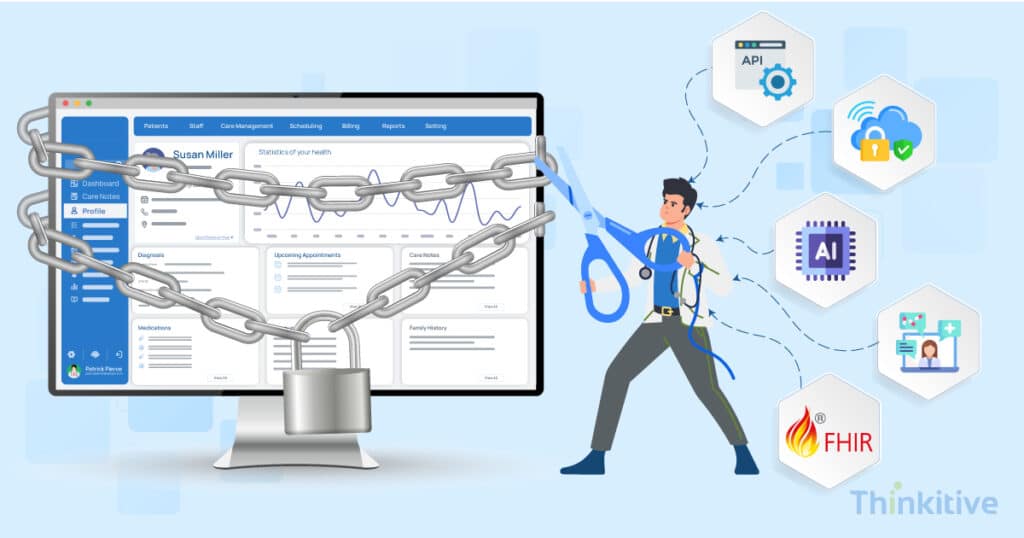
Over the years, EHRs have evolved to be the epicenter of care delivery and the backbone of modern healthcare. In fact, according to ONC, more than 99% of US non-federal acute care hospitals use certified EHR technology.
However, the high adoption rate of EHRs has given rise to a new challenge, you see, most of the healthcare practices that use these EHR systems do not actually have full control over the data that powers their operations.
In fact, many practices that tried to integrate an AI-powered medical scribe or connect a new telehealth platform or tried to migrate to a new system found that their EHR system simply didn’t allow them to.
Though on the outside it looks like a comprehensive solution, it becomes a barrier when proprietary databases, restricted APIs, expensive data exports, or vendor-controlled integrations make the process slow and costly. And this problem was mainly due to EHR data lock-in.
Now, avoiding data lock-in isn’t just about migrations or customization. It’s more about preserving the freedom to adopt new technologies, meet evolving regulatory requirements, and deliver the best possible care to patients without relying on a single EHR vendor.
So when you are building an EHR and EMR from scratch, you need to design it for interoperability, data portability, and long-term ownership of the system.
On that note, in this guide, let’s explore how you can avoid EHR data lock-in and keep control and ownership of your clinical data.
So, without further ado, let’s get started!
Build an EHR Where You Own Your Data –
Watch DemoWhat Is EHR Vendor Lock-In & Why Does It Happen?
EHR vendor lock-in is basically a situation where a healthcare organization becomes dependent on a single vendor to access, integrate, or migrate its clinical data. However, the organization does own the patient records, proprietary databases, restricted APIs, and vendor-specific workflows, which can make switching from one system to another difficult.
Now, this dependency on a single vendor does not happen overnight. It gradually develops as practices rely on closed architectures, custom integrations, and proprietary data models that limit flexibility over time.
Here are some of the most common signs that might indicate you are into EHR data lock-in:
- High costs or restrictions for exporting data
- Limited APIs for third-party integrations
- Difficulty adding AI, telehealth, or RPM solutions
- Vendor approval required for workflow changes or new features
Remember vendor lock-in is typically created during EHR development and not discovered during contract renewal. Some of the architectural decisions that you can make for EHR vendor lock-in prevention are using open standards, FHIR-based APIs, modular design, and organization-owned databases.
These decisions can make your EHR more flexible to evolve, integrate, or migrate.
How to Avoid EHR Data Lock-In When Building?
One of the best practices to prevent EHR data lock-in is to design your system with open standards, interoperable architecture, and full organizational control over your data right from the moment it goes live.
Now, every lock-in challenge can be traced back to an architectural decision made during the development stage. You see, choosing proprietary databases, closed APIs, or tightly coupled systems directly or indirectly creates long-term dependencies.
On the other hand, adopting FHIR-based APIs, modular architecture, standardized data models, and practice-owned databases keeps your EHR flexible and future-ready.
By making the right decision early, you can make your system flexible enough to integrate new technologies, migrate systems when required, and retain complete control over their clinical data without relying on a single vendor.
On that note, here is the EHR lock-in track that you might fall for, and here are also some of the ways in which you can avoid it:
| EHR Lock-In Trap | Architectural Decision That Prevents It |
| Proprietary data formats | Store clinical data using open standards such as FHIR and HL7 instead of proprietary schemas. |
| Closed or proprietary APIs | Build RESTful, standards-based APIs with complete documentation and versioning. |
| Vendor-controlled data exports | Include self-service bulk data export and backup capabilities from day one. |
| Tightly coupled application and database | Separate the data, application, and integration layers using a modular architecture. |
| Vendor-managed integrations | Build integrations using FHIR, HL7, SMART on FHIR, and OAuth 2.0 instead of proprietary connectors. |
| Cloud or infrastructure dependency | Design for cloud-agnostic deployment using containers and infrastructure-as-code. |
| Poor documentation | Maintain complete documentation for APIs, database schemas, integrations, and workflows as project deliverables. |
| Weak contractual protections | Define data ownership, export rights, supported formats, and transition assistance in the development agreement. |
Note: Every architectural decision you make today determines how much control you’ll have over your clinical data tomorrow.
The Hidden Costs of EHR Data Lock-In
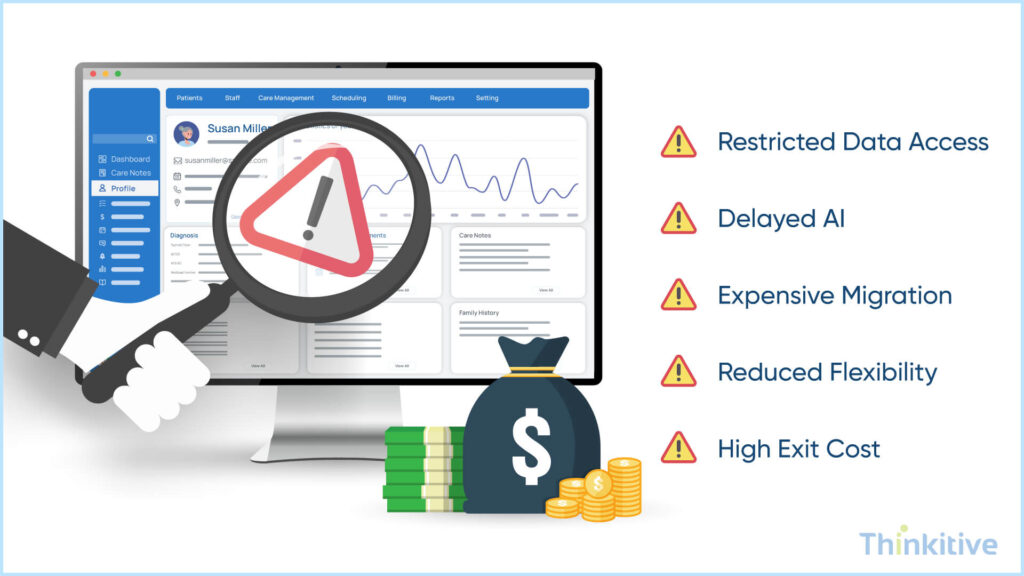
It is important for you as a healthcare organization to avoid EHR data lock-in because it affects you far more than just the ability to switch vendors. It limits how effectively you can use your own clinical data, improve operations, and adapt to your changing needs and requirements.
Here are some of the common hidden costs associated with EHR vendor lock-in:
- Restricted Access to Data: Limited export capabilities and proprietary data structures make it difficult to access complete clinical and operational data.
- Delayed AI & Analytics Initiatives: AI-powered documentation, predictive analytics, and workflow automation depend on accessible, structured data. Now, if you data cannot be easily queried or integrated, developments and upgrades can be slowed down, delaying everything that follows after it.
- Expensive Migrations: Rebuilding integrations, validating historical data, training staff of newer systems, and minimizing downtime can make EHR replacement costly and also time-consuming.
- Reduced Flexibility: Due to vendor lock-in, every new integration, workflow change, or expansion of your system’s scope would require vendor participation, which directly increases costs and implementation timelines.
One of the biggest indicators of vendor lock-in is exit cost. For instance, if you want to move your data to a new system, then you would require significant time, money, or technical efforts. This directly indicates that you are dependent on your EHR vendor, and every change in your system would require their involvement.
On that note, here are some EHR vendor lock-in examples and solutions that you can consider:
| Challenge | Solution |
| High fees for data exports | Build self-service data export capabilities |
| Limited third-party integrations | Use FHIR-based, standards-driven APIs |
| Difficult EHR migration | Design a modular architecture with independent data ownership |
| Vendor-dependent workflow changes | Build configurable workflows instead of hard-coded customizations |
Designing a Vendor-Neutral EHR Architecture
For you to own your data and avoid EHR data lock-in, designing a vendor-neutral EHR architecture is the best way. You see, with vendor-neutral architecture, you are in control of your data, integrations, and future technologies.
This way, instead of relying on proprietary tools or tightly coupled systems, you use open standards and modular components that can evolve and upgrade independently.
Here are some of the core architectural principles that you can use for EHR vendor lock-in prevention:
- Separate data from applications: Keep the clinical data layer independent so applications can be upgraded or replaced without affecting patient records.
- Build with interoperability standards: Use FHIR, HL7, and open APIs to exchange data with other healthcare systems instead of proprietary integration frameworks.
- Adopt a modular architecture: Design scheduling, billing, telehealth, AI, and patient engagement as independent services that can be enhanced without disrupting the entire EHR.
- Maintain complete data ownership: Ensure your organization controls the production database, backups, documentation, and data export processes.
- Design for future growth: Build a flexible foundation that can support emerging technologies, regulatory updates, and new clinical workflows without requiring a complete system rebuild.
Note: A vendor-neutral architecture doesn’t eliminate your need to rely on technology partners. In fact, it ensures that your organization can change partners, integrate new solutions, and modernize its EHR on its own terms rather than being constrained by a single vendor.
Regulatory Leverage That Protects Against Lock-In
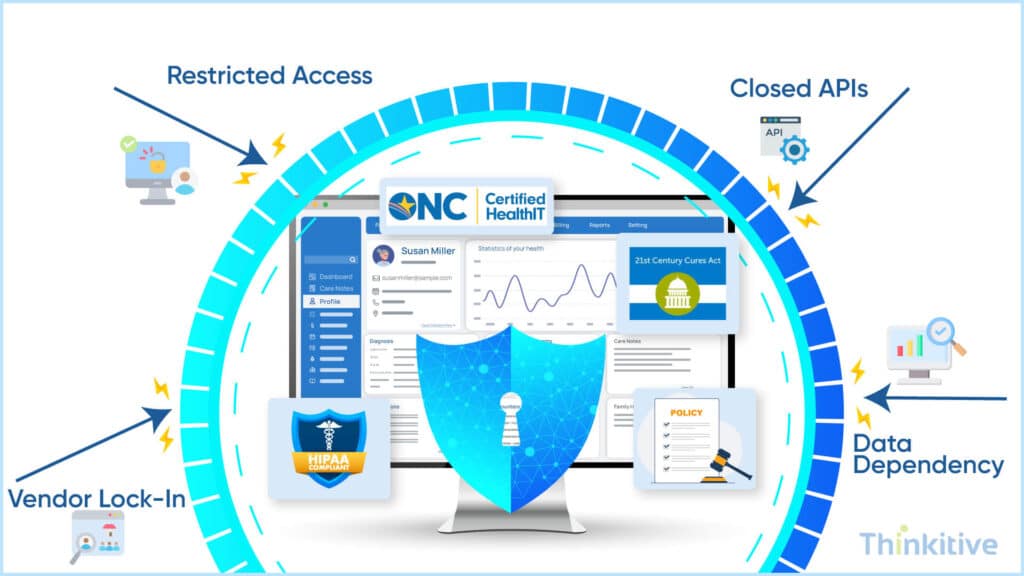
The architecture you choose does have a big role to play in avoiding EHR data lock-in. At the same time, healthcare regulations also encourage data accessibility, interoperability, and long-term flexibility.
Here are some of the regulatory compliance requirements that help you in EHR vendor lock-in prevention:
- 21st Century Cures Act: The information-blocking provisions prohibit practices that unnecessarily restrict access, exchange, or use of electronic health information (EHI), making it easier for healthcare organizations to access and share their data.
- ONC Certification Requirements: Certified EHRs must support capabilities such as standardized data export, interoperability, and patient access, reducing barriers to data portability and system migration.
- HIPAA Right of Access: HIPAA gives patients the right to access and obtain copies of their health information, reinforcing the need for healthcare organizations to maintain accessible and portable clinical data.
- Governance Policies: Regulations establish the baseline, but internal governance provides long-term protection. Define data ownership, interoperability requirements, export rights, and vendor evaluation criteria before selecting or building an EHR.
Together, all these regulations and governance practices create a strong foundation for EHR data portability. And the most effective way is to combine with a vendor-neutral architecture and open interoperability standards.
Build an EHR That Gives Full Control of Your Data –
Read GuideConclusion
Avoiding EHR data lock-in isn’t about predicting every future technology or choosing the right vendor. In fact, it’s about making the right architectural decisions from the very beginning. And the best way to do that is by building your EHR or EMR using open standards, adopting a vendor-neutral architecture, and maintaining full ownership of your clinical data..
So, basically you are creating a platform that can evolve with your practice’s needs and grow along with your practice rather than restricting them.
As healthcare continues to embrace AI, interoperability, telehealth and value-based care, flexibility will become equally important as functionality. In fact, practices that prioritize data portability, open APIs and strong governance today will be equipped to integrate new technologies, meet evolving regulatory requirements, and adapt without costly migrations or vendor dependency.
On that note, avoid EHR data lock-in and completely own your EHR system and the data in it. And if you want to know more about how to build an EHR from scratch , then get your free demo and see how it can evolve your practice.
Frequently Asked Questions
To avoid EHR data lock-in, healthcare organizations should build their EHR using open standards such as FHIR and HL7, adopt a vendor-neutral architecture, maintain ownership of their clinical data, and implement documented APIs with self-service data export capabilities. These architectural decisions make future integrations, upgrades, and migrations significantly easier.
EHR vendor lock-in typically occurs when healthcare organizations rely on proprietary data formats, closed APIs, vendor-controlled integrations, or tightly coupled system architectures. Over time, these dependencies make it difficult to migrate data, integrate third-party applications, or customize workflows without the vendor’s involvement.
The biggest risks include limited EHR data portability, higher migration costs, restricted access to clinical data, slower AI and interoperability initiatives, and reduced flexibility to adopt new technologies. Organizations may also become dependent on a single vendor for ongoing enhancements and integrations.
Common warning signs include expensive or limited data exports, proprietary APIs, undocumented database structures, vendor-controlled integrations, restricted workflow customization, and contracts that do not clearly define data ownership or exit rights.
A vendor-neutral EHR architecture separates the data, application, and integration layers while relying on open interoperability standards instead of proprietary technologies. This approach allows healthcare organizations to integrate new solutions, replace components, or migrate platforms without losing control of their data.
Proprietary data formats store clinical information in structures that are difficult to interpret or migrate outside the vendor’s ecosystem. This limits EHR data ownership in practice by making data extraction, integration, and migration more expensive and technically challenging.
FHIR and HL7 provide standardized methods for exchanging healthcare data between systems. By adopting these standards during development, organizations improve interoperability, simplify integrations, enhance EHR data portability, and reduce reliance on proprietary vendor technologies.
Common EHR vendor lock-in examples and solutions include replacing proprietary data models with FHIR-based structures, using open APIs instead of vendor-specific integrations, implementing self-service data exports, separating the data layer from the application layer, and defining data ownership and export rights in vendor agreements.
The best practices to prevent EHR vendor lock-in include designing a vendor-neutral EHR architecture, using FHIR and HL7 standards, maintaining complete data ownership, documenting APIs and database schemas, building modular systems, regularly testing data exports, and establishing governance policies that support long-term flexibility and interoperability.


