Build Your Own EHR: Handling Multi-Location Practice Data

Did you know 71% of hospitals have routine access to necessary information from outside providers, but only 42% actually report using it?
As healthcare practices are expanding across multiple clinics, specialties, and locations, managing this huge amount of patient data is becoming increasingly complex. You see, a patient may visit one location for primary care, a specialist for specialist consultation, and another one for diagnostic services. Due to this, the clinical history of the patient needs to be consistent across the organization.
With respect to this, a study found that more than 1.18 million patients had duplicate EHR records in almost 3% of cases. This highlights how easily fragmented patient identities can emerge within healthcare systems.
This means that having access to information does not mean that it can be effective; hence, only 42% of hospitals actually use it.
Now, for practices looking to build their own EHR, these challenges have to be addressed, especially at the architectural level, since it forms the core aspect of your EHR. For building a multi-location EHR, the system must maintain a unified patient record to support location-specific workflows, provider access, scheduling, billing, reporting, and security.
On that note, in this blog, let’s explore how to build an EHR for multi-location practices and other intricacies related to multi-location practice management EHR.
So, without further ado, let’s get started!
Watch How Multi-Location EHR Works in Real –
Watch Free DemoWhat Changes When an EHR Serves Multiple Locations?
Building an EHR for multi-site healthcare is quite complex. The architecture of the system must distinguish between data that is shared across the organization and data that is specific to the location of the clinic.
For instance, a patient’s identity and longitudinal clinical record must remain consistent across locations. On the other hand, data related to the operations of the practice, such as appointments, provider schedules, rooms, resources, etc., should remain associated with the location or at the point of care.
With this multi-tenant EHR architecture, you can prevent each clinic from isolating and creating data silos while still preserving location-specific workflows and access controls.
Refer to this table for some of the top location-specific concerns and how you can address them:
| Concern | How to Address It |
| Patient identity across sites | Maintain a single master patient index with cross-location matching, duplicate detection, and controlled merge/unmerge workflows. |
| Data separation vs. sharing | Maintain one longitudinal patient record while associating operational data with the relevant location. |
| Access control | Combine role-based access control (RBAC) with location-based permissions. |
| Provider records | Maintain organization-wide provider identities with location-specific privileges, schedules, and credentialing. |
| Scheduling and resources | Maintain location-owned calendars and resources with controlled cross-location visibility. |
| Reporting | Preserve location-level detail while enabling organization-wide aggregation. |
How Do You Build a Multi-Location EHR?
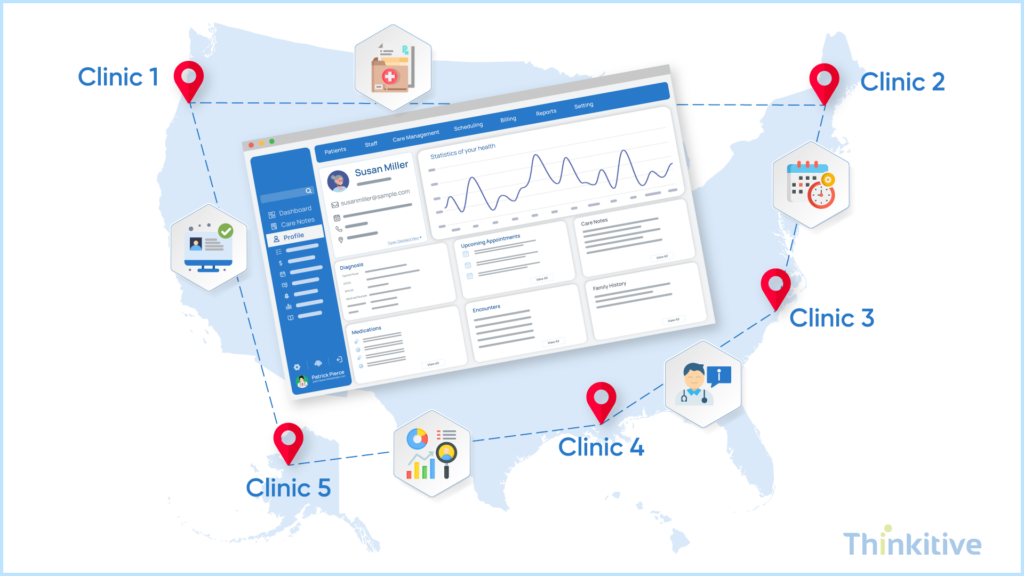
To build a multi-location EHR, you need to define the tenancy model first and then establish patient identity, model location context, implement location-aware access, standardize clinical content, and design reports around location-level data.
And typically, it follows a six-step process. On that note, here are the six stages for building a multi-location EHR:
1. Decide the Tenancy Model Before Any Data is Written: The first step is to decide how data will be isolated and shared across the organization. Depending on the requirements and scale of your EHR, it may involve a shared database, separate schemas, separate databases, or a hybrid approach. This decision is crucial because it impacts the system’s security, scalability, maintenance, and how easily data can be aggregated across multiple locations.
2. Establish the Master Patient Index and Cross-Site Matching Rule: The next step is to create a single patient identity strategy before individual locations begin operating independently. The master patient index should support patient matching, duplicate detection, and controlled merge and unmerge workflows so that the same patient does not accumulate separate records at different locations.
3. Model Location as a First-Class Attribute: Location should not be inferred from another field; instead, it should be explicitly associated with every record where it is relevant. On top of that, encounters, appointments, providers, schedules, rooms, resources, and operational records should be traceable to the appropriate location, whereas the organization-wide records should remain centralized.
4. Build Location-Scoped Access Control on Top of Roles: Role-based access control determines what a user can do; on the other hand, location-based permissions determine where they can do it- simple, isn’t it? For instance, a provider working across multiple clinics may need access to several locations, while the front-desk staff may be restricted to the location where they work.
5. Standardize Clinical Content With Location-Level Overrides: Last but not least, capture location context in operational and clinical data so that your EHR can support both site-level and organizational-level reporting. Individual locations should be able to analyze their own performance, and leadership should be able to roll the same data into enterprise-level dashboards and analytics.
6. Build Enterprise Reporting From Location-Level Data: Capture location context in operational and clinical data so the EHR can support both site-level and organization-wide reporting. Individual locations should be able to analyze their own performance, while leadership should be able to roll the same data up into enterprise-level dashboards and analytics.
Step-by-Step Guide for Building Multi-Location EHR –
Get Free Consultation
Managing Patient Identity Across Locations
One of the biggest challenges that many multi-location healthcare practices face is managing patient identity across locations. You see, when the same patient registers at different locations, your system must have the ability to recognize them as one person and preserve the clinical content of every encounter.
It is challenging because if each site creates patient records independently, then the same person can end up with multiple profiles, and their clinical histories will be fragmented across the different systems. On top of that, there will be inconsistent patient demographics as well; that is why a master patient index (MPI) is needed to provide a central identity layer that connects patient records across locations.
However, the matching strategy that you will be implementing needs to balance two major risks:
- Creation of duplicate records.
- Incorrectly merging different patients.
That is why matching rules need to be carefully curated. It can compare identifiers and demographics such as name, date of birth, contact information, address, and other organization-approved identifiers. While the high-confidence matches can be handled automatically, uncertain matches should be reviewed rather than merged automatically.
Your EHR should also provide controlled merge, unmerge, and review workflows. And to add another layer of verification, your staff should be able to investigate suspected duplicates, understand which records and clinical data will be affected, and reverse an incorrect merge when necessary.
Automated matching can be an advantage here by continuously surfacing probable duplicates as patients register or update their information. This allows staff to focus on exceptions instead of manually searching the entire patient database, while keeping final decisions on ambiguous matches under appropriate human oversight.
Standardizing Operations Without Flattening Local Practice
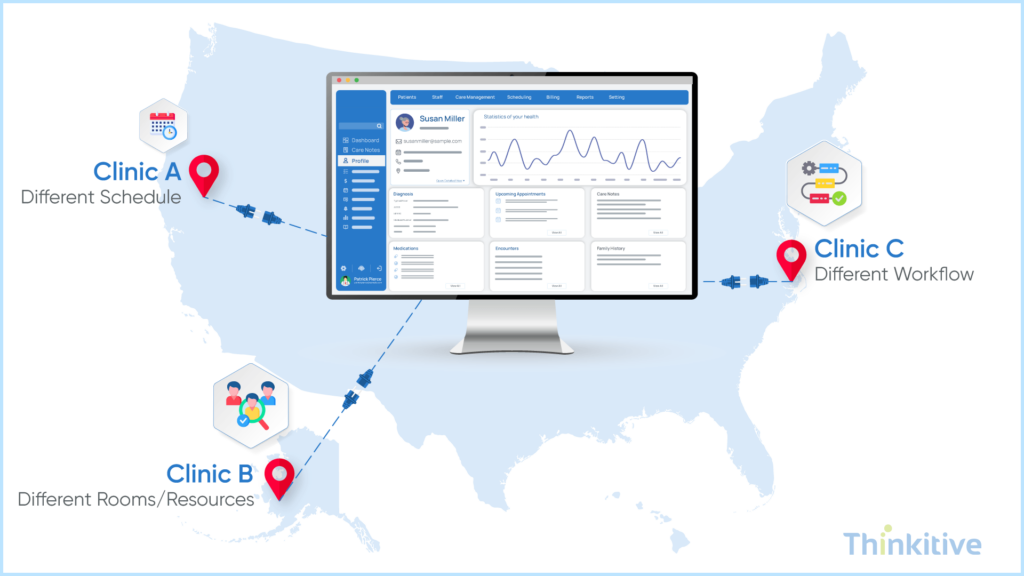
Creating a common foundation across the organization without forcing every location to follow an identical workflow is the best way to standardize operations in a multi-location EHR. You see, the goal is to standardize what needs to remain consistent across the practice and give controlled flexibility whenever required.
Here are some tried and tested ways in which you can do it:
- Standardize clinical content, allow controlled overrides: Use shared template forms, terminology, and order sets across locations. This allows sites to add approved location-specific variations without the need to create separate data structures.
- Coordinate scheduling without centralizing everything: Allow each location to manage its providers, rooms, equipment, operating hours, and appointment availability. At the same time, give authorized staff the required visibility into resources across sites when required.
- Keep workflows consistent across locations: Use common workflows and data definitions so the same clinical or operational event is documented consistently, irrespective of where it occurs. This is to ensure that the data remains comparable across multiple locations.
- Build reporting from the same underlying dataset: Preserve locations-level context for individual sites to monitor their performance while enterprise teams can aggregate the same data for organizational wide reporting and analytics.
In this way, you can give your multi-location EHR the consistency it requires where it matters and flexibility where it is needed.
Learn How to Build EHR That Supports CMS Quality Reporting on Your Own –
Read GuideCompliance Requirements for Multi-Location Healthcare Data
When it comes to compliance and security, your multi-location EHR must apply the same privacy and security controls across organizations and account for differences in how individual sites operate and share data with other healthcare organizations.
Here are some of the major compliance considerations that your multi-location EHR must support:
| Compliance Consideration | What the EHR Needs to Support |
| PHI sharing across locations | Define how participating locations share PHI based on their legal and organizational relationship, including applicable structures such as an Affiliated Covered Entity (ACE) or Organized Health Care Arrangement (OHCA). |
| State-specific requirements | Account for differences in medical-record retention, consent, privacy requirements, and professional licensure when locations operate across state lines. |
| Breach notification | Support organization-wide incident investigation, affected-record identification, documentation, and breach notification workflows when an incident impacts PHI across multiple locations. |
| Audit trails and access controls | Record who accessed or modified PHI, when the activity occurred, and the relevant location or organizational context, while enforcing role- and location-based permissions. |
Note: For a multi-location EHR, compliance should be built into the data model, access controls, audit infrastructure, and workflows from the very beginning of the development phase.
Conclusion
If you have made it to here, then you must have realized that building a multi-location EHR is more than just connecting multiple clinics to the same system. Its core requirement is a data architecture that keeps patient information unified and preserves the location-specific context of care, access, workflows, and reporting.
That is why you need to establish a clear tenancy model, maintain a reliable master patient index, implement location-aware access controls, standardize clinical data, and design the EHR system for enterprise reporting and compliance, right from the start.
This way, healthcare practices can build an EHR that scales across locations without creating fragmented data or disconnected workflows. So, what are you waiting for? Get started building your multi-location EHR system with the development of a cloud-based EHR. Know what you require for that with a free consultation from our EHR expert.
Frequently Asked Questions
A multi-location EHR is an electronic health record system designed to manage patient, clinical, administrative, and operational data across multiple healthcare locations within one organization. It provides a unified patient record while allowing each location to maintain its own providers, schedules, resources, workflows, and access permissions.
To build a multi-location EHR, organizations typically start by defining the tenancy and data architecture, establishing a master patient index, modeling location-specific data, implementing location-aware access controls, standardizing clinical content, and designing reporting that supports both individual sites and the enterprise. These components allow an EHR for multi-site healthcare to share information without creating isolated data silos.
Multi-tenant EHR architecture is an architecture in which a single EHR platform serves multiple organizations or tenants while keeping their data logically or physically isolated. Depending on security, scalability, and operational requirements, a multi-tenant EHR may use shared databases, separate schemas, separate databases, or hybrid approaches.
Patient identity is typically managed through an enterprise-wide identity strategy that allows every location to recognize the same patient. The system uses demographic and other approved identifiers to match records, detect probable duplicates, and maintain one longitudinal patient record across locations while preserving location-specific encounter and operational information.
A master patient index (MPI) is a centralized index that helps identify and match patients across an organization’s locations and systems. It is critical to a multi-location healthcare data architecture because it reduces duplicate patient records, prevents fragmented clinical histories, and helps ensure that information from different locations is associated with the correct patient.
Access control should combine role-based permissions with location-based restrictions. Roles determine what a user can access or perform, while location permissions determine where that access applies. For example, a provider working at two clinics may have access to both locations, while front-desk staff may be limited to their assigned site.
The EHR should retain location context in relevant clinical and operational records while using a shared data model for enterprise reporting. This allows individual locations to analyze metrics such as appointments, encounters, and revenue while leadership can aggregate the same data across the organization without maintaining separate reporting databases for each site.
Organizations operating across state lines need to account for differences in medical-record retention, consent, privacy requirements, and professional licensure in addition to federal requirements such as HIPAA. A multi-location EHR should support configurable policies and workflows where state-specific requirements differ.
Key multi-site EHR deployment best practices include establishing the data and tenancy model before deployment, maintaining a reliable master patient index, applying location-aware access controls, standardizing clinical data and workflows, allowing controlled location-level configuration, validating interoperability, and monitoring audit logs and security controls. A phased rollout with location-specific testing can also help identify workflow and data issues before organization-wide deployment.


