In-House vs Outsourced Medical Billing: Which Is Right for Your Practice


Did you know physicians and their staff spend around 13 hours per week on prior authorization alone?
On top of that, the American Medical Association also stated that 40% of physicians have dedicated staff for administrative tasks. Now, out of all the administrative tasks, the most time-consuming and hard to manage is medical billing.
You see, medical billing typically goes beyond submitting claims. Teams have to handle coding, eligibility, prior authorization, denial management, payment posting, and accounts receivable while keeping up with the changing requirements of payers.
Given this extensive burden on the administrative staff, practices are actively looking for ways to reduce administrative workload and improve revenue cycle performance. With regard to this, the MGMA stat pool found that more than 36% of practices are planning to outsource their revenue cycle management or at least certain areas of it.
However, the choice between in-house vs outsourced medical billing can be quite dilemmatic. You see, having an in-house billing team gives you greater control, direct oversight, and close integration with practice operations. On the other hand, medical billing outsourcing services can provide you with specialized expertise, technology, and additional capacity without the need to manage the entire billing department.
So, this brings me to the question you’ll most probably ask, ‘Out of in-house vs outsourced medical billing, which approach is better for me?’
Well, there is no specific answer to this. It depends on various factors like practice size, billing volume, staffing capabilities, technology, budget, growth plans, etc.
But this is exactly why I am writing this blog and to answer your question of, ‘How to choose between in-house and outsourced medical billing?’
On that note, let this blog be your guide to choosing the right medical billing approach for your practice, and without further ado, let’s get started!
What Is the Difference Between In-House and Outsourced Medical Billing?
Let’s start with understanding the difference between in-house and outsourced medical billing, and it is clearly about who manages the practice’s billing operations. For instance, in-house medical billing is where the practice employs its own billing staff, who are responsible for managing everything related to the practice’s revenue cycle.
In an outsourced model, an external medical billing company handles some or all of the practice’s medical billing affairs under an agreed-upon service agreement.
Let’s have a look at both of these models in detail below in the table:
| Aspect | In-House Medical Billing | Outsourced Medical Billing |
| Billing management | Managed by the practice’s internal team. | Managed by an external medical billing company. |
| Staffing | The practice hires, trains, and manages billing staff. | The billing company assigns and manages its billing staff. |
| Billing responsibilities | The practice determines and manages the billing functions handled internally. | The practice and billing company define the outsourced functions in the service agreement. |
| Technology | The practice selects and maintains the systems used for billing. | Technology responsibilities depend on the services and agreement with the billing company. |
| Day-to-day oversight | Practice leadership directly oversees billing operations and staff. | The practice oversees the vendor relationship while the vendor manages assigned operations. |
| Cost responsibility | The practice bears employee, technology, training, and other billing-related operating costs. | The practice pays the agreed fees for the outsourced services. |
| Scope | Billing can be managed entirely within the practice. | The practice can outsource selected functions or its broader revenue cycle. |
How Do In-House and Outsourced Medical Billing Compare?
The choice between in-house and outsourced medical billing is more than just who clicks the submit button for the claims. Both models differ in how the practice handles staffing expertise, costs, technology, compliance, day-to-day management, and overall revenue cycle operations.
Typically, in-house billing gives practices direct responsibility and oversight of their billing operations. However, outsourcing shifts agreed-upon functions to an external team.
Now, there is no right approach for the practice; the choice clearly depends on the practice’s resources, billing needs, operational priorities, and growth plans.
Have a look at this table to compare the key factors that you consider when evaluating:
| Factor | In-House Medical Billing | Outsourced Medical Billing |
| Staffing | Practice recruits, trains, and manages its billing staff. | External billing team handles assigned billing functions. |
| Expertise | Depends on the skills and experience of the internal team. | Provides access to professionals with specialized billing and RCM expertise. |
| Cost Structure | Includes salaries, benefits, software, training, and other overhead costs. | Typically involves service fees based on the agreed pricing model. |
| Technology | Practice selects, implements, and maintains billing systems. | Vendor may provide or support billing technology, depending on the agreement. |
| Scalability | Growth may require additional staff, technology, and resources. | Billing support can generally be adjusted as practice needs change. |
| Revenue Cycle Efficiency | Depends on internal processes, staffing, and management. | Dedicated workflows and billing expertise can support revenue cycle operations. |
| Compliance | Practice is responsible for staff training, processes, and oversight. | Vendor supports compliance for the functions it manages, while the practice retains overall responsibility. |
| Management | Practice directly manages billing staff and daily operations. | Practice manages the vendor relationship while the vendor manages its team. |
| Control & Visibility | Provides direct control over billing processes and staff. | Requires clear reporting, communication, and performance monitoring. |
| Staff Turnover | Employee turnover can disrupt billing operations and require replacement hiring. | Vendor is responsible for managing its internal staffing and coverage. |
| Best Fit | Practices with the staff, expertise, and resources to manage billing internally. | Practices seeking additional expertise, capacity, or support with billing operations. |
What Does Medical Billing Really Cost?
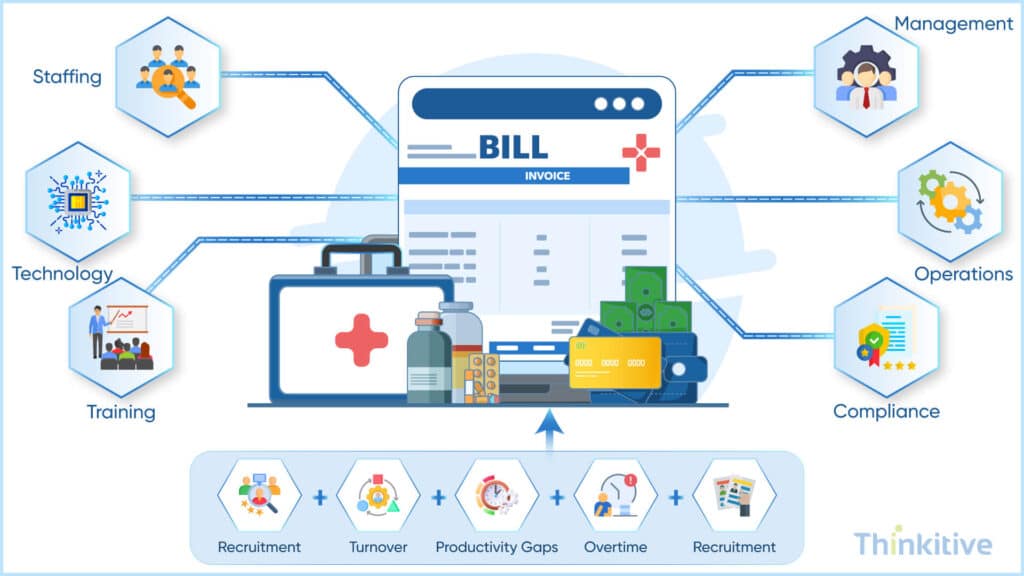
Now, this is where things get tricky. The cost of medical billing usually goes beyond the amount a practice pays its billing staff or for medical billing outsourcing services. When comparing in-house vs outsourced medical billing costs, you must consider the total cost of managing the revenue cycle, which includes staffing, technology, training, management, and other operational expenses.
Direct Costs of In-House Medical Billing
As the practice takes on the direct cost of employing and supporting its billing staff, the direct cost here includes:
- Salaries and employee benefits
- Recruitment and onboarding
- Billing and practice management software
- Clearinghouse and claim submission fees
- Training and continuing education
- Computers, office space, and other equipment
- Compliance and administrative resource
NOTE: These expenses can vary significantly based on the size of the billing team, claim volume, specialty, and the range of functions handled internally.
Hidden Costs of In-House Billing
The actual cost is typically higher than the visible operating expenses, especially with internal billing operations. For instance, staff turnover, recruitment delays, productivity gaps, overtime, technology upgrades, and management time can add up to the cost of maintaining an in-house billing team.
Let’s take an example to understand. When an experienced biller leaves, the practice may need to spend time and money recruiting a replacement while managing the potential disruption to billing operations. Along with that, updating the billing systems and training the staff with the latest updates requires ongoing investment.
What Does Outsourced Medical Billing Cost?
On the other hand, outsourced medical billing typically replaces many of these internal operating expenses with a service fee. So depending on the provider and scope of service, fees may be structured as a percentage of collections or a fixed fee, a per-claim charge, or another agreed-upon pricing model.
NOTE: The cost depends on factors such as the services outsourced, claim volume, specialty, practice size, and level of revenue cycle support required.
What Are the Pros and Cons of Outsourcing Medical Billing?
One of the major advantages of outsourcing medical billing is that it gives practices direct access to additional expertise and resources without having to build and manage a larger internal billing team. However, it comes with some of its own challenges related to control, communication, and vendor management that must be considered.
On that note, here are some of the most common pros and cons of outsourcing medical billing that you must know:
Advantages of Outsourcing Medical Billing
- Access to Specialized Expertise: Medical billing companies usually have experienced teams in core areas like claims processing, coding, denial management, payer requirements, and accounts receivable follow-up.
- Scalable Billing Support: As patient volume, provider count, or locations increase, billing needs also increase. This is where outsourced medical billing can be advantageous, giving you additional support without the need to hire extra employees.
- Staffing Flexibility: As a practice, you don’t have to look after every aspect of staffing like recruiting, training, scheduling, or retaining billing teams. This reduces administrative efforts effectively.
- Reduced Administrative Workload: By transferring agreed-upon billing functions to an external team, practice leaders and clinical staff can spend less time managing day-to-day revenue cycle activities and focus more on core practice operations.
Limitations of Outsourcing Medical Billing
- Less Direct Control: You don’t actually have direct control over managing every billing activity. However, with clear processes for oversight, reporting, approvals, and performance management, some control can be gained.
- Communication Challenges: The outsourced team may not have the same instant access to providers and practice staff as that of an internal billing team. Clear communication channels can help in defining responsibilities.
- Transition Requirements: Moving from internal billing operations to an external partner needs proper planning. Processes like data transfer, workflow changes, system integration, staff coordination, and training can all be done carefully and yet affect the transition.
- Vendor Dependencies: If significant processes of your revenue cycle are outsourced, the practice becomes dependent on the vendor’s ability to deliver consistent service. Changes in staffing, processes, or service are some of the factors that might affect your billing operations.
- Varying Service Quality: Different billing companies offer different levels of expertise, technology, communication, or reporting. That is why practices need to evaluate potential vendors carefully and establish measurable performance expectations.
What Are the Compliance and Staffing Risks of In-House Billing?
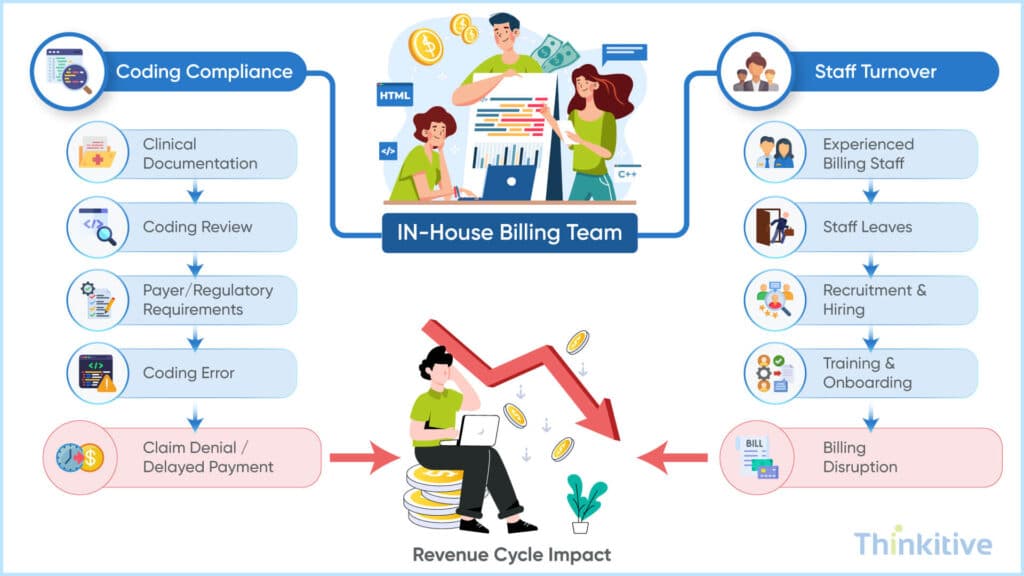
Managing medical billing internally indeed gives you direct oversight of your billing operations. However, when you are managing billing internally, you need to maintain coding accuracy, regulatory compliance, and staffing stability.
To make things worse, when internal resources are limited, gaps in any area can affect both the revenue cycle performance and compliance.
On that note, here are some risks that you need to consider for in-house billing:
- Medical Coding Compliance: Accurate medical coding is what gets you the right reimbursement and compliant billing. For this, your internal team must keep up with the changing guidelines, payer-specific requirements, documentation standards, and regulatory requirements to ensure claims are correct. Furthermore, coding errors or incomplete documentation can result in claim denials, delayed payments, incorrect reimbursement, or compliance issues.
- Billing Staff Turnover: Staff turnover can create another challenge for practices that rely on an internal billing team. So, when an experienced biller leaves, you might have to recruit and train a replacement while managing the pending work. This can have a domino effect on billing continuity, productivity, claim follow-up, denial management, and accounts receivable. And new employees might take a lot of time to learn the system.
Compliance and staffing stability must be considered alongside cost and operational control when comparing billing models. That is why a practice with sufficient resources to maintain a well-trained and stable billing team may be comfortable managing these responsibilities internally.
Choosing the Right Billing Model
If you have made it to here, then you probably know what model is right for you. But on the contrary, it is also true that there is no clear answer to the model that suits you. So, while making a choice, you must consider your practice’s cost structure, staffing, compliance needs, billing efficiency, level of control, and scalability requirements.
Here are some factors, or rather the questions, that you should ask before making a decision:
- Practice size and claim volume: Can your internal team efficiently handle your current and projected billing workload?
- Specialty: Does your specialty require specialized coding or payer expertise?
- Current billing performance: Are claims submitted promptly, denials managed effectively, and A/R followed up consistently?
- Staffing: Do you have enough qualified staff to maintain billing operations and manage turnover?
- Growth plans: Can your current model scale as you add providers, locations, or patient volume?
- Control and oversight: How much direct control do you want over billing operations?
NOTE: In-house billing may be a better fit for practices with experienced internal teams and sufficient resources, while outsourcing may make more sense for practices seeking specialized expertise, additional capacity, or reduced administrative workload. A hybrid model can also provide a middle ground by allowing practices to outsource selected functions while keeping others in-house.
Conclusion
The choice between in-house and outsourced medical billing ultimately comes down to what works best for your practice. While an in-house team can provide you with more direct control and oversight over the operations, outsourcing can offer specialized expertise, flexibility, and reduced administrative responsibilities.
Having said that, before making any decision, your practice’s costs, staffing capabilities, billing performance, compliance needs, and growth plans need to be studied. And still, the right billing model for you is not necessarily the one that costs less, but the one that can support accurate, efficient, compliant, and sustainable revenue cycle management.
If you are still not convinced about which one to choose, the option for a hybrid model can work perfectly, but that is the topic for another blog.
On that note, I hope this blog has served you well and helped you in choosing the right medical billing services for your practice.
Frequently Asked Questions
The primary difference in in-house vs outsourced medical billing is who manages the practice’s billing operations. With in-house billing, the practice hires and manages its own billing staff and systems. With outsourced billing, an external medical billing company manages some or all billing and revenue cycle functions under an agreed-upon service arrangement.
Not necessarily. The in-house vs outsourced medical billing costs depend on factors such as staffing, claim volume, technology, specialty, and the scope of services outsourced. Practices should compare the total cost of each model—including salaries, benefits, software, training, management, and other overhead for in-house billing—rather than comparing employee salaries with vendor fees alone.
The hidden costs of in-house medical billing can include employee turnover, recruitment and onboarding, training, overtime, productivity gaps, technology upgrades, management time, and maintaining billing infrastructure. These expenses can make the true cost of in-house medical billing significantly higher than salaries and benefits alone.
Outsourcing can support revenue cycle management efficiency by providing dedicated billing staff, established workflows, and specialized expertise in areas such as claims, denials, coding, and accounts receivable. However, results depend on the billing partner’s capabilities, the scope of services, communication, and performance oversight.
Managing billing internally requires the practice to maintain coding accuracy, documentation standards, payer requirements, and regulatory compliance. A medical coding compliance risk can arise when staff are not adequately trained or kept up to date with changing requirements. Billing staff turnover rate is another consideration, as frequent turnover can disrupt workflows, reduce productivity, and leave unresolved billing work.
Keeping medical billing in-house may make sense when a practice has a stable and experienced billing team, sufficient claim volume to support internal operations, strong billing processes, and the resources to manage technology, training, compliance, and staffing. Practices that value direct control and have consistently strong billing performance may also prefer an internal model.
A practice may consider outsourcing when it faces staffing shortages, increasing billing complexity, persistent denials, aging accounts receivable, or difficulty maintaining billing expertise internally. The pros and cons of outsourcing medical billing should be evaluated carefully to determine whether external support addresses the practice’s specific operational needs.
Yes. A practice can use a hybrid medical billing model by keeping certain functions in-house while outsourcing others. For example, a practice might manage patient billing and selected administrative tasks internally while outsourcing coding, claims processing, denial management, or A/R follow-up.
To understand how to choose between in-house and outsourced medical billing, evaluate your practice’s total billing costs, staffing capabilities, claim volume, specialty requirements, compliance needs, current revenue cycle performance, desired level of control, and growth plans. The best model is the one that can manage your billing accurately and efficiently while remaining sustainable as your practice evolves.


