How to Build an EHR System with Integrated Billing, Labs & Telehealth

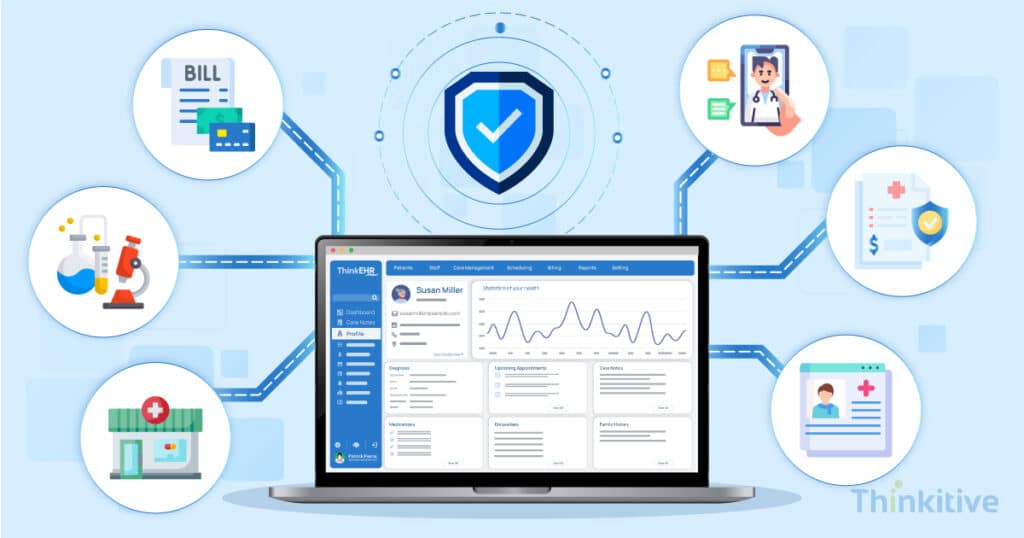
Electronic Health Records (EHRs) have today become the epicenter for healthcare practices to deliver quality care. It acts like the connecting link that helps in connecting with billing platforms, laboratory systems, telehealth platforms, and patient engagement tools.
Going through the list of things for which you depend on EHR, it can be said that almost every aspect of care depends on the EHR system operating in a connected ecosystem.
While building an EHR system is just one side of the story, not building an integrated EHR system can lead to system isolation, different systems for different tasks, staff duplicate data entry, and billing errors; all of this combines together to impact patient care.
This is why healthcare providers are looking to build an integrated EHR for their practice. It will allow them to build a system that seamlessly integrates with disparate healthcare platforms for everyday use.
Some of the most common use cases of building an integrated EHR are that it helps in automatically sending diagnoses to billing, receiving lab results in real time, or launching virtual consultations directly from patient charts.
With a well-defined EHR integration architecture, you can easily improve efficiency, reduce administrative burden, and create a better experience for both providers and patients.
On that note, in this blog, let’s see how to build an EHR system with integrated billing, labs, and telehealth platforms. And while we are at it, also have a look at how to build an EHR with built-in integrations.
So, without further ado, let’s get started!
Assess Your System for Interoperability & Integration Capabilities –
Get Free Assessment
Why Build an Integrated EHR for Modern Healthcare
If you are using an off-the-shelf EHR software, then you are probably using multiple systems for various activities that span from appointment scheduling to billing, etc. However, due to your EHR software being disconnected from other systems, it created inefficiencies, duplicate data entry, fragmented patient information, billing delays, and poor care coordination.
To solve these issues, you need to build an integrated EHR system that connects all these workflows into a single platform. This not only improves the operational efficiency of your practice, but the data-backed analysis also leads to better decision-making, faster reimbursements, and scalability when needed.
Especially with necessary systems like billing, labs, and telehealth, EHR with billing, labs, and telehealth integration needs to be embedded into the core EHR architecture.
EHR Integration Architecture: Core Components & Frameworks
The magic of a well-integrated EHR is that you don’t need custom code to connect with external applications. These EHR systems can rely on a well-designed integration architecture that enables secure, scalable, and reliable data exchange between clinical, financial, and operational systems.
The architecture comes in handy here as it combines APIs, interoperability standards, middleware, and secure communication protocols to ensure that the data flows seamlessly across the healthcare ecosystem.
Have a look at this table to know the core components and the frameworks that are involved in this:
| Architecture Component | Purpose in an Integrated EHR | Common Standards/Technologies |
| APIs | Enable real-time communication between the EHR and external systems such as billing platforms, telehealth applications, laboratories, pharmacies, and patient portals. | REST APIs, GraphQL, Webhooks |
| Middleware / Integration Engine | Routes, transforms, validates, and manages data exchanged between systems using different formats or protocols. | Mirth Connect, Rhapsody, Cloverleaf |
| Clinical Interoperability | Standardizes the exchange of clinical information such as patient records, lab orders, medications, and encounters. | HL7 v2, FHIR, SMART on FHIR, CDS Hooks |
| Billing & Payer Integration | Supports insurance eligibility, claim submission, payment reconciliation, and remittance processing. | X12 EDI (837, 835, 270/271, 276/277) |
| Security & Access Management | Protects patient information while enabling secure access to connected applications. | OAuth 2.0, OpenID Connect, RBAC, TLS Encryption |
| Data Storage & Analytics | Consolidates data from multiple systems to support reporting, AI, and population health initiatives. | FHIR Server, Clinical Data Repository, Data Warehouse |
Together, these components form the foundation of a modern EHR integration architecture. By combining standardized interoperability frameworks, secure APIs, and scalable integration pipelines, healthcare organizations can connect billing, laboratory, telehealth, and other healthcare systems while creating a platform that’s ready for future innovations such as AI-powered clinical decision support and advanced analytics.
Once your integration architecture is in place, the next step is deciding which healthcare systems to connect first. Explore our guide to the must-have EHR integrations for modern healthcare practices.
Choosing the Right Integration Approach
When building an integrated EHR, connecting different healthcare systems is only one part of the process. You also need an integration approach that allows data to move securely and reliably across every application. The right architecture should simplify future integrations instead of making every new connection more complex.
| Integration Approach | Best For |
| Point-to-Point | Connecting a small number of applications quickly. |
| Integration Engine | Managing multiple healthcare systems through a central connection. |
| API-First | Modern cloud-based EHR platforms requiring real-time communication. |
| Event-Driven | Automatically synchronizing data whenever clinical events occur. |
Whichever approach you choose, your integration architecture should support interoperability standards, secure authentication, and future scalability so new healthcare applications can be added without disrupting existing workflows.
How Do You Build an Integrated EHR?
1. Define your clinical and operational workflows: Map how patient and operational data should flow across your EHR.
2. Identify the healthcare systems that require integration: Determine which external systems your EHR needs to connect with.
3. Choose an integration engine and API strategy: Select the right APIs, middleware, or integration engine for your architecture.
4. Map data standards (FHIR, HL7, X12): Standardize data exchange using HL7, FHIR, and X12 protocols.
5. Build secure integrations using APIs and middleware: Connect systems using secure APIs and reliable integration frameworks.
6. Test end-to-end workflows: Validate data accuracy, performance, and interoperability across systems.
7. Monitor, maintain, and scale integrations: Continuously optimize integrations as your practice and technology evolve.
Common Challenges When Building an Integrated EHR
| Challenge | How to Address It |
| Legacy Systems | Use an integration engine to connect older applications. |
| Vendor-Specific APIs | Build an API gateway to simplify integrations. |
| Duplicate Patient Records | Implement a Master Patient Index (MPI) for accurate patient matching. |
| Security & Access Risks | Apply RBAC, OAuth 2.0, and encrypted data exchange. |
| Inconsistent Data Formats | Standardize data using HL7, FHIR, and X12 protocols. |
Planning Your Integration Ecosystem
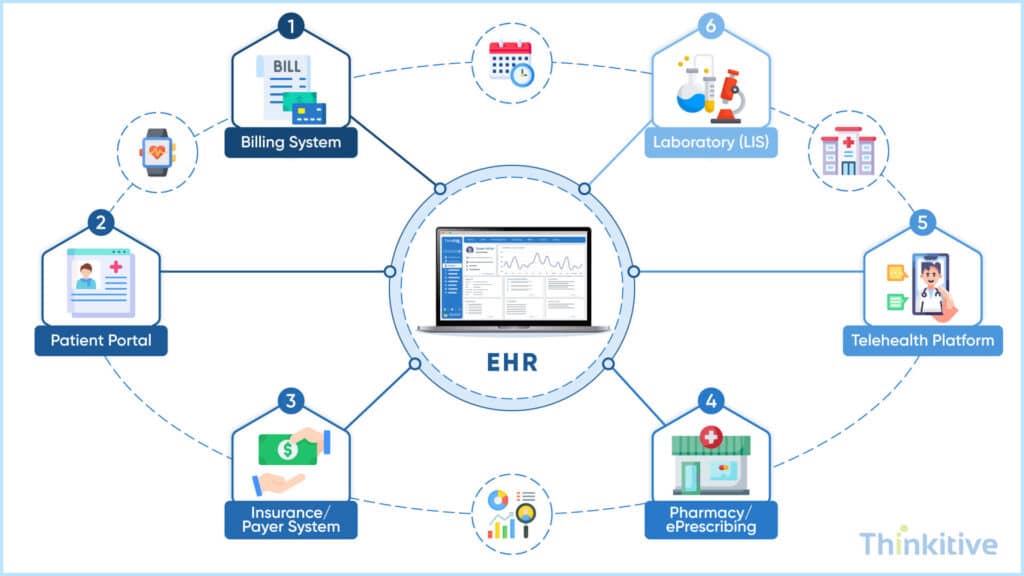
Before you actually start your integration process with third-party systems, it’s important to identify the integrations your practice actually needs. All this can be done in the planning phase of your EHR integration.
Before integrating any third-party systems, define the clinical, administrative, and financial workflows your EHR must support. Document how patient data should move between systems, identify integration points, and establish security, compliance, and performance requirements. This architectural planning helps avoid disconnected workflows and ensures every integration supports long-term scalability.
Rather than connecting every application at once, adopt a phased approach that focuses on high-value integrations first while keeping your architecture scalable. A well-planned integration ecosystem allows your EHR to support current workflows and seamlessly accommodate future technologies, regulatory requirements, and evolving healthcare needs.
Key Planning Considerations for an Integrated EHR
- Map end-to-end clinical and administrative workflows before selecting integration technologies.
- Identify data ownership and synchronization points between connected systems.
- Choose interoperability standards (HL7, FHIR, X12) based on integration requirements.
- Design for scalability so future applications can be added without redesigning the architecture.
- Define security, authentication, and access controls before implementation begins.
Extending EHR Capabilities Beyond the Clinic
Telehealth should be treated as one component of a broader integration strategy rather than a standalone capability. When designing an integrated EHR, ensure virtual consultations share scheduling, documentation, patient records, and billing workflows with the core system. This approach creates a consistent user experience while keeping the architecture scalable. For a detailed implementation guide, read our Telehealth-Ready EHR article.
Creating an Integrated EHR Workflow Across Care Delivery
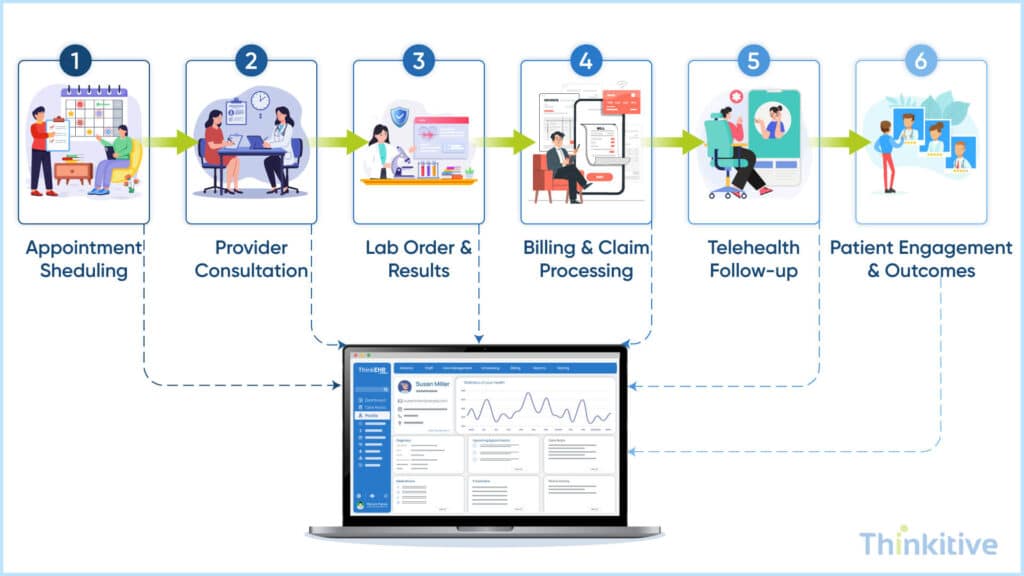
Why are you building an integrated EHR?
The answer is quite simple: building an integrated EHR gives your system the ability to connect clinical, financial, and operational workflows into a single, seamless ecosystem. This way, instead of operating as separate applications for billing, labs, telehealth, etc., all these systems can be brought together into one system that is your EHR system.
It helps you ensure consistency, accuracy, and accessibility to patient information at every given stage.
Moreover, by eliminating workflow silos and automating cross-system data synchronization, healthcare practices can reduce duplicate data entry, minimize errors, accelerate billing, and improve care coordination.
Typical Integrated EHR Workflow
A well-designed integrated EHR connects every stage of the patient journey so information flows automatically between systems instead of requiring manual data entry. A typical workflow looks like this:
1. Patient registration captures demographic and insurance information.
2. Appointment scheduling updates provider calendars and patient reminders.
3. Clinical documentation records diagnoses, medications, and treatment plans.
4. Laboratory orders and results are exchanged directly with the laboratory system.
5. Billing and claims are generated automatically using clinical documentation.
5. Patient engagement tools provide access to visit summaries, prescriptions, and follow-up communication.
When these workflows are connected, providers spend less time switching between systems, administrative teams avoid duplicate work, and patients experience faster, more coordinated care.
A connected healthcare data environment also creates the foundation for AI-powered capabilities such as clinical decision support, predictive analytics, automated documentation, and operational insights, enabling providers to deliver smarter, more efficient, and patient-centric care.
Does Your Practice Need Customized Workflow? See How Custom EHR Would Work in Action –
Book DemoEliminating Workflow Friction Through Connected Systems
Disconnected healthcare systems push your clinical and administrative staff to switch between various systems and repeatedly enter the same patient information across the EHR, billing, laboratory, and telehealth platforms.
This process will not only increase administrative workloads but also lead to data inconsistencies, billing delays, and fragmented patient records that can impact both operational efficiency and care quality.
An integration-first EHR eliminates these workflow bottlenecks by automatically synchronizing data across connected systems. As patient information is updated in real time, healthcare organizations can reduce duplicate data entry, improve data accuracy, streamline clinical and billing workflows, and enable care teams to focus more on patients than administrative tasks.
Compliance & Interoperability Requirements for EHR Integration
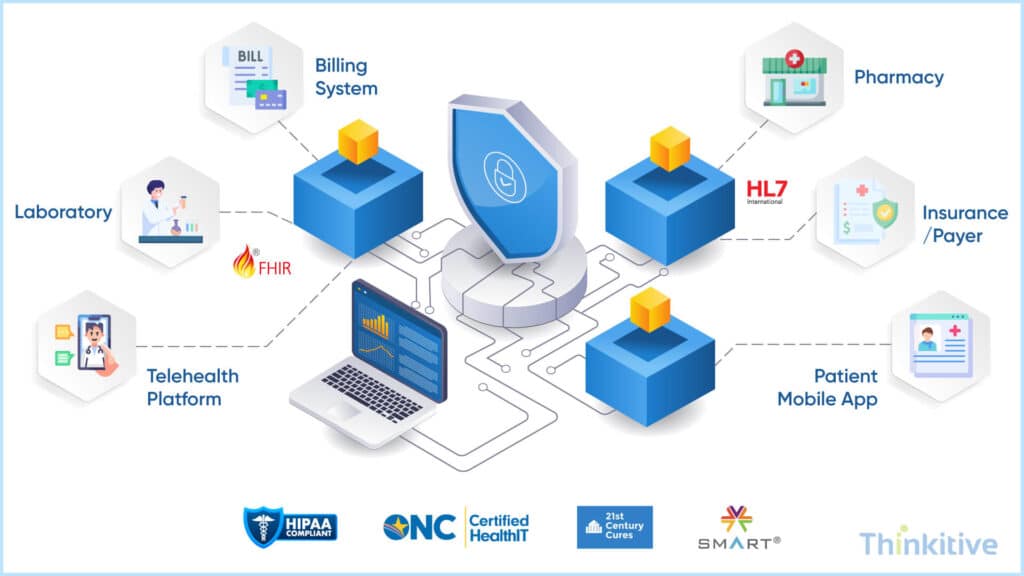
Building an integrated EHR requires more than connecting systems—it also requires ensuring every data exchange is secure, compliant, and interoperable. From the outset, your EHR architecture should support regulatory requirements such as HIPAA and HITECH by implementing encryption, role-based access controls, audit trails, and secure API authentication across all integrated applications. Organizations should also consider ONC certification requirements and the interoperability provisions of the 21st Century Cures Act to enable standardized data sharing and minimize future compliance risks.
By designing a secure and scalable integration architecture from day one, healthcare organizations can confidently support new interoperability standards, third-party integrations, and AI-powered capabilities while remaining compliant as regulatory and technology requirements continue to evolve.
Conclusion
Building an integrated EHR system is not a want but a need of the current healthcare landscape. And this is also the answer to one of the most common questions we get asked, ‘How to reduce double data entry in EHR systems’ if not, then you read in detail about that in our how to reduce double data entry in EHR article.
Building an integrated EHR starts with designing the right architecture—not simply connecting individual applications. By establishing secure APIs, interoperability standards, integration engines, and scalable workflows from the beginning, healthcare organizations can support billing, laboratory systems, telehealth, AI, and future innovations without repeatedly redesigning their platform.
On that note, let this blog be your guide to building an integrated EHR for your practice. And if you want to know what EHR features build in your system, then get a free system assessment from our EHR expert and get started.
Frequently Asked Questions
To build integrated EHR platforms means developing an EHR that seamlessly connects with other healthcare systems such as billing software, laboratory information systems, telehealth platforms, pharmacies, patient portals, and payer systems. Instead of functioning as a standalone application, an integrated EHR acts as the central hub for clinical, financial, and operational workflows, enabling secure, real-time data exchange across the healthcare ecosystem.
A well-designed EHR integration architecture provides the foundation for secure and reliable communication between the EHR and external systems. It ensures data flows efficiently through APIs, interoperability standards, and integration engines, allowing healthcare organizations to improve care coordination, reduce administrative work, and support future scalability.
FHIR-based integrations for modern EHRs enable standardized, API-driven data exchange between healthcare applications. Unlike traditional messaging standards, FHIR simplifies interoperability by allowing systems to securely share patient records, medications, appointments, laboratory results, and other clinical data in real time, making integrations faster, more scalable, and easier to maintain.
An integrated EHR workflow streamlines the movement of information across clinical, administrative, and financial systems. By automating data exchange, healthcare organizations can reduce manual tasks, minimize documentation errors, improve collaboration between departments, accelerate billing processes, and deliver a more coordinated patient experience.
One of the most effective ways to reduce double data entry in EHR systems is by integrating all essential healthcare applications with the EHR. When patient information is automatically synchronized across billing, laboratory, telehealth, and other connected systems, staff no longer need to repeatedly enter the same data, reducing errors while improving productivity.
AI enhances integrated healthcare ecosystems by automating clinical documentation, identifying care gaps, supporting clinical decision-making, predicting patient risks, and generating operational insights. AI also benefits from connected data, making integrated EHRs more valuable by enabling intelligent workflows across multiple healthcare applications.
How to build an EHR with built-in integrations starts with designing interoperability into the system architecture from the beginning. This includes selecting appropriate APIs, supporting standards like HL7 and FHIR, implementing secure authentication, choosing scalable middleware, and prioritizing integrations based on clinical and business workflows instead of adding them as afterthoughts.
EHR integrations should prioritize HIPAA compliance, end-to-end encryption, secure API authentication, role-based access control, audit logging, data integrity, and continuous monitoring. These safeguards help protect sensitive patient information while ensuring secure communication between connected healthcare systems.
Organizations that build integrated EHR systems often face challenges such as integrating legacy applications, maintaining data consistency, supporting multiple interoperability standards, ensuring regulatory compliance, managing vendor-specific APIs, and scaling integrations as healthcare needs evolve. A well-planned architecture helps overcome these challenges.
Healthcare organizations should build a flexible EHR tech stack that supports interoperability, cloud scalability, secure APIs, AI capabilities, and evolving regulatory requirements. By prioritizing high-value integrations first and adopting open standards such as FHIR, organizations can create an integration ecosystem that adapts to future technologies without requiring major system redesigns.


