Custom EHR Integration: Tailored Solutions for Complex Workflows

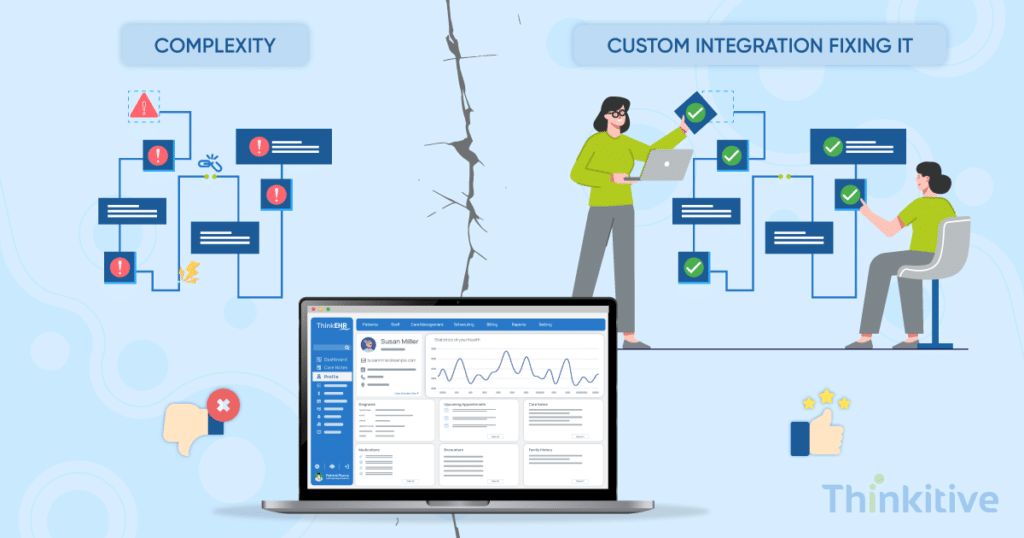
Do you realize why custom EHR integration is a need for every healthcare practice today?
Have a look at this, according to ONC, almost 86% of office-based physicians use EHR systems, and in 2026, the number is expected to complete the transition to EHR systems. This must mean that data must be flowing smoothly across healthcare systems, right?
Well, NO!
You see, another stat by ONC suggests that less than 46% of hospitals can find, send, receive, and integrate data electronically. Can you imagine the isolated data growth spread across the healthcare industry? The number is almost 60% according to a study by Deloitte.
Now, most of the EHR software systems come with basic integration capabilities. However, these standard EHR systems struggle in complex clinical environments. And this is the reason why, despite having a near-perfect adoption rate for EHR systems, more than 60% of data remains isolated, and less than half of the hospitals are able to achieve complete integration.
To understand the foundation of how these systems connect and exchange data, you can also refer to EHR Integration Guide: Complete Overview for Healthcare Organizations.
And in the foresight for healthcare practices becoming more specialized and offering value-based care, custom EHR integration is the need of healthcare providers with complex workflows.
Having said that, to answer the question I asked at the start, it is because of the integration gap in the market that has made EHR integration for complex workflows the need of the hour.
So, in an attempt to close the gap between rigid systems and real-world healthcare processes, let’s discuss how custom EHR integration is the right solution for your complex healthcare workflows.
So, without further ado, let’s get started!
Check Your System Compatibility for HL7 vs FHIR:
Get Free Consultation
When Standard Integration Isn’t Enough?
Let’s start by addressing the problem with standard EHR integration.
- Workflow Friction: In most of the standard integrations, data handling is done manually. Meaning most of the data is entered manually at every stage. This creates friction in workflows, as human intervention is required at every stage.
- Legacy Systems & Limited APIs: The use of legacy systems in healthcare is still a major challenge. Due to this, API-based integration becomes quite difficult. Furthermore, due to its complexity, it further poses challenges in establishing connections between disparate systems.
- Interconnected Healthcare Systems: As you know, every healthcare practice is unique and has unique workflows; the complexity between these interconnected systems disrupts the integration bridge, causing errors in data sharing.
While these are some of the major limitations of standard integrations, a major challenge that many practices are dealing with is flexibility. And standard integrations are simply not capable of providing it.
This leaves healthcare providers with only one choice – custom EHR integration.
When is Custom EHR Integration the Right Choice?
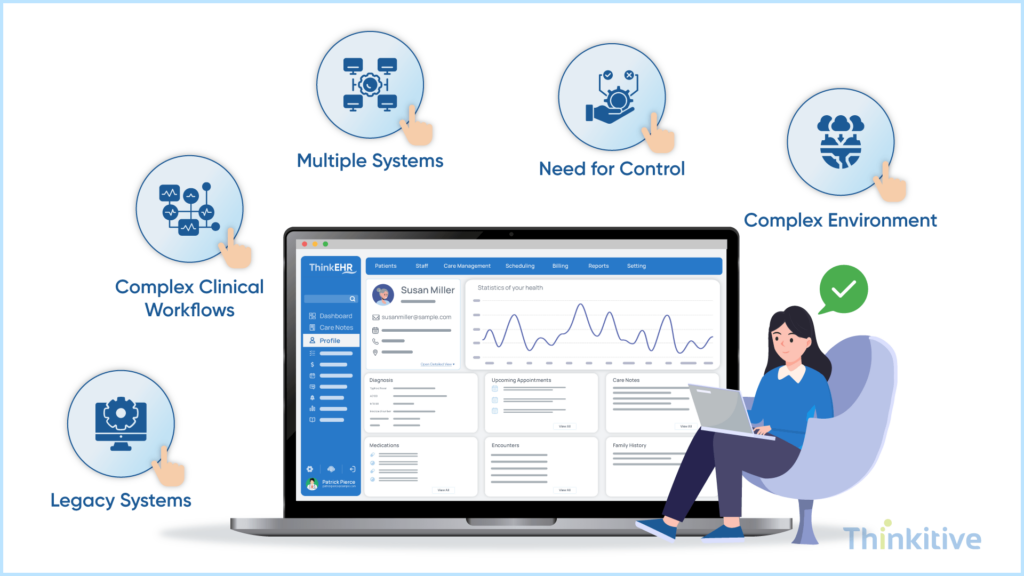
Let’s be honest here, not every practice needs custom EHR integration. Even though a customized integration is much better than a standard integration, why waste your resources if your system doesn’t actually need a custom EHR integration?
So, when do you actually need a custom EHR integration? Well, let’s find out:
- Multiple Interconnected Systems: When your workflow involves multiple interconnected systems, you will need custom integration. This is because your system needs to understand the intricacies between the connected systems and make sense of the data, so that it can be shared.
- Support Clinical Processes: Given the specialty needs and unique processes involved in your healthcare practice, at times, standard integrations fail to support the clinical process. In such cases, you are bound to need custom integration.
- Legacy Systems Limited Flexibility & Scalability: Custom EHR integration for legacy systems has become a need for healthcare providers who are using legacy systems. Since custom EHR integration gives you an edge in flexibility and also enables scalability aspects of your practice, custom EHR integration for your legacy system becomes a necessity.
- Long-Term Control Over Workflows & Data: If you want more control over your practice’s workflows and data, then custom healthcare system integration is something that you will need. You see, with custom integration you not only get more control over how the data flows, but also how the data flows and how it is being used.
- Complex Clinical & Administrative Environments: If your practice’s clinical and administrative workflows and processes are complex, then a standard EHR won’t be a solution for anyone; you have to turn to custom EHR integration to enable seamless data sharing across systems.
The Architecture of Custom Connectivity
Many think that EHR integration is just about connecting two or more systems together. However, it goes beyond that; instead of just connecting systems, it focuses more on designing a scalable, secure, and workflow-aligned architecture that allows for seamless communication between systems.
In this architecture, the first part is healthcare API integration. Since APIs are fast, they allow for real-time bidirectional data flow. In simple terms, both the connected can exchange data with others in real-time. Furthermore, directional exchange allows the data to flow outside the system, such as patient apps/portals, billing platforms, and RPM tools.
Now, the next part is middleware and integration engines. You see, no two systems naturally speak the same language. This means that the systems cannot understand each other and hence cannot share data. This is where middleware comes into the picture. It acts as a middleman between the two systems and transforms data formats in ways that allow systems to communicate with each other.
Due to this, the unstructured data gets structured, allowing systems to understand and make sense of it.
High-Level Approach to Integrating Custom Applications with EHR Systems
Suppose you have a customized system for your practice, then integrating your EHR system with such custom applications typically follows a structured approach as follows:
- Defining the use case: First, the use cases are defined for a custom EHR, where it is decided what data needs to be exchanged and how the workflow will be.
- Choosing an integration method: After the use cases are defined, a suitable integration method is chosen according to the needs. The integration is usually API-based, HL7 interface, or direct database access.
- Data Mapping: This is where the real work starts. Here, you align data fields between systems and ensure semantic consistency so that data can be exchanged seamlessly.
- Build & Test Integration: At this stage, you actually build the integration bridge by developing API connections or middleware logic. Once that is done, these integrations are validated in real-world scenarios.
- Deploy & Monitor: After the integrations are validated, it is then deployed, and the monitoring process starts, where you continuously optimize the system to ensure uptime, performance, and error handling in real-time.
Optimizing Custom EHR Integration for Complex Workflows
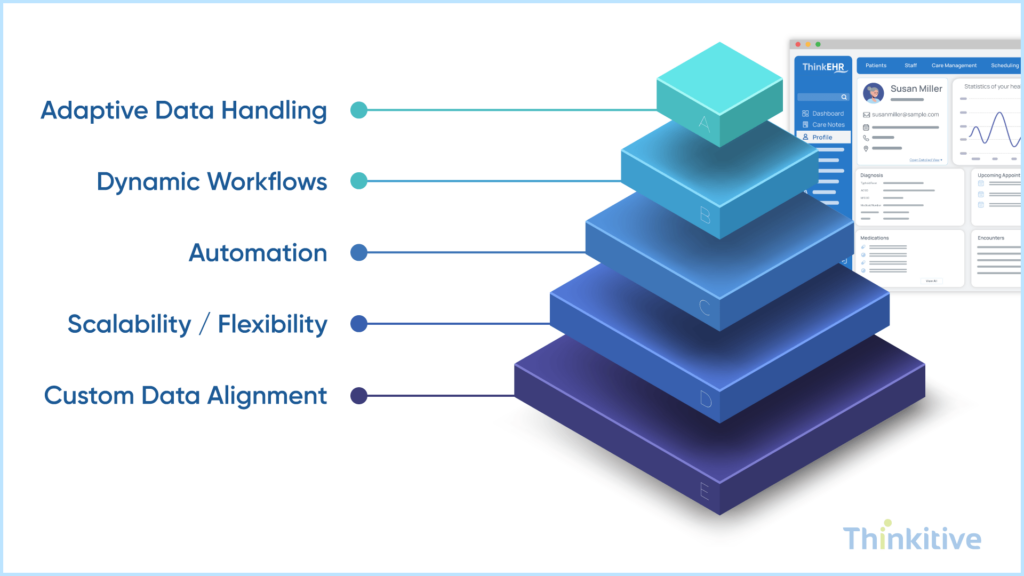
The real advantage of custom EHR integration is not enabling basic connectivity with different healthcare systems. Instead, when it adapts to the complexity of clinical and operational workflows, this is the reason custom EHR integrations need to be flexible, intelligent, and scalable. And for that, you need to optimize the integration.
- Adapting Varying Clinical Environments & Data Needs: If you are connecting with a system outside your network, then understand that since the system is in a different environment, its needs differ. On the basis of that, you need to align your integration with the necessary data requirements. The advantage of custom integration you get is that each environment gets relevant, context-aware data.
- Dynamic & Conditional Workflow Handling: Healthcare workflows are rarely linear. These workflows depend on conditions, triggers, and patient-specific factors. For dynamic workflows, custom EHR integration allows for ‘if-then’ logic or event-based action and personalized care pathways. Static integrations fail in the real world, where custom EHR integration ensures dynamic logic is applied, and the systems respond intelligently depending on the situation.
- Automating Multi-Step Clinical & Operational Processes: Most of the time, healthcare organizations have multi-step processes across their systems. In those cases, automating the integration engine can reduce manual work, minimize errors, and improve both efficiency and patient experience.
- Designing Integrations Around Evolving Workflows: Most clinics are evolving, given the patient flow, regulatory changes, introduction of new care models, and technological advancements. This can even make your custom integration bridge rigid; however, with a flexible system, you can ensure long-term scalability.
- Aligning Organization-Specific Data Structures & Workflows: Every healthcare organization has unique processes, specialties, and data requirements. To optimize, you might need custom templates and forms, aligning with specialty-specific workflows and adding custom data fields and terminologies. This way, the technology adapts to the organization and gives the desired results.
Assess Your System for Complex EHR Integrations:
Get Free ConsultationAI-Enhanced Workflow Orchestration in Custom Integration
The introduction of AI has changed everything. You see, AI is transforming custom EHR integration by enabling systems to become more intelligent, adaptive, and efficient. So, rather than just relying on predefined rules, AI can itself process and map data in the complex workflows.
In fact, it is being used today for mapping and normalization. You see, with AI-driven data mapping and normalization, the data collected from multiple systems is converted into recognizable patterns and transformed into consistent structures. This not only reduces manual effort but also minimizes errors and accelerates integration.
Another application of AI in custom EHR integration has been in enabling predictive workflow support for clinical pathways. You see, the AI-powered system can analyze historical data and clinical patterns, and on the basis of that, it can anticipate the next plan of action. In this way, it can support clinical decision-making with improved coordination.
And the last and most used application of AI has been with intelligent automation for repetitive integration tasks. These tasks might include processes like data validation, error detection, routing, and exception handling.
In this way, AI-enhanced workflow orchestration in custom integration can make your simple mechanism into a proactive, decision-supporting ecosystem to deliver more responsive patient care.
Technical Challenges in Custom EHR Integration
Typically, there are two technical challenges that you’re most likely to encounter. Here is a simplified table for your better understanding.
| Challenge | What It Means | Impact | Solution |
| Data Integrity Across Systems | Keeping patient data accurate and consistent across multiple systems. | Errors, duplicate records, and incomplete patient information. | Use standards (HL7, FHIR), real-time syncing, and validation checks. |
| Concurrency & High Data Volume | Managing multiple systems accessing and updating data at the same time. | Slow performance, data conflicts, and delays in critical information. | Use scalable systems, queue processing, and optimized APIs. |
Best Practices for Implementing Tailored Solutions
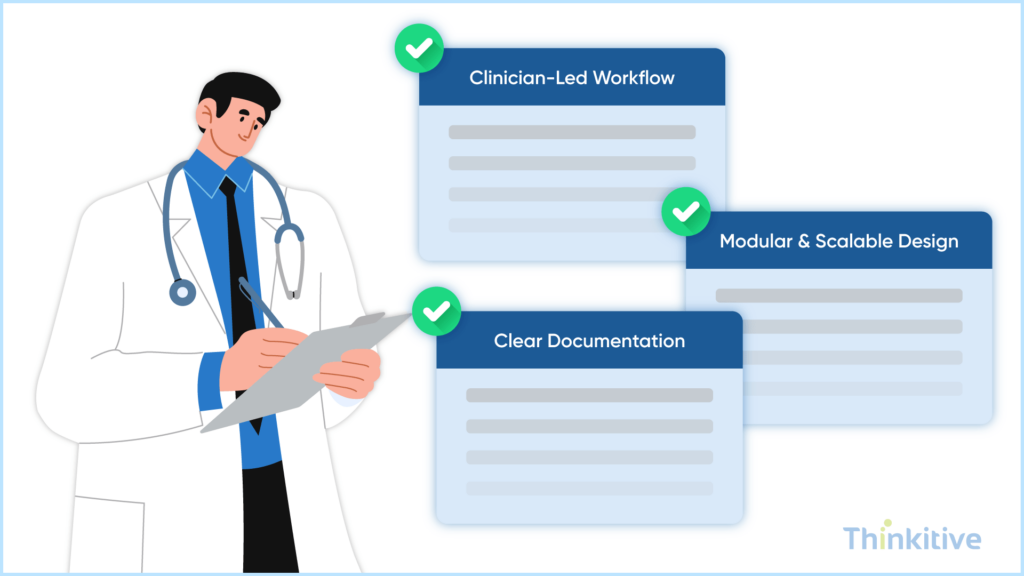
Some of the best practices for implementing a tailored EHR integration solution are as follows:
- Clinician-led Workflow Mapping: When mapping the workflow according to the needs of the clinician, most of the processes get streamlined, as the clinician is someone who is responsible for care delivery and directs the future processes in the patient’s care journey.
- Designing Modular & Scalable Integrations: Design a modular and scalable architecture of your custom integration. This is because, when the time comes, you independently improve your system and expand it to accommodate the growing needs of your practice.
- Maintaining Clear Documentation: In the long term, certain aspects of custom integration’s maintainability, proper documentation, are something that you need to stress. Since you might need to make certain changes after a while, it can easily be done if you have clear documentation, and the chances of spoiling the integration bridge can also be avoided.
Conclusion
As the healthcare industry is shedding off its traditional practices and moving towards a more holistic approach and personalized, specialty-driven healthcare practice, a custom EHR will be the strategic enabler to navigate complex workflows. This will directly have an impact on the efficiency, accuracy, and clinician experience.
And if you are thinking about having a custom EHR integration for your system, then you are at the right place and at the right time, because with this, you will be preparing your system for the future.
On that note, get your consultation on custom EHR integration and know the intricacies of your integration bridge in a better way.
Frequently Asked Questions
Custom EHR integration for complex workflows refers to connecting EHR systems with other healthcare applications in a way that aligns with specific clinical and operational processes. Unlike standard integrations, it is tailored to support unique workflows, enabling seamless data exchange and improving care coordination across systems.
To understand how to integrate custom applications with EHR systems, organizations typically use APIs (such as FHIR), middleware, or integration engines. The process involves defining use cases, mapping data, building secure connections, and testing workflows to ensure accurate and reliable data exchange across systems.
Healthcare organizations should choose custom EHR integration when they have complex workflows, multiple systems, or unique data requirements that standard solutions cannot support. It is especially valuable when flexibility, scalability, and workflow-specific automation are critical for efficient healthcare system integration.
Custom EHR integration for legacy healthcare systems typically uses middleware or integration engines to bridge gaps between modern and outdated systems. It enables data transformation, format conversion, and secure communication, allowing legacy systems to function within a modern, integrated environment.
EHR customization involves modifying workflows, data structures, and interfaces to meet specific organizational needs, while standard configuration is limited to predefined settings within the system. EHR customization allows deeper alignment with clinical workflows, making it essential for complex healthcare environments.
Healthcare API integration enables real-time, secure data exchange between EHR systems and external applications. It forms the foundation of custom EHR integration by allowing different systems to communicate efficiently, ensuring interoperability and seamless healthcare system integration.
AI enhances custom EHR integration for complex clinical workflows by automating data mapping, predicting clinical pathways, and optimizing workflows. It helps reduce manual effort, improve data accuracy, and support faster decision-making across integrated healthcare systems.
Custom EHR integration enables real-time data flow between systems, ensuring clinicians have access to up-to-date patient information. This supports faster, more accurate clinical decisions by integrating data from multiple sources into a unified, actionable view.


