How to Calculate EHR Integration ROI


Enabling your system to communicate with other systems stored in a different ecosystem is quite a complicated process. You see, there are various things involved in the process that vary from data standardization to implementing the interoperability standards; the technical capabilities are somewhat costly.
Moreover, you want to guess what the worst part is?
Yes, justifying these investments can be quite difficult. After all, what are you going to say to the investors that the system needs to share data and requires a couple of thousand dollars?
These things are simply quite complicated to explain. It requires a mindset shift from cost tracking to measuring outcomes that contribute to the growth and smooth running of your practice.
But what if I say that EHR integration ROI calculation is now possible?
In fact, there is a way to calculate the ROI of healthcare technology quite effectively. On top of that, we have curated a structured approach to ROI calculation that can, at times, let you know a near-accurate number.
So, let’s try to turn technical expenses into business value and know it even before we start the venture.
On that note, let’s know the intricacies of EHR integration ROI calculation and try to get an EHR ROI formula to get a near-accurate figure before starting the project.
So, without further ado, let’s get started!
Calculate the Cost & ROI for Your EHR Integration Project –
Get Free Consultation
The ROI Formula Explained
One thing that the subject of mathematics has taught us in school is that if you want to find anything, deriving its formula is the best way to do it. With that principle in mind, let’s have a look at the ROI formula that you can use for EHR integration ROI calculation.
Typically, the ROI is calculated through this formula:
ROI = (Total Benefits – Total Costs) / Total Costs
And this is exactly the formula that you have to use to calculate the ROI. Here, total benefits mean everything that is contributing to the money you are saving or earning through the venture. On the other hand, the total cost is the initial investment you’ve made for the project.
Simple, isn’t it?
While it looks and appears simple, the intricacies can be quite confusing. You see, what to calculate as cost in an EHR integration project is often blurred with the features of EHR software. On top of that, calculating benefits can be even trickier as it hides the efficiency benefits.
So, let’s clear that up for you to understand the ROI calculation process quite simply.
What counts as ‘Total Costs’?
Consider the total cost as the full investment and not just the amount you pay the developers. Some of the typical cost-driving factors in this are:
- Implementation/Integration cost
- EHR vendor or API feeds, including HL7 or FHIR
- Data mapping and testing processes
- Training and onboarding of staff and users
- Ongoing maintenance and support of the integration bridge
All the money you invested in all these aspects of EHR integration becomes your total cost of ownership, and not just the upfront cost you pay.
What counts as ‘Total Benefits’?
This is where things get tricky. In simple terms, total benefits can be counted as measurable gains. Some of the examples of this are:
- Faster billing, which leads to improved cash flow
- Few claim denials, which helps in revenue recovery
- Reduced admin work for cost savings
- Higher patient throughput for more revenue
- Fewer errors leading to avoided loss
Now, if you look at these explanations, all these things have a direct or indirect impact on the finances of your practice. Refer to the table below for a clear understanding of what things are involved.
| Category | Costs (What You Invest) | Benefits (What You Gain) |
| Financial | Integration cost, vendor fees | Increased revenue, faster reimbursements |
| Operational | Training, workflow changes | Time savings, staff productivity |
| Technical | Maintenance, upgrades | System efficiency, interoperability |
| Risk/Compliance | Security, compliance costs | Reduced penalties, fewer errors |
How to Calculate ROI Step-by-Step
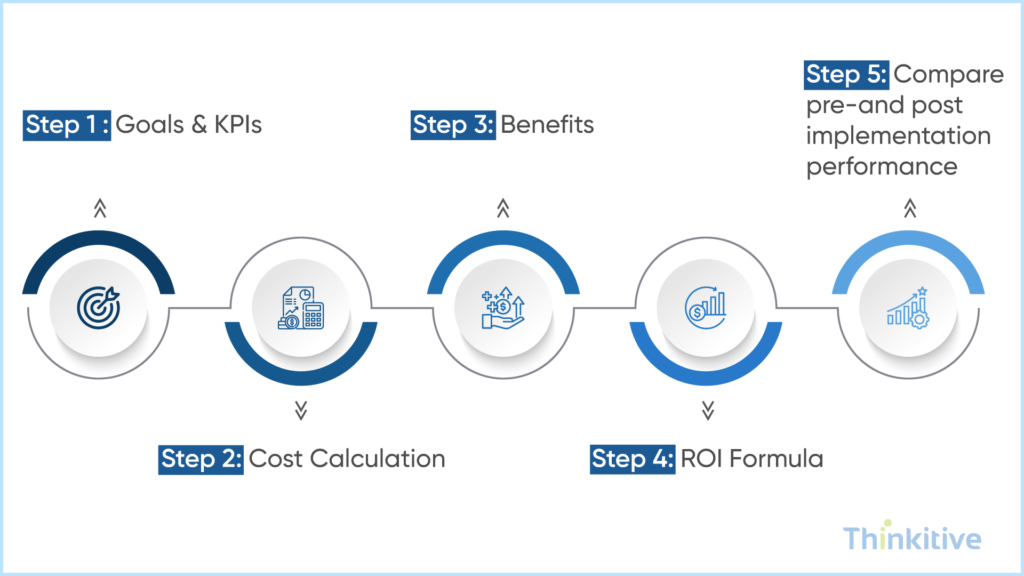
Now comes the calculation plan, and this is where you’ll see what I meant by blurring the lines between benefits and costs.
Here are some aspects that you need to know in terms of this:
- Define measurable goals and KPI: The very first thing that you need to do for calculating ROI is to define measurable goals and key performance indicators. Meaning, you can only measure what you can calculate, and for that, some factors must be set. This includes vendor fees, time saved, patient treatments, etc.
- Calculate total investment: Once you have defined the measurable goals and KPIs, you need to calculate the total investment you have made for EHR integration.
- Quantify measurable benefits: After the total investment, you need to measure the benefits of the goals and KPIs that you have predefined.
- Apply the ROI formula: Once you have all the numbers, all you need to do is apply the formula we discussed earlier and calculate the expected outcome.
- Compare pre- and post-implementation performance: Last but not least, compare the performance of your system before implementation and after implementation. The difference will make the ROI quite clear.
Also, if you are interested in knowing the complete breakdown of any EHR integration project, then read our blog – How Much Does EHR Integration Cost? Complete Pricing Breakdown 2026.
Get Cost Estimation for Your Custom EHR Integration –
Calculate CostKey Metrics Used in ROI Calculation
Remember the KPIs we talked about? Well, defining those is something where most of the practices get it wrong. Choosing the wrong metrics and then calculating the ROI of your integration project would lead you nowhere.
Helping you in getting a clear idea about what metrics you have to calculate, here are the key metrics that you have to calculate:
- Clinical Efficiency: Efficiency is one of the core things that EHR integration directly improves. To calculate this better, you need to understand the time saved while doing a certain task and how many errors you manage to reduce. These two factors alone can put your ROI calculation on the right track.
- Financial Impact: Since everything comes down to money, you need to calculate the impact this EHR integration bridge has had on your finances. Some of the core concepts in this are improved billing and reducing claim denials.
- Operational Improvements: Calculate the improvement you have made after investments like faster workflows and throughput, which can be achieved for your operational team.
All these things are somehow, or another, tied to automation, and the impact automation can have on efficiency and time savings is what EHR integration has made its mark in the ecosystem.
Example: ROI Calculation in Practice
Let’s try to calculate the ROI of a mid-size healthcare organization. Let’s say it is a mid-size multi-specialty clinic with 10-15 providers that decides to integrate its EHR system with billing and lab systems to reduce manual work through automation and improve revenue cycle efficiency.
Now, let’s try to break down the costs and benefits or financial earnings to get the numbers. Refer to the table below for a better understanding:
| Category | Monthly Impact ($) | Description |
| Costs (One-time + ongoing) | ||
| Integration cost (one-time) | $15,000 | Development, APIs, data mapping |
| Maintenance & support | $500/month | Ongoing updates and fixes |
| Training | $2,000 (one-time) | Staff onboarding |
| Benefits (Monthly gains) | ||
| Reduced admin workload | $2,000/month | Less manual data entry |
| Faster billing cycles | $1,500/month | Improved cash flow |
| Fewer claim denials | $1,000/month | Revenue recovery |
On the basis of this, let’s calculate the total cost:
- One-time cost = $17000
- Annual maintenance = $500 * 12 = $6000
- Total cost = $23000
Now, let’s calculate the total financial gains:
- Monthly benefits = $4500
- Annual benefits = $4500 *12 = $54000
Now, let’s apply the ROI formula:
- (54000 – 23000)/23000 = 1.348
- 1.348 * 100 = 135%
ROI = 135%
Here, one of the core things that you need to understand is that an organization recovers its initial investment in the initial 5-6 months. And only once you’ve recovered your investment, the gains can be counted as profits, and if it’s a loss, then it’s a loss.
Also, actual ROI may typically vary depending on practice size, integration complexity, and adoption speed of this newer technology.
Factors the ROI Formula May Miss
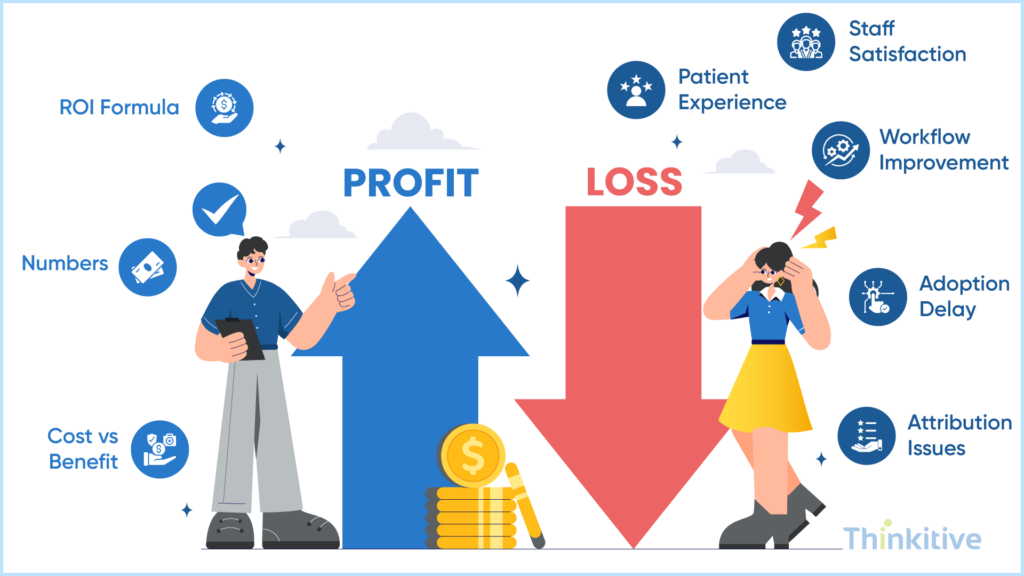
When trying to calculate the numbers for the ROI formula, there is a high chance that you might get a few things wrong. This can throw your entire calculation out of the window in an instant.
So, at least knowing these factors can help you calculate things better. On that note, here are some of the factors that you might miss for your EHR ROI formula:
- Intangible benefits: Some of the benefits are not directly reflected in the finances. For example, the patient experience with the system or provider satisfaction when using it can be quite confusing. These factors must be calculated carefully, as a slight change can have a huge impact on the numbers.
- Attribution challenges: The integration bridge can impact different attributes of your system. Meaning, while some can change the efficiency rate, the same integration bridge can help someone reduce the number of errors. Given the wide range of aspects involved in this, understanding and correlating these challenges becomes crucially important.
- Time lag between implementation and measurable returns: You might implement your EHR integration today, but its true success can only be measured after it has time with its actual users. This time lag factor between implementation can impact the returns hugely. So this can impact the numbers in ways you can’t think.
So, these are the factors, and calculating them carefully is necessary for accurate EHR integration ROI calculation.
Know What You Truly Need from Custom EHR Integration –
Get Free ConsultationConclusion: Presenting a Clear ROI Case
ROI is an ongoing measurement process, once the initial investment is recovered. And just like money, it compounds over time. That is why it is so crucially important that you track the right things and refine calculations as per your needs.
So, use the insights to support your decision better and make the right decisions that suit your practice the best. On that note, let this blog be your guide to calculate the ROI better and in a much more sophisticated way.
And if you think your needs are quite complicated, then talk to our expert, and calculate your ROI more accurately.
Frequently Asked Questions
To perform an accurate EHR integration ROI calculation, you need to compare the total financial and operational benefits gained from integration against the total investment made.
In simple terms, how to calculate EHR integration ROI:
- Identify all costs (implementation, training, maintenance)
- Quantify measurable benefits (revenue gains, cost savings, time saved)
- Apply the ROI formula to determine returns over a defined period
This approach helps organizations clearly understand the ROI of healthcare technology investments.
The standard EHR ROI formula is:
(Total Benefits – Total Costs) / Total Costs
This formula is widely used to evaluate the ROI of healthcare technology, including EHR integrations.
An EHR integration ROI formula example would include:
- Total benefits from improved billing and efficiency
- Total costs, including integration, vendor fees, and maintenance
The result shows how much return you generate for every unit of investment.
A complete EHR integration ROI calculation should include the full total cost of ownership, not just initial development.
Key cost components:
- Integration and implementation costs
- EHR/API (HL7/FHIR) vendor fees
- Data mapping, testing, and compliance
- Staff training and onboarding
- Ongoing maintenance and support
Including all these ensures a realistic view of the ROI of healthcare technology.
To evaluate performance improvements, organizations rely on EHR efficiency metrics such as:
- Reduction in administrative workload
- Time saved in documentation and data entry
- Claim processing and billing cycle time
- Patient throughput and appointment handling
- Error reduction and data accuracy
These metrics help measure EHR integration business impact beyond just financial returns.
The timeline to achieve ROI varies depending on integration complexity and adoption speed.
Typically:
- Small to mid-size practices: 3–6 months
- Larger organizations: 6–12 months
Faster ROI is often seen when integrations focus on revenue cycle improvements and automation, directly impacting the ROI of healthcare technology.
The ROI of automated clinical workflows is one of the biggest drivers of integration value.
Automation helps by:
- Reducing manual data entry
- Improving billing accuracy and speed
- Minimizing human errors
- Enhancing staff productivity
These improvements significantly boost the overall EHR integration ROI calculation by increasing efficiency and lowering operational costs.
Several factors can distort your EHR integration ROI calculation, including:
- Ignoring hidden costs like training and maintenance
- Overestimating efficiency gains
- Delayed user adoption
- Poor data quality or integration issues
To ensure accuracy, organizations must carefully track both costs and EHR efficiency metrics over time.
To maximize the ROI of healthcare technology, organizations should:
- Continuously optimize workflows and automation
- Train staff to fully utilize integrated systems
- Monitor and improve EHR efficiency metrics
- Expand integrations (labs, billing, patient portals)
- Regularly evaluate performance and outcomes
These steps help improve how to measure EHR integration business impact and ensure long-term value.


