EHR Integration Budget Guide: From $5K to $30K

There is a difference between being optimistic and being realistic. You see, everybody is optimistic about creating a connected healthcare ecosystem for their practice. However, when it comes to planning, rather than being realistic, they are often overcommitted and underdelivered.
I don’t think you will find any concrete stat anywhere, but poor planning often results in factors like increasing EHR integration budget beyond the EHR integration cost estimate, and in some cases, failure.
Today, where a connected healthcare ecosystem is the need of the hour, healthcare IT budgeting is something that cannot be overlooked. You see, when you know what you want to achieve with your EHR integration, most of the things get cleared. With this, you can define a clear EHR integration budget that has little to no scope to increase, under favorable conditions.
After all, your healthcare software integration budget finally needs to be aligned with the scope of the project, systems involved, and business goals that you want to achieve.
On that note, let’s be optimistic while being realistic at the same time, at least with your EHR integration.
So, without further ado, let’s get started!
Basic vs Advanced EHR Integration – Which One Do You Need? –
Get System Assessment
How Much Budget is Needed for EHR Integration?
Let’s start with the basic question that most of you will surely have: ‘How much budget is actually needed for EHR integration?’
The answer to that question is quite complex to give you an exact number. There are numerous factors that impact this cost. And the intricacies of this can be quite compelling, but removing all these negligible factors, integration complexity, endpoints to be integrated with, and defining clinical, technical, and operational workflows are some of the major factors that impact your budgeting.
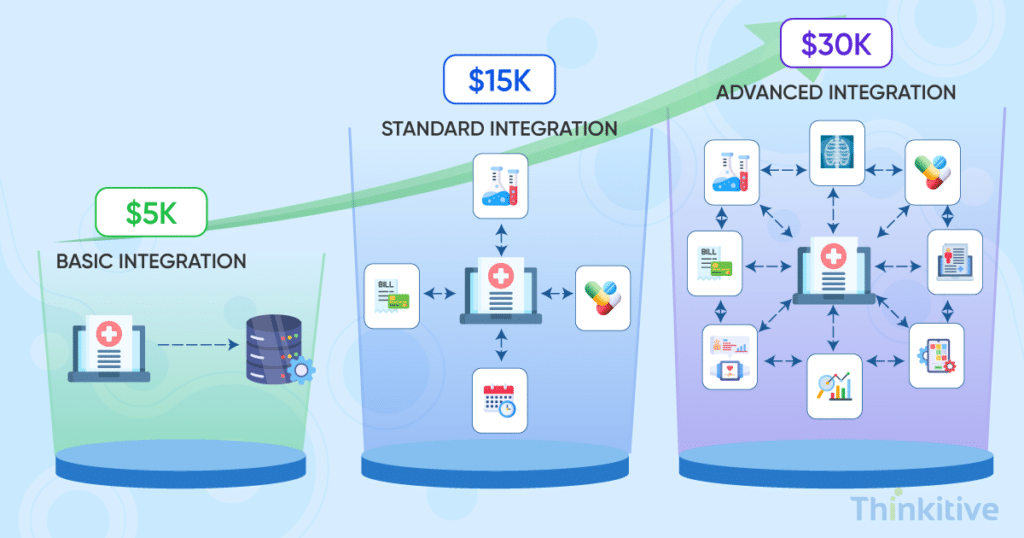
Still, for those who insist on giving a vague number for their EHR integration cost estimate, projects typically range from $5000 to $30000. Depending on the project and what is required, this number can change as the estimate itself, vaguely.
This is the reason why setting up realistic expectations before planning is necessary for your EHR integration budget.
So, moving on with the budget tiers, let’s take the number above and see what you can get in each budget tier.
Also, before deep diving into that, if you want to know how EHR integration project cost is broken down, then read our blog – How Much Does EHR Integration Cost? Complete Pricing Breakdown 2026.
Budget Tiers Explained
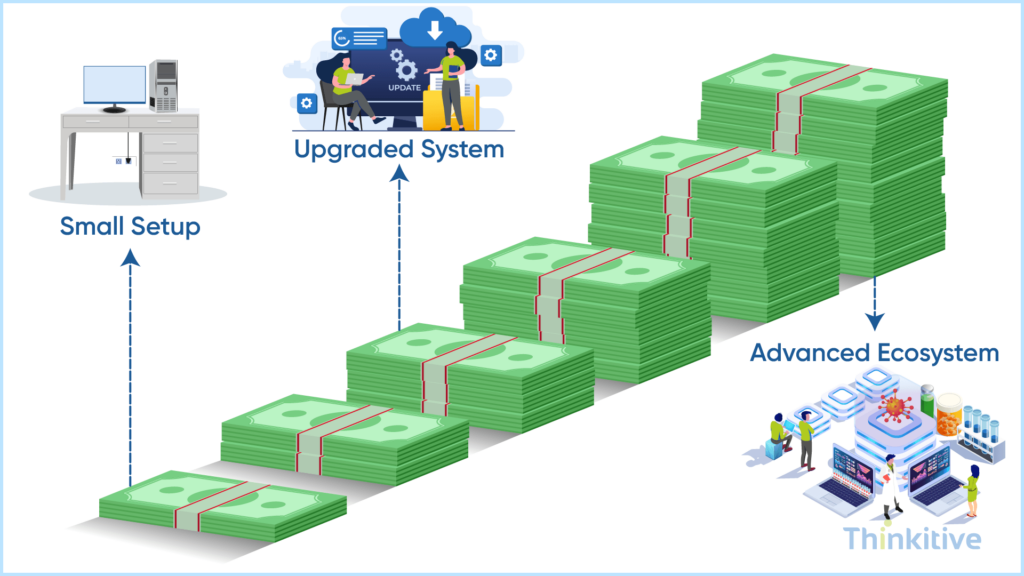
- Tier 1 – $5K – $15K Budget (Entry-Level Integration)
If you are looking for even a basic integration, then your healthcare software integration budget needs to be at least $5000, and it can increase up to $15000. Furthermore, some of the essential features of this type of integration’s scope are single endpoint integration and giving the system read-only access.
This is best suited for small practices, and practices can develop and build a great MVP solution with this. Apart from that, some of the distinct features in this type of integration are that it involves basic data retrieval and simple HL7 parsing.
- Tier 2 – $15k – $30K Budget (Standard Integration)
Moving beyond just basic integration capabilities, standard integration involves all the features of basic integration and more. This can be clearly seen in its scope as it involves multi-endpoint integration and, rather than just a one-way exchange, it allows for bi-directional data exchange between the connected systems.
Furthermore, the technical depth of integration is also much greater. You see, with HL7 and FHIR mapping, real-time synchronization of data can be achieved. In simple terms, it can be considered as integration in its purest form.
How to Minimize Your EHR Integration Cost –
Get Free ConsultationKey Components of an Integration Budget
When it comes to EHR integration budget or any budget for that matter, you need to understand the key components to clearly understand and get an estimation of your budget. So, without further ado, let’s deep dive into it:
- Development & Engineering Effort: This is the core factor that drives or determines the cost of your EHR integration. It typically includes the time developers spend building, configuring, and customizing the integration. This cost varies for the complexity of workflows, systems involved, and custom logic. The higher the engineering effort, the higher the cost.
- API & Interface Setup (HL7, FHIR): These are basically setting up communication systems using standards like HL7 and FHIR. There are some critical differences between these standards, like HL7 requires more parsing and handling of message formats. FHIR, on the other hand, is API-based and is faster to implement.
- Data Mapping & Transformation: Accurately translating and aligning the data that your system actually understands also requires cost. This is done by data mapping processes and data transformation processes. These processes typically include field-to-field mapping, data format conversion, etc.
- Testing, Deployment & Maintenance: Before actually going live with your integration bridge, it needs to be rigorously tested. It typically includes validating data accuracy, workflows, and edge cases. During deployment, it involves moving your integration to the production setup, and once deployed, maintaining it by monitoring, bug fixes, and updates.
- Compliance Costs (HIPAA Safeguards, ONC Requirements): Since it will be a part of the healthcare IT ecosystem, it needs to strictly adhere to regulatory standards like HIPAA and ONC guidelines. Some of the notable things that are included in this are data encryption and access controls, audit logs, security measures, and certification or regulatory alignment.
What Drives Your Budget Up or Down
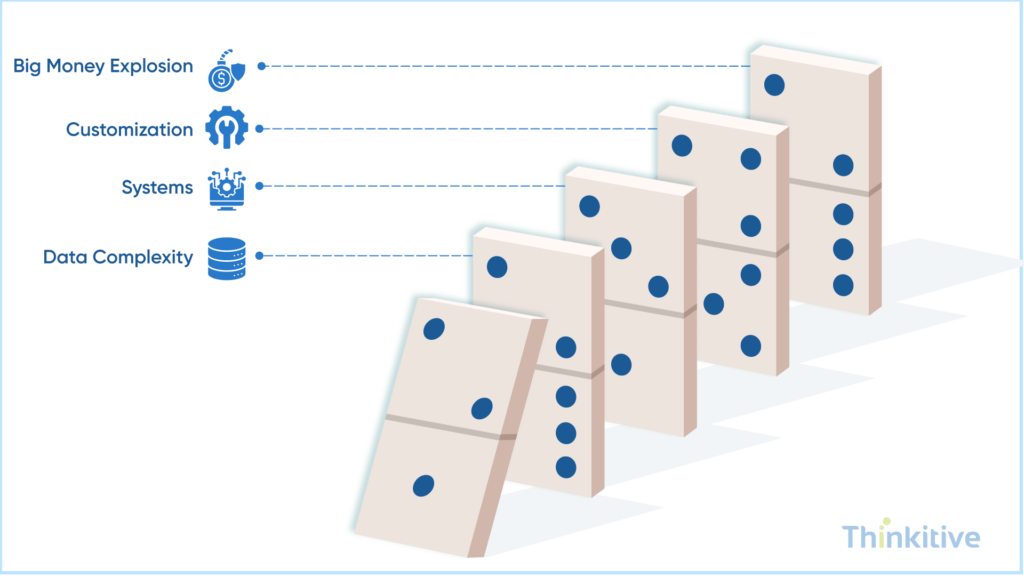
The key components that we’ve just discussed are the costs that you have to pay. However, this cost can go up and down depending on various factors. Let’s have a look at some of these factors that drive your EMR connectivity pricing:
- Data Complexity & Volume: The most important factor that drives the cost of your EHR integration budget is data complexity and volume of data you want to map or transform. Simplifying complex data requires a lot of engineering effort, and so does the volume of the data. So, the higher the complexity of data or volume of data, the higher the cost of your EHR integration.
- Number of Systems & Integrations: If you want to integrate your system to multiple systems, let’s say 50, then it is bound to require more engineering efforts, and naturally, you will need more integration bridges. So, long story short, a higher number of system connections requires higher integration, which impacts your costs.
- Customization vs. Standard APIs: For modern integrations, you need to rely on APIs. Now, for some integrations, you require standard APIs, and for some systems, you need to customize them. Standard APIs charge a certain amount, but customization can vary depending on the system and vendor.
- Internal vs External Resources: Last but not least, you will need resources to build this bridge. Some things can be solved internally, and some externally, depending on what you choose. Setting up internal resources can at times be costly, whereas outsourcing can be comparatively a little cheaper.
Costly EHR Integration? Learn How to Bring the Cost Down –
Get Free ConsultationHow to Plan a Realistic EHR Integration Budget
Remember, we talked about being optimistic as well as being realistic?
Well, let’s start with drawing out a realistic plan for the EHR integration budget.
So, first things first, define the scope of your project and what you want to achieve through this integration. It can be as simple as reducing time while filing claims or allowing your providers quick accessibility to the required information, etc.
If you know these things clearly, you have mostly done half of your budgeting. The next part of these mainly involves adding numbers and comparing which one suits the best.
So, naturally, coming to the next part, allocate the budget across the development process. Be optimistic about the rates and plan accordingly, but remember to be realistic at the same time. Also, add a contingency buffer of about 10-20%, so that you have everything covered, in case things go out of hand.
Once that is done, create a roadmap of development and ensure you use best practices so that costs stay minimal and quality stays maximum. And this is how you would create a reliable cost estimate, with some amount allocated if things go out of hand.
Common Budgeting Mistakes to Avoid
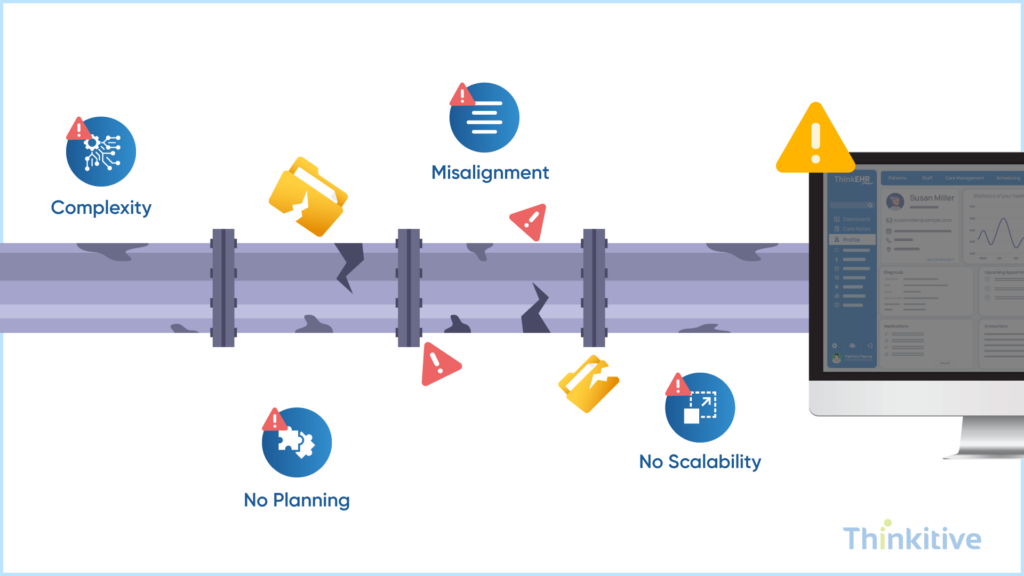
There are certain mistakes that people unintentionally commit when it comes to drawing a healthcare software integration budget. These mistakes will not only help you draw an accurate estimation plan but also, in certain aspects, keep the price as low as possible.
So, here are some mistakes that you need to avoid:
- Understanding Integration Complexity: While some integrations look simple on the surface, multiple data formats, workflows, and edge cases can be overwhelming. So, focus carefully on the discovery stage; it helps you understand your system, know your data, and find a solution to avoid complexity.
- Skipping Contingency Planning: Many budgets are built for best-case scenarios, and these underlying surprises can be costly. So keep in mind vendor delays or API limitations, data quality issues, and additional testing cycles.
- Misalignment Between Technical & Business Teams: When business expectations don’t match technical realities, the budget simply is pointless. Set clear communication standards and shared goals alignment to keep the budget realistic and controlled.
- Ignoring Long-Term Scalability: Most projects plan for their current needs, but it can lead to costly rework later, as can be seen today with legacy systems. You see, it can vary from adding new integrations, handling increasing data volume, and architecture redesign, etc.
Plan Your EHR Integration Project & Budget –
Get StartedConclusion: Building a Scalable EHR Integration Budget
Most people do not worry about budgeting as a cost planning. And just switching the perspective can do wonders for your budgeting. The best way is to think of budgeting as a strategic investment and not just as a cost.
Also, for those who are quite obsessed with numbers, the difference between a $5000 integration project and a $30000 integration project is seen in the outcomes clearly. You see, basic integration will give you read-only access, while standard integration will equip you with the capabilities of exchanging data between systems.
And last but not least, plan for scalability and future integrations, because along with your practice, the data will also grow. So, let’s prepare with the first step on execution, get on a call with our EHR integration experts, and know where your system stands.
Frequently Asked Questions
The answer to how much budget is needed for EHR integration typically ranges from $5,000 to $30,000, depending on complexity. A basic API-based integration may cost on the lower end, while multi-system, real-time integrations with custom workflows fall on the higher end. Your final EHR integration budget depends on scope, standards used, and vendor requirements.
The EHR integration cost for small practices usually falls between $5,000 and $15,000. Smaller clinics often require simpler integrations such as lab connections or billing sync, which keeps the healthcare software integration budget relatively controlled. However, costs can increase if customization or multiple systems are involved.
An accurate EHR integration cost estimate depends on several factors, including:
- Number of systems and endpoints
- Data complexity and volume
- Integration type (real-time vs batch)
- Standards used (HL7 vs FHIR)
- Vendor/API access fees
These variables play a key role in healthcare IT budgeting and can significantly impact the final cost.
When it comes to budgeting for HL7 and FHIR interfaces, HL7 integrations are often cheaper upfront but require more effort in data parsing and maintenance. FHIR integrations, on the other hand, are API-driven and faster to implement but may depend on vendor support and licensing fees. The choice directly affects your overall EHR integration budget.
A typical healthcare software integration budget includes:
- Development and engineering effort
- API and interface setup
- Data mapping and transformation
- Testing and deployment
- Ongoing maintenance and support
- Compliance and security measures
These components form the foundation of effective healthcare IT budgeting for integration projects.
EMR connectivity pricing varies widely based on integration scope and complexity. A single API connection may cost a few thousand dollars, while enterprise-level integrations involving multiple systems and real-time data exchange can reach $30,000 or more. Custom workflows and vendor fees also influence pricing.
Common mistakes in EHR integration budget planning include:
- Underestimating integration complexity
- Ignoring vendor/API fees
- Skipping contingency planning
- Overlooking long-term scalability
Avoiding these issues is essential for accurate healthcare IT budgeting and project success.
To plan a realistic EHR integration budget, organizations should:
- Clearly define integration scope and requirements
- Choose appropriate standards (HL7 or FHIR)
- Include a contingency buffer (10–20%)
- Account for vendor and compliance costs
- Focus on scalable architecture
A structured approach to healthcare IT budgeting ensures better cost control and long-term value.


