How Custom EHR Reduces Physician Burnout: Data-Backed Guide

The talk about healthcare providers being burned out at work is not new, at least in 2026. And interestingly, every technology that has been introduced lately has been actively trying to solve this exact problem.
Let’s have a look at some of the studies to show how much clinical documentation burden is impacting healthcare providers. According to the American Medical Association, physicians apparently spend 13 hours every week on indirect patient care. On top of that, an additional 7.3 hours per week are spent on administrative work.
Now, if you combine all the hours these healthcare providers spend on tasks other than patient care, it counts more than their entire day’s working hours. And these are some of the most prominent things that contribute to clinical stress and administrative overload that keeps on piling.
This is the reason why healthcare providers are actively looking for custom EHR development to solve their EHR usability problems and make the lives of their healthcare providers a little easier.
Having said that, many physicians have come to us to build an EHR system that would actually help them reduce physician burnout. The question that we keep getting is, ‘How does custom EHR reduce physician burnout?’ or ‘What EHR features improve physician workflow efficiency?’
Well, the answer to these questions is not that simple, as the answer changes as per your needs and, broadly speaking, your practice.
But to help you reduce clinician documentation burden and make an attempt to answer some of your questions, I have decided to pen this blog.
On that note, let’s see how EHR usability can enhance your practice and how you can reduce physician burnout with a custom EHR.
So, without further ado, let’s get started!
According to the National Institutes of Health (NIH), improved EHR workflow support reduced clinical documentation time by 21% and after-hours EHR use by 10%, demonstrating how better EHR usability can directly reduce physician burnout.
Assess Your System for Usability Issues –
Get Free Assessment
Key Takeaways
- Physician burnout is closely linked to excessive documentation, inefficient workflows, and poor EHR usability.
- A custom EHR reduces physician burnout by simplifying documentation, automating repetitive tasks, and aligning workflows with clinical practice.
- Features such as clinical documentation automation, personalized dashboards, and intelligent task management improve physician workflow efficiency.
- Better EHR usability reduces after-hours charting, improves provider satisfaction, and allows clinicians to spend more time with patients.
- Measuring documentation time, physician satisfaction, and workflow efficiency helps organizations continuously improve clinician well-being.
How Does EHR Usability Contribute to Physician Burnout?
Physician burnout isn’t a new issue, but it’s becoming increasingly difficult for healthcare organizations to ignore. While heavy patient loads, staffing shortages, and growing regulatory demands all contribute to burnout, the technology physicians use every day also plays a major role. For many clinicians, the EHR has become another source of stress instead of a tool that makes their work easier.
A major reason is the growing clinician documentation burden. Physicians often spend a significant part of their day documenting visits, reviewing lab results, managing inbox messages, and completing administrative tasks. According to the American Medical Association (AMA), office-based physicians spend more than five hours in the EHR for every eight hours of scheduled patient care. Even after clinic hours end, the work often continues.
The problem isn’t simply that physicians use EHRs for long hours—it’s that many systems aren’t designed around how clinicians actually work. Repetitive data entry, excessive clicks, fragmented workflows, and difficult navigation interrupt patient interactions and increase mental fatigue. Instead of supporting clinical decisions, these inefficiencies often slow physicians down.
This is where EHR workflow efficiency becomes essential. When healthcare organizations begin looking at how custom EHR reduces physician burnout, they often discover that improving usability can have just as much impact as hiring additional staff. A physician-centered EHR that simplifies documentation and fits naturally into clinical workflows helps reduce administrative workload, improves provider satisfaction, and allows physicians to spend more time where they want to be—with their patients.
How Custom EHR Reduces Physician Burnout
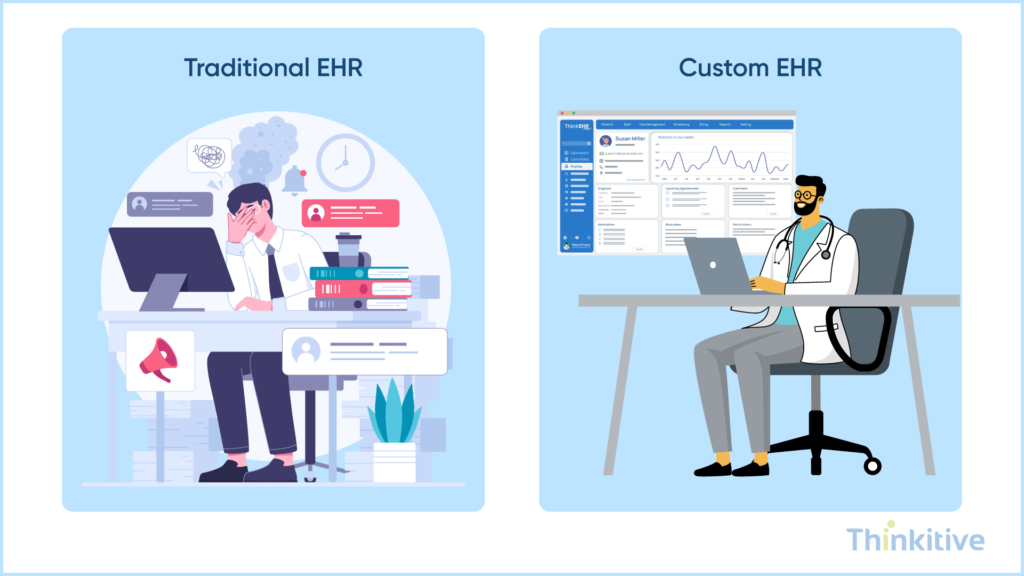
Every medical specialty has its own way of delivering care, yet many traditional EHR systems expect every physician to follow the same workflow. That mismatch creates unnecessary work throughout the day. A custom EHR takes the opposite approach—it is built around the physician’s workflow, making everyday tasks faster, simpler, and less frustrating.
One of the biggest advantages is reducing the clinician documentation burden. Instead of repeatedly entering the same information, physicians can use specialty-specific templates, auto-filled fields, voice documentation, and clinical documentation automation to complete notes more efficiently. Common tasks such as ordering labs, prescribing medications, or reviewing patient histories can often be completed in fewer steps, reducing unnecessary clicks and screen switching.
Custom EHRs also improve EHR workflow efficiency by displaying only the information clinicians need at a particular moment. Rather than searching through multiple tabs or navigating cluttered interfaces, physicians have quick access to the most relevant patient data. This makes documentation feel more natural and helps clinicians stay focused during patient visits instead of being distracted by the software.
The benefits extend beyond convenience. A 2024 study published by the National Institutes of Health (NIH) found that physicians who received better EHR workflow support spent 21% less time writing clinical notes and reduced their after-hours EHR use by 10%. These improvements may seem modest individually, but over weeks and months, they can save hours of administrative work and help reduce physician fatigue.
Ultimately, understanding how custom EHR reduces physician burnout is about recognizing that better technology supports better care. When physicians spend less time documenting and more time treating patients, everyone benefits—from providers and care teams to healthcare organizations and, most importantly, the patients they serve.
Value-Based Care EHR Features for Enhanced Outcome –
Get GuideEHR Features That Improve Physician Workflow Efficiency
Modern EHR systems are being built to reduce physician burnout. They are able to do that by eliminating administrative work and aligning workflows with the way the practice works.
On that note, here are some of the EHR features that improve physician workflow efficiency:
- Streamline Documentation & Reduced Administrative Burden: Some of the major reasons for physician burnout turn out to be lengthy documentation and duplicate data entry. Here, custom EHRs can simplify charting with specialty-specific templates, structured documentation, and integrated workflows that are curated to reduce clicks and eliminate repetitive tasks. All these functions help physicians complete records faster and maintain accuracy and compliance.
- Personalized Dashboards & Faster Navigation: Generic EHR systems are built on a one-size-fits-all approach, but the problem with these systems is that their interfaces are extremely interactive, which slows clinicians down. Here, a custom EHR provides role-based dashboards, quick-access shortcuts, and personalized layouts that surface the most relevant patient information. Faster navigation means less time spent searching through screens, shifting the focus to care delivery.
- Intelligent Task Automation: You can curate your own workflows in your EHR system. With these customized workflows, routine tasks like prescription renewals, referrals, follow-up reminders, and order routing can be automated. By reducing manual administrative work, physicians can spend more time on clinical decision-making and patient interactions.
- Smart Alert Management: Alert fatigue is another major problem for physicians; this is a byproduct of workflow interruptions due to too many unnecessary clicks. Custom EHRs help you prioritize clinically relevant notifications based on specialty and patient context, helping physicians focus on critical information while minimizing distractions.
- Intelligent Inbox Management: Managing patient messages, refill requests, lab results, and referrals can quickly become overwhelming. With intelligent inbox management, you can have organized communications on the basis of priority, and routine tasks assigned to the right team members to reduce the time physicians spend handling administrative messages.
- Clinical Documentation Automation: Clinical documentation automation is achieved with a combination of technologies like ambient AI, speech recognition, and smart templates to generate encounter notes during or immediately after visits. Now, by reducing the manual need for documentation and cutting down on after-hours charting, you can spend less time on paperwork and more time with patients.
Measuring the Impact of Better EHR Usability
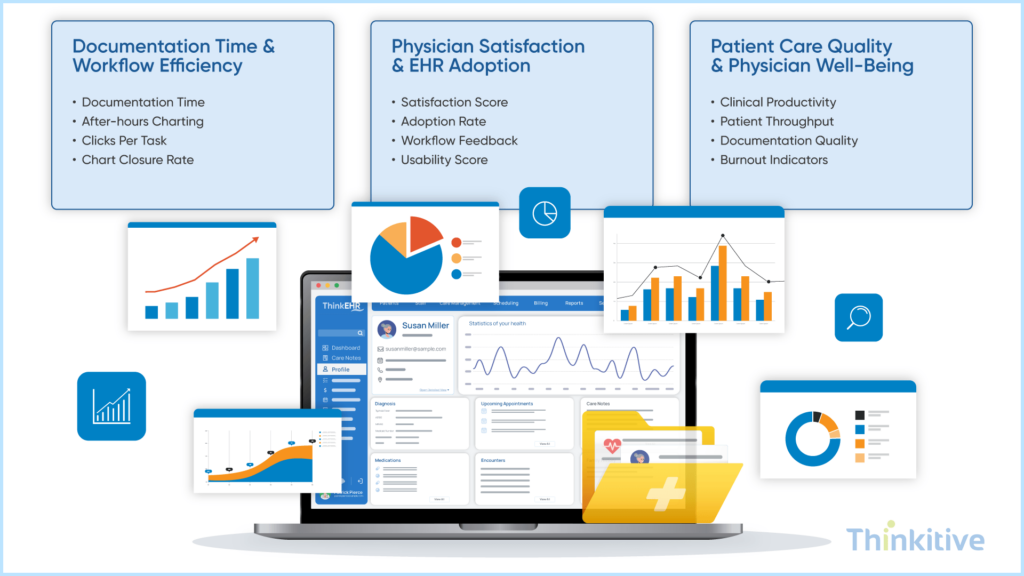
The best way to measure the effectiveness of your EHR usability is to track the KPIs or Key Performance Indicators to measure how the changes are affecting physician efficiency, satisfaction, and patient outcomes.
Here are some of the KPIs that you should track:
- Documentation Time & Workflow Efficiency: One of the most important metrics that you must note is average documentation time per encounter, chart closure rates, after-hours charting, and clicks per task. Now, a reduction in these indicators shows that physicians are spending less time on administrative tasks and more time with patients.
- Physician Satisfaction & EHR Adoption: Gather regular feedback by conducting regular physician satisfaction surveys and EHR usability assessments. High adoption rates, improved usability scores, and fewer workflow complaints indicate that the system is supporting clinicians rather than slowing them down.
- Patient Care Quality & Physician Well-Being: Some of the other things that you have to monitor are clinical productivity, patient throughput, documentation quality, and physician burnout indicators. You see, when the physician spends less time navigating the EHR, they can focus more on delivering quality care and improving both provider well-being and patient experience.
Custom EHR Features & Their Ability to Reduce Repetitive Work –
Get DemoBuilding a Physician-Centered EHR Strategy
If I have to answer your question, ‘How to reduce clinician documentation burden?’ in one sentence, then I would say that by building a physician-centered EHR, you can easily reduce the clinical documentation burden.
And this is one of those processes that is not only lengthy but also continuous in nature. For instance, you have to constantly make improvements in your EHR system to improve its usability through regular feedback.
Other than that, you must create a roadmap for its continuous improvement and make the clinical-first digital transformation your top priority.
Conclusion
EHR usability is directly related to your EHR software’s ability to align itself with your practice’s clinical and administrative workflows. And this is the best way to improve the efficiency and effectiveness of your EHR system and also reduce physician burnout by a huge margin.
Furthermore, physician-centered EHR design is something that is still preferred by many for long-term clinical and operational value. That is why, when it comes to building a sustainable healthcare technology, you must focus on both clinicians and patients and balance them out effectively.
On that note, let’s assess your EHR usability for your providers with our EHR expert and know how a customizable EHR can help reduce physician burnout in your practice.
Frequently Asked Questions
EHR physician burnout refers to the physical, emotional, and mental exhaustion clinicians experience due to inefficient electronic health record systems. Excessive documentation, repetitive data entry, poor usability, and after-hours charting increase administrative burden, making EHR usability an important factor in physician well-being.
EHR Usability refers to how easily physicians and clinical staff can navigate, learn, and use an Electronic Health Record system to complete their daily tasks. A highly usable EHR minimizes unnecessary clicks, simplifies documentation, and supports intuitive workflows, allowing clinicians to spend more time on patient care and less time managing software.
Poor EHR Usability increases administrative workload by requiring excessive documentation, duplicate data entry, complex navigation, and frequent interruptions. These inefficiencies extend documentation into after-hours charting, increase cognitive load, and contribute to emotional exhaustion. Improving usability is one of the most effective ways to Reduce Physician Burnout while enhancing physician productivity.
Understanding how custom EHR reduces physician burnout starts with recognizing that every healthcare organization has unique clinical workflows. A custom EHR aligns documentation, navigation, automation, and specialty-specific workflows with physicians’ daily routines, reducing unnecessary administrative work. By streamlining clinical tasks and improving efficiency, custom EHRs help physicians spend more time with patients and less time completing paperwork.
Clinician Documentation Burden refers to the time and effort healthcare providers spend documenting patient encounters, completing compliance requirements, and performing other administrative tasks within an EHR. Excessive documentation often leads to longer workdays and after-hours charting. Organizations can reduce clinician documentation burden by simplifying workflows, automating repetitive tasks, and using specialty-specific documentation templates.
Several EHR features that improve physician workflow efficiency include specialty-specific templates, personalized dashboards, intelligent task automation, smart alert management, integrated inbox management, voice recognition, and Clinical Documentation Automation. Together, these features reduce manual work, improve navigation, and help physicians complete clinical tasks more efficiently.
Clinical Documentation Automation uses technologies such as ambient AI, speech recognition, smart templates, and automated note generation to streamline clinical documentation. Instead of manually creating encounter notes from scratch, physicians can review and finalize AI-assisted documentation, reducing charting time, minimizing after-hours work, and improving overall workflow efficiency.
A custom EHR helps reduce alert fatigue by displaying only clinically relevant notifications based on specialty, patient condition, and physician preferences. Instead of overwhelming clinicians with unnecessary alerts, intelligent alert management prioritizes high-risk notifications, reducing interruptions and improving clinical decision-making while helping Reduce Physician Burnout.
Yes. Better EHR Usability simplifies documentation, improves EHR Workflow Efficiency, and reduces the time physicians spend navigating complex interfaces. As administrative burden decreases, physicians experience greater job satisfaction, improved work-life balance, and more meaningful patient interactions, all of which contribute to lower burnout rates.
The best Physician Burnout Software should go beyond basic documentation tools and support physician-centered workflows. Healthcare organizations should look for solutions that offer customizable workflows, Clinical Documentation Automation, intelligent task automation, smart alert management, personalized dashboards, analytics for measuring EHR Workflow Efficiency, and seamless interoperability. These capabilities help reduce administrative burden, improve physician satisfaction, and support long-term burnout reduction.


