Build Reports That Actually Matter

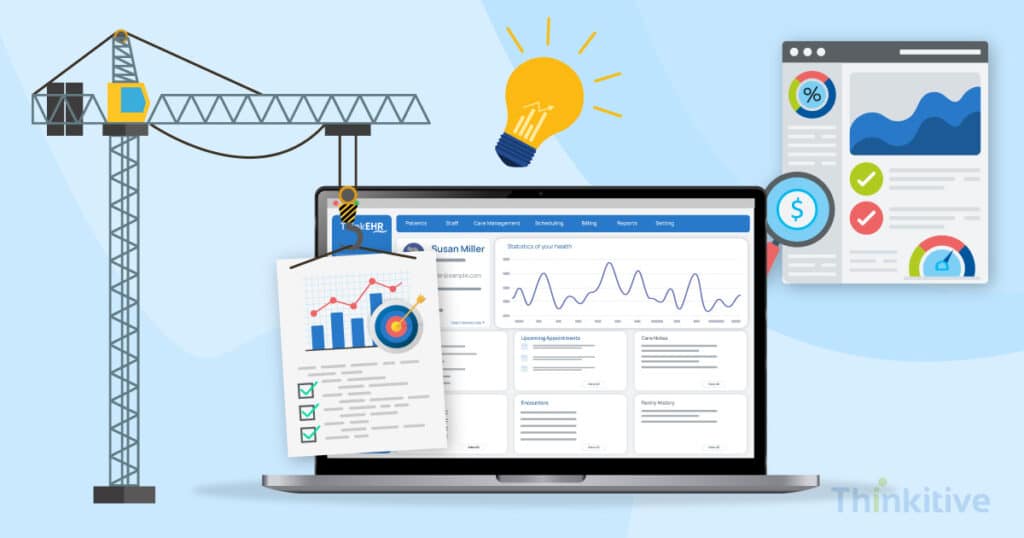
Reports are the core of healthcare, and they form the backbone of care delivery and a patient’s care journey. So, next time you think just access to a patient’s EHR is enough to deliver the best possible care, think again.
Let me show you a statistic that would give you a better idea of this. Research by the Journal of the American Medical Informatics Association showed that comparing individual EHR data with that of a comprehensive and longitudinal exchange changed care quality measures by 15%. This had an impressive impact on outcomes by 19%.
This is the impact of reports.
Providers have indeed improved their care quality with the adoption of EHR systems into their practice. This was clearly established in a national physician survey, which showed that 78% of physicians said that EHR has enhanced overall patient care, which includes accessibility and clinical care metrics.
However, the 15% care quality improvement opportunity is still missed by many providers or healthcare organizations. And this is an overwhelming concern for clinicians in 2026 in the form of low-signal data dumps.
Most of the practices have data, but they are simply not able to make the most out of it. And this is also one of the integral reasons for missed insights. To make the situation even worse, poor template designs and reporting capabilities lead to burnout and physicians having their pajama time.
However, with the rise of custom EHR projects, healthcare providers are rethinking EHR report design. In this, their demand is simple – help us build reports that actually matter. In short, they want to ingrain the capability of creating high-signal, low-noise reporting environments with which healthcare professionals can improve their operations and clinical practices.
On that note, in this blog, let’s see how meaningful reporting bridges documentation and helps healthcare providers in making better decisions. So, without further ado, let’s get started!
Assess Your EHR System for AI Readiness
Get Free AssessmentHow Do You Build Meaningful EHR Reports for Clinicians?
Let’s start with the basics of any report. The DESIGN!
Most reports look like a paper with a lot of boxes, filled with data that couldn’t be understood. The design of the report is important because of its readability. And when a person knows where to look to find what he needs, things make more sense, and decision-making is better.
Steps to Build Meaning EHR Reports?
1. Understand the clinician’s workflow before designing the report.
2. Prioritize the most important information using a clear visual hierarchy.
3. Design reports for multiple devices, including mobile screens.
4. Customize reports for each specialty and clinical workflow.
5. Keep reports simple, relevant, and easy to scan to reduce cognitive overload.
While these aspects help you in building better reports, there are some principles that can take your reports from good to great. On that note, here’s a quick brief on the design principles that you need to know:
- The 3-Second Rule: Design the reports in such a way that a person should know what it is at just a glance, or, as it says in mathematics, in 3 seconds. This way, with just a glance, your provider can know what to find where, and most critical items can be caught in action, improving speed and accuracy in decision-making.
- Visual Hierarchy: There should be a visual hierarchy in the document, or in this case, the reports. To give you an example, the first thing that should get a person’s attention should be the headline, which should be followed by a short, simple, insightful line. If the reports include pie-charts or graphs of some sort, then it should be the second thing that catches the attention. And the last part is the support context text that comes in the second fold.
- Mobile-First Reporting: Mobile usage has increased vastly over the past few years. Being our easiest access to the latest technology, don’t you think it’ll make more sense if the reports are built for a mobile format as well? The problem with ignoring mobile screens is that the chances of missing the smaller details increase. With access to reports on mobile devices and with a similar approach, key insights will have more visibility to speed up the process.
- Speciality-Specific Reporting: Every specialty has specific needs, diagnosis procedures, tests, labs, and they all have different readings. This is what makes reporting even more difficult. Some of the report’s structure simply doesn’t align with the workflows or practices. Impacting both clinical workflows and care delivery procedures.
Effective healthcare reports have this impact on care delivery and process. When you understand the end use case of building EHR reports, you’ll make this process much better. However, one thing to consider in your healthcare reporting best practices is to avoid cognitive overload through intentional EHR report design.
What Makes an EHR Report ‘Meaningful’ in 2026

Earlier in healthcare, the main problem was inaccessibility of data – cut to 2026, that problem has become a major problem for healthcare practices. Healthcare practices generate data exabytes, and between 2013 and 2020, it is expected to increase from 153 to 2314 exabytes.
Today, the need for practice is not access to data, but access to meaningful data. And to get that, EHR reporting is essential. Only when your provider can find the data he needs can he make actual use of the information that he has. And since you want a custom EHR report built into your system, you need to understand how you can add meaning to your reports.
For instance, reporting will contain retrospective summaries and decision-ready reports. Depending on the process of diagnosis or treatment, these reporting styles will change. For instance, a provider will need summaries for diagnosis; on the other hand, a biller would just need the type of service to make quick decisions. This is how you add meaning to your reports. Understanding the requirements and building your reports accordingly. One that supports daily clinical and operational actions should be decision-ready and should be designed accordingly.
Another healthcare reporting best practice that you can adopt is making your reports simple and relevant to outshine the complex visualizations that you might encounter. When the reports are simple and contain only the relevant information that you need, you don’t actually need complex graphs and other things to make designs, and this is the capability that your software system should have.
Do you know what forms the base of good reporting features in custom EHR? Well, analytics, reporting and predictive modeling are the core concepts on which a practice can generate good reports. So reading this blog – Advanced Analytics, Reporting & Predictive Modeling for Custom EHR Systems would help you things in a much better way.
Get Reports that You Actually Need
Free ConsultationHealthcare Reporting Best Practices that Drive Adoption
Talking about best practices reports and not talking about their best practices is something you simply cannot ignore. And one such thing in reporting that you can ingrain in your software is push vs. pull reporting. Effective report building is a process that contains both analysis and information gathering, and as they say, healthcare delivery is a collaborative effort; you need to ingrain this philosophy into your EHR system.
Let’s discuss this in detail below:
- Push Reporting: Push reporting is basically the process where the system itself analyzes the reports and gives insights directly to clinicians or administrators. Some of the prime examples of these are inbox summaries, exception alerts, or daily highlights. It is a constructive process and should be treated accordingly. There is no need for external interference in this type of reporting. This is where the system pushes the reports to you.
- Pull Reporting: The next is pull reporting, which is called pull reporting because here you pull the information from the users. For instance, before joining a virtual consultation or during appointment scheduling, if you want your patients to fill in some details, then it can be ingrained in the workflows. Furthermore, to make it easy for providers to find, you can manually search dashboards.
This mechanism is like finding a needle in a stack of hay by pulling a large magnet.
Some other healthcare reporting best practices include standardized data capturing methods. Due to this, reporting consistency can be ensured, and clinicians can actually get the reports that they can trust and use.
But reporting is a two-way process. Meaning your system might have the capability to analyze and give world-class reports, but if they do not lead to any decisions that create an impact, then it is useless. So remember to design and ingrain better documentation habits to ensure clinical decisions are made effectively and efficiently.
The Custom Advantage: Why Generic Reports Fall Short
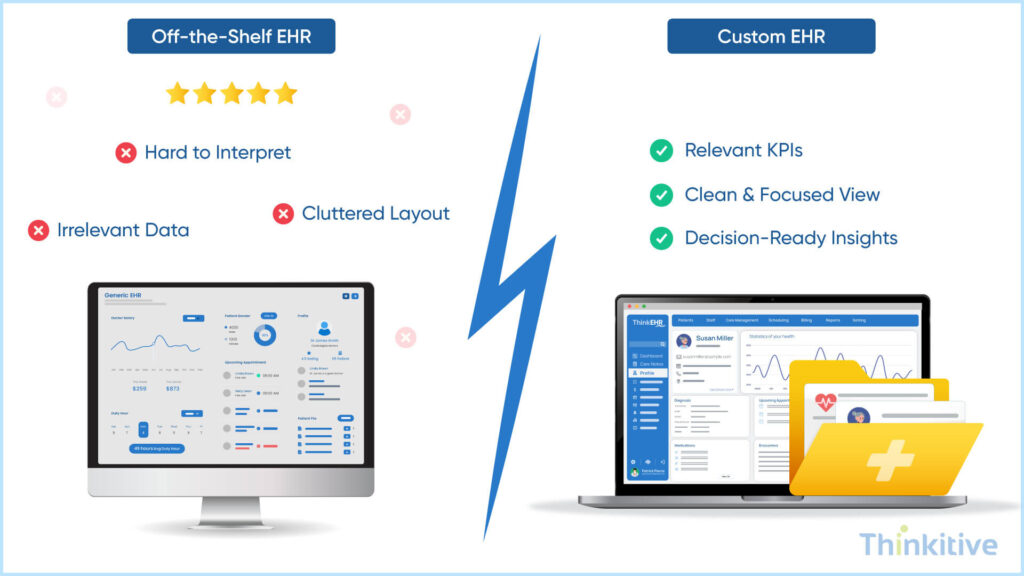
Many healthcare providers are looking for custom EHR report-building features in their EHR software. This problem that they have to deal with is because of the one-size-fits-all approach these standard systems have adopted. Due to this approach, the intricacies of the core of the reports get lost.
On top of that, the chances of the creation of clutter of unnecessary information are higher; this can oftentimes be irrelevant. Here, custom EHR report building can be a great tool to analyze and remove clutter efficiently. Meaning, even if there is very little information present in a clutter, the system will bring it down and provide it in a comprehensive way by showing only relevant metrics, making the decision-making process better.
Every practice is unique, and oftentimes the reporting logic of each practice seems to be distinct from one another. In such cases, the logic for reports to drive clinical decisions is extremely important. With this, reporting becomes easy, and practice logic is met effectively.
The table below summarizes the key differences between standard EHR reports and custom EHR reports designed for clinical decision-making.
| Feature | Standard EHR Reports | Custom EHR Reports |
| Report Design | Generic templates | Specialty-specific layouts |
| Clinical Relevance | One-size-fits-all | Workflow-based reporting |
| Data Presentation | Static information | Real-time actionable insights |
| Decision Support | Limited | Supports clinical decisions |
| Flexibility | Limited customization | Fully customizable |
On top of that, if you want your system to be future-ready, then prepare reports for the future with BI. With this, you don’t have to rely on exporting tools, and your systems become an inclusive system for reporting and analytics.
See Which Processes AI can Simplify for Your Practice
Get Free ConsultationConclusion
If you’ve made it till here, then by now, I guess you’ve never looked at reporting like this, right? Even if you don’t have something that I want, I can assure you that with custom EHR report building aspects, you actually transform your EHR from a simple record-keeping software to a system of insights.
Furthermore, by building meaningful EHR reports, you can significantly reduce burnout chances of your clinicians, improve the quality of care, and support the growth aspect of your practice.
Also, if you are looking to be in the middle of your custom EHR software development venture, then it is the time for custom EHR report building, as it will give you long-term value for investment.
On that note, get your consultation from our EHR expert for custom EHR software and see a smooth transition from simple records keeping to advanced analytics without risking duplication of your content.
Frequently Asked Questions
Building meaningful EHR reports starts with understanding clinical workflows, organizing information using clear visual hierarchy, customizing reports for each specialty, minimizing unnecessary data, and presenting real-time insights that support faster clinical decisions.
Custom EHR report building involves designing reports around a practice’s specific clinical workflows, quality metrics, and decision-making needs. Unlike standard EHR reports—which are often generic and rigid—custom reports allow tailored data views, real-time filters, specialty-specific KPIs, and actionable insights that directly support care delivery and operations.
Most EHR reports fail because they focus on data extraction rather than clinical relevance. They often present static, aggregated data without context, timeliness, or prioritization. When reports lack real-time updates, clinical benchmarks, or role-based views, they become informational instead of decision-enabling.
In 2026, meaningful EHR reports are real-time, concise, and decision-oriented. They surface only what matters—risk flags, trends, gaps in care, and next-best actions—within the clinician’s workflow. Integration with AI insights, predictive indicators, and mobile-friendly access further defines modern, meaningful reporting.
Effective EHR report design reduces burnout by minimizing cognitive overload. By prioritizing critical metrics, eliminating redundant data, and using intuitive visualizations, clinicians spend less time interpreting reports and more time acting on insights. Well-designed reports replace manual chart reviews and reduce after-hours data analysis.
Healthcare reporting best practices include clinician-led report design, role-based access, real-time data refresh, and alignment with clinical workflows. Reports should be simple, actionable, and measurable—focused on outcomes rather than volume. Planning for scalability, compliance, and interoperability is also essential for long-term value.
Custom EHR reports support Medical Decision Making by presenting relevant clinical data, risk indicators, and historical trends at the point of care. They help clinicians assess complexity, evaluate treatment options, and justify decisions with evidence—improving accuracy, compliance, and documentation quality.
Planning for the reporting aspect during custom EHR software development ensures the data architecture supports meaningful insights from day one. Retroactive reporting often exposes data gaps, workflow mismatches, and performance issues. Early planning enables cleaner data models, optimized queries, and reports that evolve alongside clinical and business needs.
Mobile-first EHR reporting improves adoption by delivering insights where clinicians already work—on the move. Quick-loading dashboards, glanceable metrics, and touch-friendly interactions make reports more usable during rounds or between visits. Convenience and accessibility directly increase report usage and clinical impact.


