5 Must-Have Integrations When You Build Your EHR

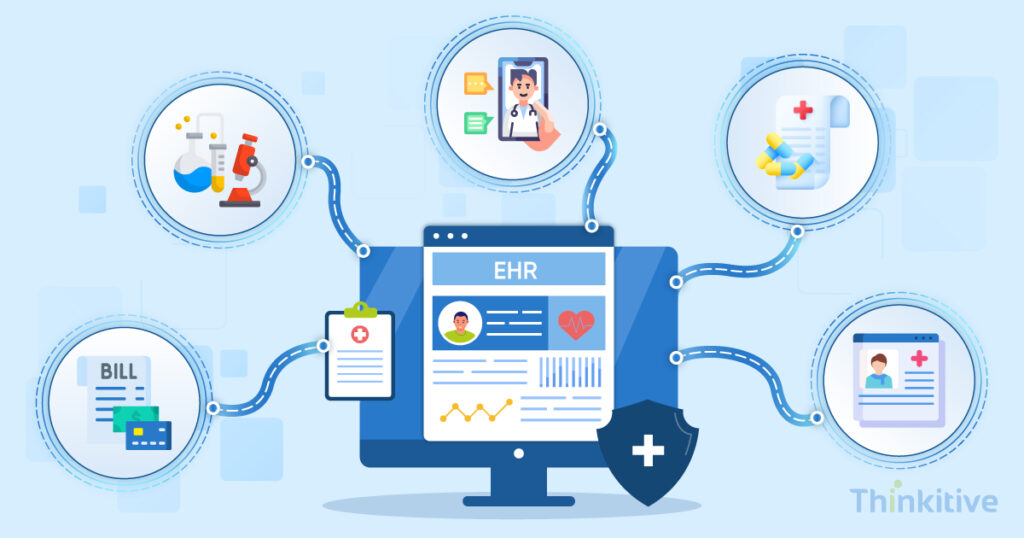
Delivering care is a very collaborative effort, while the focus is majorly on the doctors, but they too depend on several healthcare service providers to deliver care. You see, you always need to be in contact with laboratories, pharmacies, billing platforms, telehealth solutions and other healthcare applications on a day-to-day basis.
Now to access the information in their system you would have to open their specific app and search the information you need, right? This would have to switch between multiple apps from time to time.
Tired of these inefficiencies, several healthcare practices have finally opted to build their own EHR system. This is because they understood that building an EHR system isn’t about designing clinical workflows and adding new features to the list.
These healthcare practices simply wanted to create a well-connected platform that supports seamless data exchange across different healthcare systems. In this as well, you have to identify the right integrations so that you can eliminate information isolation, reduce administrative efforts and improve coordination between your care team.
Despite all this, the major reason why many healthcare practices have adopted a well-integrated EHR system is to give them easy and instant access to up-to-date patient information. Now, if you are someone looking to build a custom EHR, then you will need integrations to carry out your day-to-day activities.
These essential EHR integrations support your day-to-day clinical and administrative workflows while creating a connected healthcare ecosystem.
On that note, let’s deep dive into the top 5 must-have EHR integrations!
How To Build EHR that Integrates with Billing, Labs & Telehealth Systems –
Read Guide5 Must-Have EHR Integrations When You Build a Custom EHR
Every modern EHR relies on a core set of integrations that support daily clinical and administrative workflows. Below are the five integrations every healthcare organization should prioritize when building a custom EHR.
| Integration | What It Connects | Why It’s Essential |
| Billing & Revenue Cycle | Claims, coding, reimbursements | Streamlines financial workflows and reduces claim errors. |
| Laboratory Systems | Lab orders and diagnostic results | Speeds up diagnosis and improves care coordination. |
| Telehealth | Virtual consultations and scheduling | Enables seamless remote care delivery. |
| Electronic Prescribing (eRx) | Pharmacies and medication networks | Improves prescribing accuracy and patient safety. |
| Patient Portal | Patients, providers, and care teams | Enhances patient engagement and communication. |
Why Must-Have EHR Integrations Matter for Modern Healthcare
Today, EHR is more than just a digital record-keeping system. Over the years, it can become the epicenter for clinical and administrative workflows. However, the true value of the EHR system depends on its ability to connect with other healthcare systems to help you deliver quality care.
Now, without the right integrations, it will just be a new system, and you will still have to switch between applications to access the healthcare information you want. This will also stop some of your other things in their track like managing prescriptions, review lab results, schedule virtual consultations or process insurance claims.
Due to these disconnected workflows, the administrative effort increases, decision-making is delayed, and information is stored in isolation.
That is why some of these essential integrations have become the baseline for building a modern EHR. By integrating your EHR with laboratories, pharmacies, billing systems, telehealth solutions, and other healthcare applications, you can streamline workflows, improve care coordination, and give providers instant access to accurate patient information from a single platform.
Why is Billing Integration Essential for an EHR?
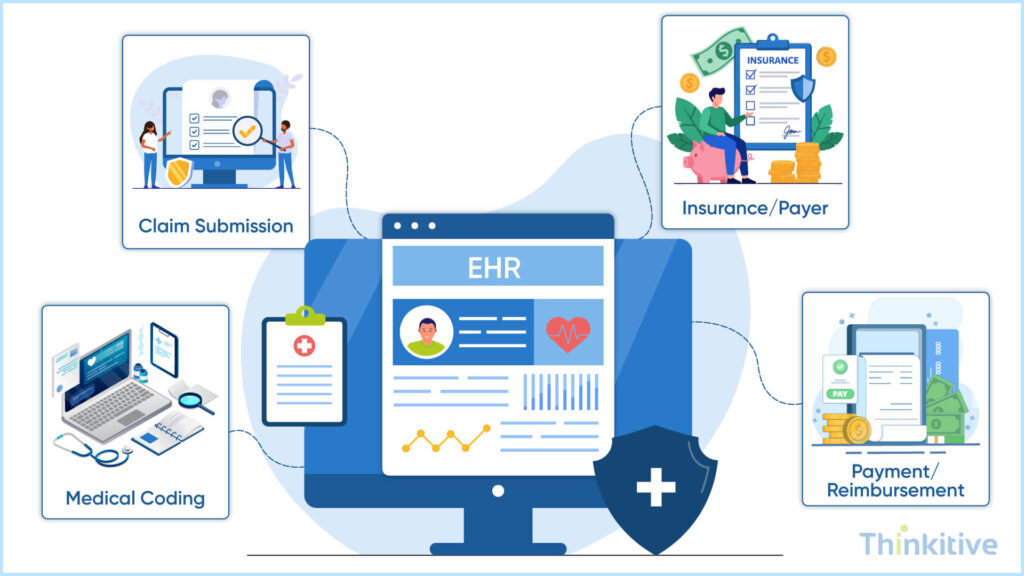
First things first, let’s get the finances right. Billing and revenue cycle management are among the most frequently used systems in any healthcare practice. That is why, it is said that patient care doesn’t end after the consultation, it continues with accurate coding, claims submission, and payment collection.
Building an integrated EHR with billing and RCM ensures clinical documentation flows seamlessly into financial workflows, reducing duplicate data entry and manual reconciliation.
Once integrated, your EHR automatically shares clinical information with your billing system, reducing duplicate data entry, streamlining claims processing, and improving reimbursement accuracy. This allows providers and billing teams to work from the same up-to-date patient information without switching between multiple applications.
Rather than functioning as separate systems, an integrated EHR and billing platform create a connected workflow from patient documentation to reimbursement.
Here are some of the key benefits of this EHR integration:
- Automates coding, billing, and claims workflows
- Reduces manual data entry and administrative overhead
- Improves reimbursement accuracy and reduces claim denials
- Minimizes administrative workload
- Strengthens financial visibility
Want to learn more about billing workflows? Explore our guide to EHR Billing Features, then you will need integrations to carry out your day-to-day activities.
Assess Your EHR System for Multiple System Readiness –
Get Assessment & Consultation
Laboratory & Diagnostic: Connecting Clinical Data in Real Time
Laboratory and diagnostic integration is another essential EHR integration that connects your EHR with Laboratory Information Systems (LIS) and diagnostic platforms. Laboratory and diagnostic data play a critical role in clinical decision-making.
So, by integrating your EHR with Laboratory Information System (LIS) and diagnostic platforms, you can order tests, receive results, and review reports without leaving the EHR.
Modern laboratory integrations also support secure electronic test ordering and result sharing using interoperability standards such as HL7 and FHIR, helping providers access accurate diagnostic information without switching between systems.
By eliminating manual result retrieval and disconnected workflows, laboratory integration helps providers make faster and more informed clinical decisions.
Some of the key benefits of having this integration built into your EHR system are:
- Enables electronic test ordering and results
- Improves diagnostic workflows
- Reduces manual data entry
- Supports faster clinical decisions
- Enables secure data exchange
Patient Portal & Communication Integration: Strengthening Patient Engagement
A modern EHR should empower patients just as much as it supports providers and that’s exactly why EHR integration must have patient portals and communication integrations. For instance, integrating a patient portal within your EHR gives patients secure access to their health records, upcoming appointments, prescriptions, lab results and care plans through a single convenient platform.
Beyond improving accessibility to information, patient communication integration also help in automating appointments, follow-up messages, care plan notifications and routine communications.
These activities improves patient engagement allowing them to be more involved in care and reducing the rate of missed appointments, and minimizes the administrative workload for front-office staff.
Modern patient portals continue to evolve with features that improve accessibility and strengthen communication between patients and providers.
Some of the key benefits of this EHR integration include:
- Gives patients secure access to health records and care plans
- Automates appointment reminders and follow-up communications
- Improves patient engagement and reduces no-shows
- Supports secure patient communication
- Enhances the overall patient experience
Telehealth: Enabling Connected Virtual Care Delivery
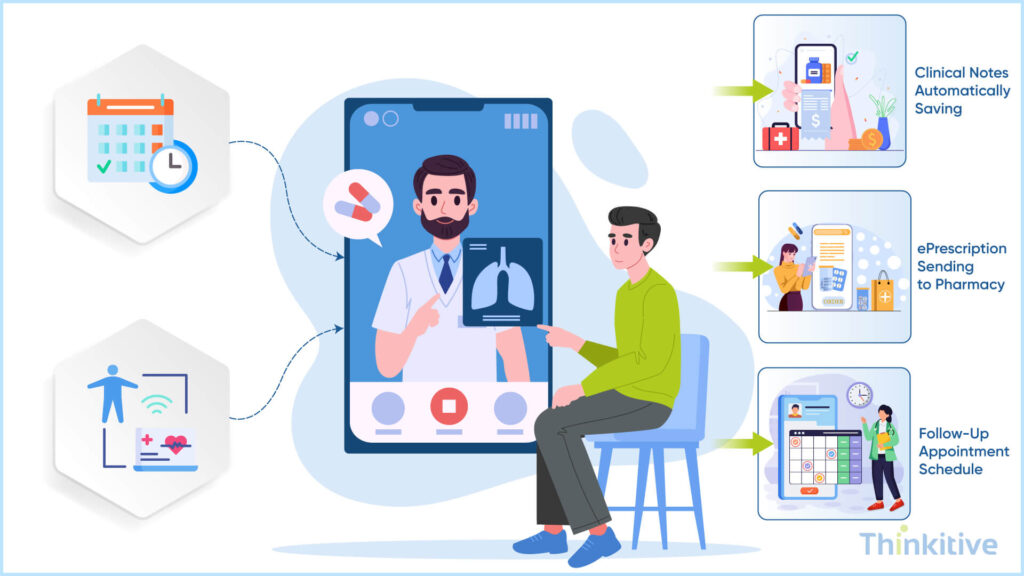
Virtual care has become a standard part of modern healthcare, making telehealth one of the essential integrations for any modern EHR. Integrating telehealth directly into your EHR allows providers to schedule virtual appointments, conduct video consultations, and document patient encounters without switching between multiple systems.
More importantly, telehealth integration keeps patient records, appointment details, and clinical documentation synchronized throughout the care journey, ensuring every virtual visit becomes part of the patient’s complete medical record.
To learn what it takes to build a telehealth-ready EHR with the right features, workflows, and architecture, read our complete guide on Telehealth-Ready EHR Development.
Electronic Prescribing (eRx): Improving Medication Management & Patient Safety
Another must-have EHR integration is Electronic Prescribing (eRx), which enables providers to prescribe medications directly from the EHR system. This eliminates manual handwritten processes by a huge margin.
On top of that by connecting with pharmacy networks, prescriptions can be directly sent to the pharmacies reducing errors and making prescribing much faster and convenient for both providers and patients.
Beyond prescription transmission, an integrated eRx solution gives clinicians access to medication histories, refill requests, formulary information, and pharmacy communications within the same workflows.
Here are some of the key benefits of this EHR integration type:
- Streamlines medication prescribing and refill workflows
- Provides access to medication history and formulary information
- Supports secure communication with pharmacies
- Improves prescribing accuracy with automated safety checks
- Enhances patient safety and medication management
See How an EHR with Seamless Integration Works –
Get Free DemoConclusion
From billing to patient portal and telehealth to electronic prescriptions these five must-have EHR integrations will help you turn your EHR system to an MVP EHR system covering all the necessary aspects of your clinical and administrative needs.
Every modern healthcare practice depends on multiple connected systems, and choosing the right integrations from the beginning helps eliminate disconnected workflows, improve care coordination, and simplify daily operations. Start with these five essential integrations, then expand your ecosystem as your organization grows.
On that note, let this blog be your guide to building a well-integrated EHR system for your practice. So, what are you waiting for? Assess EHR and EMR software requirements with our EHR expert and get started.
Frequently Asked Questions
Start with the integrations that support your practice’s day-to-day clinical and administrative workflows. For most healthcare organizations, billing and revenue cycle management, laboratory systems, electronic prescribing (eRx), patient portals, and telehealth are the highest priorities. These essential EHR integrations reduce duplicate data entry, improve care coordination, and ensure providers have access to accurate patient information from a single platform. As your practice grows, you can expand your EHR with additional integrations such as imaging, remote patient monitoring (RPM), and AI-powered healthcare solutions.
The must-have EHR integrations for modern healthcare organizations include billing and revenue cycle management, laboratory and diagnostic systems, telehealth platforms, electronic prescribing (eRx), and patient portals. These integrations enable seamless data exchange between healthcare systems, reduce manual work, improve care coordination, and give providers instant access to critical patient information from a single platform.
When you build an integrated EHR, the most essential integrations are those that support everyday clinical and administrative workflows. These include laboratory systems for test orders and results, billing platforms for claims and reimbursements, telehealth solutions for virtual care, ePrescribing networks for medication management, and patient engagement platforms for secure communication. Together, these essential integrations for building a modern EHR create a connected and scalable healthcare ecosystem.
Billing and revenue cycle integration connects clinical documentation with coding, claims processing, reimbursement, and payment workflows. This reduces duplicate data entry, minimizes billing errors, accelerates reimbursements, and improves revenue cycle efficiency. Integrated billing workflows also help healthcare organizations maintain accurate financial records while reducing administrative burden.
Laboratory and diagnostic integration enables providers to electronically order tests, receive results in real time, and access diagnostic reports directly within the EHR. This improves clinical workflows, reduces transcription errors, supports faster diagnoses, and enhances care coordination by ensuring providers always have access to up-to-date diagnostic information.
Telehealth integration allows providers to schedule virtual appointments, conduct video consultations, document encounters, and communicate with patients without leaving the EHR. It creates a connected workflow that improves continuity of care, reduces administrative effort, and supports AI-assisted documentation for more efficient virtual care delivery.
The best EHR integrations for healthcare practices are those that align with their clinical and operational workflows. For most organizations, the top 5 must-have EHR integrations include billing and revenue cycle management, laboratory systems, telehealth platforms, electronic prescribing, and patient portal integrations. These integrations help streamline operations, improve patient care, and create a more connected healthcare environment
Electronic prescribing (eRx) integration improves patient safety by enabling providers to send prescriptions electronically while automatically checking for drug interactions, allergies, duplicate therapies, and dosage issues. It also provides access to medication histories and formulary information, helping clinicians make more informed prescribing decisions and reducing medication errors.
Patient portal integrations give patients secure access to their health records, prescriptions, laboratory results, appointments, and care plans through the EHR. They also support automated appointment reminders, follow-up messages, and secure communication with providers. Modern portals may include AI-powered self-service features, making it easier for patients to manage their care while improving engagement and satisfaction.


