Telehealth-Ready EHR: What You Must Build

There is a steep rise in the use of telehealth technologies in healthcare practices. You see, according to the American Medical Association, the number of physicians using telehealth increased from 25% to 71% from 2018 to 2024.
This number has only increased since then, and today the landscape of the use of telehealth technologies has completely changed.
As virtual care becomes a standard part of healthcare delivery, organizations are embedding telehealth directly into their EHRs instead of relying on standalone platforms. That is why there is a significant rise in building telehealth EHRs that not only act as the epicenter for practices, but also provide a platform for both providers and patients to connect virtually.
Furthermore, given the digital drive in the healthcare industry, this trend seems to be only increasing as time passes by. However, out of all the requirements and queries that we get from the prominent healthcare providers about virtual care EHR features, especially related to telehealth-ready EHR, they prominently ask, ‘How to build a telehealth-ready EHR?’
Well, answering that in simple words is easier said than done. On that note, let this blog serve you as a telehealth-ready guide to build EHR software for your practice, and while answering almost all the questions that you might have regarding HIPAA-compliant telehealth EHR features, also try to find out everything that you need to know about building a telehealth-ready EHR.
So, without further ado, let’s get started!
Assess Your System for Telehealth Capabilities –
Get Free Assessment
Why Healthcare Organizations Need a Telehealth-Ready EHR
The American Medical Association stated that nearly 71% of physicians now work in practices that offer telehealth. This makes it clear that virtual care is no longer a temporary shift; it has become a standard part of healthcare delivery rather than just an added service.
By forcing healthcare organizations to think beyond standalone telehealth tools, increasing patient expectations contributes more to it. To deliver connected, efficient care, they need to build telehealth EHR capabilities directly into their core platform.
Here are some of the reasons why many healthcare organizations are making this shift:
- Expand access to care by reaching patients in rural areas, supporting those with mobility challenges, and offering greater scheduling flexibility.
- Improve convenience and continuity of care by giving providers complete patient information during both in-person and virtual visits, ensuring everyone stays on the same page.
- Create a connected digital ecosystem through a telehealth-ready EHR, where scheduling, documentation, billing, messaging, and virtual visits work seamlessly instead of operating in silos.
However, building these capabilities is not just about offering video consultations; it’s all about creating a healthcare platform that can support long-term digital care delivery.
Core Virtual Care EHR Features Every Platform Should Include
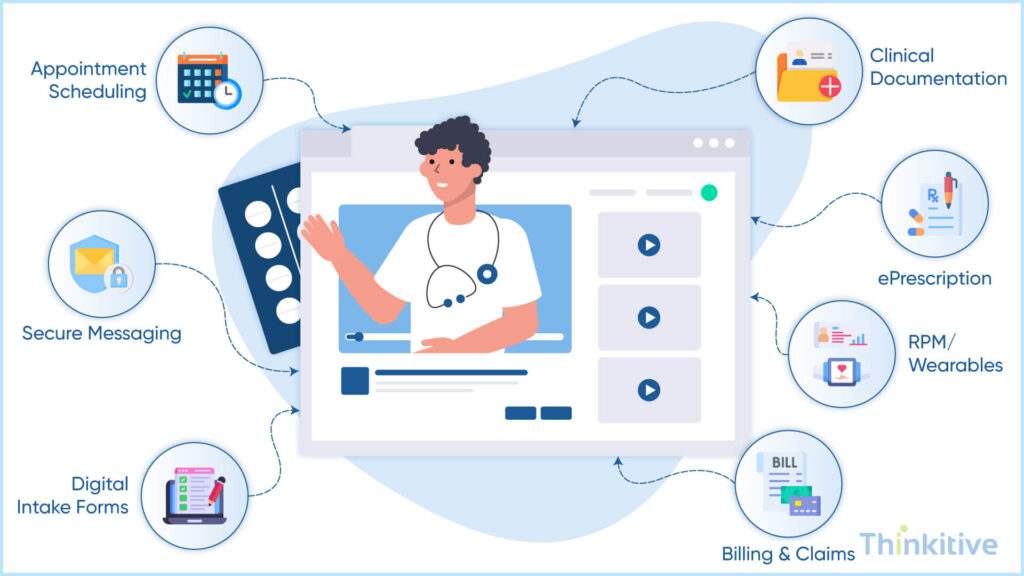
Video consultation takes center stage; however, they are just one piece of the puzzle. The real value of it comes from creating a connected experience where providers can easily manage every step of the virtual care journey without even leaving the EHR.
It means building together capabilities including integrated appointment scheduling, virtual visit management, secure patient communication, digital intake forms, clinical documentation, and HIPAA-compliant telehealth EHR features.
Information flows seamlessly from one care stage to the next when all these functions work together, instead of getting trapped in disconnectedness.
Let’s have a look at some of the impactful capabilities:
- Appointment scheduling with automated reminders and virtual visit management.
- Secure video consultations integrated with real-time clinical documentation.
- Digital intake forms and patient communication tools that reduce paperwork and keep patients informed throughout their care journey.
Incorporating these virtual care EHR features can allow your organization to streamline workflows and create a smooth and more consistent experience for providers and patients. This is exactly what sets a modern telehealth-ready EHR apart from a basic video conferencing solution.
Essential Telehealth EHR Features
| Feature | What It Enables |
| Video Consultations | Conduct secure virtual appointments |
| Appointment Scheduling | Book and manage virtual visits |
| Clinical Documentation | Capture visit notes during consultations |
| Secure Patient Messaging | Communicate safely before and after visits |
| ePrescribing | Send prescriptions electronically |
| Billing Integration | Simplify telehealth reimbursement workflows |
| Remote Patient Monitoring | Monitor patient health between visits |
Designing an Effective Telehealth EHR Integration Strategy
A successful telehealth platform is not built by connecting a video tool to an EHR. It requires a thoughtful telehealth EHR integration strategy that brings clinical and operational workflows together. When every system works in sync, providers are more likely to deliver efficient, coordinated care without unnecessary disruptions.
A strong integration strategy should focus on:
- Connecting telehealth with core workflows:
Integrate virtual care with appointment scheduling, patient records, and care management systems so information flows seamlessly throughout the patient journey.
- Supporting clinical and operational efficiency:
Ensure telehealth workflows align with documentation, billing, patient communication, and care coordination to reduce manual work and improve collaboration across teams.
- Building a unified digital health ecosystem:
Instead of treating telehealth as a separate solution, make it part of a broader effort to create a unified virtual care experience by connecting telehealth with scheduling, documentation, billing, and patient communication.
Your organization can create a stronger foundation to deliver continuous, high-quality care and adapt to evolving patient needs when telehealth is woven into the core EHR infrastructure.
Building HIPAA-Compliant Telehealth Workflows
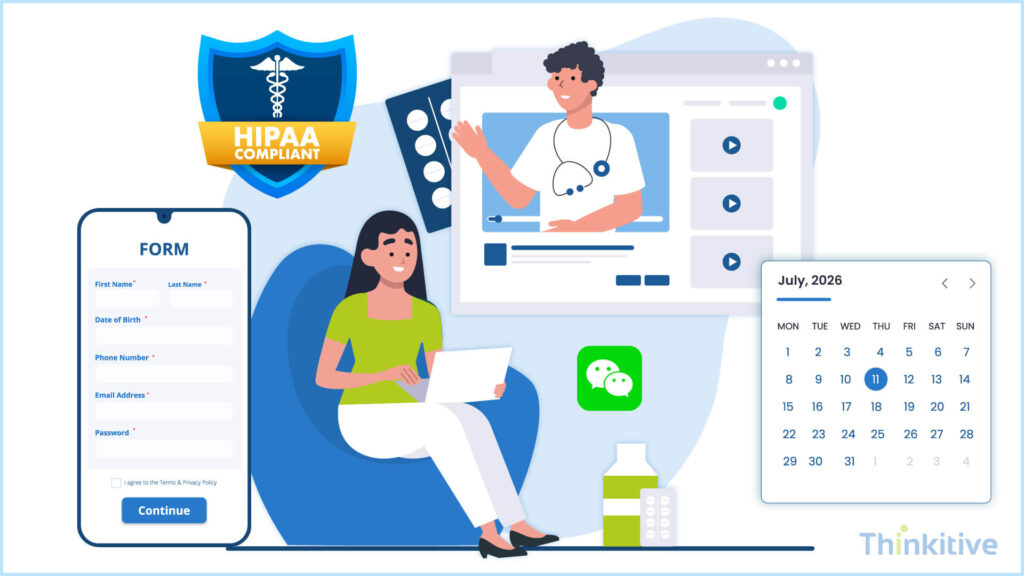
A seamless virtual care experience means little if your patient data is not protected. Rather than being treated as a final checkbox, security and compliance should be embedded into every workflow.
- Protect patient data at every touchpoint
Every interaction, from virtual consultations to secure messaging and digital document sharing, should always safeguard sensitive health information. Encryption, role-based access, and secure communication channels can prevent unauthorized access while maintaining patient trust.
- Include the right security capabilities
A secure platform should always incorporate HIPAA-compliant telehealth EHR features like multi-factor authentication, audit trails, access controls, and encrypted data storage. Together, all these capabilities can create a strong security framework.
- Stay aligned with HITECH requirements
Along with data protection, organizations should also maintain detailed audit logs while establishing breach notification processes to meet HITECH requirements. All these measures can enhance transparency, simplify compliance reporting, and strengthen accountability across telehealth workflows.
If you are making compliance a core part of the platform rather than an afterthought, your organization is more likely to scale virtual care with greater confidence while building lasting trust with your patients.
Build an EHR That Integrates with Billing, Labs & Telehealth –
Learn MoreSupporting Remote Patient Monitoring and Connected Care
Virtual care never ends when the video call does. For patients with chronic conditions, recovering after surgery, or requiring ongoing follow-ups, care continues well beyond the clinic.
This is exactly where remote patient monitoring becomes a measurable extension of a telehealth-ready EHR.
Integrating remote patient monitoring devices and patient-generated health data into the EHR can provide a complete view of your patient’s health between visits. Instead of relying heavily on periodic appointments, it becomes easy to track vital signs, monitor health trends, and identify potential concerns even before they become serious.
The impact goes beyond better visibility, as connected care helps to maintain continuity while keeping your patients actively involved in their overall treatment. It also enables your care team to make informed decisions on the basis of real-time data, rather than isolated snapshots.
Simply put, a well-designed telehealth-ready EHR does not just support virtual visits, but also helps your organization deliver more connected, continuous care whenever and wherever patients need it.
Improving Provider Efficiency Through Telehealth Automation
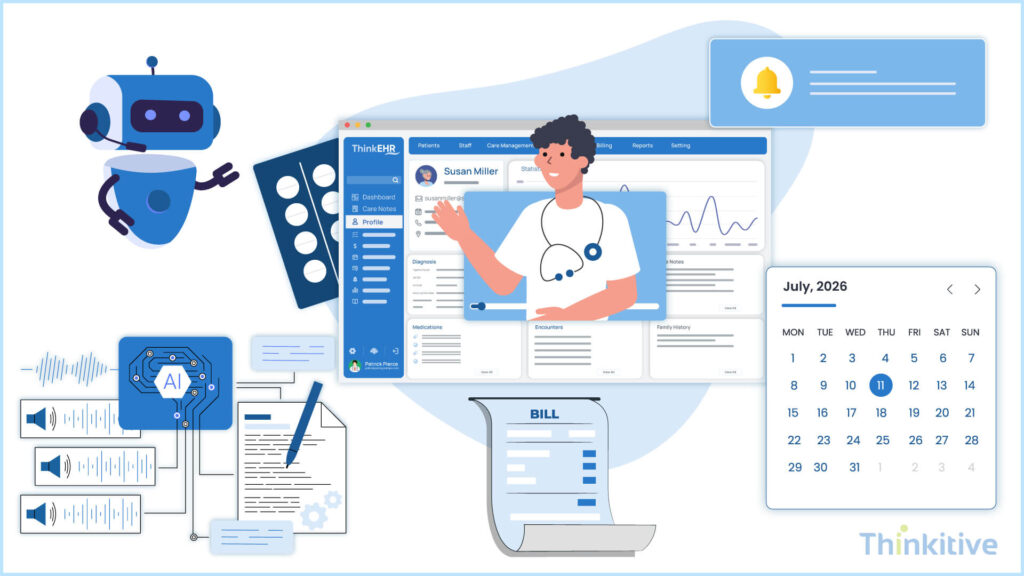
Better patient access is not the only advantage of a modern telehealth platform; it also gives you extra time to focus more on care, rather than routine administrative tasks. By automating repetitive workflows, your organization can improve efficiency without even adding complexity to daily operations.
- Automate routine tasks
As tasks like appointment reminders, digital patient intake, and post-visit follow-up communications can be handled automatically, it can result in reduced missed appointments, minimized manual efforts, and a seamless patient experience.
- Simplify clinical documentation
With AI-assisted documentation, you can capture conversations, generate clinical notes, and support providers with accurate recordkeeping during virtual visits. This also allows you to spend more time engaging with your patients.
- Boost productivity across the care team
It is obvious that if administrative work is less, clinicians and support staff are more likely to focus on higher-value activities. This also improves workflow efficiency and helps organizations to deliver more timely and coordinated care.
Telehealth EHR Architecture Checklist for Long-Term Success
Building a telehealth platform is not just about meeting today’s requirements; it’s all about creating an architecture that can adapt to tomorrow’s healthcare landscape.
If you are confused about how to build a telehealth-ready EHR, check the checklist below to make sure your platform is ready for long-term success.
1. Support FHIR, HL7, and ONC interoperability.
2. Build HIPAA- and HITECH-compliant workflows.
3. Design a scalable cloud architecture.
4. Enable secure video consultations and messaging.
5. Integrate scheduling, billing, and documentation.
6. Support remote patient monitoring.
7. Continuously monitor performance and compliance.
Witness Seamless Integration into Custom EHR System –
Get Free DemoConclusion
A successful telehealth-ready EHR is built on more than virtual consultations. It combines seamless integration, secure workflows, automation, interoperability, and connected care to deliver a better experience for both providers and patients.
As virtual care continues to evolve, healthcare organizations that build telehealth EHR platforms with scalability and compliance in mind will be well-positioned to improve care delivery, strengthen patient engagement, and support long-term growth.
Ready to build a future-ready telehealth platform? Click here to explore how to create EHR software with telehealth integrated technologies for holistic and complete digital care.
Frequently Asked Questions
Building telehealth EHR capabilities means integrating virtual care tools such as video consultations, appointment scheduling, clinical documentation, secure messaging, and patient communication, directly into an EHR system. This creates a connected workflow that supports both in-person and virtual care without relying on separate platforms.
The most important features include integrated appointment scheduling, secure video consultations, digital patient intake, clinical documentation, patient messaging, remote patient monitoring, billing support, and interoperability with other healthcare systems. Together, these features create a seamless experience for providers and patients.
Building a telehealth-ready EHR starts with identifying clinical and operational requirements. The platform should support virtual visits, secure data exchange, interoperability standards like FHIR and HL7, HIPAA compliance, scalable architecture, and workflow automation to ensure long-term success.
A telehealth-ready EHR remains HIPAA compliant by protecting patient data throughout every virtual care workflow. This includes implementing end-to-end encryption, role-based access controls, multi-factor authentication, secure messaging, audit logs, and encrypted data storage. Organizations should also align telehealth workflows with HITECH requirements, maintain detailed audit trails, and establish breach notification processes. Embedding these security measures into the platform from the beginning helps protect sensitive health information while supporting secure, compliant virtual care.
Telehealth EHR integration connects scheduling, patient records, documentation, billing, and communication into a single workflow. This reduces duplicate data entry, improves care coordination, and allows providers to spend more time delivering care instead of managing multiple systems.
Remote patient monitoring extends care beyond virtual appointments by collecting patient-generated health data from connected devices. This allows providers to monitor health trends, detect potential issues early, and deliver timely interventions without requiring frequent in-person visits.
AI can automate clinical documentation by generating visit notes, summarizing conversations, and reducing manual data entry. It can also improve patient engagement through automated reminders, personalized follow-up messages, and intelligent alerts that support proactive care management.
A comprehensive checklist should include interoperability with FHIR and HL7 standards, HIPAA and HITECH compliance, scalable infrastructure, secure data exchange, workflow automation, audit logging, patient access capabilities, and support for future healthcare technologies.
Common challenges include integrating telehealth with existing systems, maintaining data security and compliance, ensuring interoperability, managing implementation costs, training healthcare staff, and encouraging user adoption. Careful planning and a scalable implementation strategy can help overcome these challenges.


