Trusted by 125+ Clinics

Mental Health Billing Services with 97% Claim Acceptance

Maximize your practice's revenue with end-to-end outsourced mental health billing services at a flat 2.5% fee. We help therapists, psychiatrists, and psychologists reduce billing errors, prevent repeat claim denials, and capture every eligible reimbursement.

+1 (405) 638-3126

Free billing audit in 48 hours. No setup fees. Works with your EHR and clearinghouses.

Book a Free Billing Audit

No calls required. No patient data needed.

Step 1 of 4 — takes under a minute

What's your specialty?

Please pick your specialty.

Audit request received.

A senior billing specialist will reach out within one business day to set up your walkthrough. Want to lock in a time right now?

12+ YearsIn Healthcare RCM
1,047+Providers Served
125+Clinics Nationwide
Clutch★★★★★ 4.8 · verified reviews
WHY MENTAL HEALTH PRACTICES LOSE REVENUE

6 Places Your Practice Is Leaking Revenue

Time-based coding errors, authorization gaps, telehealth billing issues, and uncollected copays can leave significant revenue on the table for mental health practices, therapists, and psychologists.

$580M

Revenue Lost to Coding & Documentation Gaps

Medicare improperly paid an estimated $580M of $1B in psychotherapy payments. Undocumented session time was the most common reason.

HHS OIG Audit, 2023

Wrong Payer

Claims Lost to Behavioral Health Carve-Outs

Separate behavioral health benefit administrators can make it difficult to identify the correct payer, resulting in rejected or delayed claims.

Behavioral health billing challenge

40 / Week

Unpaid Sessions from Authorization Gaps

Physicians handle an average of 40 prior authorizations weekly, while 32% say requests are often or always denied. Missed session limits and reauthorization dates can put payments at risk.

AMA, 2025

42.9%

Revenue at Risk from Telehealth Billing Errors

42.9% of Medicare fee-for-service outpatient mental health visits were virtual in 2023. Incorrect POS codes and payer-specific modifiers can lead to claim issues.

JAMA Network Open, 2026 (2023 data)

Missed Codes

Unclaimed Revenue from Missed Add-On Codes

Overlooked interactive complexity, crisis psychotherapy, and psychotherapy-with-E/M add-on codes can leave eligible services unbilled.

Behavioral health billing challenge

56%

Revenue Left in Uncollected Patient Balances

Point-of-service copay collection dropped from approximately 90% in 2019 to 56% in 2022, leaving practices with more outstanding balances.

MGMA Stat, 2025 (2022 data)

3 ADVANTAGES OF THINKITIVE

3 Reasons to Choose Thinkitive for Mental Health Billing Services

See how Thinkitive's mental health billing services improve collections, reduce administrative work, and control billing costs. Calculate your potential savings with a flat 2.5% fee.

Calculate My Savings →
  1. Maximize Reimbursement 97% net collection

    Specialty-aware coding and pre-submission checks help capture eligible psychotherapy and psychiatry charges, reduce underpayments, and improve the revenue your practice collects.

  2. Simplify Your Behavioral Health Revenue Cycle one accountable team

    One dedicated team manages eligibility, carve-outs, authorizations, claims, denials, and A/R follow-ups, reducing administrative work and giving your practice one point of accountability.

  3. Reduce Mental Health Claim Denials 32% fewer denials

    Pre-submission checks for session documentation, coding, authorization status, and payer-specific telehealth requirements help prevent avoidable denials and repeated claim rework.

OUTSOURCE BEHAVIORAL HEALTH BILLING

One Team for Every Step of Mental Health Medical Billing, from Eligibility to Reimbursement

Our behavioral health billing services cover every stage of your revenue cycle, from insurance verification and prior authorizations to coding, claims management, denial recovery, A/R follow-ups, patient billing, and reporting.

Verify Mental Health Benefits Before the First Session

Verify insurance coverage, mental health benefits, and payer requirements before appointments to identify carve-outs, coverage limits, and potential eligibility issues.

Mental Health Benefits Verification
Check active coverage, copays, deductibles, coinsurance, and network status before scheduled therapy or psychiatry visits.
Behavioral Health Carve-Out Identification
Identify separate behavioral health administrators and confirm the correct payer before submitting claims.
Early Coverage Issue Detection
Flag inactive policies, incorrect subscriber details, carrier changes, and out-of-network coverage so eligibility issues can be addressed before appointments.
Insurance verification worklist for next-day appointments showing each patient's active plan, coverage status, copay, remaining deductible, secondary coverage and a flag for services that need prior authorization.

Keep Prior Authorizations and Visit Limits on Track

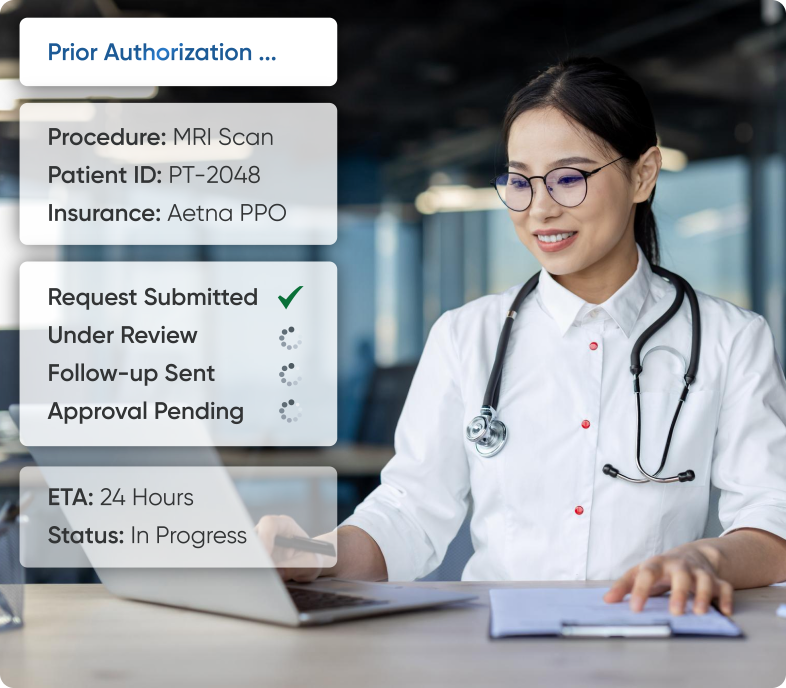
Coordinate mental health authorizations, monitor approved session counts, and track reauthorization dates to help prevent unpaid visits and avoidable denials.

Prior Authorization Coordination
Submit authorization requests with required information and follow up with payers on pending decisions.
Authorized Session & Visit Limit Tracking
Monitor approved visits, remaining sessions, and payer-imposed limits for each patient's treatment plan.
Reauthorization & Expiry Monitoring
Track authorization end dates and reauthorization requirements before approved sessions are exhausted.
Prior authorization tracker listing pending cases by payer with the CPT code requested, submission date, clinical documents attached, current status, approval number and expiry date, with overdue requests highlighted.

Capture Every Billable Mental Health Service Accurately

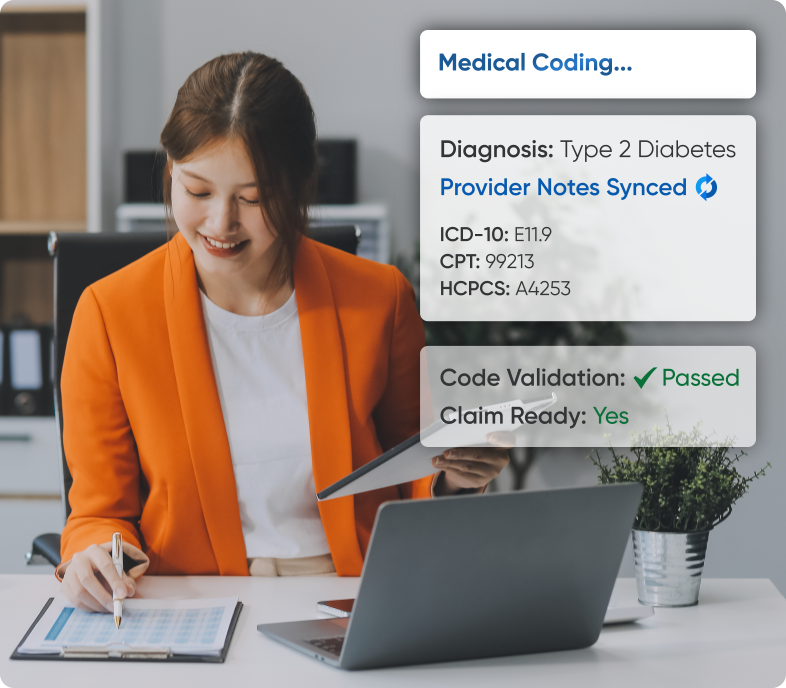
Apply appropriate CPT and ICD-10-CM codes to psychotherapy, psychiatric evaluations, E/M combinations, and eligible behavioral health add-on services when supported by documentation.

Time-Based Psychotherapy Coding
Match documented session minutes to codes 90832, 90834, and 90837 using applicable time thresholds.
Psychiatry & E/M Coding
Code psychiatric evaluations and eligible E/M psychotherapy combinations using documented services and applicable payer requirements.
Add-On & Crisis Code Identification
Identify supported interactive complexity, crisis psychotherapy, and other applicable add-on coding opportunities.
Medical coding review screen showing an encounter note beside assigned ICD-10-CM and CPT codes, suggested modifiers, NCCI edit warnings and links to the documentation supporting each code.

Submit Accurate Therapy & Psychiatry Claims

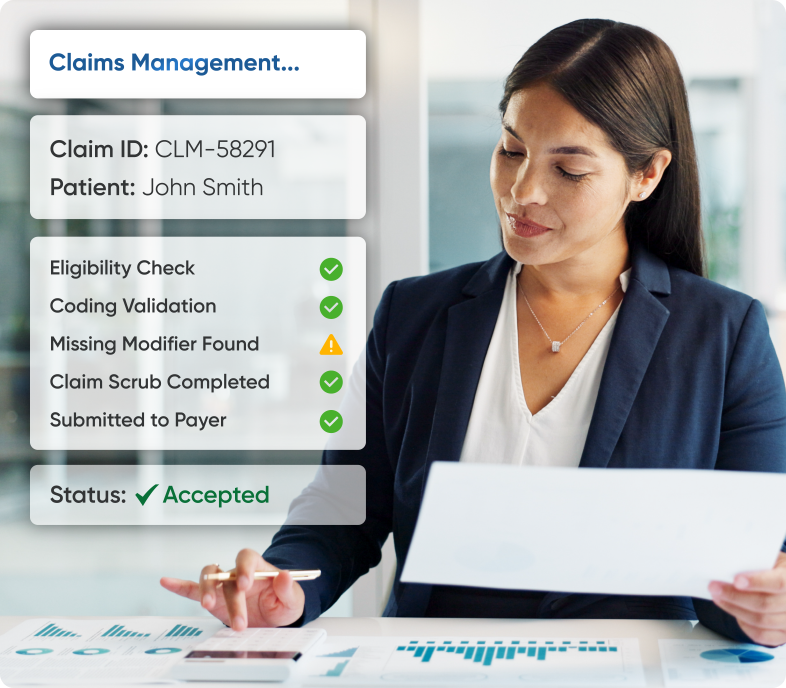
Prepare and submit mental health claims using accurate session charges, specialty coding, and payer-specific billing requirements for therapy and psychiatry visits.

Session-Based Charge Entry & Reconciliation
Reconcile completed appointments with documentation and charges to identify missing or inaccurate billable sessions.
Telehealth POS & Modifier Validation
Apply payer-required place-of-service codes and modifiers to eligible virtual therapy and psychiatry claims.
Claim Scrubbing & Submission
Validate patient, provider, diagnosis, and procedure details before submission; correct and resubmit rejections.
Claims management dashboard showing the daily charge entry queue, claims scrubbed and ready for submission, clearinghouse first-pass acceptance rate and rejected claims flagged for same-day correction.

Resolve Claim Denials Before They Affect Your Collections

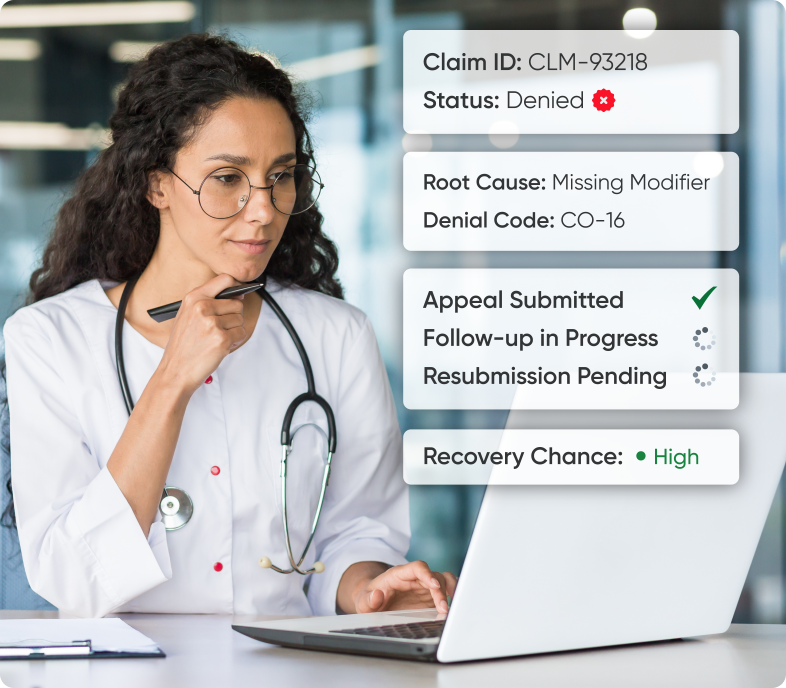
Investigate mental health claim denials, correct underlying billing issues, and manage appeals to pursue eligible payer reimbursements for your practice.

Denial Identification & Root-Cause Analysis
Review payer codes to identify documentation, session-time, coding, eligibility, and authorization-related denial patterns.
Claim Corrections & Appeals
Correct claim errors and prepare supporting documentation for payer reconsideration, resubmission, or formal appeals.
Payer Follow-Ups & Resolution Tracking
Track appeal deadlines, contact payers, and document outcomes for unresolved denied claims.
Denial management board grouping denied claims by CARC reason code and payer, each showing the appeal deadline countdown, assigned analyst, appeal status and dollars recovered to date.

Recover Outstanding Payments Across Your Revenue Cycle

Monitor unpaid mental health claims, investigate payment delays, and identify underpayments to strengthen collections and reduce outstanding receivables across your practice.

A/R Aging & Claim Prioritization
Prioritize overdue therapy and psychiatry claims by age, balance, and filing deadlines.
Insurance Follow-Ups & Payment Tracking
Contact insurers about unpaid claims, processing delays, and unresolved reimbursement status.
Underpayment Identification & Recovery
Compare payments with expected reimbursements and pursue eligible discrepancies through payer follow-ups.
Accounts receivable aging report broken into 0-30, 31-60, 61-90 and 90+ day buckets by payer, showing balances worked this week, timely filing deadlines approaching and underpayments flagged against contracted rates.

Simplify Patient Billing for Recurring Therapy & Psychiatry Visits

Manage session-level copays, deductibles, statements, and payment follow-ups to support clearer patient billing and consistent collections for ongoing therapy visits.

Session-Level Copay & Deductible Billing
Track copays, coinsurance, and deductibles for individual therapy and psychiatry appointments.
Patient Statements & Billing Follow-Ups
Prepare understandable statements showing session charges, insurance payments, and patient responsibility.
Outstanding Patient Balance Management
Follow up on unpaid balances and coordinate agreed payment arrangements with patients.
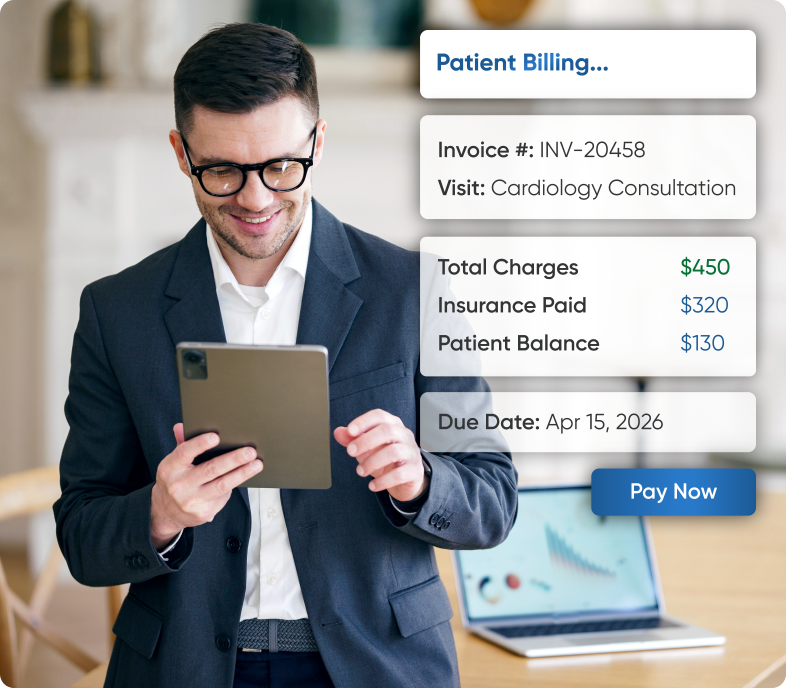
Patient billing screen showing a statement preview with insurance paid and patient responsibility, balance history, an active payment plan schedule, online payment link status and a log of patient calls handled.

Gain Visibility Into Your Mental Health Revenue Cycle

Provide visibility into behavioral health billing performance through regular reports covering collections, denials, and accounts receivable trends across your practice.

Monthly Billing Performance Reports
Monitor submitted claims, collections, outstanding balances, denial rates, and days in A/R.
Denial & Payer Performance Insights
Identify recurring denial reasons, payer patterns, and reimbursement issues requiring attention.
Revenue Cycle Performance Monitoring
Review aging claims and collection trends to track progress across your revenue cycle.
Revenue cycle analytics dashboard showing first-pass acceptance rate, denial rate by payer and reason, days in A/R trending by month, net collection rate and collections against charges for the current period.

See How Our Behavioral Health Billing Services Fit Your Existing Workflow

Trusted by 125+ US Clinics

Why Practices Choose Thinkitive as Their Mental Health Billing Company

Explore how Thinkitive's outsourced mental health billing services help healthcare practices streamline billing workflows, resolve claim denials, and improve collections while working with their existing EHR systems.

Hear It Directly From Our Clients

SPECIALIZED BILLING FOR EVERY PRACTICE TYPE

Mental Health Billing Services Tailored to Your Practice

From therapy session coding to psychiatric evaluations and psychological testing, our billing team supports the unique revenue cycle requirements of different mental and behavioral health practices.

Therapists & Counselors

Billing Services for Therapists, LPCs, LCSWs & LMFTs

Manage psychotherapy billing with accurate session-based coding, family therapy billing, and documentation checks.

Billing code expertise
  • 90791
  • 90832–90837
  • 90846
  • 90847
Psychiatrists & PMHNPs

Specialized Psychiatry Billing Services

Support psychiatric evaluations, medication management, E/M services, and psychotherapy add-on coding with accurate claim submission.

Billing code expertise
  • 90792
  • E/M + 90833
  • 90836
  • 90838
Psychologists

Medical Billing for Psychologists

Manage psychological testing and evaluation billing with appropriate code selection and documentation-based claim validation.

Billing code expertise
  • 96130–96139
Behavioral Health Group Practices

Billing Support for Multi-Provider Practices

Coordinate billing across multiple rendering providers under one tax ID while maintaining accurate provider-level charge and claim records.

Key billing requirement
  • Multiple rendering providers
  • One tax ID
Telehealth Practices

Mental Health Telehealth Billing Services

Manage virtual therapy and psychiatry claims with payer-specific POS codes, telehealth modifiers, and multi-state billing requirements.

Billing code expertise
  • POS 02 / 10
  • Modifier 95 / 93
How to Get Started

4 Simple Steps to Outsource Medical Billing Services

Start with free medical billing audit services to identify revenue gaps, assess your current billing performance, and plan a smooth transition to outsourced medical billing within 7–14 days.

1. Free Practice Audit & Scoping

We Read Your Numbers Before We Talk About Price - Day 1 to 2

Start with medical billing audit services that assess your A/R, denials, claims, and billing workflows to identify revenue gaps and prioritize improvements.

  • Review 30-, 60-, 90-, and 120+ day balances to identify overdue claims and prioritize recovery.
  • Analyze recent 837 claims and 835 remittances to assess first-pass acceptance and recurring payment issues.
  • Review your EHR, practice management system, and clearinghouse workflows to understand how claims move through your practice.
  • Define billing support based on your specialty, claim volume, provider count, and revenue cycle needs.

Key Deliverables

  • A written overview of aging trends, denial patterns, and priority areas.
  • Initial A/R and first-pass acceptance metrics to measure progress after onboarding.
  • A service plan and pricing tailored to your practice’s billing requirements.
  • A named billing team and account manager for communication, performance reviews, and ongoing support.

2. BAA, Access & Payer Setup

Everything Is Set Up Before the First Claim Moves - Day 3 to 7

Set up secure system access, payer connections, and billing workflows to prepare your medical billing services for a smooth transition.

  • Complete the Business Associate Agreement (BAA) and establish authorized access before sharing patient or billing data.
  • Set role-based permissions across your EHR, practice management system, and clearinghouse, with appropriate access controls and audit trails.
  • Configure payer IDs, fee schedules, and contracted rates to support accurate claim submissions and payment posting.
  • Initiate required electronic data interchange (EDI) and electronic remittance advice (ERA) enrollments while maintaining existing submission workflows where possible.

Key Deliverables

  • Documentation of authorized users, permissions, and applicable privacy and security controls.
  • A record of payer IDs, EDI connections, ERA status, and outstanding enrollment requirements.
  • Agreed processes for charge entry, coding, claim submission, payment posting, and practice-specific requirements.
  • A transition schedule identifying when the team will begin managing your billing operations.

3. Parallel Run

Your Current Biller Stays On While We Prove the Numbers - Day 8 to 14

Compare billing performance before the full transition. Your new billing team processes claims alongside your current biller, reconciles submissions, and works outstanding A/R to help keep revenue moving.

  • Submit daily claim batches and reconcile them against 999 and 277CA responses to track acknowledgments and identify submission issues.
  • Review ICD-10-CM and CPT coding, applicable NCCI edits, and supporting documentation before claims are submitted.
  • Work aged receivables and denials in parallel while tracking payer deadlines and outstanding recovery opportunities.
  • Keep your current billing team active throughout the parallel run to help prevent missed claims or gaps during the transition.

Key Deliverables

  • Compare first-pass acceptance results between the new team’s claim batches and your existing billing operation.
  • Track encounters, submissions, acknowledgments, and outstanding items to identify potential gaps.
  • Organize denials by CARC code, assigned owner, current status, and next action.
  • Document whether the billing operation is ready for full handover or requires further validation.

4. Full Handover & Reviews

You Keep the Logins, the Data, and Full Visibility - Day 15 Onward

Transition to fully managed medical billing services with a dedicated team, clear performance reporting, and continued access to your billing data and systems.

  • Manage charge entry, coding, claim submission, payment posting, and patient billing through your dedicated billing team.
  • Preserve claim histories, notes, appeal details, statuses, and follow-up dates throughout the handover.
  • Track collections, denial trends, A/R aging, first-pass acceptance, and payer performance to identify improvement opportunities.
  • Review reimbursement rates, underpayments, and payer payment patterns to flag discrepancies and potential revenue gaps.

Key Deliverables

  • Review collections, denials by CARC code, A/R aging, and first-pass acceptance.
  • Maintain visibility into outstanding claims, current status, and next follow-up dates.
  • Continue under a month-to-month agreement without a long-term commitment, subject to the agreed contract terms.
  • Know your point of contact and escalation process, including support availability during US business hours.
CALCULATE YOUR MENTAL HEALTH BILLING SAVINGS

See How Much Your Practice Can Save with Thinkitive's Mental Health Billing Services

Answer four quick questions to compare your current billing costs with Thinkitive's flat 2.5% fee and estimate your potential savings with outsourced mental health billing.

Step 1 of 4

What is your practice type?

Quote request received.

A senior billing specialist will send your exact quote within one business day. Want to lock in a time right now?

Estimated annual savings —

Answer the three questions and your estimate appears here, based on switching to 2.5% flat.

Practice type
—
Monthly collections
—
Current fee
—

Runs in your browser. Nothing is sent until you ask for a quote.

Didn’t See Your Specialty?

From Family Medicine and OB/GYN to other specialized practices, get medical billing support tailored to your specialty. Let’s discuss your billing needs and find the right fit for your practice.

HIPAA COMPLIANCE & DATA SECURITY

Secure Mental Health Billing with HIPAA-Aligned PHI Protection

Protect sensitive patient information with signed BAAs, controlled billing access, and documented security practices. Our outsourced billing workflows prioritize patient privacy and responsible PHI handling.

HIPAA compliant SOC 2 Type II ONC certified

HIPAA & HITECH: Protecting Sensitive Mental Health Information

Protect sensitive patient information through signed BAAs, controlled PHI access, and documented safeguards across outsourced mental health billing operations.

What's At Risk

  • Unauthorized PHI access can expose sensitive mental health diagnoses, treatment details, and patient insurance information.
  • Weak access controls can allow billing personnel to view patient records beyond their assigned responsibilities.
  • Missing BAAs or inadequate security safeguards can expose your practice to privacy violations and compliance risks.

Why It Matters

  • HIPAA requires appropriate safeguards when billing partners access, use, or disclose protected health information.
  • Mental health records require careful handling because they may contain sensitive diagnosis and treatment information.
  • Signed BAAs and controlled access establish clear responsibilities for protecting PHI across outsourced billing operations.

How We Handle It

  • Signed Business Associate Agreements establish responsibilities before our team accesses your practice's PHI.
  • Named users receive role-based permissions limited to their assigned billing responsibilities.
  • Access is reviewed during staffing changes and revoked promptly when responsibilities or assignments end.

SOC 2 Type II & ISO 27001: Security Controls That Protect Sensitive Patient Information

Keep sensitive patient and billing information protected through documented security controls, controlled system access, and secure mental health billing operations.

What's At Risk

  • Weak security controls can expose sensitive patient and billing information to unauthorized access or misuse.
  • Excessive system permissions make it difficult to control who can access protected health information (PHI).
  • Poorly documented security procedures and unmonitored activity can delay the detection and investigation of security incidents.

Why It Matters

  • SOC 2 Type II provides independent assurance about the design and operating effectiveness of defined security controls over an audit period.
  • Your practice needs billing partners that follow documented security procedures rather than informal employee practices.
  • Controlled access and consistent monitoring help protect patient information and maintain accountability across billing operations.

How We Handle It

  • Named users receive role-based permissions limited to their billing responsibilities.
  • System activity is monitored to support accountability and identify suspicious access.
  • Access permissions are reviewed regularly and revoked promptly when staffing responsibilities change.

Coding Standards: Accurate Coding Starts With Knowing the Rules

Our certified billing and coding professionals follow current coding guidelines, payer requirements, and behavioral health-specific rules to support accurate claims and fewer avoidable denials.

What's At Risk

  • Incorrect CPT, ICD-10-CM, or psychotherapy time-based coding can trigger denials, underpayments, and payer scrutiny.
  • Unsupported modifiers or missed psychotherapy add-on codes can cause claim rejections and lost reimbursement opportunities.
  • Coding beyond clinical documentation can create compliance concerns during payer reviews and audits.

Why It Matters

  • Accurate coding keeps claims aligned with documented psychotherapy sessions, psychiatric evaluations, and services performed.
  • Specialty-specific coding knowledge helps prevent errors involving session duration, E/M combinations, and behavioral health add-on codes.
  • Consistent coding and documentation support cleaner claims, appropriate reimbursement, and smoother payer reviews.

How We Handle It

  • AAPC- and AHIMA-certified coders review claims against applicable CPT, ICD-10-CM, and HCPCS requirements.
  • Coders validate session durations, psychiatric evaluations, and eligible add-on codes against clinical documentation.
  • NCCI edits, modifier requirements, and payer-specific coding rules are reviewed before claims are submitted.

Payer & Government Requirements: Payer Rules Change. Your Billing Team Has to Keep Up.

Our behavioral health billing services account for payer-specific policies, Medicare and Medicaid requirements, authorization rules, and documentation standards.

What's At Risk

  • Incorrect payer identification can cause rejections when behavioral health benefits are managed by separate carve-out administrators.
  • Overlooking Medicare, Medicaid, or commercial payer requirements can result in recurring denials and reimbursement delays.
  • Missing authorization, telehealth modifier, or documentation requirements can leave completed mental health services unpaid.

Why It Matters

  • Payers have different coverage, coding, authorization, and documentation requirements for behavioral health services.
  • Medicare and Medicaid claims must follow applicable program, provider, and service-specific billing rules.
  • Staying current with payer requirements helps reduce avoidable denials and delays across your revenue cycle.

How We Handle It

  • Behavioral health payer requirements and carve-out arrangements are checked during eligibility and claim workflows.
  • Medicare, Medicaid, and commercial payer rules are applied according to applicable services and provider requirements.
  • Payer responses, policy changes, and recurring denial patterns are monitored to address billing issues promptly.

Certified Billing Team: Qualified Professionals Behind Every Billing Decision

Our billing and coding professionals bring relevant credentials, behavioral health knowledge, and ongoing oversight to support consistent mental health billing operations.

What's At Risk

  • Limited specialty knowledge can lead to errors in psychotherapy coding, psychiatric evaluations, and add-on services.
  • Inexperienced billing staff may overlook payer requirements, resulting in missed follow-ups and avoidable denials.
  • High staff turnover and poor oversight can disrupt claims processing, denial management, and A/R follow-ups.

Why It Matters

  • Qualified coding professionals bring established coding knowledge to complex mental health billing workflows.
  • Behavioral health experience helps billing teams understand psychotherapy, psychiatry, and specialty-specific payer requirements.
  • Clear team ownership and oversight help maintain billing continuity and timely claim resolution.

How We Handle It

  • AAPC- and AHIMA-certified professionals are assigned according to your specialty and billing requirements.
  • A dedicated account manager and backup resources support communication and billing continuity.
  • Team performance is reviewed through billing KPIs, denial trends, A/R aging, and agreed performance measures.
YOUR SYSTEMS. OUR BILLING EXPERTISE.

Outsourced Mental Health Billing That Works With Your Existing Systems

Our billing team works within your existing EHR, practice management systems, and clearinghouses, keeping your mental health billing workflows intact without disrupting daily operations.

Waystar 837 batches, claim edits, 835 ERA auto-post
Change Healthcare 837P and 837I filing, rejection work queues
Availity Eligibility, auth status, appeal uploads
Office Ally Low-cost filing, we work every reject
Eligible API eligibility checks before the visit
TriZetto Claim scrubbing, 277CA reconciliation
Inovalon ABILITY Medicare DDE, ADR tracking, 835 posting
Claim.MD Small practice filing, we own the reject queue
Payer web portals Direct portal claims where no EDI path exists
AdvancedMD Bill inside your existing AdvancedMD workflow
eClinicalWorks Claims and A/R handled in your system
athenahealth Work directly inside your athenahealth setup
Tebra (Kareo) Keep billing inside your existing workflow
DrChrono Charges, claims and follow-ups in one system
NextGen Work inside NextGen without moving your data
Practice Fusion Bill directly from your existing EHR
SimplePractice Keep behavioral billing in your current system
TherapyNotes Handle therapy claims without changing platforms
CureMD Billing managed inside your existing EHR
Brightree Keep billing and A/R in Brightree
Patient Statements Digital statements with online payment links
Payment Plans Structured plans set up and tracked in your system
Patient Portal Balances Balances kept current inside your existing portal
Payment Processors Reconciled against posted payments daily

*No migration. Works with 30+ EHRs & 10+ Clearinghouses. We work inside what you already run, using your existing access and submitter IDs under a signed BAA. No platform switch, no rerouting your billing, and no migration back if you ever leave.

STATE-SPECIFIC BILLING EXPERTISE

Outsource Mental Health Billing Services Across All 50 States

Get mental health billing services tailored to your state's Medicaid programs, Medicare Administrative Contractor (MAC) jurisdiction, and payer-specific requirements. Select your state to explore relevant payer rules and billing considerations for your practice.

Find your state

50 states supported — tell us yours on the audit call and we'll confirm your exact payer setup.

California

Medicaid program
Medi-Cal
Your Medicare MAC
Noridian (Jurisdiction E)
What trips claims up here

Medi-Cal managed care plans add their own balance-billing limits, and major commercial payers each apply their own edits that are not interchangeable.

We enroll under your existing submitter IDs, so we bill whichever payers you already contract with — in California or any other state. Check my payers →

Mental Health Billing Services for Small Practices

Simplify billing operations with outsourced mental health billing services tailored to your practice size, specialty, and budget. Reduce administrative workloads, improve collections, and focus more on delivering quality patient care.

FAQs

Fair Questions, Straight Answers

How much do mental health billing services cost?

Mental health billing costs depend on your practice size, claim volume, and services required. Thinkitive offers outsourced mental health billing at a flat 2.5% fee, helping practices manage their revenue cycle without maintaining a full in-house billing team. Book a free billing audit to understand your potential costs and savings.

What does mental health medical billing include?

Mental health medical billing covers the complete process of managing insurance claims and patient payments. This includes eligibility verification, prior authorization, psychotherapy and psychiatry coding, claim submission, denial management, A/R follow-ups, patient billing, and payment reconciliation. A comprehensive billing service also provides regular reports to track collections and outstanding claims.

What's the difference between billing CPT codes 90834 and 90837?

CPT 90834 is generally used for psychotherapy sessions lasting 38–52 minutes, while 90837 applies to sessions lasting 53 minutes or longer. The selected code must reflect the actual documented session time and applicable payer requirements. Accurate time documentation helps prevent coding errors, claim denials, and reimbursement discrepancies.

Do mental health billing companies handle prior authorizations and session limits?

Yes. Mental health billing companies can manage prior authorization requests, track approved session counts, monitor visit limits, and follow up on pending approvals. Tracking authorization expiry dates and reauthorization requirements helps practices avoid billing for sessions beyond approved limits and reduces preventable authorization-related denials.

How do you bill telehealth therapy (POS 02 vs. POS 10)?

For Medicare professional claims, POS 02 applies when telehealth is provided to a patient outside their home, while POS 10 applies when the patient receives telehealth services at home. Modifier requirements depend on the payer and service. Correct POS and modifier selection helps prevent telehealth claim rejections and payment delays.

Can psychiatrists bill medication management and therapy on the same day?

Yes, psychiatrists may report eligible evaluation and management (E/M) services alongside psychotherapy when both are provided, separately identifiable, and appropriately documented. Applicable psychotherapy add-on codes include 90833, 90836, and 90838. The provider's qualifications, documentation, and payer-specific billing requirements must support reporting both services.

Do you work with behavioral health carve-out payers?

Yes. Behavioral health benefits are sometimes administered by separate companies rather than a patient's primary medical insurer. Our billing workflows include identifying the responsible behavioral health payer, verifying mental health coverage, and checking payer requirements before claim submission to help prevent rejections caused by incorrect payer identification.

Can your mental health billing team work inside our existing EHR?

Yes. Our outsourced mental health billing team works within supported EHR systems, practice management platforms, and clearinghouses already used by your practice. This helps maintain existing clinical and administrative workflows without requiring an unnecessary platform migration. System compatibility and access requirements are reviewed during onboarding.

How long does it take to switch mental health billing companies?

The transition timeline depends on your practice size, billing volume, EHR access, and payer setup requirements. Thinkitive's planned onboarding process includes a billing audit, BAA and system access setup, payer configuration, and a parallel billing run, with a target transition period of 7–14 days.

Do you sign a BAA, and how do you protect sensitive mental health records?

Yes. A Business Associate Agreement (BAA) establishes responsibilities for handling protected health information (PHI) when a billing company works on behalf of a healthcare provider. Mental health billing workflows should also use appropriate access controls, authorized users, and documented safeguards to protect sensitive patient and insurance information.

What reports are included in mental health revenue cycle management?

Mental health revenue cycle management reports can include claim submissions, collection rates, denial trends, A/R aging, outstanding balances, and reimbursement performance. These reports help practice owners and administrators identify recurring billing issues, monitor payer performance, and understand how effectively their practice is collecting earned revenue.

Do you provide specialized billing services for therapists and counselors?

Yes. Billing services for therapists and counselors include psychotherapy coding, session-time validation, insurance verification, prior authorization tracking, claim submission, and denial follow-ups. Our billing workflows support services provided by LPCs, LCSWs, LMFTs, and other eligible behavioral health professionals, subject to applicable payer and provider requirements.

Do you handle psychological testing and evaluation billing?

Yes. Psychological testing and evaluation billing involves selecting appropriate codes, validating supporting documentation, and submitting claims according to payer requirements. Relevant CPT code families include 96130–96139. Accurate documentation of testing services, time, and provider responsibilities helps support appropriate claim submission and reimbursement.

How does behavioral health RCM help reduce claim denials and improve collections?

Behavioral health RCM manages billing activities from insurance verification and authorization tracking to coding, claim submission, denial resolution, and payment collection. Coordinating these activities helps identify billing issues earlier, reduce preventable claim rework, follow up on outstanding reimbursements, and improve visibility into your practice's revenue cycle.

What should I consider before outsourcing behavioral health billing?

Evaluate a billing company's experience with psychotherapy and psychiatry coding, behavioral health carve-outs, prior authorizations, telehealth claims, and denial management. Also review its HIPAA safeguards, BAA process, EHR compatibility, reporting capabilities, pricing transparency, and account management approach before choosing an outsourced behavioral health billing partner.

Blogs

Everything You Need to Know About Medical Billing

Medical Billing Outsourcing: The Complete Guide (2026) card image

Medical Billing Outsourcing: The Complete Guide (2026)

In-House vs Outsourced Medical Billing: Which Is Right for Your Practice card image

In-House vs Outsourced Medical Billing: Which Is Right for Your Practice

Is Outsourcing Medical Billing Worth It? A Cost-Benefit Breakdown card image

Is Outsourcing Medical Billing Worth It? A Cost-Benefit Breakdown

Get Consultation

Get Consultation

Please enter your full name.

Please enter a valid work email address.

Please enter a phone number.

Audit request received.

A senior billing specialist will reach out within one business day to set up your walkthrough. Want to lock in a time now?

Find My Actual Number

Please enter your full name.

Please enter a valid work email address.

Please enter a phone number.

Audit request received.

A senior billing specialist will reach out within one business day to set up your walkthrough. Want to lock in a time now?