AI Scribe, AI Coder & AI Clinical Decision Support — Modern AI-Powered EHR Features

Do you know how many practices have adopted AI-powered EHR features?
The number will shock you. According to a survey about AI use cases, almost 100% of healthcare systems reported adoption for ambient AI clinical documentation. Out of which almost 53% reported a high degree of success with these tools.
With this AI medical scribe feature, the Permanente Medical Group reported 2.5 million uses in a year, saving almost 15,000 hours. Riding the waves of this trend, many healthcare organizations have adopted AI medical scribes to reduce clinician documentation time and workload.
And in 2026, many healthcare practices are choosing custom EHR to have AI-powered EHR features like AI medical scribe, AI clinical decision support, and AI medical coding, to name a few. You see, this transition in EHR systems is seen because many providers are looking to ingrain AI as their EHR systems’ core capability and not an additional or optional add-on.
You see, many providers like yourself struggle with piling pressure on patients, documentation, etc. And AI-powered EHR features give them an option to reduce the pressure, avoid mistakes, and drive clinical care delivery with accuracy and data-driven practices. The best example of this can be seen in this study by HealthIT, which suggests that 71% of US hospitals use predictive AI in their EHRs for clinical decision support, risk prediction, and workflow augmentation.
These EHR-integrated AI automations turn your EHR system from static databases to active clinical assistants. But to harness the maximum benefits from these AI-powered features, understanding the intricacies of these features is extremely important.
On that note, let’s have a deep dive into the top AI-powered EHR features and how EHR-integrated AI automation can transform your practice, allowing you to provide better care, improve productivity, and make the work of your providers a little easier.
So, without further ado, let’s get started!
Note: Before moving ahead, you actually need to understand the core concepts of these AI-powered features for better understanding. Read our blog – Advanced Analytics, Reporting & Predictive Modeling for Custom EHR Systems, to understand the process about how these modern EHR features work.
What Is an AI Medical Scribe and How Does It Reduce Physician Burnout?
Let’s talk about these features one by one, starting with the one that has been adopted mostly by healthcare practices – the AI medical scribe.
So, let’s try to understand how the AI medical scribe works.
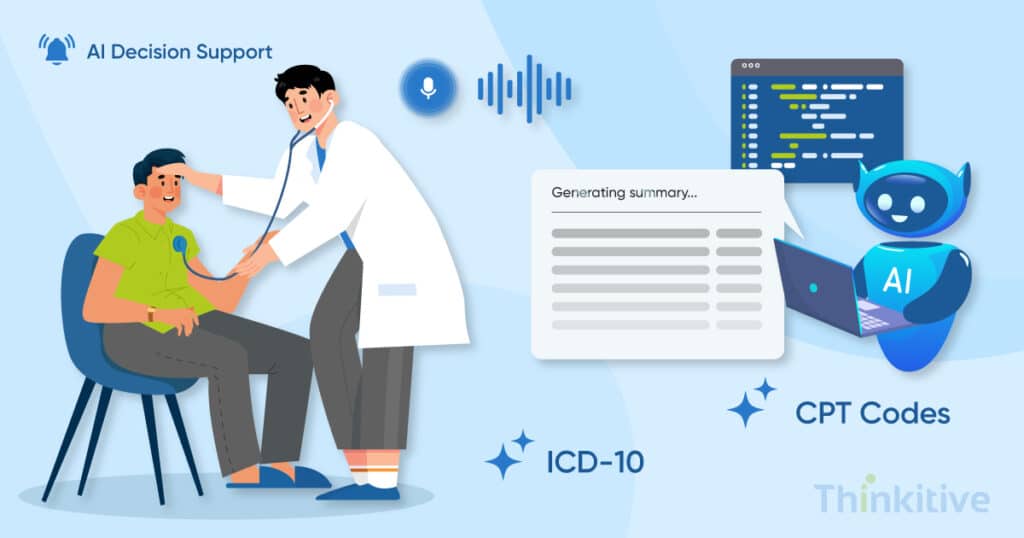
With ambient clinical intelligence, the AI medical scribe is integrated into the EHR system. This way, the scribe system passively listens to conversations between clinicians and patients. And once these consultations end, this system converts these conversations into real-time, structured clinical documentation within the EHR system.
How Does an AI Medical Scribe Help Clinicians?
- Captures patient-clinician conversations automatically using ambient listening technology during consultations.
- Converts conversations into structured clinical documentation directly within the EHR, making documentation and note-taking much easier.
- Uses ambient listening and natural language processing to identify clinical intent, key symptoms, assessments, and care plans without disrupting clinical workflows.
- Adapts to specialty-specific documentation styles for routine visits, follow-ups, and complex consultations instead of relying on generic templates.
- Reduces physician documentation burden and after-hours charting, helping clinicians spend less time on paperwork and reducing burnout.
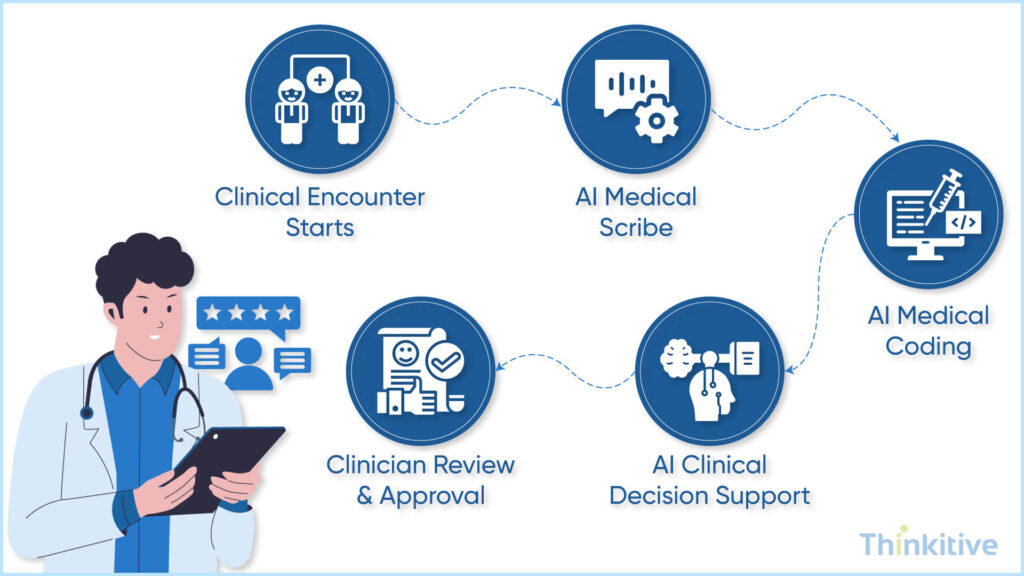
However, there is just one concern that you need to address during its implementation. You need to ensure that the data that this system generates is accurate and something that your providers can trust. The best way to ensure that is to follow a Human-in-the-Loop (HITL) model. In this, clinicians review, edit, and approve the documentation generated by the system before finalizing and sending it forward.
AI Medical Scribe vs Traditional Clinical Documentation
To better understand the role of each AI-powered EHR feature, here’s a quick comparison of their primary functions and the value they bring to healthcare organizations.
| Capability | AI Medical Scribe | Traditional Documentation |
| Documentation Method | Automatically captures conversations and generates notes | Manual typing or dictation |
| Clinical Context | Understands symptoms, assessments, and care plans | Requires manual interpretation |
| EHR Integration | Creates structured notes directly in the EHR | Requires manual entry into the EHR |
| Documentation Time | Significantly reduced through automation | Time-intensive and repetitive |
| Physician Burnout | Reduces after-hours charting and documentation burden | Higher administrative workload |
| Final Approval | Clinician reviews and approves notes (Human-in-the-Loop) | Fully manual documentation |
Autonomous Revenue Integrity: AI Medical Coding
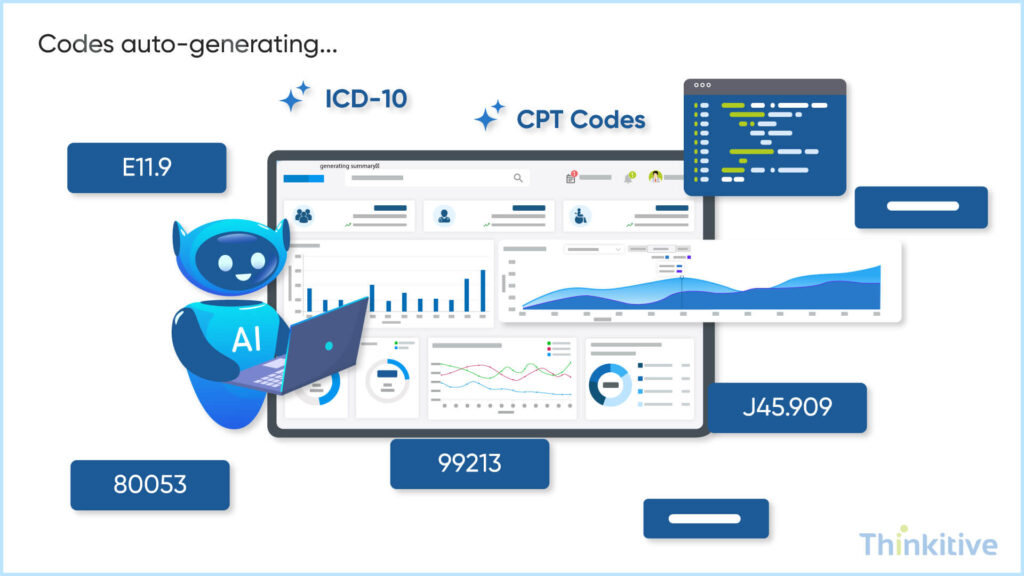
Another AI-powered EHR feature that many providers are demanding from their healthcare IT vendors is AI medical coding. With this, you can bring transparency into your modern EHR systems by validating clinical documentation.
Let’s see how it works and how it can enhance the financial health of your practice.
So, traditionally, coding processes involved post-visit manual reviews, documented diagnoses, procedures, and clinical context with coding standards such as ICD-10, CPT, and HCPCS. This process was long, tiring, and prone to errors.
However, with AI medical coding embedded into the system, instead of review, the AI module in the EHR continuously aligns documented diagnoses, procedures, and clinical context with ICD-10, CPT, and HCPCS coding standards in real time.
Due to this proactive approach, certain aspects of your administrative workload can be reduced, and certain error-prone areas like undercoding, claim denials, and billing delays can be eliminated. This improves reimbursement accuracy, and importantly, these AI-generated codes remain fully traceable to their supporting clinical evidence. This way, audit-ready outputs can be produced that meet compliance and payer scrutiny requirements.
In simple terms, AI medical coding adds an assistive layer that accelerates clinicians’ and coders’ workflows, preserving oversight, accountability, and regulatory compliance.
Assess Your EHR System for AI Readiness
Get Free AssessmentContext-Aware Guidance: AI Clinical Decision Support (CDS)
Coming to the most important and in-demand AI-powered EHR feature – AI Clinical Decision Support.
Before getting into the intricacies of AI clinical decision support, I want you to have a look at this stat. Even before the introduction of advanced AI solutions into the EHR system, almost 40-57% of US hospitals and major ambulatory practices already had clinical decision support systems present in their healthcare systems.
And as discussed earlier, today, almost 71% of healthcare systems use generative AI for clinical support. This shows that providers have always wanted to make their software systems intelligent, and the advancements have been ongoing for a long time.
In this, the arrival of AI has brought it into the mainstream and given it a little push for accurate and efficient care delivery. Today, with the help of AI clinical decision support, the EHR systems have evolved from static, rule-based alerts to context-aware AI clinical decision support.
In simple terms, this system understands, analyzes, and interprets patient data from patients’ history, real-time clinical inputs, and evidence-based guidelines to deliver relevant, in-encounter guidance when it matters most. This makes the care delivery process much easier and quite personalized in nature.
Some of the other use cases of AI clinical decision support have been covering gaps in care delivery. For instance, given the rising pressure on healthcare providers, there are chances that providers might miss certain things during consultation. During this, these AI clinical decision support systems proactively work in the background to identify care gaps such as missed screenings or follow-ups, and inform you in a timely manner so that no stone is left unturned during care delivery.
And one of the major doubts that many healthcare providers have had is that these CDS systems will replace their providers. Well, that’s not actually true. You see, CDS is built to support and not replace the clinical judgement of the providers. These systems will only offer transparent, explainable insights that enhance better decision-making while keeping accountability firmly with the clinician.
Why Workflow-First Integration Matters
The major challenges that many healthcare providers face in integrating their AI-powered features into their EHR systems are that their ventures usually fail. I mean, these systems are not able to give the expected results. The reason behind this is that providers have developed standalone AI tools, which fail in real clinical environments.
That is why, when you’re developing a custom EHR software with AI-powered features, you need to build native, EHR-embedded AI features for zero-friction adoption. And another reason why this is important is that, when you have all three AI features like AI medical coding, AI medical scribe, and AI CDS, and if they are embedded into the EHR workflows, these modules are able to share data between them, enabling consistent clinical and administrative workflows for the practice.
The difference between having AI embedded into an EHR system and having that AI module working alongside the EHR system is the data. You see, the accessibility of data on which the AI makes decisions is better when AI is present inside and not outside the system.
AI-Powered Features That You Can Integrate Into Your EHR System
Get Free ConsultationTrust, Accuracy & Adoption Guardrails
Some of the concerns that you need to take into consideration when building AI-powered EHR features are that you need to make the system trustworthy, accurate, and adaptable accordingly. For instance, clinician oversight is a non-negotiable design principle. In short, during every process, having the human or provider in the loop can ensure the trustworthiness factors for users.
To add another layer of trust, your AI modules must have that explainability factor. In simple words, these modules must explain how they come to a certain conclusion. Along with explainability, traceability is something that you should have; it brings the transparency factor into the process.
On top of that, coming to the accuracy of your EHR system, you need to manage bias, edge cases, and clinical variability. There are chances that AI modules give biased judgments, which can impact the care for patients. That is why you need to manage bias, edge cases, and clinical variability. The best way to do that is to train and feed your EHR software AI features on clean and quality datasets.
Here, you need to understand that building trust is necessary to support sustained adoption of AI-powered EHR features, because these features will only be used when your providers are able to trust them and rely on them for many processes.
Modernize Your EHR
Get Free ConsultationKey Takeaways
- AI medical scribes reduce documentation time and physician burnout.
- AI medical coding improves coding accuracy and reimbursement workflows.
- AI clinical decision support provides context-aware recommendations without replacing clinicians.
- EHR-integrated AI automation delivers better adoption than standalone AI tools.
- Human oversight, explainability, and traceability are essential for trustworthy AI-powered EHR features.
Conclusion: The Frontline of Modern EHR Intelligence
If you have made it this far, you now have a clear understanding of how AI-powered EHR features improve clinical workflows, reduce physician burnout, and support better patient care. Moreover, with ambient, assistive AI reduces administrative friction without disrupting care, by taking care of most of the documentation and CDS aspects.
Furthermore, some anticipated AI-powered features, like advanced analytics and predictive modeling, can also be embedded into your system with these AI-powered EHR features.
On that note, make your EHR system smarter so that you can deliver care much faster, better, and more accurately. Click here to get your first free consultation and analyze the system readiness of your system for AI-powered features and get started with your custom EHR development.
Frequently Asked Questions
An AI medical scribe is an ambient clinical intelligence solution that automatically listens to patient-clinician conversations, generates structured clinical documentation inside the EHR, and reduces physician documentation burden while keeping clinicians in control through review and approval workflows.
An AI medical scribe captures clinical conversations and understands context to generate structured, EHR-ready notes. Unlike basic voice-to-text tools, it identifies clinical intent, organizes data into appropriate fields, and supports downstream workflows like coding and decision support—significantly reducing manual documentation effort.
Modern AI scribes are trained on specialty-specific datasets and medical ontologies, enabling accurate interpretation of clinical language. Advanced speech models adapt to regional accents and speaking styles, while continuous learning from real-world clinician usage further improves accuracy across specialties and geographies.
AI medical coding systems can function autonomously for routine, low-risk encounters, but most healthcare organizations retain human review for complex or high-impact codes. A Human-in-the-Loop model ensures coding accuracy, compliance, and audit readiness while still delivering meaningful efficiency gains.
AI-generated notes are legally defensible when they include clinician review, clear authorship, and full audit trails. Compliance depends on traceable data sources, version control, and alignment with documentation standards—ensuring AI supports, rather than obscures, clinical accountability.
Alert fatigue occurs when clinicians are overwhelmed by excessive, low-value system alerts. AI-driven CDS reduces this by prioritizing relevance—using patient context, encounter data, and clinical history to surface only meaningful recommendations, improving adoption and trust in decision support tools.
Human-in-the-Loop oversight places clinicians at key validation points across AI workflows:
- Reviewing AI-generated clinical notes
- Approving or adjusting suggested medical codes
- Accepting or dismissing CDS recommendations
This ensures safety, accountability, and regulatory compliance without slowing care delivery.
Yes, when architected correctly. EHR-integrated AI solutions use encrypted data pipelines, role-based access, audit logging, and data minimization. These controls align with evolving HIPAA and interoperability standards, ensuring sensitive patient data remains protected throughout AI-driven workflows.
AI-powered EHR features reduce cognitive and administrative burden by automating documentation, coding, and surfacing insights. Clinicians retain full control over decisions, diagnoses, and care plans—ensuring AI acts as a support system, not a replacement for professional judgment.


