Do You Offer Ongoing Support & Maintenance After the Integration?

Yes! That would be our answer to the question asked in the title of this blog. You see, as healthcare software systems are becoming a norm in the healthcare industry, the need to build a connected healthcare ecosystem has become a necessity.
Both EHR software development and EHR integration require significant investment on your end, and as healthcare practices are turning digital, it is becoming even more essential. Moreover, as the number of custom healthcare software development projects increases, going live is simply the start of the process. After the software is up and running, it needs support and maintenance to ensure it runs smoothly.
Support and maintenance are the two major cornerstones that are essential for long-term success and to ensure that your system is always capable of assisting you in care delivery. In this blog, we will see the different facets of support and maintenance after EHR integration and why each one of them is important for your patients, practice, and healthcare software systems as well.
Proactive System Monitoring for Peak Performance
One of the major functions of support and maintenance after EHR is successfully integrated into your system is to continuously monitor the intricacies of your system. This is to ensure that the system is working properly and all the functions are fulfilling the assigned tasks conveniently.
Also, with continuous monitoring, the loopholes in the system performance can be easily identified and addressed before they can impact operations and create havoc. On the basis of this, you can perform regular system health checks that will optimize the performance of your system, and all the measures are taken in time to ensure the system is always running and functioning at its peak performance.
Rather than automating this process, your proactive interference and monitoring of system health can minimize downtime and ensure that the system is available to use at all times. Furthermore, when you’re away, you can set certain parameters and train your system in such a way that as soon as it crosses the threshold, you automatically get updated with alerts and notifications for potential anomalies.
Dedicated Technical Support When You Need It Most
When you’re partnered with Thinkitive, you enjoy all the exclusive benefits of having a support team ready for you. We understand that your system can encounter a problem at any time that can disrupt your practice processes, from care delivery to other administrative tasks. A dedicated technical support team is at your bay and will be all over the problem as soon as you contact them.
When working with Thinkitive, you can access technical support from various channels such as phone, email, ticketing system, etc. This way, the gap between support needed and support can be minimized, leading to quicker problem-solving and enhanced care delivery.
Furthermore, all the support staff at Thinkitive are experienced and have developed niche expertise in integrated EHR systems. This gives you a major advantage as the problem can be easily solved and that too quickly.
You see, the typical response time is crucial for the healthcare system as care delivery can be interrupted. On the other hand, always read the service level agreement for different types of issues and give your vendor a hard bargain to get exactly what you want.
And just in case an issue is complex and needs specialized attention, then the dedicated technical support team can raise the issue with senior management to get it solved as soon as possible.
Keeping Your System Up-to-Date with Regular Maintenance & Updates
Another reason why you need support and maintenance is because the technological landscape is constantly changing. Because of this, the regulatory landscape is also changing, and for your digital practice to smoothly navigate the landscape, you need to maintain and update the software regularly.
Along with this, there are certain software updates, patches, and security enhancements that you need to simplify your work; all of this can be done by the maintenance and support team. However, the process of updating software can be tricky as the problem must be first identified, planned, and enrolled in the next update so that no processes or functions of the clinic are disrupted.
Furthermore, you always see a new feature or functionality in your applications, right? Well, that is done with updates. To keep your system up-to-date with the latest technological trends and regulatory updates, a support team is required.
Comprehensive Training & Ongoing Education Resources
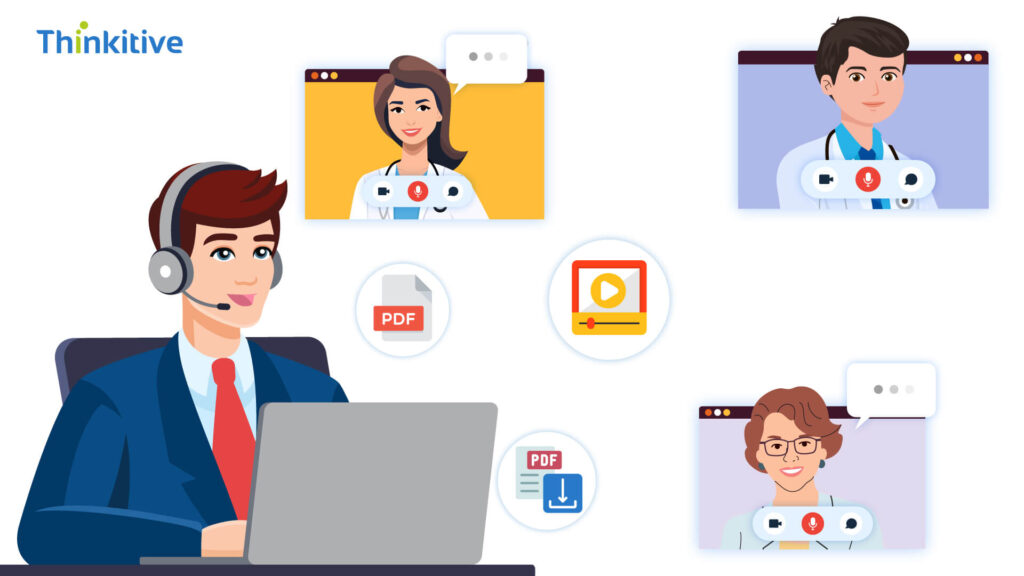
Before providing maintenance and support for EHR integration services, one crucial factor needs to be there. If your staff members or users are not able to use the software, then what is its use?
That is why you need to provide comprehensive training with the right resources, such as webinars, online tutorials, and guides so that they know how to make the most of using the software. This whole activity also needs to be followed every time you introduce a new function or enhance the functionality of your software.
Also, whatever educational material you’re providing to your staff members and users, ensure that they are updated so that it serves as a guide for new staff members as well as for existing staff members to stay proficient.
Last but not least, whenever you’re creating a customized training sessions plan, keep the possibility of customized training sessions based on the specific needs of your practice.
Get Your Copy of the EMR Software Development Vendor Checklist
Schedule for Upcoming WebinarScalability & Adaptability for Your Evolving Needs
The last reason why you need support and maintenance for EMR integration is to make your software scalable and adaptable to the evolving needs of your practice. You see, as your practice grows, the data also grows, and it becomes difficult for the system to handle large amounts of requests for data transfer and maintain such large volumes of data.
The support and maintenance services can make changes in your software infrastructure and architecture to adapt to the growing needs of your practice. Whether that be adding new users, modules, or post-implementation integration, everything is just a request away.
Along with the option of scaling your practice, your practice can also be adaptable to growing needs due to the flexibility it offers for support levels based on your organizational requirements.
That is why, every once in a while, you need to check in and discuss the needs of your practice and what can be done to enhance your system with support and maintenance.
Partnering for Long-Term Success: Our Commitment to You
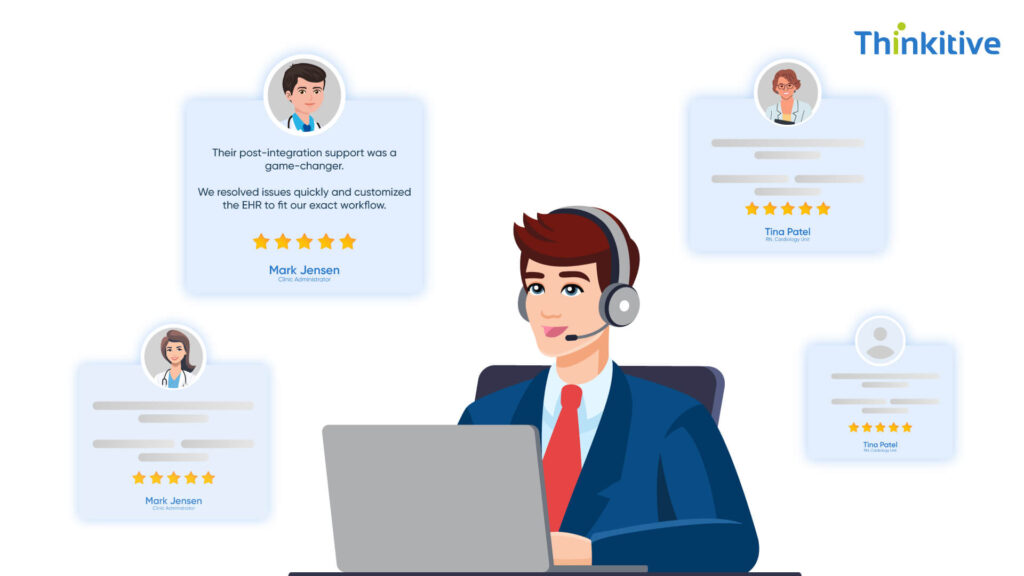
You probably need a partner for EHR integration, so don’t just look for a partner that would integrate the system. Instead, look for a partner who is ready for a long-term commitment and provides you with ongoing support for a long time.
This is important because you can ensure continued success with this and constantly optimize your system to make it more reliable. Also, since the partner is there with you from the start, they can easily fix the errors, and you build a relationship based on trust for reliable support; that also adds to the factor that your problems would be solved quickly and almost instantly.
Conclusion
For EHR integration to stay integrated into your healthcare system and function as it is supposed to, support and maintenance are required. Also, support and maintenance are required to ensure your software performance is always at its peak and nothing is working as it is supposed to.
Support and maintenance for EHR integration for Thinkitive involves proactive monitoring, technical assistance, regular updates, and extensive training so that no lead is left unturned.
Still looking for a reliable and responsive EHR integration partner for support and maintenance? Well, look no further. Click here, and let’s get started.
Frequently Asked Questions
Thinkitive will assign you a project manager and they will be your primary point of contact for support.
We offer 24/7 support so that your practice never gets affected due to lack of support.
We usually offer remote support as we understand that technology has solved most of the problems in that sector. However, if the requirements demand on-site support, then it can also be provided.
EHR integration maintenance and support come in various forms. Documentation like user manuals and best practice guides help with routine tasks. Self-help resources often include FAQs, online knowledge bases, and vendor-provided portals for troubleshooting. For more complex issues, direct technical support from the EHR vendor or third-party specialists is usually available, offering assistance with upgrades, troubleshooting, and system optimization.
We directly ask the users and also share a feedback form with them to understand our shortcomings better and curate the process in a way that helps us improve our process.
When things get tricky with EHR integration maintenance, we first try our best to troubleshoot and find a fix ourselves. If it’s beyond our expertise, we’d quickly loop in our senior specialists or the EHR vendor directly. We want to get things running smoothly for you again ASAP!
Yes.
During EHR integration maintenance, we treat your system like it’s our own treasure. We have strict access controls, only letting authorized personnel in. All changes are carefully logged and monitored, and we run thorough security checks before and after. Think of it as giving your system a health check-up with the best security doctors around!
We have regular data backups stored securely in a separate location. In case of any disruption, we can quickly restore our systems and your patient data, ensuring minimal downtime and continued access to essential information for seamless patient care.
Yes. You can check our latest case studies for EHR integration to understand better.


