Choosing Frontend & Backend to Build Your EHR

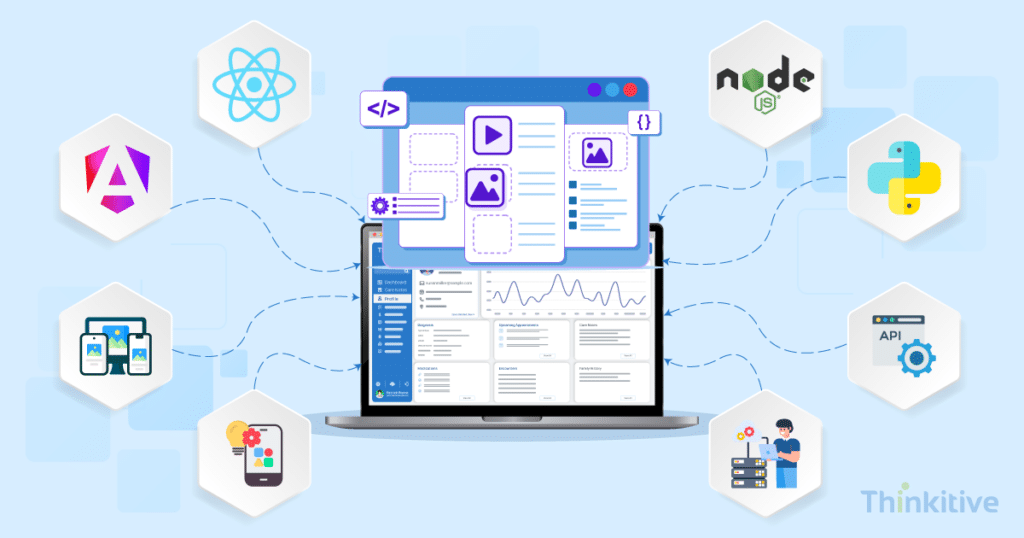
Choosing the right frontend and backend technologies is one of the most important decisions when building an EHR system. The frameworks you choose determine how your application performs, scales, integrates with other healthcare systems, and adapts to future innovations such as AI, interoperability, and cloud-native deployment.
These decisions also have a direct impact on the end-user experience. According to Springer, poor EHR usability is one of the major contributors to physician burnout, while research published by the National Institutes of Health found that 75% of physicians experiencing burnout identify EHRs as a primary source of stress.
In another study published by PubMed Central (PMC), more than 55% of surveyed nurses reported that EHR systems interfered with patient care and contributed to an unsatisfactory work experience. While multiple factors influence usability, selecting the right frontend and backend frameworks plays a significant role in building responsive, intuitive, and scalable healthcare applications.
So, how do you choose the right frontend and backend technologies for building EHR software?.
In this guide, we’ll compare popular EHR frontend technologies and backend frameworks, explain where each one performs best, and help you select the right combination based on your healthcare organization’s technical requirements and long-term roadmap.
So, without further ado, let’s get started!
Which Frontend & Backend Technologies Suits You Best –
Get Free Assessment
Understanding the Role of Frontend & Backend Technologies in EHR Systems
Let’s start with the basics by understanding what the EHR frontend technologies are, along with the EHR backend frameworks, and how they influence every aspect of your EHR software.
Frontend technologies are the part of an EHR system that users interact with every day. The screen you are reading this on, or the dashboard you work on in clinics, is developed with frontend technologies. Frontend technologies help you in defining the UI or User Interface of your EHR system.
On the other hand, everything that happens behind the computer screen is the magic of the backend technologies. Let’s try to understand with the help of an example. For instance, you request a data profile from your EHR system; everything that goes on behind the screen, right from requesting other servers for access and bringing the desired patient profile to the screen, is done with backend technologies.
The real strength of an EHR lies in how its frontend and backend technologies work together to deliver a seamless user experience and reliable system performance. To understand how they work, look at it like front-end technologies help in collecting and displaying information, while the backend technologies do most of the heavy lifting to make the system work.
And since your EHR software will be used by clinicians and your healthcare staff, it must deliver fast performance, intuitive user experiences, and have the ability to scale with the growing needs of patients, users, integration, and clinics.
Choosing the right frontend and backend frameworks determines how easily your EHR can scale, integrate with other systems, and adapt to future requirements. It can include feature updates, scalability, integrations, or future support. Only with a well-supported framework can you reduce technical debt, accelerate development, and make ongoing maintenance a little cost-effective.
Choosing the Right EHR Frontend Technology
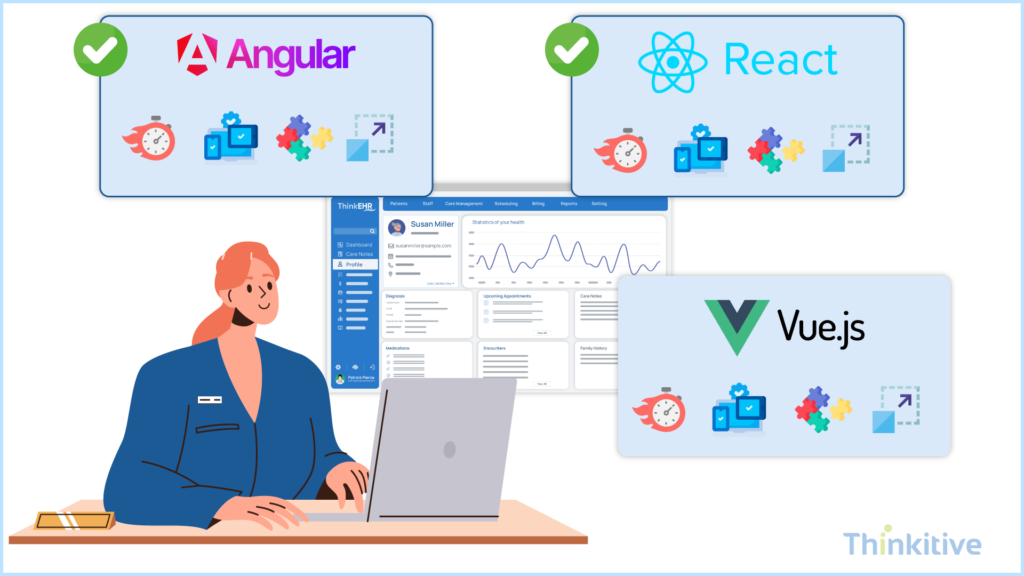
When evaluating the EHR frontend technology stack, you must prioritize a few things. Here are some of the key factors on which you should be choosing your frontend technologies.
- Performance & Speed: To ensure fast access to patient records, charts, and clinical workflows.
- User Experience & Usability: Helps clinicians navigate the system with fewer clicks and less effort.
- Scalability: Technologies that must support the growth in users, locations, features, and patient volume.
- Mobile Responsiveness: Delivers a consistent experience across different devices, right from desktops and tablets to smartphones.
- Maintainability & Future Readiness: The tech stack you are choosing for the frontend must be easy to update, integrate, and add new capabilities over time.
React vs Angular for EHR Development
Now, amongst all the choices, React and Angular are the most popular frontend technologies that are used in modern healthcare applications. Let’s have a look at the core differences to help you understand which one suits you the best:
| Factor | React | Angular |
| Architecture | Flexible component-based library | Structured full-fledged framework |
| Learning Curve | Easier to learn | Steeper learning curve |
| Development Speed | Faster development and customization | More setup and configuration required |
| Performance | Excellent for dynamic healthcare UIs | Strong for large enterprise applications |
| Scalability | Highly scalable | Highly scalable |
| Best For | Custom EHRs, healthcare startups, SaaS platforms | Large hospitals and enterprise healthcare systems |
To sum up in a gist, React is often preferred for modern EHR development as it offers more flexibility with faster development cycles. On the other hand, Angular is a stronger choice if the scope of your EHR software is quite large and requires a highly structured architecture.
Now, when building the frontend, your main focus should be building a responsive interface that allows providers to access information across devices, while maintaining a consistent experience.
Features such as intuitive navigation, role-based dashboards, streamlined documentation workflows, and real-time data updates help reduce clicks, minimize cognitive load, and enable healthcare professionals to focus more on patient care than software navigation.
Watch in Real-Time How Technology Combinations Can Work For You –
Book DemoSelecting the Best EHR Backend Frameworks
Backend technologies power the core functionality of healthcare applications by managing patient data, business logic, integrations, security, and clinical workflows.
Typically, the processes involved are user requests, storing, and retrieving clinical information. It also involves enforcing access controls and enabling secure communications with disparate healthcare systems like labs, pharmacies, billing systems, and other healthcare platforms.
Node.js vs. Python for EHR Backend Development
Out of all the backend technologies that can be used for EHR development, Python and Node.js stand out. Here is a quick comparison to help you understand the difference and know which one to choose:
| Factor | Node.js | Python |
| Performance | Excellent for real-time applications | Good, but generally slower for high-concurrency workloads |
| Scalability | Highly scalable with event-driven architecture | Scalable, but often requires additional frameworks and services |
| API Development | Fast and efficient for RESTful APIs | Strong API support with Django and FastAPI |
| Healthcare Integrations | Well-suited for API-heavy EHR ecosystems | Well-suited for data processing and integrations |
| AI & Machine Learning | Limited native ecosystem | Industry leader for AI, ML, and predictive analytics |
| Development Speed | Fast development with JavaScript ecosystem | Rapid development with extensive libraries |
| Talent Availability | Large developer community | Large developer and data science community |
| Best For | Modern SaaS EHRs and interoperability platforms | AI-powered EHRs, analytics, and clinical decision support |
Now, if your goal is to have a system with high performance capabilities, API-driven exchanges, and enable real-time data exchange, then Node.js makes the perfect choice for you. And choose Python if your EHR roadmap includes AI medical scribes, predictive analytics, CDS, or any other data-intensive healthcare capabilities.
Building a Cohesive EHR Frontend & Backend Stack
The right EHR frontend and backend technology selection is important, but the real success of your EHR depends on how well they work together. A cohesive technology stack helps you ensure seamless data flow, consistent user experiences, easier integrations, and long-term scalability.
Let’s look into the intricacies of this:
- Aligning Frontend & Backend Technologies for Healthcare Workflows: The frontend and backend must be designed to support the same clinical and administrative workflows. This alignment helps you to ensure faster performance, smoother experience, and efficient data handling across applications.
- Support Interoperability, Scalability & Future AI Integrations: A well-planned technology stack should support healthcare interoperability standards, growing user demands, and future innovations like AI-powered features.
Many EHR projects face challenges due to poor technology alignment. This leads to limited scalability and integration constraints. That is why choosing compatible technologies and designing for future growth can help to avoid costly redevelopment efforts.
Common Frontend and Backend Technology Combinations
Different healthcare organizations often choose different technology combinations based on their development priorities and long-term goals. While there is no one-size-fits-all solution, some combinations are widely adopted because they complement each other well.
| Frontend | Backend | Best For |
| React | Node.js | Fast SaaS EHR platforms and API-first applications |
| React | Spring Boot | Scalable healthcare platforms with complex workflows |
| Angular | .NET Core | Large enterprise hospitals and multi-location health systems |
| React | Python | AI-enabled EHRs with analytics and clinical decision support |
How to Choose Frontend & Backend for EHR Development
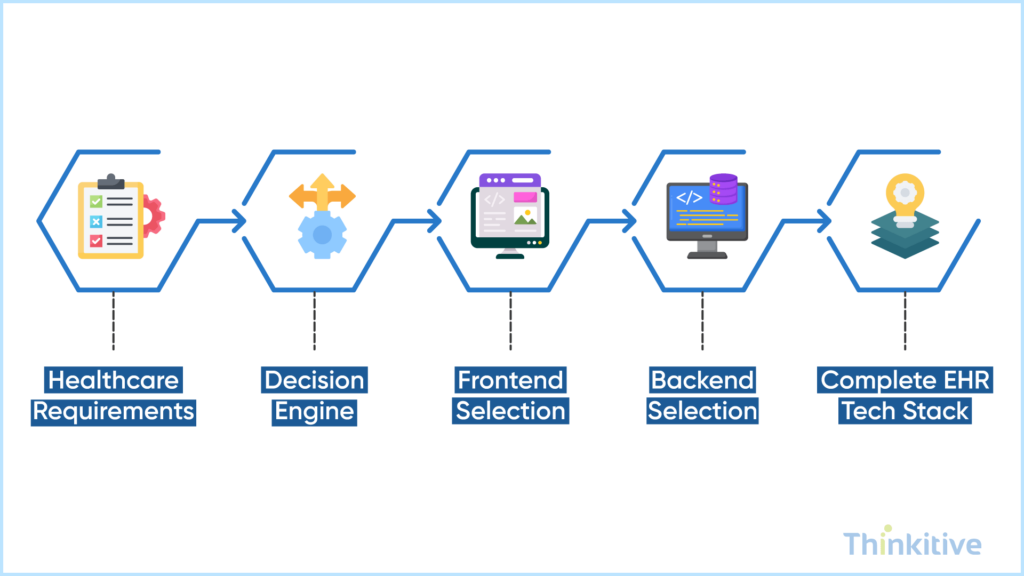
Now, the main question is, ‘How to choose frontend and backend for EHR development?’
Well, let me be honest, there is no universal frontend or backend technology that suits EHR development the best. The right choice depends on your practice, growth plans, technical requirements, and long-term goals.
That is why evaluation is necessary; on the basis of your current needs, you will define the scope and future of your EHR software.
So first things first, you need to match your framework choices to startup, growth-stage, and enterprise healthcare organizations. Since different practices have different needs, depending on your needs, you must choose the right one. For instance, you should choose speed and flexibility if you are a startup.
On top of that, you must also balance technology decisions on the basis of speed, scalability, and maintenance requirements. The ideal frontend and backend combination depends on your priorities, whether that is faster product launches, enterprise scalability, interoperability, mobile accessibility, or AI-driven capabilities.
Which Frontend and Backend Stack Should You Choose?
| If your priority is… | Recommended frontend | Recommended backend |
| Fast MVP development | React | Node.js |
| AI-powered EHR features | React | Python |
| Large enterprise hospitals | Angular | Spring Boot or .NET Core |
| Real-time interoperability & APIs | React | Node.js |
| Long-term scalability | React | Spring Boot |
| Structured enterprise architecture | Angular | .NET Core |
Frontend and backend technologies are only one part of the overall EHR architecture. They should align with your database, cloud infrastructure, integration strategy, security requirements, and future roadmap to create a sustainable healthcare technology ecosystem.
To understand how cloud infrastructure, databases, AI, and interoperability fit into the complete architecture, explore our guide to the EHR technology stack.
Conclusion
If you have made it this far, then you know that everything about building your own EHR depends on what EHR frontend and backend stack you choose. I have made an effort to help you understand what choices to make.
However, along with that, you must also take framework decisions that impact your scalability, compliance, and future innovations. But still, the success of your EHR software will majorly depend on user experience, backend performance, and interoperability.
On that note, I hope I have answered your question, ‘How to develop an EHR system and how to choose frontend and backend for EHR development?’ in this blog, and let this blog be your guide for EHR frontend and backend selection.
And if you are still a little confused, then assess your requirements from our EHR expert, and know exactly what it is that you need.
Frequently Asked Questions
An EHR frontend and backend stack refers to the collection of technologies used to build and run an Electronic Health Record system. The frontend includes the user interface that clinicians and staff interact with, while the backend manages patient data, business logic, security, integrations, and system performance. Together, they form the foundation of a modern EHR tech stack.
The best EHR frontend technology depends on your project requirements, scalability goals, and user experience expectations. React is widely used for modern healthcare applications because of its flexibility, performance, and component-based architecture, while Angular is often preferred for large enterprise healthcare systems that require a structured development framework.
The React vs Angular for EHR development debate depends largely on project complexity and organizational needs. React offers faster development, greater flexibility, and a large ecosystem, making it a popular choice for custom EHR platforms. Angular provides a more structured architecture and built-in features that can benefit large healthcare enterprises with complex application requirements.
Some of the most popular EHR backend frameworks include Node.js, Django, FastAPI, Spring Boot, and ASP.NET Core. These EHR backend frameworks are commonly used to build secure, scalable, and interoperable healthcare applications capable of handling large volumes of patient data and healthcare integrations.
When evaluating Node.js vs Python for EHR backend development, the right choice depends on your goals. Node.js is well-suited for API-driven healthcare applications and real-time data exchange, while Python excels in AI, machine learning, analytics, and clinical decision support. Many modern healthcare platforms use both technologies to leverage their respective strengths.
In EHR systems, the frontend collects user inputs and displays patient information, while the backend processes requests, manages data, enforces security, and handles integrations. These layers communicate through APIs to provide a seamless experience for clinicians, administrators, and patients.
The best frameworks for EHR development are those that align with your clinical workflows, scalability requirements, interoperability goals, and long-term technology strategy. Popular choices include React and Angular for frontend development, combined with Node.js, Python, .NET, or Java-based frameworks on the backend.
Yes. React and Node.js are one of the most popular technology combinations for custom EHR development. React delivers a fast, responsive user interface for clinicians and administrative staff, while Node.js powers scalable backend services, APIs, and real-time data exchange. Together, they provide a flexible foundation for building modern EHR systems that support interoperability, cloud deployment, and future enhancements such as AI-powered features.
To understand how to choose frontend and backend for EHR development, organizations should evaluate factors such as scalability, performance, interoperability, security, development speed, maintenance requirements, and future AI capabilities. The ideal technology stack should support both current operational needs and long-term business growth.


