Advanced Tech Stack for Building Your Own EHR (2026)

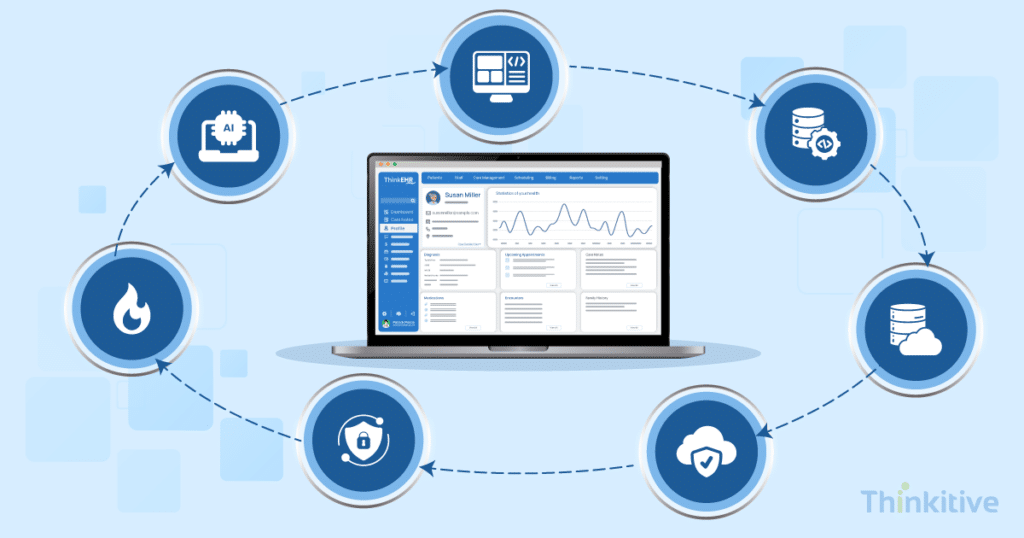
Electronic Health Records, from what started as a record-keeping software system, have slowly evolved to be the epicenter of healthcare practices recently. You see, at the core, EHR is still the software that helps practices store, manage, and share healthcare records, but today practices want them to be a practice management software, or a telehealth platform, and at times even a billing platform.
And surprisingly, EHR tech stack has even allowed practices to mould the software as per their will and wish, though it is a restricted way due to the overwhelming laws and regulations. However, there is again a shift in the EHR software landscape. Healthcare practices are demanding cloud-native, AI-enabled, and interoperable systems.
Technology decisions determine the long-term success of modern healthcare platforms. They not only determine how your system is going to perform, but also define the growth scope of your EHR system.
However, the question that keeps popping up during every discovery phase is, ‘How to choose the right tech stack for EHR?’
Well, let’s try to find the right EHR technology stack for your practice, and learn about some of the common challenges that you’re most likely to face.
So, without further ado, let’s get started!
Assess Your Current Tech Stack to Choose the Right EHR Tech Stack –
Get Assessment
What Makes a Modern EHR Tech Stack in 2026?
The modern EHR tech stack in 2026 is built to be cloud-native, interoperable, AI-ready, secure, and scalable. While these are some of the most demanded from healthcare practices, the use cases of traditional EHRs have not faded.
Finding a middle ground between both, let’s try to find how the EHR technology stack would look in 2026.
Core Layers of an EHR Technology Stack
There are several layers working together in an EHR technology stack. Let’s have a look at them:
| Technology Layer | Purpose in an EHR System | Common Technologies |
| Frontend Layer | Provides the user interface for physicians, nurses, administrators, and patients to access and interact with the EHR. | React.js, Next.js, Angular, TypeScript |
| Backend Layer | Handles business logic, clinical workflows, APIs, scheduling, billing, and data processing. | .NET Core, Java Spring Boot, Node.js |
| Database Layer | Stores patient records, clinical documentation, billing data, audit logs, and operational information. | PostgreSQL, Microsoft SQL Server, MongoDB |
| Interoperability Layer | Enables secure data exchange between EHRs, labs, pharmacies, payers, and third-party healthcare applications. | FHIR, HL7 v2, SMART on FHIR, REST APIs, Mirth Connect |
| Security Layer | Protects PHI through authentication, authorization, encryption, monitoring, and audit controls. | OAuth 2.0, OpenID Connect, RBAC, MFA, AES Encryption |
| Infrastructure Layer | Provides hosting, scalability, disaster recovery, monitoring, and deployment capabilities. | AWS, Azure, Google Cloud, Docker, Kubernetes |
| AI & Analytics Layer | Supports clinical decision-making, documentation automation, predictive analytics, and reporting. | AI Medical Scribes, Machine Learning Models, NLP, Power BI, Tableau |
Balancing Scalability, Security, Interoperability & Performance
The art of choosing the best tech stack for EHR development is to balance multiple priorities at the same time. You see, you want your system to be scalable enough to support growing patient volumes, secure enough to protect PHI, and meet HIPAA requirements. Along with that, the system should be interoperable to exchange data, and on top of that, it should be high-performing so that even under heavy workloads, it should not break the system.
This is why strong technology is important, to ensure that improvements in one area do not compromise another.
Key Considerations When Evaluating the Best Tech Stack for EHR Development
The secret to selecting the right tech stack lies in understanding your core needs and requirements. The challenge lies in evaluating technologies that improve one area without compromising another. So here are a few things that you must consider:
- Compliance and security requirements
- FHIR and HL7 interoperability support
- Cloud deployment capabilities
- Integration flexibility
- Scalability for future growth
- Development and maintenance costs
- AI and analytics readiness
TIP: Your tech stack must align with both your current requirements and future endeavors.
Choosing the Right Frontend & Backend Technologies
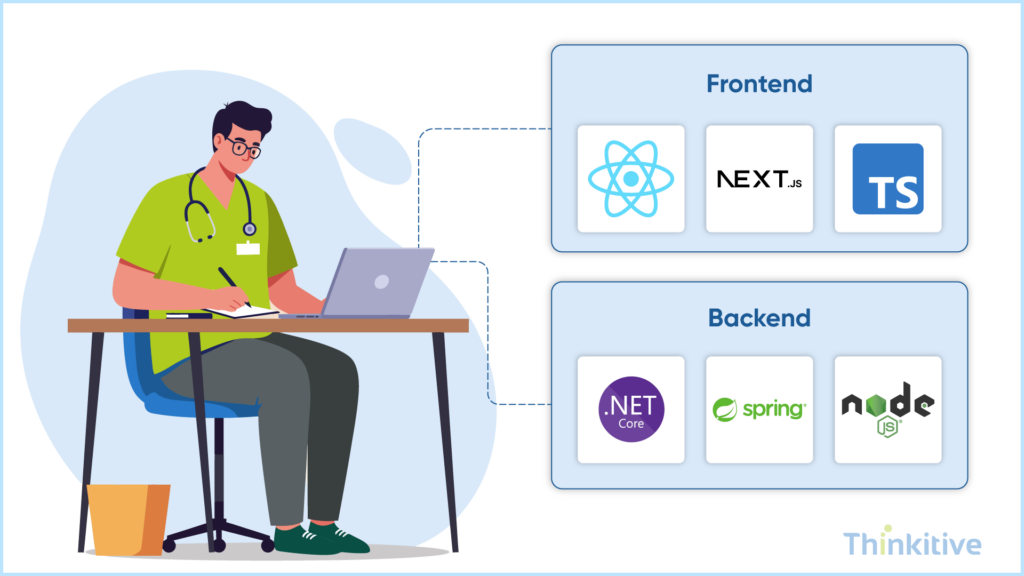
The EHR frontend and backend stack form the foundation of your EHR tech stack. So, let’s see how to choose the right one.
Designing the User Experience Layer
The part of the software that the end user interacts with on a daily basis is the frontend. Now, modern EHRs commonly use technologies like React.js, Next.js, and Typescript to create fast, responsive, and user-friendly interfaces.
Now, a well-designed frontend is the one that helps clinicians navigate through the software and its different features smoothly, like patient records, document encounters, and access critical information efficiently.
Powering Clinical Operations Behind the Scenes
The backend technologies, on the other hand, power the core functionality of your EHR system. This includes patient management, clinical workflows, billing, scheduling, and integrations. Some of the most common technologies in this are .NET Core, Java Spring Boot, and Node.js, as they provide security, reliability, and scalability as required for healthcare applications.
Building a Scalable EHR Frontend & Backend Stack
A scalable EHR stack combines a responsive frontend with a robust backend capable of handling growing patient volumes and complex healthcare workflows. Choosing modern technologies allows healthcare practices to improve their performance, support future integrations, and easily expand their EHR system’s capabilities as their practice grows.
If you’re evaluating frontend frameworks, backend technologies, and APIs in more detail, read our complete guide to choosing an EHR frontend and backend stack.
Which Cloud Infrastructure Suits Your Practice Best –
Free ConsultationWhy Cloud Infrastructure Matters in Modern EHR Systems
Cloud-native EHR architecture allows you to run on modern cloud infrastructure. This makes your system more flexible, scalable, and resilient than traditional on-premise systems. One of the major benefits of cloud-native EHR architecture is that it allows practices to quickly scale resources, improve system availability, reduce infrastructure costs, and support remote access without significant investment, as seen in traditional practices.
Cloud-native architecture allows you to build the platform to handle increasing patient volumes, large amounts of clinical data, and growing integration requirements. However, you need to consider your infrastructure as it should support high availability, disaster recovery, data encryption, automated backups, and regulatory compliance, while maintaining fast system performance and minimal downtime.
So, when choosing a cloud environment, you should evaluate factors such as security, compliance support, scalability, reliability, and integration capabilities. Some of the leading cloud providers that you can explore are AWS, Azure, and Google Cloud, which offer healthcare-focused services that help practices to build secure, compliant, and future-ready EHR systems.
Learn more about designing cloud-native EHR platforms in our dedicated guide on cloud architecture for healthcare software.
Building Reliable Data Foundations for EHR Systems
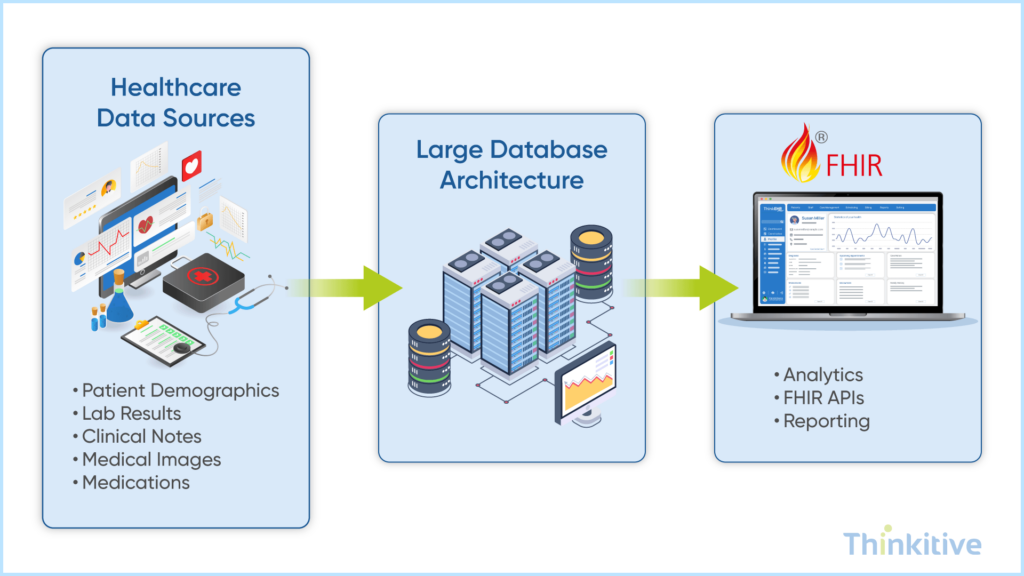
Healthcare data management is another aspect that requires quite a bit of attention. Let’s see the intricacies that are in this that you must know.
Managing Structured & Unstructured Healthcare Data
So, being a data management system, every EHR system must be able to manage both structured data and unstructured data. This includes patient demographics, diagnoses, medication, lab results, clinical notes, medical images, documents, etc.
Now, the tech stack allows you to design a database architecture that ensures all the data is stored efficiently and accessed whenever needed.
Scalability, Performance & Data Integrity Considerations
It is also natural that with time, as your practice grows, every other component in your system starts increasing, like patient records, clinical transactions, etc., which will increase workloads without affecting performance.
Now, the architecture should be able to support high availability, fast query processing, data consistency, backup, and recovery mechanisms. This ensures strong data integrity, leading to accurate and reliable patient information.
Supporting Interoperability, Analytics & Long-Term Data Growth
Modern systems require you to adopt a modern database architecture that should support healthcare interoperability standards, enabling seamless data exchange with external systems. This provides the foundation for analytics and reporting.
Other than everything, they must also accommodate long-term data growth while maintaining performance, security, and compliance with healthcare regulations.
Explore our detailed guide on EHR database architecture to understand storage models, performance, and scalability considerations.
Assess Your EHR System for AI-Readiness –
Get Free AssessmentExtending EHR Access Across Devices
Being part of the digital landscape, one of the best ways to improve connectivity is mobile EHR app development. And that is a completely different ball game, so let’s talk about the intricacies of this:
Growing Demand for Mobile Healthcare Access
First things first, all healthcare professionals are increasingly relying on mobile devices to access patient information, review clinical data, communicate with care teams, and manage workflows on the go.
By having a mobile EHR application, you can improve care coordination, support faster decision-making, and provide greater flexibility for healthcare providers.
Security & Usability Considerations for Healthcare Mobility
Being a healthcare application, your mobile application will naturally handle sensitive patient information. Due to this, the applications must have strong security measures like secure authentication, data encryption, and role-based access controls.
At the same time, the UI also needs to be intuitive and optimized for smaller screens. This will help clinicians complete tasks quickly and efficiently.
Supporting Seamless Experiences Across Devices
One of the core things that you must keep a keen eye on is providing a consistent experience across smartphones, tablets, and desktop systems. Now, synchronizing these datasets and workflows across devices is also important. Only after the datasets are synchronized at the same time can you ensure access to healthcare providers at all times.
For a deeper look at mobile EHR app development, read our complete guide to building secure healthcare applications for clinicians.
AI Infrastructure for Modern EHR Platforms
AI is the modern-day need for healthcare platforms. Moreover, with technology favoring the inclusion of AI in day-to-day tasks, here are some things that you can consider. Starting with the core and basic functioning of an AI-powered EHR system, here are a few things that you are considering integrating into your system:
| AI Capability | Purpose | Supporting Technologies |
| AI Medical Scribe | Automatically generates clinical notes from patient-provider conversations | NLP, Speech-to-Text, Large Language Models (LLMs) |
| Documentation Automation | Creates summaries, encounter notes, and discharge documentation | Generative AI, NLP, FHIR APIs |
| Workflow Automation | Automates scheduling, follow-ups, reminders, and administrative tasks | AI Agents, Workflow Engines, RPA |
| Medical Coding Assistance | Suggests ICD-10 and CPT codes from clinical documentation | Machine Learning, NLP, Clinical AI Models |
Coming to the clinical decision support and predictive healthcare part, here are certain features that you can include:
| AI Capability | Purpose | Supporting Technologies |
| Clinical Decision Support | Provides alerts, recommendations, and care guidance | Machine Learning, Rules Engines, Clinical Knowledge Bases |
| Risk Prediction | Identifies high-risk patients and potential complications | Predictive Analytics, ML Models |
| Population Health Analytics | Detects trends and care gaps across patient populations | Data Warehousing, AI Analytics Platforms |
| Personalized Care Recommendations | Supports evidence-based treatment planning | AI Models, FHIR Data Access, Clinical Intelligence Platforms |
If you’re building a modern EHR, your technology stack should support AI-ready infrastructure from day one. Now, this will include adopting cloud-native infrastructure, scalable databases, and API-first architectures. This allows AI services to access and process data more efficiently. The flexibility that it brings to the system makes it easier for you to introduce new AI capabilities to your system without any disruptions.
One of the key aspects is ensuring that your system supports FHIR-native AI integrations. For instance, your system, combined with REST APIs, SMART on FHIR, and modern integration frameworks, enables AI applications to deliver insights directly within provider workflows.
This leads to the creation of a more intelligent, connected, and efficient healthcare ecosystem.
Security, Compliance & Interoperability Layers
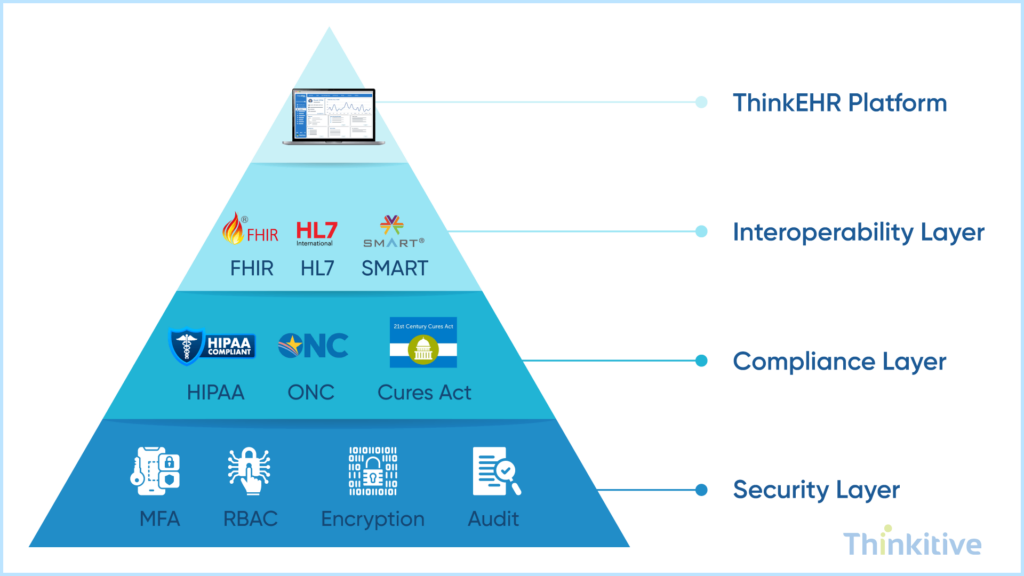
Given the sensitive nature of data that you deal with, here are a few things about compliance, security, and interoperability layers that you should know.
HIPAA-Compliant Architecture & Security Controls
You must look at security and compliance as the foundational components of every modern EHR platform. For building a HIPAA-compliant EHR system, you must include data encryption, role-based access controls, multi-factor authentication, audit logs, and continuous monitoring features to protect sensitive patient information and reduce security risks.
Supporting FHIR, HL7 & Healthcare Data Exchange Standards
Interoperability allows healthcare practices to exchange data seamlessly across EHRs, laboratories, pharmacies, payers, and third-party applications. Now, supporting these standards like FHIR, HL7, SMART on FHIR, and REST APIs ensures that healthcare data can be shared securely, accurately, and in real time.
ONC Certification & 21st Century Cures Act Mandates
Modern EHR systems must be designed in such a way that they support regulatory requirements related to interoperability, patient access, and data sharing. Building these capabilities into the technology stack can help you meet the ONC certification requirements. Along with that, you will also comply with the 21st Century Cures Act mandates, which help you maintain long-term regulatory readiness.
How to Choose the Right Tech Stack for EHR Development
If you have someone who has made it till here, then I can be assured that you’re quite serious regarding your EHR tech stack. Now, selecting the right EHR technology stack involves more than just choosing a programming language and frameworks. That is why evaluation of your technologies based on your scalability, compliance, and interoperability needs is very important.
This is done to verify your systems’ ability to support future innovations such as AI and advanced analytics. So, here is a checklist that you can refer to before making any decision:
- Supports HIPAA compliance and healthcare security requirements
- Provides native support for FHIR, HL7, and healthcare interoperability standards
- Can scale with growing patient volumes and clinical data
- Supports cloud-native deployment and disaster recovery
- Enables seamless integrations with EHRs, labs, pharmacies, and third-party systems
- Includes APIs and architecture that support AI and automation initiatives
- Delivers high performance and availability for clinical workflows
- Has a strong developer ecosystem and long-term community support
- Supports mobile healthcare applications and multi-device access
- Aligns with budget, implementation timelines, and maintenance requirements
The best EHR technology stack does not usually have all the latest technology or even the popular ones. The best EHR tech stack is the one that aligns with your practice’s clinical, operational, and strategic objectives.
Watch How a Customized EHR Works in Real-Time –
Get Free DemoConclusion
Building your own EHR in 2026 requires much more than selecting a frontend framework or database. The right technology stack must support scalability, interoperability, security, compliance, cloud-native deployment, and emerging AI capabilities.
From choosing modern frontend and backend technologies to implementing FHIR-based integrations and AI-ready infrastructure, every technology decision influences the long-term success of your platform. By prioritizing flexibility, performance, and future readiness, healthcare organizations can create EHR systems that not only meet today’s operational needs but also adapt to evolving regulations, patient expectations, and healthcare innovations for years to come.
Ready to evaluate the right technology stack for your EHR? Talk to our EHR experts and receive a technology assessment tailored to your clinical and business requirements and start building your own EHR.
Frequently Asked Questions
An EHR technology stack is the collection of technologies, frameworks, databases, infrastructure, security controls, interoperability standards, and AI capabilities used to build and operate an Electronic Health Record system. A modern EHR technology stack typically includes frontend and backend technologies, cloud infrastructure, database architecture, FHIR and HL7 interoperability, and security features that support compliant, scalable, and high-performing healthcare applications.
The best tech stack for EHR development depends on the organization’s goals, scalability requirements, and compliance needs. Many healthcare organizations choose React or Next.js for the frontend, .NET Core or Spring Boot for the backend, PostgreSQL for data management, cloud platforms like AWS or Azure, and FHIR-based APIs for interoperability.
When selecting an EHR frontend and backend stack, organizations should consider performance, scalability, security, integration capabilities, and long-term maintenance. The chosen technologies should support complex healthcare workflows while providing a responsive user experience and reliable system performance.
Cloud-native EHR architecture enables healthcare organizations to scale resources efficiently, improve system reliability, reduce infrastructure costs, and support remote access. It also simplifies disaster recovery, security management, and future technology upgrades compared to traditional on-premise deployments.
The best EHR database architecture is one that can securely manage both structured and unstructured healthcare data while supporting scalability, performance, and interoperability. Relational databases such as PostgreSQL and Microsoft SQL Server are commonly used because they provide strong data integrity and support complex healthcare workloads.
Mobile EHR app development should focus on security, usability, performance, and seamless access to patient information. Healthcare organizations should ensure mobile applications support secure authentication, encrypted data transmission, responsive interfaces, and synchronization across devices.
AI can be integrated into healthcare platforms through clinical documentation automation, medical coding assistance, workflow automation, predictive analytics, and clinical decision support. Modern AI-ready EHR platforms often use machine learning, natural language processing, and FHIR-based APIs to enable intelligent healthcare workflows.
Organizations should evaluate technologies based on compliance requirements, security controls, interoperability standards, scalability, cloud readiness, development costs, and future innovation goals. A modern EHR technology stack should support HIPAA requirements, FHIR, HL7, SMART on FHIR, secure authentication, encryption, and APIs that enable long-term growth and healthcare interoperability.
Key EHR development trends in 2026 include AI-assisted documentation, cloud-native healthcare platforms, FHIR-first interoperability, predictive analytics, mobile-first healthcare experiences, automation, and intelligent clinical decision support. These technologies are shaping the next generation of healthcare software platforms.


