EHR Vendor Integration: How to Choose the Right Approach by System

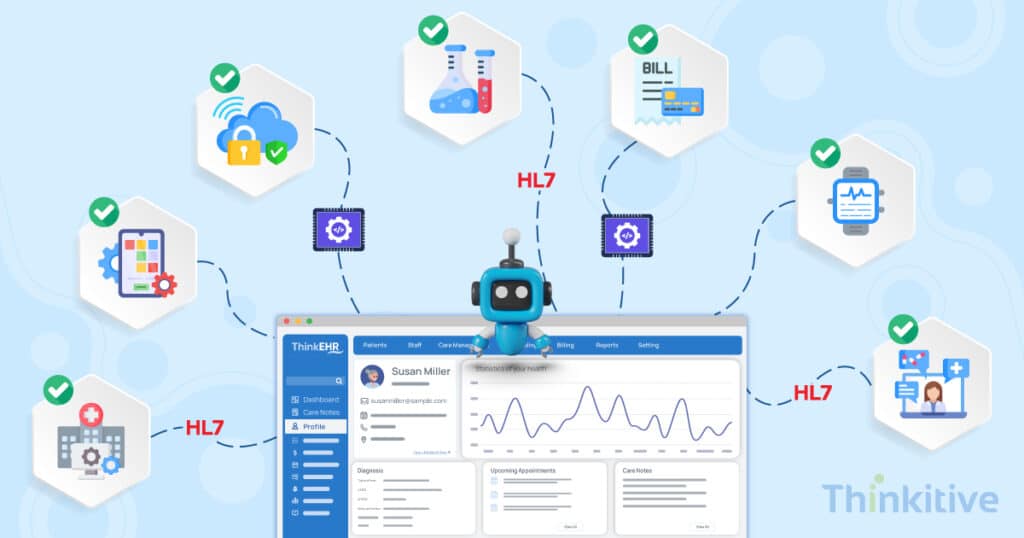
There are two shifts happening in the healthcare industry right under our noses. It is quite obvious that everyone is trying to be a part of the connected healthcare ecosystem that makes the electronic sharing of data easy.
However, the second shift that is lurking within these trends is of moving away from legacy systems and adopting a modern API-first approach. This is due to two major factors: the business need for practices to have business agility and the regulatory requirements of laws like the 21st Century Cures Act and CMS interoperability rules.
In this scenario, healthcare interoperability is seen as the solution to help healthcare practices make this swift shift smoothly. And in achieving this interoperability, the role of EHR vendor integration cannot be ignored.
These EHR vendors impact the cost, scalability aspects of your system, and the speed of implementation. Furthermore, as the nature of practices is also changing, the complexity of the healthcare system has become a multi-EHR environment. Due to these choices, EHR vendor integration has become even more important.
On that note, let’s try to uncover the intricacies of healthcare interoperability solutions and different EHR integration methods that you can choose. However, the main focus will be on helping you choose the right EHR vendor integration.
So, without further ado, let’s get started!
Assess Your System & Choose the Right Approach for EHR Vendor Integration –
Get Free System Assessment
EHR Integration Methods & Platforms
Let’s start with the methods. Modern EHR integrations use different methods, which mainly depend on system compatibility, scalability aspects, and workflow requirements. However, when all the crucial components are at play, you need to choose the right approach to improve their interoperability, reduce complexity, and support long-term growth.
- Direct EHR API Integration Using REST & FHIR
One of the most common methods used is direct EHR API integration, which connects your EHR system with other healthcare applications using RESTful APIs and FHIR standards. With this approach, you can enable secure, real-time data exchange for patient records, appointments, medications, and clinical workflows. Moreover, these methods can be easily seen in modern cloud-based healthcare applications.
- HL7-Based Integration Through Interface Engines
HL7 integration is another widely used method for connecting legacy systems with hospitals, laboratories, billing platforms, and radiology systems. These interface engines have a huge role to play in this, as they help translate, route, and manage HL7 messages between multiple systems, making the integration more reliable in complex environments.
- EHR Integration Platforms, Aggregators & Middleware
EHR integration platforms and middleware are a simplified way of connecting multiple healthcare systems together by acting as a centralized communication layer. This method can reduce development effort and time by a huge margin, and on top of that, it improves scalability and helps manage integration across different vendors and technologies quite easily.
However, while all these different methods exist, there are some kind of trade-offs that you have to compromise with. You see, direct EHR API integration offers greater control and customization but requires more development time.
Similarly, EHR integration platforms improve speed and scalability, but when it comes to flexibility, they will entirely depend on third-party tools. So, these things must be considered when selecting the right method.
Last but not least, modern healthcare integrations use standards like SMART on FHIR and CDS Hooks to support interoperability, healthcare apps, and clinical decision support.
Which EHR Integration Method Suits Your Best –
Get Free ConsultationVendor Ecosystem & Healthcare System Integration
Now that you’re quite aware of the different methods, something you need to know about this is that it affects interoperability, scalability, and implementation flexibility. This is where understanding a vendor’s ecosystem becomes crucial for you, which many ignore. You see, the integration approach must align with their operational and technical goals.
- Differences Between Closed, Hybrid & API-First EHR Systems
Refer to this table to understand the differences between this system better:
| EHR System Type | Characteristics | Integration Flexibility | Common Challenges |
| Closed EHR Systems | Proprietary architecture with limited external access | Low | Vendor lock-in, restricted APIs, costly integrations |
| Hybrid EHR Systems | Supports both legacy interfaces and modern APIs | Moderate | Complex maintenance and mixed integration standards |
| API-First EHR Systems | Built around APIs and interoperability standards like FHIR | High | Dependency on API governance and security management |
- Impact of Vendor Architecture on Healthcare System Integration
If you have understood the above differences, then you must have gotten an idea that vendor architecture determines how easily healthcare systems can exchange data, support workflows, and scale integration. Typically, legacy systems or architectures often depend on HL7 interfaces and middleware, while modern cloud-native platforms support real-time API-based integrations, mobile applications, analytics tools, and patient engagement solutions more efficiently.
- Role of USCDI, ONC (g)(10) & 21st Century Cures Act Requirements
Now, there are certain regulatory frameworks that are driving healthcare interoperability and standardized data access. In this USCDI, ONC and the 21st Century Cures Act are some of the prominent names. Let’s try to understand each one of their roles. For instance, USCDI defines standardized clinical data elements for exchange. On the other hand, ONC (g)(10) certification requirements encourage secure API access using the FHIR standard. And as discussed earlier, the 21st Century Cures Act promotes interoperability by reducing information blocking and improving patient access to healthcare data.
- Developer Access Models: Sandboxes, App Marketplaces & Approval Workflows
Many EHR vendors provide their developer ecosystem that includes testing sandboxes, app marketplaces, and certification processes. Now, all these have specific functions like Sandboxes, which allow developers to test integrations safely, whereas app marketplaces help distribute approved healthcare applications. And approval workflows ensure security, compliance, and compatibility before integrations are deployed in production environments.
EHR Vendor Integration Comparison: How Leading Systems Differ
This table will help you understand this in a much better way:
| Vendor | Integration Model | Standards Support | Developer Access | Flexibility | Complexity |
| Epic Systems | Controlled ecosystem | FHIR, SMART on FHIR, Proprietary APIs | Restricted, app-based access | Moderate | High |
| Oracle Health | Hybrid (API + HL7) | FHIR, SMART on FHIR, HL7 | Moderate | High | Medium |
| Allscripts | Open API ecosystem | FHIR, HL7 | Open developer access | High | Medium |
| NextGen Healthcare | Hybrid integration model | FHIR, Custom APIs | Moderate | Moderate | Medium |
| athenahealth | API-first architecture | REST APIs, FHIR | Open developer ecosystem | High | Low |
Now, let’s discuss each of these vendors one by one:
- EPIC system:
It follows a controlled integration ecosystem through App Orchard, making it one of the best options for large health systems that want compliance, governance, and deeply integrated clinical workflows. However, onboarding can be slow and at times restrictive. If you want to read more about EHR integration with EPIC, then read our blog – Epic EHR Integration: Complete Guide to Epic API and FHIR Connectivity.
- Oracle Health:
Oracle offers a hybrid integration model that combines modern APIs with HL7 support. This makes it a practical choice for enterprises balancing interoperability needs with legacy systems. Also, Oracle health used to be known as Cerner. And if you want to read in detail about Cerner then read our blog – Cerner EHR Integration: Connecting Oracle Health with Third-Party Apps.
- Veradigm:
Compared to other vendors, Veradigm provides a more open API ecosystem with little to no restrictions, enabling faster development cycles and greater flexibility for organizations seeking quicker integration. Read more about Veradigm EHR integration in this detailed blog – Allscripts Integration: Streamlining Clinical Data Exchange.
- NextGen Healthcare:
NextGen system supports a hybrid architecture that accommodates both modern APIs and legacy workflows. This makes it suitable for specialty clinics and mid-sized healthcare providers. Read this blog – NextGen EHR Integration: Connecting NextGen with Modern Clinical Systems, to know in depth.
- Athenahealth:
Athenahealth, on the other hand, uses an API-first ecosystem with streamlined developer onboarding. This is perfectly suitable for smaller practices to achieve faster deployment and scalable integrations. Athenahealth is one of the most popular EHR systems and many practices even depend on it. If you are one of them then read this detailed blog— Athenahealth Integration: API-Driven EHR Connectivity for Practices to learn its intricacies.
How to Choose the Right EHR Vendor Integration Approach
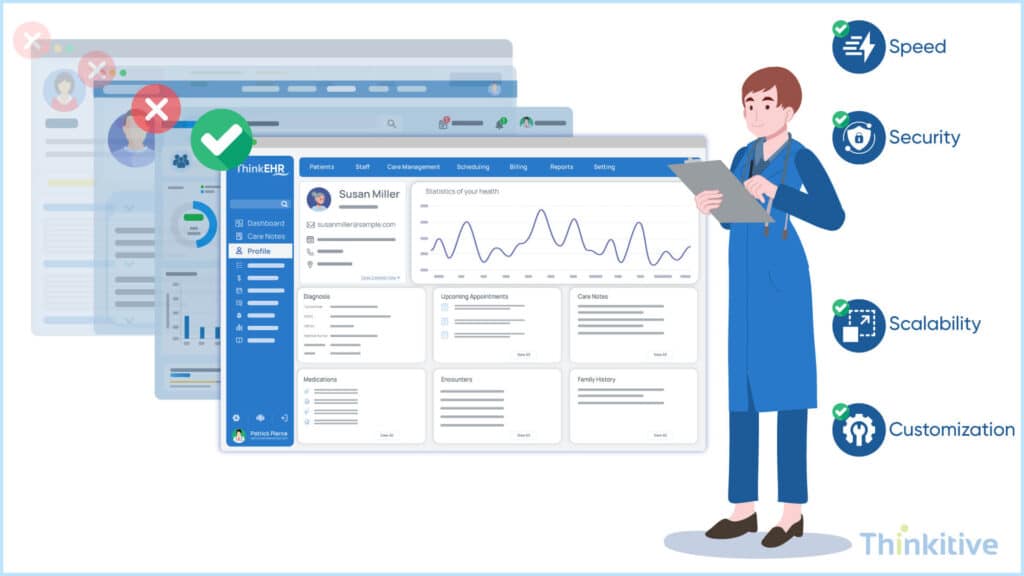
Now you must ask a question: how to choose the right EHR vendor integration approach, right?
Well, let’s try to simplify this for you.
- Matching Integration Method to Vendor Ecosystem
Different EHR vendors support different models, and that is not a secret anymore. That is why it is important to match your integration method to that of the vendor ecosystem. You see, API-first vendors are better suited to real-time cloud integration, while legacy systems may require HL7 interfaces, middleware, or custom connectors. When choosing this, keep in mind the architecture of your vendor and how it can help in reducing complexity and maintenance challenges.
- Evaluating Data Access & Workflow Requirements
As a healthcare practice, you must be able to evaluate what data your practice needs to exchange and at what frequency. Because your clinical and operational workflows depend on it. Here, real-time patient updates, billing workflows, etc., may all require different interaction approaches and performance capabilities. Checking that with your vendor’s ability can go a long way.
- Balancing Cost, Speed & Customizations
Every integration comes bearing a cost, and the speed of exchange can also vary. Along with that, it might also limit your system’s customization ability. When choosing your EHR vendor integration, consider these three factors and balance them out depending on your needs and requirements.
- Planning for Scalability & Long-Term Interoperability
Also, choose the integrations that support future growth, additional systems, and have enough flexibility to adhere to the compliance requirements and expanding patient data exchange needs. The best way is to choose a standards-based approach like FHIR, SMART on FHIR, and scalable APIs so that you can maintain interoperability as the healthcare ecosystem evolves.
The best integration strategy often depends on the healthcare use case. Large hospital networks may require middleware and enterprise integration engines, while small practices may benefit from lightweight API-based integrations. Specialty clinics, telehealth providers, RPM platforms, and analytics systems may each require different interoperability strategies based on workflow complexity and vendor compatibility.
Security, Compliance & Data Governance
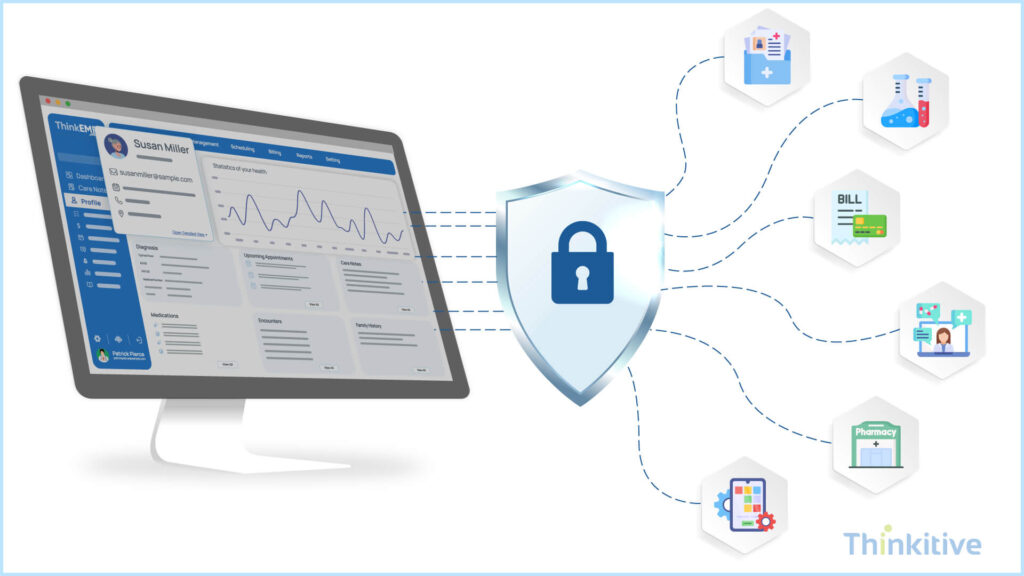
Given the sensitive nature of the data that you are exchanging across the healthcare system, security and compliance play a critical role in ensuring its safety. Practices must ensure that integrations follow the regulations, protect data privacy, and maintain secure access controls.
Let’s discuss some of the intricacies of securing data and ensuring its privacy below:
- HIPAA & HITRUST Compliance Requirements: All the healthcare integrations must comply with HIPAA regulations to protect patient health information both at rest and in transit. Along with HIPAA, some of the practices even follow the HITRUST security framework to strengthen risk management, cybersecurity, and compliance practices across integrated healthcare environments.
- OAuth 2.0 & SMART App Launch Authentication Models: For those who opt for API-based connectivity, they commonly use OAuth 2.0 for authentication and authorization. Furthermore, when these SMART App Launch builds on OAuth standards to allow third-party healthcare applications to securely access EHR data while maintaining controlled user permissions and patient data security.
- TEFCA & Interoperability Frameworks Shaping Data Exchange: Emerging interoperability initiatives such as TEFCA are helping to standardize nationwide healthcare data exchange. These frameworks encourage secure, scalable, and trusted interoperability between providers, payers, EHR vendors, and health information networks.
- Audit Trails, Access Control & Compliance Monitoring: Integrated healthcare systems should maintain detailed audit logs to track user activity, data access, and interactions with different systems. This helps organizations to detect unauthorized access, maintain accountability, and support regulatory compliance efforts, with role-based access control, continuous monitoring, and compliance reporting.
Assess Your System for Advanced EHR Integrations –
Get Free System AssessmentCommon Challenges in Multi-Vendor Integration
There can be certain challenges that can arise in multi-vendor integration. Here are some challenges that you need to be aware of and how to overcome them:
| Multi-Vendor Integration Challenge | Description | Business Impact |
| FHIR Version Variability | Different vendors support different FHIR versions such as DSTU2, STU3, or R4, creating compatibility issues | Increased development complexity and additional data mapping effort |
| Inconsistent USCDI Adoption | Vendors may implement standardized clinical data elements differently or incompletely | Data inconsistencies and reduced interoperability accuracy |
| Vendor Certification & Approval Delays | Some EHR vendors require app reviews, certifications, or lengthy onboarding processes | Slower deployment timelines and delayed integrations |
| Managing Integrations at Scale | Organizations often handle multiple APIs, workflows, and vendor-specific requirements simultaneously | Higher maintenance costs and operational complexity |
| Legacy System Compatibility | Older healthcare systems may rely on HL7 interfaces instead of modern APIs | Additional middleware and integration management requirements |
| Security & Compliance Coordination | Different vendors may use different authentication, security, and compliance standards | Increased governance and compliance monitoring effort |
Conclusion: Building a Scalable Vendor-Agnostic Strategy
Flexible and vendor-aware architecture is the core component of building a scalable EHR integration ecosystem. And the base of this is formed by standardization with the use of APIs and FHIR.
Apart from that, you must also align the integration decisions with long-term growth and the intricacies of your clinical and administrative workflows. Having said that, one thing you should know is that the best EHR integration approach by system is often defined by the system. In simple words, your system will guide you for what it needs; the only thing that you need to do is assess and analyze your system through and through.
So, what are you waiting for? Assess your system with an expert and choose the right EHR integration method.
Frequently Asked Questions
API-first vendors such as athenahealth and Veradigm are often considered more developer-friendly due to their open API ecosystems and simplified onboarding processes. However, the best choice for EHR vendor integration depends on your workflow requirements, scalability goals, and healthcare interoperability solutions strategy.
Direct EHR API integration offers greater customization, real-time connectivity, and workflow control, making it suitable for advanced healthcare applications. EHR integration platforms and middleware are better for organizations managing multiple systems because they simplify healthcare system integration and reduce development complexity.
Enterprise-level EHR vendor integration timelines can range from a few weeks to several months, depending on vendor approval workflows, integration complexity, security reviews, and interoperability requirements. Large-scale healthcare system integration projects involving multiple vendors and legacy systems generally require longer implementation cycles.
Epic Systems uses a more controlled ecosystem through App Orchard, which involves stricter governance and approval processes. Oracle Health, formerly Cerner, follows a hybrid approach combining APIs and HL7 interfaces, offering greater flexibility for healthcare interoperability solutions and legacy system support.
Common security risks include unauthorized API access, weak authentication controls, data breaches, insecure third-party applications, and inconsistent compliance practices across vendors. Secure EHR integration methods typically use OAuth 2.0, SMART on FHIR authentication, encryption, audit logging, and role-based access control to protect patient data.
HL7-based integrations often require interface engines, custom mapping, and additional maintenance, which can increase long-term costs. FHIR EHR integration generally reduces development complexity and supports faster deployment, although costs can still vary depending on vendor APIs, customization needs, and infrastructure requirements.
Small clinics often benefit from lightweight API-based integrations or cloud-based EHR integration platforms that support faster deployment and lower maintenance overhead. The best EHR integration approach by system depends on workflow complexity, vendor compatibility, and long-term scalability goals.
Vendor app marketplaces can simplify onboarding, certification, and deployment, but they may also introduce licensing fees, revenue-sharing models, or approval costs. These ecosystems can affect overall EHR vendor integration budgets and implementation timelines depending on the vendor’s governance structure.
USCDI standards help standardize clinical data exchange across healthcare systems, improving interoperability and reducing data inconsistencies. They play a major role in modern healthcare interoperability solutions by supporting consistent FHIR EHR integration and regulatory compliance.
Write-back functionality allows external applications to update or insert data directly into EHR systems. Successful EHR API integration for write-back workflows requires secure authentication, vendor-approved APIs, validation controls, audit logging, and compliance monitoring to maintain data accuracy and patient safety.
Organizations commonly face issues such as API permission changes, incomplete production data mapping, stricter security requirements, vendor certification delays, and workflow inconsistencies when transitioning from sandbox to production. Proper testing, governance, and planning are essential when learning how to integrate with different EHR vendors successfully.


